
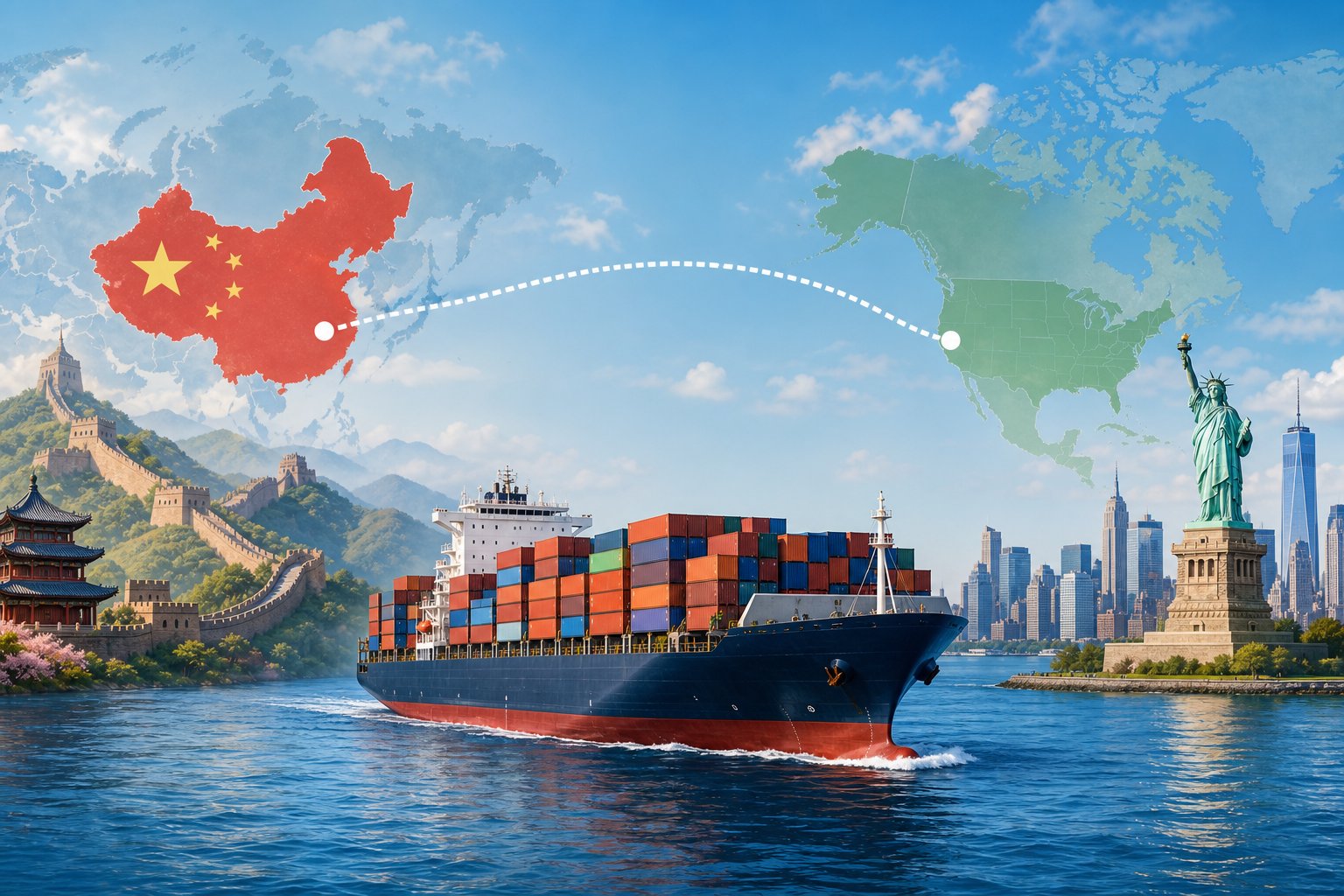
Shipping China to US is a huge part of global trade, moving billions in goods every year. If you’re a small business ordering your first samples or a seasoned company managing containers, you’ll want to get this process right to save time and money.
The cost for shipping China to US depends a lot on your shipping mode. Express courier services start around $5 per kilogram for smaller packages, air freight averages $3 per kilogram for mid-sized shipments, and ocean freight is usually best for loads over 500 kilograms.
Transit times can be as quick as 3 days for express shipping, but standard ocean freight might take 30 to 40 days. Your shipping decisions will impact your costs and delivery times.
This guide covers the main shipping channels, how to calculate true costs (tariffs and customs fees included), and tips for picking a freight forwarder that fits your needs.
Key Takeaways
- Ocean freight is cheapest for shipments over 500 kg, while express courier works best for packages under 150 kg.
- Shipping China to US costs include base freight, customs duties, port charges, and possible tariff fees.
- You need proper documentation and customs clearance paperwork to avoid delays at US ports.
Overview of Shipping Channels and Modes
Shipping China to US gives you three main options—each with different costs, speeds, and handling requirements. Ocean freight works for high-volume cargo with FCL and LCL services. Air freight serves time-sensitive shipments, and DDP solutions handle everything door-to-door, including customs.
Ocean Freight: FCL and LCL Options
Ocean freight from China to the US is usually the most affordable way to send large shipments. You can pick between FCL (full container load) or LCL (less than container load) depending on how much you’re shipping.
FCL shipping gives you a whole container—usually 20-foot or 40-foot. You pay a flat rate, no matter how much space you use. It’s best if you have at least 15 cubic meters of goods, since it protects your cargo and speeds up processing.
LCL shipping lets you share a container with others. Your freight forwarder combines shipments, and you pay only for the space you use. LCL rates hover around $110 per cubic meter as of June, which works for smaller loads.
Ocean freight from China to the US usually takes 14 to 22 days to big ports like Los Angeles, Long Beach, and New York. Transit time depends on your starting port, destination, and whether you book direct or with stops.
Air Freight and Express Services
Air freight from China can get your cargo to US airports like LAX, JFK, or MIA in 2 to 3 days. This method is great for high-value products, perishables, or anything you can’t wait weeks for.
Air freight rates for shipments over 1,000 kg are about $7.73 per kilogram. Yes, it’s pricier than ocean, but it cuts down transit time and saves on inventory costs.
Express services with DHL, FedEx, and UPS offer the fastest shipping China to US. They deliver in 2 to 4 days, door-to-door, with tracking and customs handling included. Express shipping costs about $17.87 per kilogram, but you get pickup, customs, and final delivery all in one.
Express is best for urgent documents, samples, small parcels, or emergency inventory—basically, when speed is more important than cost.
DDP and Other Door-to-Door Solutions
DDP shipping China to US means “delivered duty paid.” Your freight forwarder manages everything from the Chinese factory to your US warehouse, including customs, transport, and duty payment.
With DDP shipping, you get one all-inclusive price. Your forwarder handles customs compliance and import duties, so you don’t get hit with surprise fees. It’s a relief for anyone tired of logistics headaches.
DDP shipping China to US usually adds $500 to $2,000 to your freight cost, depending on cargo value and where it’s going. That covers customs brokerage, duty advances, destination handling, and inland trucking.
You can also pick door-to-port, where your forwarder delivers to the US port and you handle pickup, or port-to-door, where you manage export but let them handle US import and delivery. It’s all about what works for you and your team.
Key Cost Factors and Freight Rate Trends
Shipping China to US costs change all year. Fuel surcharges, carrier space, and what you ship all play a role in your final freight costs.
Current Market Pricing
Ocean freight is the go-to for bulk shipments. A 20-foot container (FCL) usually costs $2,000 to $3,500, and a 40-foot runs $3,500 to $6,000. Shipping smaller amounts? LCL (Less than Container Load) starts around $50 to $80 per cubic meter.
Air freight averages $5 to $8 per kilogram for standard service. Express courier options like DHL, UPS, and FedEx run $8 to $12 per kilogram and deliver in 3 to 5 days. Rates change with fuel prices and demand spikes.
Transit times by destination:
- West Coast ports: 15-20 days
- East Coast ports: 25-35 days
- Air freight: 5-10 days
- Express service: 3-5 days
Freight Rate Drivers and Surcharges
Your freight rate covers more than just shipping. Fuel surcharges change monthly, based on bunker fuel for ocean and jet fuel for air. Carrier space can get tight before Christmas or Chinese New Year, pushing rates up fast.
Common surcharges:
- Peak season surcharge (PSS): For high-demand months
- Bunker adjustment factor (BAF): Covers fuel swings
- Currency adjustment factor (CAF): For exchange rate shifts
- Port congestion fees: If major ports get backed up
The goods you ship matter too. Hazardous, oversized, or temperature-sensitive cargo costs more. Customs might charge inspection fees if they need to check your shipment physically.
How to Calculate Landed Cost
Your landed cost covers everything from the factory in China to your final US destination. Start with your freight rate, then add customs duties based on your product’s HS code. Import duties and customs fees usually run $100 to $500 per shipment.
Other costs to watch for:
- Cargo insurance (0.3% to 0.5% of value)
- Customs brokerage fees
- Terminal handling charges
- Inland trucking ($200 to $1,000+)
- Warehousing and storage
You can lower landed costs by picking the right Incoterms. FOB (Free on Board) and EXW (Ex Works) are popular for US importers. If you don’t have enough for a full container, consider consolidating shipments with others to save per unit.
Major Shipping Routes and Port Selection
China’s major export ports connect to US destinations through established Pacific routes. Transit times range from 14 to 35 days, depending on where you’re shipping. The port you pick can affect costs, speed, and customs headaches.
Top Ports in China
Shanghai Port handles the most US-bound cargo and offers the widest carrier options for ocean freight. You’ll get frequent sailings and reliable schedules from this East China hub.
Shenzhen’s terminals—Yantian and Shekou—serve as the main South China gateway for electronics and consumer goods. These ports connect fast to US West Coast destinations, usually in 14-20 days.
Ningbo-Zhoushan is a solid alternative to Shanghai for Zhejiang province manufacturers. It’s now one of the world’s busiest container ports.
Other important ports in China include:
- Qingdao – serves North China manufacturing regions
- Guangzhou (Nansha) – handles diverse cargo from the Pearl River Delta
- Tianjin – main gateway for Beijing and northern factories
- Xiamen – efficient for Southeast China exporters
Key US Entry Ports
Shipping China to US always starts with picking the right port. West Coast Ports like Los Angeles and Long Beach handle about 40% of all Chinese imports, making them the fastest ocean freight entry points.
Seattle and Oakland are decent backup options when California ports get congested. Sometimes, it just comes down to where there’s less traffic.
East Coast Ports such as New York/New Jersey, Savannah, and Charleston get cargo either through the Panama Canal or via rail after it lands on the West Coast. If your goods are headed east, these ports can save you time and money.
Gulf Coast Ports like Houston serve as strategic entry points for central US markets. You might find less congestion here than on the coasts, which is a relief for tight schedules.
Route Planning and Transit Times
The Trans-Pacific route offers the fastest shipping China to US West Coast, taking about 14-20 days. Ships usually go straight from Shanghai, Ningbo, or Shenzhen to Los Angeles, Long Beach, or Seattle.
The Panama Canal route takes longer—around 25-35 days—but delivers right to East Coast ports. This route skips inland transport costs, which is handy if speed isn’t your top priority.
Factors affecting your transit time:
- Sailing frequency from your departure port
- Weather and seasonal patterns
- Port congestion at both ends
- Carrier reliability
Think about your factory location, where your goods need to end up in the US, and how fast you need delivery. Sometimes, going through the West Coast and using rail beats direct East Coast shipping for inland destinations.
Customs Clearance, Documentation, and Tariffs
Shipping China to US means dealing with customs paperwork, tariff calculations, and legal responsibilities. If you miss documents or file things incorrectly, you could face weeks of delays and thousands in penalties.
US Importer of Record and ISF Filing
You have to name a US Importer of Record before your shipment arrives. This person or business handles the imported goods and makes sure all customs rules are followed.
The Importer of Record pays duties, taxes, and keeps everything compliant. If you’re a foreign seller without a US business, you’ll need a customs broker or third-party logistics provider to take on this role.
ISF filing errors cause automatic delays and penalties from $5,000 to $10,000. You must submit your Importer Security Filing at least 24 hours before your ocean shipment leaves China. This includes info about the seller, buyer, manufacturer, and what’s in the cargo.
The ISF rule only applies to ocean freight. Air and express shipments have different entry processes, but you still need to provide accurate info ahead of time.
Required Customs Documentation
Every shipment needs key documents to clear customs. The commercial invoice lists your products, quantities, values, and sale terms. Customs uses it to check duties and verify what’s inside.
The bill of lading acts as your shipping contract and receipt. For ocean freight, you’ll get either a master or house bill of lading, depending on your carrier or freight forwarder.
Your packing list shows how the goods are packed—box counts, weights, and sizes. Customs checks this during inspections to make sure it matches your declarations.
Other documents might include certificates of origin, product test reports, FDA registration for food, and permits for regulated goods. Missing or incorrect paperwork can add 3-7 days to clearance and trigger $300-800 in extra fees.
Section 301 Tariffs and Duties
Multiple tariff layers now create total duties that can top 55% for many Chinese products. You’ll pay regular customs duties based on classification, plus Section 301 tariffs from recent trade disputes.
Section 301 tariffs add 7.5% to 25% on top of normal duty rates for most Chinese goods. These charges hit thousands of product categories and really bump up your final costs.
Calculate tariffs using the total customs value—product cost plus international shipping. If your goods cost $10,000 and shipping is $1,000, tariffs apply to $11,000.
Common Tariff Rates:
- Electronics: 0-6% base duty + 7.5-25% Section 301
- Textiles: 8-32% base duty + 7.5-25% Section 301
- Home goods: 3-9% base duty + 7.5-25% Section 301
HS Codes and Product Classification
Your HS code decides what tariff rates you’ll pay. This six-to-ten digit number sorts goods in the Harmonized Tariff Schedule used worldwide.
If you get the HS code wrong, you’ll pay the wrong duties and could face penalties. You can ask US Customs for a binding ruling to confirm your code before shipping China to US.
Work with your supplier or customs broker to get the right codes. Lots of products fit in more than one category, so you’ll need to know exactly what your product is made of and how it’s used.
Customs might reclassify your goods during inspection if they don’t agree with your code. That can mean extra duties, interest, and $500-1,000 in extra fees per shipment.
Packaging, Labeling, and Handling Requirements
Proper packaging protects your shipment during the long trip from China to the US. Good labeling makes customs clearance and marketplace compliance—especially for Amazon FBA—a lot smoother.
Packaging Optimization Strategies
Your packaging choices impact shipping costs and product safety when shipping China to US. Reducing dimensional weight saves money and keeps goods safe.
Use boxes that actually fit your products. Extra space means higher chargeable weight. For big orders, think about custom-sized packaging instead of standard boxes.
Material Selection Guidelines
- Double-wall corrugated cardboard for ocean freight
- Single-wall boxes for air freight under 30 lbs
- Bubble wrap or foam for fragile stuff
- Moisture barriers for ocean freight to prevent humidity damage
Weight Distribution Best Practices
Balance weight across each box to stop shifting in transit. Put heavy items at the bottom, lighter ones on top. Try to keep boxes under 50 lbs, or mark them clearly if they’re heavier.
Run drop tests on your packaging before you ship a big batch. Spending a couple bucks on better packaging beats losing hundreds to damaged goods.
Labeling and FNSKU Compliance
Amazon wants FNSKU labels on every product that enters their fulfillment centers. These barcodes keep your inventory separate from other sellers’ stock.
Apply FNSKU labels in China before shipping. That way, you avoid Amazon’s prep service fees, which can add up fast.
Required Label Elements
- FNSKU barcode—clear and scannable
- Product title matching your Amazon listing
- Condition (New, Used, Refurbished)
- Warning labels if your product category needs them
Each box needs a shipping label with the Amazon shipment ID, destination fulfillment center, and box contents. For multi-box shipments, use the “Box 1 of 3” style on each label.
Country of origin markings have to be on your products and packaging to meet US customs rules. “Made in China” should be visible, readable, and permanent.
Cargo Dimensions and Chargeable Weight
Carriers charge you based on actual weight or volumetric weight—whichever is higher. Knowing this helps you avoid surprise costs when shipping China to US.
Volumetric Weight Formula
Multiply length × width × height in centimeters, then divide by 5000 for air freight or 6000 for express. Compare that number to your actual weight in kilograms.
For example, a 50cm × 40cm × 30cm box is 60,000 cubic centimeters. Divide by 5000 for air freight—that’s 12 kg. If your box actually weighs 8 kg, you’re still charged for 12 kg.
Optimization Techniques
Try to shrink box dimensions without losing protection. Even a 10% cut in box size can mean big savings over many shipments.
Consolidate products into fewer boxes when you can. One 20 kg box is usually cheaper than two 10 kg boxes, thanks to lower handling fees and better space use.
Different product types need different packaging. Electronics need anti-static materials, while textiles can go in poly bags. Match your packaging to your product for the best results.
Delivery, Last-Mile, and Fulfillment Considerations
Once your goods make it through US customs, they enter the domestic distribution network. Last-mile delivery and fulfillment choices decide how fast customers get their orders. Who acts as the importer of record and whether you use delivered duty paid changes how much control you have at this stage.
Customs Release and Domestic Distribution
After your shipment lands at a US port, customs processes your entry documents and releases the cargo. Your importer of record—whether that’s you, your buyer, or an agent—must pay all duties and taxes before release.
Customs clearance usually takes 1-3 business days for standard shipments. Once cleared, your freight forwarder or carrier moves goods to a US warehouse or distribution center. That’s where international shipping ends and domestic logistics start.
If you choose delivered duty paid (DDP), you control things through customs and into US distribution. You get to pick warehouses and delivery partners. If you don’t use DDP, your buyer makes those calls after customs release.
Last-Mile Delivery Options
Shipping China to US involves a lot of moving parts, but last-mile delivery stands out as a major cost factor. It accounts for about 53% of total shipping costs in business-to-consumer supply chains.
This final stage takes products from distribution centers right to customers’ doorsteps. It’s where speed and accuracy really matter.
You’ve got several choices for last-mile delivery. Working with third-party logistics providers that use modern warehouse management systems can speed things up.
Express couriers like UPS, FedEx, and DHL offer 2-3 day delivery across the US. If you need it fast, they’re hard to beat.
Regional carriers often give you more affordable rates for less urgent deliveries. Some businesses set up micro-warehouses in big metro areas to shorten delivery distances and get orders out faster.
Amazon FBA and E-Commerce Integration
Amazon FBA lets you ship inventory straight from China to Amazon’s fulfillment centers. You send bulk shipments to Amazon warehouses, and they handle storage, picking, packing, and shipping to customers.
This setup works well for e-commerce sellers. Amazon manages the whole fulfillment process, and your products become eligible for Prime shipping—which customers love.
You’ll have to follow Amazon’s specific labeling and packaging rules when shipping China to US. Don’t skip those details, or you’ll run into headaches later.
Many freight forwarders offer door-to-door shipping from China to US. This includes pickup from your supplier, export paperwork, transport, customs clearance, and delivery to your warehouse or fulfillment center.
This approach cuts down on the hassle of coordinating with multiple service providers. It’s a relief not having to juggle so many contacts.
Frequently Asked Questions
Importing from China means picking the right shipping method, understanding duty rules, and handling customs paperwork. Costs change based on shipment size and speed, and transit times depend on your method and possible customs delays.
What shipping methods are available for importing goods, and how do they compare in speed and cost?
You’ve got three main shipping China to US options: ocean freight, air freight, and express couriers. Each comes with its own trade-offs for cost and delivery speed.
Ocean freight is the cheapest for big shipments. Full Container Load (FCL) is best if you can fill a 20-foot or 40-foot container.
Less than Container Load (LCL) lets you share space with other importers if your shipment is smaller. Air freight costs more but gets your goods there much faster.
Air freight works for time-sensitive products, high-value items, or smaller shipments when speed is key. Express couriers like DHL, FedEx, and UPS offer the fastest delivery times.
These services handle customs and provide door-to-door tracking. They’re great for urgent shipments under 500 pounds, but the cost per pound is much higher.
Ocean freight usually takes 20 to 40 days from major Chinese ports to the US. Air freight delivers in about 5 to 10 days. Express couriers can get your goods there in 3 to 5 days.
How are import duties, taxes, and customs fees calculated, and who is responsible for paying them?
The $800 duty-free threshold no longer applies for goods from China. You now pay duties on all shipments from China, no matter the value.
Import duties depend on your product’s classification code, value, and country of origin. The Harmonized Tariff Schedule sets the duty rate for each product category.
You calculate duty by multiplying the customs value (product cost, international shipping, and insurance) by the tariff rate. Some products come with extra fees.
As the importer of record, you’re legally responsible for all duties, taxes, and customs fees. Freight forwarders or customs brokers usually pay these on your behalf and bill you later.
Some shipping methods include these costs in their quotes, while others bill them separately. Always check the fine print so you’re not surprised.
What documents are typically required for customs clearance when importing commercial goods?
You need a commercial invoice showing the seller, buyer, product description, quantity, and value. Customs uses this as the main assessment document.
A packing list details what’s inside each box or container, including weights and dimensions. Customs officers check this to verify contents.
The bill of lading for ocean freight or air waybill for air shipments proves ownership and gives shipping details. This transfers from the shipper to you as the consignee.
You must submit an importer security filing 24 hours before your ocean shipment leaves China. This filing lists the manufacturer, seller, buyer, and shipment contents.
Some products need extra permits or certificates. Examples include FDA registration for food, FCC approval for electronics, and certificates of origin for certain tariffs.
How long does delivery usually take, and what factors most commonly cause delays in transit or at customs?
Ocean shipping from China to the US takes 15 to 35 days, depending on the ports and shipping route. West Coast ports like Los Angeles and Long Beach get shipments faster than the East Coast.
Air freight delivers in 5 to 10 days from departure to arrival at your facility. Express couriers usually take 3 to 5 days, including customs and final delivery.
Port congestion is the most common cause of ocean shipment delays. Peak seasons—think pre-holiday—can add days or even weeks to transit times.
Weather and equipment shortages create more delays. Incomplete or wrong documentation causes customs delays, too.
Missing info on invoices, wrong product classifications, or missing permits will hold your shipment. Customs inspections add time if they select your shipment for examination.
Product compliance issues can stop shipments at the border. If your goods don’t meet US safety standards, lack proper labeling, or contain restricted materials, customs won’t release them until you fix the problems.
What are the best practices for packaging, labeling, and ensuring goods arrive without damage or compliance issues?
Pack your goods in sturdy corrugated boxes that can handle stacking and rough handling. Use bubble wrap, foam, or air pillows to protect items from shocks during transport.
Each box should have clear labels with your company name, destination address, and box number. Add “Made in China” labels on both packaging and products to follow origin marking rules.
Product labels must meet US regulations for your category. Food needs nutrition facts and ingredients. Electronics require FCC marks. Textiles need fiber content and care labels.
Use pallets for bigger shipments to make handling easier and reduce damage risk. Shrink wrap or banding keeps boxes secure on pallets during the journey.
Test your packaging before placing big orders. Ship a few sample packages to yourself to spot weaknesses in your packing method. It’s a simple way to prevent costly damage later.
Work with your supplier to make sure products meet US safety standards before shipping China to US. Ask for test reports and compliance certificates for regulated items. Fixing compliance issues after arrival costs way more than preventing them up front.
How can shipments be tracked end-to-end, and what should be done if a package is lost or held by customs?
Shipping China to US often feels stressful, especially when you want to keep an eye on your package. Your freight forwarder or carrier gives you a tracking number when your shipment leaves China.
Just enter this number on the carrier’s website. You’ll see updates as your shipment moves from origin to destination.
Ocean freight tracking lets you know when your container loads onto the vessel and departs the port. It also tells you when it arrives at the US port and clears customs.
But don’t expect instant updates—these usually refresh every few days, not in real time. That’s just how ocean freight goes.
Shipping China to US by air or express? Those options give you more detailed tracking. You can watch your package reach each facility and move through sorting, which is honestly pretty reassuring.