
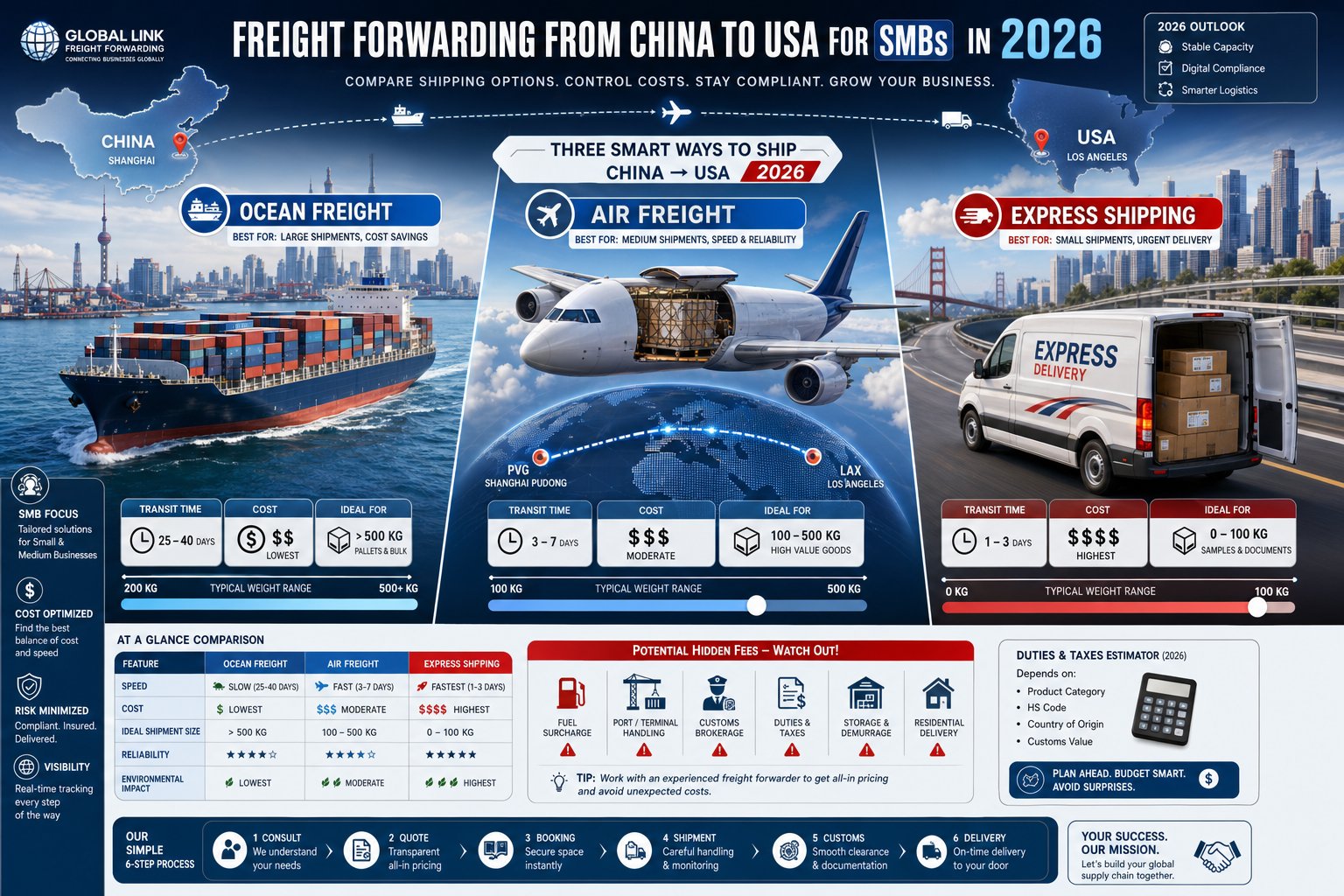
Freight forwarding for SMBs has become a crucial part of import shipping from China to the USA. Small business freight services face a maze of choices—different modes, costs, and compliance hurdles.
Every shipping mode, whether ocean, air, or express, comes with its own price tag, speed, and requirements. If you’re running a small business, understanding the real differences between these options is key. Freight forwarding comparison isn’t just about the sticker price—it affects customs, duties, landed cost, and even your sanity.
Most SMB importers use ocean freight for bigger shipments, while air freight makes sense when speed trumps savings. Got a 200-kg shipment? Air might be cheaper. Over 500 kg? Ocean usually wins.
It’s not easy to keep up with all the moving parts. Freight forwarding for SMBs means you need to know how to calculate true costs, pick the right route, and avoid those sneaky extra fees. Let’s dig into how you can compare options, keep costs down, and get your goods delivered without headaches.
Key Takeaways
- Ocean freight is usually the best deal for shipments over 500 kg, while express works for packages under 150 kg.
- Total shipping cost includes freight rates, customs duties, port fees, and documentation charges.
- Choosing the right mode and route can cut your China to USA shipping costs by 30% or more.
Freight Forwarding for SMBs: Main Shipping Modes in 2026
SMBs have four main international shipping solutions for import shipping from China to the USA. Each one balances cost, speed, and cargo needs differently. Ocean freight stays king for big loads, but air and express can save the day when time’s tight.
Ocean Freight: FCL and LCL
Ocean freight splits into FCL (full container load) and LCL (less than container load). You pick FCL if you can fill at least 60-70% of a container—either a 20-foot or a 40-foot high-cube.
In June 2026, a 20GP container costs $4,307-$5,264 to major US ports. A 40HQ will run $5,018-$6,133. LCL, on the other hand, charges by cubic meter—about $110/cbm. Transit times? LCL takes 10-17 days, FCL runs 14-22 days.
Air Freight and Air Cargo
Air freight gets your goods from China to the US in just 2-3 days. You pay by weight, and rates drop as shipments get heavier. In June 2026, air cargo costs $7.73/kg for loads over 1,000 kg.
If you’re shipping high-value electronics or anything that can’t wait, air freight makes sense. It’s more stable and predictable than ocean, but you’ll need to pack carefully to meet airline rules.
Express Courier Solutions
Express couriers like DHL, UPS, and FedEx take care of door-to-door delivery, often in just 2-4 days. Express shipping costs $17.87/kg in June 2026. Yes, it’s pricey, but you get tracking, customs paperwork, and peace of mind.
Express is perfect for urgent orders, samples, or small high-value shipments under 200 kg. Most couriers offer DDP (delivered duty paid), so your recipient won’t get hit with surprise fees.
Multimodal and Hybrid Services
Multimodal shipping mixes two or more freight modes in one trip. The classic combo is sea-air—ship by ocean to somewhere like Anchorage, then finish by air to New York. It’s not as fast as pure air but much cheaper, and it trims a week off ocean time.
Freight forwarders often consolidate small LCL shipments to get better rates and efficiency. If you’re an SMB with smaller loads, this can stretch your budget further.
Freight Forwarding Comparison: What Drives Cost?
Freight forwarding for SMBs means juggling a lot of cost factors. Ocean or air charges, fuel surcharges, cargo size, routes, and even the time of year all play a part. If you want to avoid sticker shock, you’ve got to understand what’s behind those numbers.
Freight Rates and Surcharges
Base rates are just the start. For sea freight, you pay per container (FCL) or per cubic meter (LCL). Air freight always charges by kilogram.
Fuel surcharges, peak season fees, congestion charges, and handling fees can pile up fast. Always ask for an all-in quote with every fee listed. In June 2026, 20ft container rates jumped 74% month-over-month, while LCL rates stayed flat at $110/cbm.
Cargo Volume, Weight, and CBM Calculations
Carriers charge by whichever measurement makes them the most money. For LCL, it’s per CBM—length × width × height (in meters). Air freight uses chargeable weight, which is either actual or volumetric (length × width × height in cm ÷ 6,000), whichever is higher.
If you fill most of a container, FCL is usually cheaper per unit. Smaller loads? LCL lets you share space and save. Try a freight calculator to see if consolidating into a 40ft container beats splitting into two 20fts.
Transit Time and Route Selection
Transit times depend on the route and mode. West Coast sea freight takes 14–22 days, East Coast adds a week, and air freight lands in 2–3 days.
Direct sailings to LA or Long Beach are faster than routes with extra stops. Fewer ports mean fewer chances for delays. Express shipping is quickest but costs $17.87/kg (June 2026), while standard air freight is a bit slower and much cheaper.
Balance your need for speed against your budget. Air is great for high-value, time-sensitive goods. Bulky, low-value stuff? Stick with ocean.
Peak Season and Market Impacts
Rates spike before big shopping seasons like Black Friday and Christmas. Carriers add peak season surcharges and space gets tight. In June 2026, FCL rates surged 66–74% as demand outpaced supply.
Book early if you’re shipping in peak months. Lock in your quote for at least 2-3 weeks. If you can, shift non-urgent cargo to off-peak months for better rates.
Ports, Routes, and Delivery Choices for SMB Importers
Your choice of origin and destination ports can make or break your US import logistics plan. West Coast ports like LA and Long Beach are faster, but East Coast ports might save you on inland trucking, depending on where your warehouse is.
Top Chinese and US Ports
Shenzhen and Guangzhou lead southern China exports, shipping regularly to Los Angeles and Long Beach. Shanghai is the main hub for trans-Pacific routes, including the busy Shanghai to New York lane.
In the US, LA and Long Beach handle most container traffic from China. New York/New Jersey serve the Northeast, Savannah is booming for the Southeast, and Houston covers the Gulf Coast. Miami is a hub for Latin America and direct Chinese cargo.
Each port has its own terminal handling fees and labor rules. These can affect how fast you get your shipment and what you pay at the end.
West Coast vs East Coast Delivery
Freight forwarding for SMBs is all about making smart choices, especially when you import shipping from China to the USA. West Coast ports like LAX can deliver ocean freight in just 14-22 days, making them the fastest route for most Trans-Pacific shipments.
East Coast routes tack on another 7-14 days, thanks to the longer sailing distance or Panama Canal detours. Your final warehouse location really matters here.
West Coast ports work best for distribution centers in California, Nevada, and Arizona. If your goods stay east of the Mississippi River, East Coast ports like New York, New Jersey, and Savannah can help you cut inland trucking costs.
JFK handles air freight quickly for the New York metro area. Equipment availability changes between coasts—right now, West Coast ports are struggling with container shortages (as of June 2026), while the East Coast has a bit more box availability but higher destination charges overall.
Port Congestion and Terminal Handling
Terminal handling charges (THC) jump around by port and carrier, usually falling between $300-$600 per container at US ports. These fees cover the process of moving containers from the ship to the terminal yard.
Demurrage hits you if you leave containers at the terminal past the free window (normally 3-5 days). Detention racks up when you hold carrier-owned containers outside the port longer than allowed. Both can sting: $100-$150 per container per day is pretty standard.
Los Angeles and Long Beach have seen equipment delays this year due to a capacity surge. New York and New Jersey run steadier, but you’ve got to nail your ISF filing and paperwork or risk customs holds.
Savannah and Houston are usually less congested than mega-ports, but they might not have as many direct sailing options from smaller Chinese ports.
Door-to-Door and Final Delivery
Door-to-door service bundles ocean freight, customs clearance, and inland trucking into one neat rate. It’s much simpler than port-to-port pricing, though you’ll probably pay a bit more for the convenience.
Door-to-door delivery usually adds $400-$1,200 per container, depending on how far your warehouse is from the port. Los Angeles to inland California is cheaper than New York to the Midwest, for example.
Your forwarder arranges drayage (the short port haul), warehousing if you need it, and final truck delivery. Final delivery timing depends on how fast customs clears your goods and whether a trucker’s available—plan for 2-5 extra days after port arrival for door-to-door completion.
If you can’t take full containers right away, warehousing near major ports runs $8-$15 per pallet per week. Transloading at port-adjacent facilities lets you break bulk and ship to multiple destinations, which can save time and headaches.
US Customs, Duties, and Documentation Requirements
Freight forwarding for SMBs gets complicated when US Customs clearance enters the picture. You’ll deal with multiple fees, tariffs, and a mountain of paperwork that all impact your landed costs.
The de minimis exemption for Chinese goods disappeared in May 2025, so now nearly every shipment needs formal entry and full documentation.
Import Duties and Tariff Updates
Your import duty comes from the Harmonized Tariff Schedule (HTS code), which is a 10-digit number that sets your exact rate. The base Most Favored Nation (MFN) duty varies a lot—anywhere from 0% up to 37% or more, depending on what you’re importing.
Section 301 tariffs add another 7.5% to 25% for most Chinese products, and some items can get hit with rates as high as 100%. You’ve got to add up both the base HTS duty and any Chapter 99 tariffs to know your real cost.
Section 301 rates are still active in 2026, with 178 product exclusions extended until November 10, 2026. These exclusions cover certain medical devices, machinery, and some solar gear, but always check the latest rates at usitc.gov before you lock in your shipment costs.
Don’t forget the Merchandise Processing Fee (MPF) at 0.3464% of entered value and Harbor Maintenance Fee (HMF) at 0.125% for ocean cargo. These add up fast on big-ticket shipments.
Customs Clearance Best Practices
Working with a licensed customs broker makes clearance smoother and helps you avoid expensive mistakes. Your broker files entries, pays duties, and talks to US Customs for you.
File your Importer Security Filing (ISF 10+2) at least 24 hours before your ocean vessel loads. Late or wrong ISF filings can cost you $5,000 to $10,000 per violation. Make sure you’ve got your customs bond in place before your goods land.
Incoterms matter—a lot. With FOB terms, you handle customs clearance and duty payments yourself. DDP (Delivered Duty Paid) or DDP shipping means your supplier takes care of customs and duties, but you lose control over compliance decisions.
CIF covers freight and insurance, but customs is still your job. Most experienced importers prefer FOB or DAP terms with their own customs broker so they can keep things under control.
Required Documents and Compliance
Every shipment needs a full commercial invoice with detailed product descriptions, values, country of origin, and HTS codes. Your packing list has to match the invoice exactly—weights, dimensions, and carton counts included.
The bill of lading is your proof of ownership and shipping contract. You’ll get an ocean bill of lading for sea freight, or an air waybill for air shipments.
Regulated products bring extra paperwork. Medical devices need FDA registration. Chemicals require TSCA compliance and maybe EPA notices. Hazardous goods need detailed documentation and proper labels.
Keep records showing supplier due diligence for the Uyghur Forced Labor Prevention Act (UFLPA). US Customs can detain your goods if you can’t prove your supply chain is clean. Broker documentation fees usually run $100 to $300 per entry, depending on how complicated things get.
2026 De Minimis and Section 301 Changes
The de minimis exemption is gone for commercial shipments from China as of May 2, 2025. Shipments under $800 used to skip duties and customs, but now every import needs full entry processing, duty payment, and proper paperwork.
This shift killed off a lot of low-value parcel strategies that e-commerce sellers loved for avoiding duties and simplifying logistics. Now, you’ve got to budget for clearance costs and tariffs—no matter how small your shipment.
Section 301 tariffs keep evolving. Watch for updates from the Office of the US Trade Representative (USTR) about exclusions or rate changes. Some products might get temporary relief or a reclassification that lowers your duty rate.
Check your HS codes with your broker every quarter and see if new exclusions pop up. Even small tweaks can shave a few points off your tariff burden, especially on high-volume imports.
Strategies to Reduce Shipping Costs and Optimize Freight
Freight forwarding for SMBs isn’t just about picking sea or air for your import shipping from China. Smart moves like consolidation, the right insurance, timing your shipments, and using digital tools can cut your total landed costs by 15-30%.
Consolidation and Break-Even Calculations
Consolidation means combining several smaller shipments into one bigger container, slashing shipping costs. Instead of paying for a half-empty container, you share the space with other shippers using a consolidation service.
The break-even point usually lands when you’re shipping 5-10 cubic meters regularly. Under that, you’ll pay premium rates for less-than-container-load (LCL) shipments. Over that, you can negotiate better rates or just go full container.
When you consolidate, you split origin charges like terminal handling and documentation across more cargo, making each unit cheaper to ship. LCL consolidation works best for 1-8 cubic meters if you can wait a couple of days for cargo to be grouped at the origin warehouse.
To see if consolidation makes sense, divide total freight charges by the number of units. Compare that to individual shipment costs—sometimes it’s a no-brainer.
Insurance, Warehousing, and Value-Added Services
Cargo insurance is your safety net against loss or damage in transit. Basic carrier liability only covers $500-$750 per shipment, which is rarely enough. Full cargo insurance runs 0.3-0.5% of your shipment’s value but can save your business if disaster hits.
Warehousing at origin lets you store goods in China until you’ve got enough for a consolidated shipment. Storage runs $5-$15 per cubic meter monthly, but you might save more on freight by shipping bigger loads less often.
Origin charges—pick-up, customs clearance, port handling—don’t change much whether you ship one pallet or ten. Consolidating at a warehouse means you pay these fees once instead of over and over.
Value-added services like repackaging, labeling, or inspections cost $0.50-$3 per unit, but they can prevent returns and cut down on domestic handling costs once your goods arrive.
Seasonal and Compliance Considerations
Peak season surcharges can spike air freight rates by 20-50% during high-demand months. Think September-November and just before Chinese New Year in late January or early February.
Chinese New Year shuts down factories for 2-3 weeks, causing shipping backlogs before and after. Golden Week in October brings similar headaches. Book space 4-6 weeks early during these times, or try shipping in off-peak months for better rates.
Air freight charges skyrocket during peak season since fewer passenger flights mean less cargo space. Your air waybill will show these surcharges as separate line items.
Plan your inventory around these holidays to avoid last-minute, expensive shipments. Shipping in March-May or June-August usually gives you the lowest air freight rates and plenty of space.
Freight Calculator and Live Rate Tools
A freight calculator helps you estimate costs before you commit. Just plug in weight, dimensions, and route to compare sea, air, and express options side by side.
Enter your cargo’s chargeable weight (actual or volumetric, whichever is more) for accurate quotes. Volumetric weight for air freight is length × width × height ÷ 6000 (in centimeters).
Live rate tools pull real-time pricing from different carriers and freight forwarders. Rates change weekly with fuel, capacity, and demand. Tools that update daily give you the clearest picture of what you’ll actually pay.
Most freight optimization platforms let you filter by transit time, cost, or reliability. Always compare the total landed cost—including insurance, customs duties, and destination fees—not just the base freight rate you see on your air waybill.
Frequently Asked Questions
Freight forwarding for SMBs shipping from China to the USA can feel like a maze. Picking the right method means understanding when each option actually saves you money—and watching out for those sneaky hidden costs that can double your initial quote.
Transit times can swing by weeks, depending on your route. Rate changes in 2026? They’re mostly tied to fuel prices and seasonal demand, so you really have to keep an eye out.
What are the main freight shipping methods from China to the USA, and when should each one be used?
Ocean FCL is the go-to if you’re import shipping from China with at least 15 cubic meters of goods. You pay a flat rate for a whole container—usually a 20-foot, 40-foot, or 40-foot high-cube box.
Ocean LCL shipping fits best for shipments between 1 and 15 cubic meters. Your cargo shares space with other shippers, and you pay by the cubic meter instead of the whole box.
Need speed? Air freight is your answer when time matters more than price, or if your shipment’s too small for ocean. Charges are per kilogram of chargeable weight—whichever is higher, actual or volumetric.
Express courier services like DHL, FedEx, and UPS offer door-to-door delivery in under a week. It costs the most, but you get pickup, customs brokerage for low-value items, and final delivery all wrapped up.
How can I accurately compare total landed cost for air freight versus ocean freight from China to the USA?
First, calculate the chargeable weight or volume for each mode. For air freight, multiply length × width × height in centimeters, then divide by 6,000. Express couriers use 5,000 as the divisor.
Next, add all surcharges to your base rate. Ocean freight usually includes bunker adjustment factor, peak season surcharge, terminal handling charges at both ends, and documentation fees.
Air freight quotes often skip fuel surcharges, which run 20 to 35 percent of the base rate. Don’t forget to tack on security surcharges and airport handling fees too.
Think about your inventory carrying costs and risk of stockouts. Sometimes paying extra for air makes sense if it keeps your production line running or lets you jump on a hot market trend.
What are the typical transit times from China to the USA by air, ocean (FCL/LCL), and express courier in 2026?
Express courier usually delivers door-to-door in 3 to 5 business days from major Chinese cities to U.S. destinations. That includes customs clearance and final drop-off.
Air freight moves in 5 to 10 days airport-to-airport, but you’ll need to add 2 to 4 days on each end for pickup, trucking, and customs. It’s not as quick as courier, but sometimes it’s the sweet spot.
Ocean FCL from Shanghai to Los Angeles takes about 14 to 18 days port-to-port. West Coast routes are faster, while East Coast adds 7 to 10 days if you’re going through the Panama Canal.
LCL shipments take longer than FCL because of all the consolidation and deconsolidation. Expect 18 to 25 days for West Coast ports and up to 28 to 35 days for the East Coast.
What factors are driving freight rate changes from China to the USA in 2026, and how should shippers plan for volatility?
Carrier capacity on the China-USA lane has a direct impact on rates. If shipping lines add more vessels, rates drop; if they pull capacity, prices climb.
Bunker fuel prices feed into the bunker adjustment factor, which can change every month. When oil prices spike, your ocean freight bill goes up—even if the base rate doesn’t budge.
Chinese New Year always triggers rate spikes in late January as factories rush to ship before the holiday. Rates dip in March when demand falls, then climb again from July through October during peak season.
Book your shipments at least 7 days before sailing to dodge spot booking premiums of 5 to 15 percent. If you ship regularly, look into contract rates with freight forwarders—they can lock in pricing for 3 to 12 months and help with freight forwarding comparison.
How does U.S. customs clearance work for parcels and freight arriving from China, and where does clearance typically occur?
Ocean freight clears at the U.S. port of arrival before you can get your cargo. Your customs broker files your entry documents electronically with U.S. Customs and Border Protection.
Air freight clears at the airport where your goods first land in the U.S. For express courier shipments under $800, the courier handles clearance using the de minimis exemption.
You’ll need a customs bond for commercial shipments valued over $2,500. Single-entry bonds usually cost $100 to $200 per shipment, while continuous bonds run $400 to $500 per year and cover unlimited entries.
Your broker needs your commercial invoice, packing list, and bill of lading to file your entry. They also need the right HTS code for your products to figure out duty rates and any special requirements. It’s all part of US import logistics and small business freight services that keep things moving.
What fees beyond freight (duties, taxes, brokerage, port/terminal charges) should be included when comparing shipping quotes for freight forwarding for SMBs?
Freight forwarding for SMBs can get complicated, especially when you start looking at all the extra costs. Import duties depend on your product’s HTS classification and where it comes from.
Rates swing from 0 up to 37.5 percent of your cargo value, but most consumer goods land somewhere between 0 and 15 percent. That’s a wide range, so it’s worth digging into your specific product code before you budget.
Customs brokerage fees usually run $75 to $150 per entry for ocean freight. For air freight, you’ll see $50 to $100 per entry instead.
Express couriers might include basic brokerage for shipments under $800, though they’ll tack on extra charges for formal entries. It’s easy to overlook these, and they add up fast.
Terminal handling charges and port fees are another big piece, often adding $250 to $400 per container at both origin and destination. These cover moving your container from the ship to the terminal, then from the terminal out the gate.
If you need inland trucking to get your shipment from the port to your warehouse, expect to pay $200 to $800, depending on distance and whether you need a chassis rental. Those numbers can shift quite a bit, so always ask ahead.
And if you don’t pick up your container within the free time window—usually 3 to 5 days—you’ll get hit with detention and demurrage fees. It’s a hassle, but that’s just part of US import logistics for small business freight services.