
If you’re searching for the right freight forwarding China to USA solution, you’re definitely not alone. First-time importers face a maze of shipping options, customs forms, and logistics headaches—it’s a lot to take in.
Freight forwarders play a crucial role in China to USA shipping. They manage shipping routes, handle documentation, clear customs, and arrange delivery from your Chinese supplier all the way to your U.S. warehouse or fulfillment center.
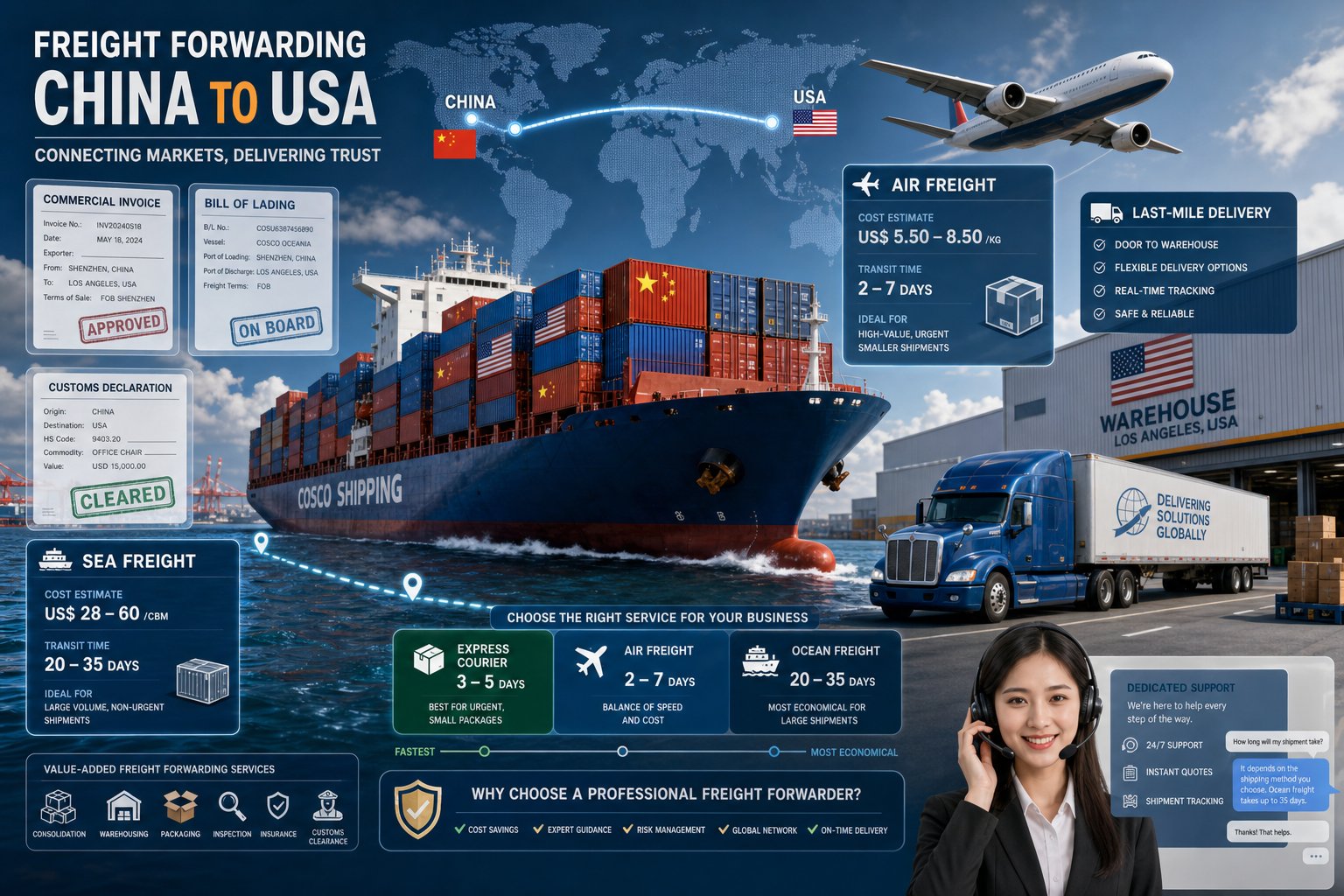
Choosing the right freight forwarding China to USA partner can save you money and help you avoid frustrating delays. Shipping costs vary widely: sea freight usually runs $80 to $150 per cubic meter, while air freight jumps to $5 to $8 per kilogram. Express couriers can deliver in as little as 3 days, but ocean shipping can take up to 35.
So how do you pick the best freight forwarder? It depends on your product, shipment size, budget, and timeline. This guide ranks and compares top China to USA freight forwarders, focusing on pricing transparency, door-to-door services, warehouse coverage, customer support, and overall fit for first-time importers.
Key Takeaways
- Freight forwarding China to USA services handle logistics, customs clearance, and delivery from supplier to U.S. destination.
- Shipping costs and transit times depend on your choice of sea freight, air freight, or express courier.
- Pick a freight forwarder based on your shipment size, product type, and whether you need customs brokerage or warehousing.
Understanding the Role of Freight Forwarders
Freight forwarders coordinate China to USA shipping by managing transportation, documents, and communication with multiple carriers. They’re not quite the same as customs brokers or NVOCCs, though sometimes those roles blur together.
Key Responsibilities and Services
A freight forwarder arranges the movement of your cargo but doesn’t typically own the ships or planes. Instead, they connect with ocean carriers, airlines, and trucking companies, building a shipping plan that fits your needs.
They’ll handle factory pickup in China, prepare export documents, and book cargo space. If your shipment is small, they’ll consolidate it with others and manage the whole transit process.
Once your goods reach the U.S., the freight forwarder works with customs brokers, arranges delivery to your warehouse, and keeps you updated with tracking info. China-based forwarders often have an edge with factory-side coordination because they’re right there in your supplier’s time zone.
They’ll also help with commercial invoices, packing lists, and bills of lading. Need advice on packaging or the best shipping method for your budget? A good forwarder covers that too.
Freight Forwarders vs. Customs Brokers vs. NVOCCs
These three players in import logistics do different things, though some companies offer all three services.
A customs broker clears your goods through U.S. Customs, handling tariff codes, duties, and compliance. They need a license from U.S. Customs and Border Protection.
An NVOCC (Non-Vessel Operating Common Carrier) issues its own bills of lading and consolidates cargo for ocean shipments. They’re registered with the Federal Maritime Commission and act as a carrier to you, but as a shipper to the ocean carrier.
Freight forwarders coordinate the whole logistics process. Sometimes they’re also NVOCCs or partner with customs brokers, but not always.
Understanding these differences helps you figure out if your freight forwarding China to USA partner can truly handle everything—or if you’ll need to juggle multiple providers.
Why Experience Matters in Freight Forwarding China to USA
Working with an experienced logistics partner can really reduce shipping risks and unexpected costs. New importers often struggle with incomplete paperwork, surprise port charges, or poor coordination between carriers and suppliers.
A knowledgeable freight forwarder knows the China-USA trade lane inside out. They anticipate peak season congestion, know which carriers are reliable, and spot documentation problems before they become customs delays.
They’ll also communicate clearly across time zones, explain destination charges, and give realistic transit estimates. Inexperienced forwarders might look affordable at first, but hidden costs and mistakes quickly add up.
Popular Shipping Methods from China to the USA
First-time importers have several options for freight forwarding China to USA, each with its own pros, cons, and price tags. It’s important to understand the real-world differences between ocean freight, air freight, express couriers, and DDP door-to-door services.
Air Freight, Sea Freight, and Express Services Compared
Sea freight is the go-to option for most China to USA shipping because it’s cheapest for medium and large shipments. Transit time ranges from 15 to 35 days, depending on your ports. It’s best if you can plan ahead and don’t need goods in a rush.
Air freight is much faster—usually 3 to 8 days from China to the U.S.—but the price per kilogram is much higher. Still, it’s worth it for urgent orders, high-value items, or products with short shelf lives. Sometimes, speed is worth the premium.
Express services (think DHL, FedEx, UPS) deliver door-to-door in 2 to 5 days. It’s the fastest route and works well for small shipments, samples, or emergencies. These services include tracking and customs clearance, but you’ll pay for the convenience.
Don’t just default to the cheapest or quickest method—match your shipping method to your timeline, budget, and shipment size.
FCL vs. LCL: Which Suits Your Shipment?
With FCL (Full Container Load), you rent the whole container for your goods. LCL (Less than Container Load) means your cargo shares space with other importers’ shipments.
Choose FCL if your shipment fills at least half the container or you want faster port processing. A 20-foot container holds about 10 pallets (28 cubic meters), while a 40-footer holds 20 pallets (58 cubic meters). The cost is fixed, so filling it up saves money per unit.
LCL works for smaller shipments—you pay only for the space you use. However, LCL usually takes longer, since your goods must be consolidated at origin and deconsolidated at destination. More handling means more chances for delays.
Both options are part of ocean freight, but your shipment volume determines which one is best for your bottom line and schedule.
Door-to-Door and DDP Shipping Explained
Door-to-door shipping means your freight forwarder manages everything—from your supplier in China to your U.S. warehouse. You don’t have to arrange separate trucking or customs clearance.
DDP (Delivered Duty Paid) shipping takes it a step further. One all-inclusive rate covers pickup, ocean or air freight, customs duties, clearance, and final delivery. With DDP door-to-door, you know your total landed cost upfront. No surprise charges at the port.
DDP sea freight is cheaper but slower, while DDP air is much faster but pricier. Many new importers prefer DDP because it simplifies billing and shifts customs risks to the forwarder.
Always double-check what’s included in your DDP quote. Some fees—like terminal handling or residential delivery—can sneak up on you.
Amazon FBA Shipments and E-commerce Logistics
Shipping to Amazon FBA centers isn’t like regular freight. Your goods need specific carton labels, pallets, and advance shipping notifications to meet Amazon’s requirements.
Freight forwarders who know Amazon FBA rules will handle labeling, book appointments, and ensure your inventory arrives ready for check-in. They’ll manage the process from your Chinese supplier to the assigned fulfillment center.
E-commerce shipments tend to be smaller and more frequent than traditional wholesale orders. Instead of quarterly containers, you might ship weekly or monthly. Many forwarders offer e-commerce services that include quality checks, repackaging, and direct delivery to multiple Amazon warehouses.
Customs Clearance and Compliance for China to USA Shipping
U.S. customs clearance requires the right paperwork, proper product codes, and financial guarantees before your goods can enter the country. Knowing your HS codes, ISF filing deadlines, and bond requirements helps you avoid delays and penalties.
Must-Have Export and Import Documents
You’ll need a commercial invoice showing the value, product description, and buyer/seller details. The packing list breaks down what’s in each box, with weights and dimensions for inspection.
The bill of lading acts as your shipping contract and receipt. A certificate of origin proves where your products were made, which affects duty rates.
Professional freight forwarding China to USA services usually prepare these documents for you. They check everything before your shipment leaves China. Missing or wrong paperwork can stall your goods at U.S. ports and cost you money.
Some products need extra certificates. Food, cosmetics, and medical devices require FDA approval. Electronics with radio frequencies need FCC certification. A good freight forwarder will flag these requirements early so you don’t get caught off guard.
Freight Forwarding China to USA: HS Codes, Customs Bonds, and ISF Filing
If you’re new to freight forwarding China to USA, you need to get familiar with a few crucial requirements. The HS code, a 10-digit number, classifies your product for customs and determines your duty rate and whether you need special permits.
Classifying your goods incorrectly? That can lead to penalties or shipment holds—nobody wants that. You should also complete ISF filing at least 24 hours before your ocean container loads at the Chinese port.
This Importer Security Filing asks for 10 data elements about your cargo. If you file late or make mistakes, you’ll face fees starting at $5,000.
A customs bond guarantees you’ll pay all duties and fees. Use a single-entry bond for one shipment, or a continuous bond for multiple imports during the year.
If you’re importing more than $2,500 in goods, a bond isn’t optional. First-time importers need to understand these requirements before placing orders—otherwise, you might get stuck with delays or extra costs.
Most customs brokers can get the bond and file ISF for you if you use their services. That’s one less headache to worry about.
Strategies for Successful U.S. Customs Clearance
Working with an experienced customs broker makes U.S. import regulations and customs compliance a lot less intimidating. These licensed professionals talk directly to customs officers and resolve issues fast.
Always declare accurate product values on every document. Undervaluing goods to save on duties? That’s a quick way to trigger customs inspections and even fraud charges.
The importer of record is legally responsible for honest declarations. Build in extra time for possible delays—port congestion, random inspections, and document reviews can all add days.
If you can, book shipments during off-peak months to avoid seasonal backlogs. Keep detailed records of every import transaction.
U.S. Customs requires you to hold onto invoices, bonds, and entry documents for five years. Good record-keeping protects you during audits and helps clear up disputes if they come up.
Freight Forwarding China to USA: Cost Structure and Pricing Transparency
Freight forwarding China to USA can get confusing, especially for new importers. Understanding how forwarders calculate charges, apply destination fees, and structure their pricing helps you avoid surprise expenses and budget more confidently.
Total Landed Cost and Cost Breakdown
Total landed cost covers everything from the supplier’s door in China to your warehouse in the USA. This includes ocean or air freight, customs duties, import taxes, insurance, and handling fees.
A transparent freight forwarder should give you a detailed cost breakdown for each component. Landed cost usually includes base freight rates, fuel surcharges, security fees, and documentation charges.
Don’t forget customs clearance, duty payments (based on your product’s HS code), and delivery to your final destination. Many new importers underestimate inland transportation costs in the USA, which can add $200 to $800 per container depending on the distance from the port.
Always request itemized quotes from several forwarders to compare pricing. Watch out for hidden fees buried in vague line items like “handling charges.”
A reputable forwarder breaks down every cost, so you can see exactly where your money goes. That’s the kind of transparency you want.
Common Destination and Destination Fees
Destination charges kick in once your cargo hits a USA port. Terminal handling charges (THC) usually run $400 to $600 per container.
If your shipment gets inspected, customs examination fees are typically $150 to $300. Port congestion surcharges change based on demand at key entry points like Los Angeles, Long Beach, and New York.
During peak season, surcharges might add $500 to $1,000 per container. Demurrage and detention fees stack up if you don’t pick up your container within the free time, often 3 to 5 days.
Chassis fees, document fees, and bills of lading can tack on another $100 to $300. Understanding freight rates from China to USA helps you anticipate these costs.
Ask your forwarder for a full list of destination fees before you book. It’s better to know upfront than get surprised later.
Incoterms and Their Impact on Pricing
Incoterms spell out who pays for each shipping stage and who takes the risk. FOB (Free on Board) means you pay all costs after goods leave the Chinese port, while your supplier handles export clearance.
CIF (Cost, Insurance, and Freight) covers ocean freight and insurance to the destination port, but you still pay destination charges. EXW (Ex Works) might look cheaper at first, but it pushes all responsibility onto you from the supplier’s facility.
This can mean higher total costs if you don’t control Chinese logistics. DDP (Delivered Duty Paid) covers everything, including customs and delivery, so you get price certainty—but usually at a premium.
Most new importers find FOB terms offer the best mix of control and simplicity. Your incoterm choice directly affects your shipping cost from China to the USA and your financial risk at each stage.
Volumetric and Chargeable Weight Considerations
Freight forwarders charge you based on whichever is greater: actual weight or volumetric weight. Volumetric weight is about package size—multiply length × width × height (cm), then divide by 5,000 for air freight or 6,000 for express.
Large, lightweight shipments get charged by volumetric weight, which can really bump up your costs. For example, a box measuring 100 × 80 × 60 cm weighs only 15kg but gets billed as 96kg for air freight.
That’s a big difference. Optimize your packaging to cut down on dimensional weight charges.
Consolidate small boxes into fewer large ones when you can. Sea freight usually doesn’t use volumetric calculations for full containers, making it more cost-effective for bulky goods.
Understanding chargeable weight helps you pick the right shipping method and packaging strategy for your China to USA shipping.
Freight Forwarding China to USA: Choosing the Right Freight Forwarder
Choosing a freight forwarder for China to USA shipping isn’t just about picking a big name. You should weigh operational reliability, service scope, and pricing transparency first.
How do different forwarders handle transit times, port congestion, and risk management? That’s what really matters for your import logistics.
Top-Rated Providers and Their Strengths
Big global companies like DHL Global Forwarding, Kuehne + Nagel, and Expeditors International have huge networks and standardized processes. They’re great for high-volume importers who need consistency across several trade lanes.
But their pricing is usually higher, and smaller accounts might not get the fastest responses. China-based providers like Sinotrans, SF Express, and Sino Shipping offer stronger factory coordination and often better rates.
They know Chinese export procedures inside and out, so they can fix origin-side issues quickly. Leeline Shipping and Winsky Freight focus specifically on China-USA routes, which is ideal if you want deep lane expertise.
Digital platforms like Flexport and Freightos have made booking and tracking easier for tech-savvy businesses. DFH Logistics does door-to-door DDP services, handling customs and delivery in one go.
DocShipper even adds product sourcing to the mix, which is handy if you need more than just transportation. Your best fit depends on shipment volume, service needs, and whether you value global reach or China-specific experience more.
Criteria for Comparing Providers
When you’re comparing freight forwarders, check their Federal Maritime Commission registration for ocean shipments. This is a must for any forwarder moving cargo to the USA.
Ask for detailed quotes that separate origin charges, freight costs, and destination fees. Hidden charges at US ports can wreck your budget if you only look at headline prices.
Ask directly about terminal handling, customs examination, and demurrage costs. Also, see if they offer customs brokerage or work with licensed brokers—this keeps your China to USA shipping compliant and on schedule.
Find out what shipment types they handle: FCL, LCL, air freight, Amazon FBA, etc. Communication is just as important as pricing—test their responsiveness early and ask how they manage time-zone differences.
Professional forwarders usually assign a dedicated contact, not a rotating cast of reps. That makes a big difference when things get complicated.
Managing Transit Times, Port Congestion, and Last-Mile Delivery
Ocean freight from China to USA ports usually takes 15-30 days, depending on the port pair and carrier schedule. Air freight shortens that to 3-7 days, but you’ll pay a lot more.
Ask your forwarder for realistic timelines based on current carrier schedules, not just the best-case scenario. Port congestion at big gateways like LA and Long Beach can add 5-10 days in peak season.
Experienced forwarders track congestion patterns and may suggest alternative ports or inland routes to avoid delays. Ask how they handle schedule changes if vessels miss departures or arrive late.
Last-mile delivery coordination is where good forwarders really shine. For Amazon FBA shipments, your forwarder should know labeling, pallet specs, and scheduling at fulfillment centers.
Standard deliveries need clear communication with your receiving warehouse about delivery windows and unloading equipment. Contract logistics providers like AEB Logistics and Ardi Logistics offer warehousing and distribution services for added flexibility after customs clearance.
Risk Management: Insurance, Real-Time Tracking, and Warehousing
Cargo insurance protects your goods if they’re lost or damaged. Most forwarders offer marine cargo insurance as an optional add-on.
Check coverage limits, deductibles, and exclusions before you sign up. Real-time tracking is now standard for China to USA shipping—your forwarder should provide container numbers, vessel schedules, and arrival estimates through an online portal or regular updates.
This kind of visibility helps you plan inventory and update your team or customers. Warehousing and distribution services come in handy if you need temporary storage before final delivery.
Some forwarders have their own facilities near major ports, while others work with third-party logistics providers. These services are great if you import large volumes but distribute to multiple locations or need to inspect goods before forwarding them.
Integrated supply chain solutions that combine freight forwarding with sourcing, quality control, and inventory management are available, but they usually require higher volume and longer commitments.
Frequently Asked Questions
First-time importers tend to have the same questions about shipping costs, transit times, documentation, and how to verify a freight forwarder for China to USA shipping. Getting a handle on these details can seriously reduce your risk and help you set realistic expectations.
How do I choose a reliable freight forwarder for my first shipment from China to the USA?
Start by checking if the freight forwarder is registered with the Federal Maritime Commission (FMC) for ocean freight. This confirms they’re authorized and regulated for China to USA shipping.
Ask about their experience with the China-USA trade lane. Just having international experience isn’t enough—they need to know U.S. customs, ISF filing, and the quirks at American ports.
Request references from other importers who ship similar products. A solid forwarder should connect you with clients or share case studies that show their experience with your type of cargo.
Pay attention to their communication during the quote process. If they respond quickly, provide clear answers, and ask thoughtful questions about your shipment, that usually reflects how they’ll handle things once your cargo is moving.
Freight Forwarding China to USA: Key Documents and Compliance Steps
If you’re dealing with freight forwarding China to USA, you’ll need to get your paperwork in order right from the start. A commercial invoice is essential and should list accurate product descriptions, values, and supplier details.
This invoice has to match the actual shipment. Otherwise, customs might delay your goods.
A packing list is also required. It shows what’s inside each carton or pallet, helping customs officers verify the shipment without opening every box.
Your freight forwarder or customs broker must file an Importer Security Filing (ISF) at least 24 hours before your ocean cargo is loaded onto the vessel. Missing this deadline can lead to penalties or cargo holds, so keep an eye on the clock.
You’ll need a customs bond to guarantee payment of duties and taxes. First-time importers usually go with a single-entry bond, while regular importers might prefer an annual bond.
Getting your product classification right using the correct HS code is critical. Your customs broker can help, but ultimately, the responsibility falls on you.
Freight Forwarder Comparison: Shipping Costs from China to USA
When it comes to freight forwarding China to USA, air freight usually runs between $4 and $8 per kilogram. The exact rate depends on volume, destination, and season, and urgent shipments during peak times will cost more.
Ocean freight pricing works differently. For full containers, a 20-foot container (FCL) typically costs between $1,500 and $4,000, depending on the ports and current market swings.
If you’re shipping less than a container load (LCL), expect to pay $50 to $150 per cubic meter. Carriers will charge based on whichever is greater—weight or volume.
These base rates only cover the freight itself. You’ll also have to budget for origin charges in China, destination terminal handling, customs clearance, and inland delivery in the USA.
Cheapest Shipping Methods: Small Orders vs. Full Containers
For small orders under 2 cubic meters, ocean LCL is usually the most affordable way to go. You share space with other shippers, so you only pay for what you use.
Sometimes, express courier services like DHL or FedEx compete with air freight for very small shipments under 100 kilograms. If you want speed and easy customs, these services often include door-to-door delivery.
Once your shipment hits around 15 cubic meters, booking a full 20-foot container makes more sense financially. The tipping point depends on current LCL versus FCL rates—always check before booking.
If you need quick delivery for shipments between 100 and 500 kilograms, standard air freight tends to offer better value than an express courier, yet it’s still faster than ocean shipping.
How Long Does Freight Forwarding China to USA Take?
Express courier services from China to the USA usually take 3 to 5 days door-to-door. This includes customs clearance and delivery straight to your address.
Standard air freight takes about 5 to 10 days from factory pickup to arrival at the U.S. airport. After that, add another 2 to 5 days for customs clearance and final ground delivery to your warehouse.
Ocean freight from major Chinese ports like Shanghai or Shenzhen to U.S. West Coast ports takes about 15 to 20 days at sea. If you’re shipping to the East Coast, expect another 10 to 14 days for a total of 25 to 35 days.
Once your ocean cargo arrives, plan for 3 to 7 more days for port processing, customs, and inland delivery. All in, door-to-door ocean shipping usually takes between 25 and 45 days, depending on your final destination.
What questions should I ask a freight forwarder about customs clearance, duties, and delivery terms before booking?
If you’re dealing with freight forwarding China to USA, it’s smart to get clear on customs clearance right away. Ask who actually handles U.S. customs clearance and if they use a licensed customs broker.
Some forwarders include brokerage as part of their service. Others just coordinate with outside brokers, so it’s worth digging into those details.
Always ask which charges show up in the quote and which ones sneak in later. Be specific—destination terminal handling fees, customs exam charges, and inland delivery costs can add up.
Get them to explain the Incoterms they’re quoting. For example, with FOB, you’re on the hook for costs and risks after the cargo leaves China. DDP means the forwarder manages everything, including duties and final delivery. It’s easy to get tripped up here if you don’t double-check.
Ask how they handle customs duty payments. Do they pay duties up front and bill you later, or do you need to set up your own customs bond and pay directly? It’s a hassle if you don’t know this in advance.
And what if customs wants more paperwork or decides to inspect your cargo? Make sure you know their process for these situations. Understanding customs procedures helps you prepare for possible delays and avoid headaches.