
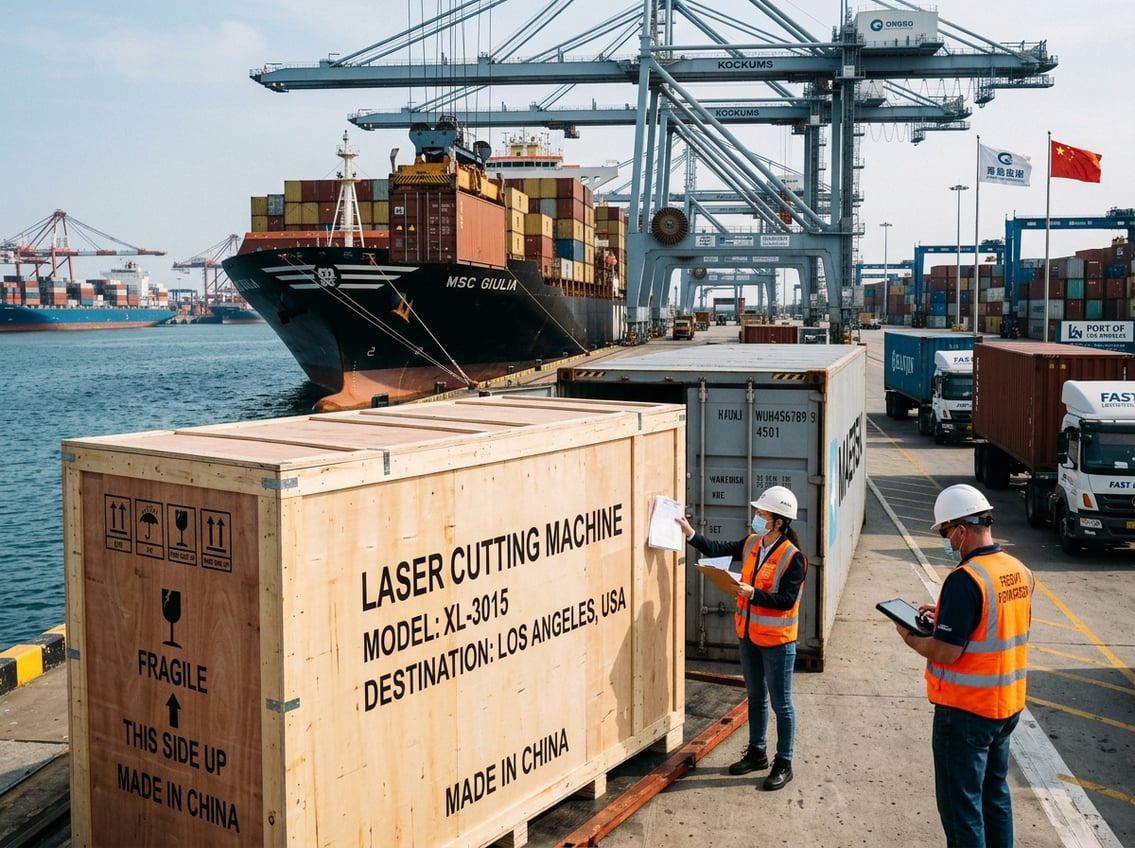
China to USA Ocean Freight is one of the busiest trade routes out there, and it’s not getting any simpler. Let’s dig into a real shipment—moving a LASER CUTTING MACHINE from China to the U.S.—and see what actually happens step by step.
If you’re working with big, pricey stuff like a LASER CUTTING MACHINE or CNC equipment, this kind of breakdown might save you some headaches.
Shipment Overview
This case covered several bulky industrial machines, each packed in wooden crates. The journey started in Qingdao, China and wrapped up at a consignee in the Midwest, USA.
Here’s what we were dealing with:
- Total volume: about 23–28 CBM
- Total weight: roughly 2,200–4,500 kg
- Packed in wooden crates (non-stackable, export-compliant)
- Commodity: LASER CUTTING MACHINE
- Incoterm: Initially CIF, later switched to DDP/DDU
The client wanted a CIF (Cost, Insurance, Freight) quote at first. But they got cold feet, mostly due to worries about surprise fees at the U.S. end.
Step 1: Incoterm Strategy and Risk Control
One of the first big decisions was to drop CIF in favor of a setup with more control. CIF tends to frustrate U.S. importers because:
- Destination charges are rarely clear upfront
- The consignee loses control over customs clearance
- Local handling fees can balloon at U.S. ports
The freight forwarder recommended switching to DDP (Delivered Duty Paid) or at least FOB (Free On Board). That way, the client could see costs coming and steer the process a bit more.
Step 2: Container Planning and Load Optimization
The shipper thought a 20-foot container (20GP) would be enough. But after checking crate sizes, the plan hit a snag:
- A 20GP container holds about 33 CBM
- The cargo volume was around 23 CBM
- Non-stackable crates meant a lot of wasted space
The forwarder figured the cargo could just fit into a 20GP, but only if they partially disassembled crates or got creative with loading. That seemed risky.
LCL (Less than Container Load) was an option for flexibility, but it meant more handling and possible damage. In the end, they went with FCL (Full Container Load) to keep things simple and safer.
Step 3: Cost Structure Breakdown
Here’s how China to USA Ocean Freight costs stacked up:
Origin Charges (China):
- Trucking from the factory to port
- Export customs clearance
- Documentation fees
- Terminal handling charges (THC)
Ocean Freight:
- Base ocean freight rate (varies with the season)
- Peak season surcharges (sometimes)
Destination Charges (USA):
- Port handling fees
- Customs clearance
- ISF filing (Importer Security Filing)
- Delivery to the final address
Duties and Tariffs:
- Import duty based on HTS code
- Section 301 tariffs on Chinese goods (sometimes up to 25–50%)
Sometimes, tariffs and shipping together nearly matched the value of the machine. That’s a tough pill to swallow for buyers.
Step 4: Customs Compliance and Documentation
U.S. import rules are strict, and the paperwork has to be spot-on. Here’s what’s needed:
- Commercial Invoice
- Packing List
- Bill of Lading
- HTS Code classification
- ISF (10+2 filing)
The forwarder kept stressing the need for:
- Accurate cargo value declaration
- Correct HS/HTS codes
- Clear consignee information
Mess up the paperwork and you risk customs holds, penalties, or even seizure. Nobody wants that on their plate.
The forwarder even asked for the contract between supplier and buyer to double-check the declared values. Better safe than sorry, right?
Step 5: Operational Execution
Here’s how the shipment moved, one step at a time:
- Empty container sent to the supplier
- Factory loads the cargo
- Container returns to the port terminal
- Export customs clearance
- Vessel departs from Qingdao
- Ocean transit (about 18–30 days, depending on the U.S. port)
- Arrival at a U.S. port (like Los Angeles or Long Beach)
- Customs clearance and ISF validation
- Final delivery by truck
Door-to-door coordination helped avoid communication gaps and delays. It’s easy to forget just how much hassle you can avoid with tight coordination.
Step 6: Risk Management
Plenty of risks came up, but the team tackled them as they appeared:
- Damage risk: They picked FCL over LCL to keep the cargo safe.
- Cost overruns: They dodged these by skipping CIF terms.
- Customs delays: They kept these to a minimum with careful paperwork.
- Tariff shock: They faced this early by showing the full cost breakdown.
The forwarder kept the client in the loop the whole way, so there weren’t any nasty surprises.
Step 7: Customer Decision Outcome
When the customer saw the total landed cost, importing from China just didn’t add up. Tariffs and logistics costs tipped the scales.
They ended up buying a used machine in the U.S. instead, which honestly was the smarter move for them.
Even though the shipment never happened, the process saved the client from a costly mistake. That’s worth something in my book.
About AEB Logistics
AEB Logistics has been in the freight game for years, helping clients navigate complicated international moves like this one. They’re not just about moving boxes—they care about getting the details right and making sure clients know what they’re in for.
If you’re thinking about shipping heavy machinery or need help with customs, they’re worth a look. Nobody can promise zero headaches, but these folks know how to keep surprises to a minimum.
Key Takeaways: China to USA Ocean Freight
- Pick your Incoterms carefully.
- CIF is risky for U.S. imports unless you really trust the origin forwarder.
- Container choice isn’t just about volume.
- Think about how your cargo fits, stacks, and handles.
- Tariffs can be a dealbreaker.
- Always add up the total landed cost before you commit.
- Get the paperwork right.
- Documentation mistakes can cause huge delays and fines.
- Be transparent.
- Honest cost breakdowns build long-term credibility, even if you don’t close the deal.