
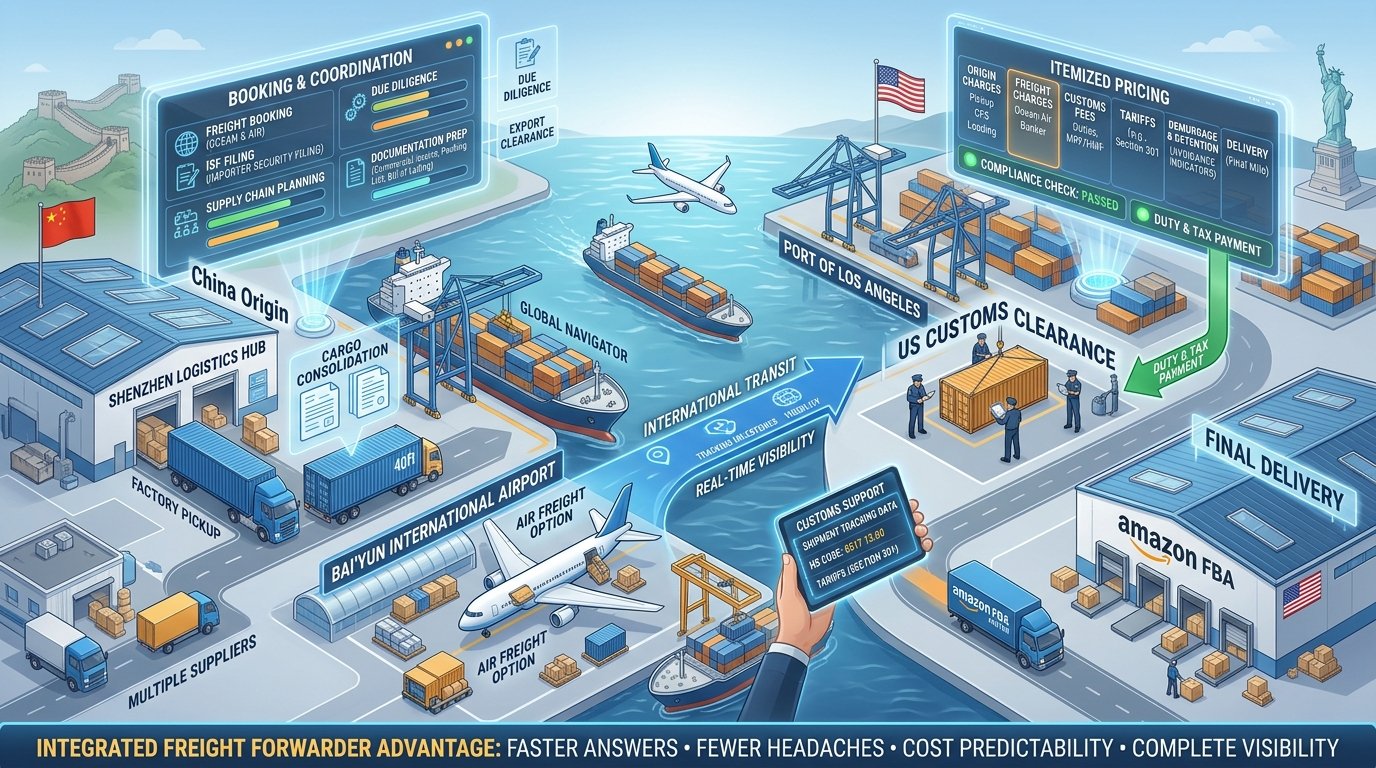
Shipping from China to the USA isn’t just about booking cargo on a ship. You need a partner who handles customs clearance, consolidates orders from different suppliers, and delivers straight to your door—without shuffling you from company to company.
Most U.S. importers lose time and money by working with freight forwarders who only manage ocean or air transport, then leave customs and delivery to someone else.
China to USA shipping takes careful coordination. Your freight forwarder should manage factory pickups, export paperwork, freight booking, ISF filing, customs clearance, and final delivery to your warehouse or Amazon FBA center.
When one company controls everything, you get faster answers, clearer prices, and fewer headaches.
The best freight forwarders know the rules and the real-world shipping details. They understand Section 301 tariffs, HS codes, and how to dodge demurrage fees at busy U.S. ports.
You’ll get real-time tracking and quotes that spell out every charge from start to finish.
Key Takeaways
- Pick freight forwarders who handle everything—from China pickup to U.S. customs and final delivery.
- Transparent pricing with line-by-line origin, destination, and customs fees keeps surprises away.
- Licensed customs brokers and tracking systems help keep your imports compliant and visible.
Choosing a Freight Forwarder With End-to-End Control
Importers who stick with partners that control every step—from factory pickup to delivery—deal with fewer delays and surprise fees.
The best freight forwarders handle consolidation, customs, and last-mile delivery under one roof, not by passing your shipment around.
Why Integrated Partners Reduce Delays
A freight forwarder from China to USA who manages your whole shipment cuts out the waiting that happens when different vendors touch each step.
One partner who coordinates pickup, export clearance, transport, customs, and warehouse delivery keeps your shipment moving without gaps.
Integrated forwarders use connected systems to share shipment data at every stage. This means you get real-time tracking from the moment your supplier loads the goods to customs and delivery.
You can catch problems early, before they throw off your schedule.
Consolidation services run smoother when one partner manages it all. Your forwarder can combine cargo from different suppliers, clear it as one entry, and split it up for delivery—without juggling multiple companies.
This saves time and usually cuts freight costs compared to handling each supplier separately.
Evaluating Experience in China–USA Shipping
Your freight forwarder China to USA should know U.S. customs regulations and have good relationships at major Chinese ports.
Pick partners who’ve shipped your product type before and understand the HS codes that set your duties.
Ask how long they’ve run the China–USA route and which ports they use most. Forwarders with solid carrier contracts score better rates and space, especially during peak season.
Check if they have teams in both countries. Staff in China can visit suppliers, verify cargo, and fix paperwork fast. U.S. customs teams should respond quickly to CBP holds and compliance issues.
Ask for references from importers with similar products. The right partner has solved challenges like FDA compliance for supplements or special handling for lithium batteries.
Transparent Pricing and Cost Predictability
Freight forwarders who show every line item in their quotes help you calculate your total landed cost before you place an order.
Your quote should break out ocean or air freight, origin charges, destination fees, customs brokerage, duties, and delivery as separate items.
Watch for vague terms like “destination charges” or “handling fees” with no numbers attached. The best partners list terminal fees, chassis costs, and paperwork charges so you know what you’re paying for.
Landed cost calculators that include duties based on your HS codes give you a clearer budget than quotes that only show freight costs. AEB Logistics and similar forwarders now offer tools that estimate your all-in cost per unit, including customs and delivery.
Ask if rates include the usual surcharges or if things like fuel, peak season, or security fees show up later. Fixed all-in pricing shields you from rate jumps, while itemized quotes show where costs shift over time.
Customs Clearance and Regulatory Compliance Essentials
Getting products through U.S. Customs and Border Protection takes accurate paperwork, the right classifications, and a handle on current duty rates.
Missing or wrong documents can stall your shipment for days—or even weeks.
U.S. Import Regulations and Customs Entry
Every shipment entering the U.S. needs a formal customs entry filed with U.S. Customs and Border Protection.
You need an Importer of Record—the legal entity on the hook for compliance and paying duties.
Your customs broker files the entry, but you have to supply the correct documents. The commercial invoice shows value and details; the packing list covers contents and packaging.
You also need to file an Importer Security Filing (ISF) at least 24 hours before your ocean cargo loads at the foreign port. ISF violations can cost you $5,000 per shipment.
This filing includes seller, buyer, manufacturer, and cargo details.
Customs compliance means following all rules, from product safety to country-specific restrictions.
Working with experienced freight forwarders who know China to USA shipping helps you dodge the usual compliance pitfalls.
HTS Classification and Duty Calculation
Every product needs an HTS code from the Harmonized Tariff Schedule. This 10-digit number sets your duty rate and flags any special tariffs.
Classification mistakes are common. Your supplier might suggest the wrong code. HTS classification takes knowing what your product’s made of, how it works, and what it’s for.
Your duty calculation adds the base tariff rate and any extra tariffs. Section 301 tariffs on Chinese goods run from 7.5% to 25%, depending on the product. Extra duties can apply based on current trade rules.
Misclassification can mean underpaying (and getting hit with penalties) or overpaying duties. Either way, it’s a pain. A good customs broker double-checks your HTS codes before filing.
Managing Documentation and Customs Holds
Customs holds happen when U.S. Customs and Border Protection flags your shipment for extra review. The most common reasons: missing paperwork, value questions, or compliance worries.
You need clean, consistent paperwork to avoid holds. Your commercial invoice and packing list must match. Any mismatch raises eyebrows.
If customs issues a hold, your broker gets a notice explaining what they need. Responding quickly with the right documents can get your shipment released in days instead of weeks.
Keep digital copies of all import documents handy. Depending on your product, you might need certificates of origin, test reports, or compliance statements. Having these ready beats scrambling when customs asks for them.
Shipping Methods and Multi-Modal Options
Shipping from China to the USA comes with trade-offs between speed, cost, and handling. Your choice really depends on shipment size, urgency, and whether you want door-to-door or just port-to-port service.
Air Freight From China: Speed vs. Cost
Air freight from China to the USA gets your goods there in 3-7 days. It’s the fastest option for urgent shipments.
You pay by actual weight or volumetric weight—whichever’s higher.
The formula: length × width × height in centimeters, divided by 6,000. Rates usually run $4 to $8 per kilo, depending on fuel and season.
Air freight works best for high-value, time-sensitive, or perishable products. If you’re restocking Amazon FBA or rushing an order, the speed can be worth it.
Couriers like DHL and FedEx offer door-to-door delivery in 2-5 days, with customs clearance and tracking built in. For shipments under 200 kg, express couriers sometimes cost less than standard air freight after you add handling fees.
When to choose air freight:
- Product launches with tight deadlines
- Small, high-margin goods
- Emergency restocks
- Temperature-sensitive items
Ocean Freight: FCL, LCL, and Expedited Services
Ocean freight from China to the USA gives you two main options: full container load (FCL) or less than container load (LCL).
FCL makes sense if you fill at least 60-70% of a container.
A 20-foot container holds around 28 cubic meters; a 40-foot container, about 58. With FCL, your container goes straight from China to your U.S. destination without extra stops.
LCL means you share container space with other importers. You pay only for the space you use, but consolidation adds 3-7 days to transit. LCL costs more per cubic meter but saves you from paying for empty space.
Standard ocean freight from China takes 15-30 days, depending on ports. Expedited ocean cuts 5-10 days by using faster ships and priority terminal handling.
FCL vs LCL comparison:
| Factor | FCL | LCL |
|---|---|---|
| Best for | Shipments filling 60%+ of container | Smaller cargo volumes |
| Transit time | 15-30 days | 20-35 days |
| Cost per CBM | Lower | Higher |
| Handling | Less touchpoints | More handling at consolidation |
Door-to-Door and DDP Shipping Solutions
Door-to-door shipping handles everything from your supplier’s factory in China to your warehouse in the USA. You get one bill and a single point of contact, which saves you from juggling multiple carriers or customs brokers.
DDP shipping (delivered duty paid) means your freight forwarder takes care of all customs duties, taxes, and clearance before your goods arrive. You’ll know your total landed cost up front—no surprise border fees.
This approach bundles origin pickup, ocean or air transport, customs, and final delivery into one service. DDP is especially handy for Amazon FBA forwarding, since you need precise delivery windows and pre-paid duties.
Door-to-door services cost more than port-to-port, but you save time and avoid coordination headaches. Your forwarder files ISF, manages customs bonds, and sets up delivery appointments so you can focus on your business.
Cost Structure, Surcharges, and Documentation Management
Freight forwarders charge more than just the base shipping rate. Understanding each line item helps you compare quotes and avoid confusion.
Duties, taxes, and proper documentation all add layers of cost that affect your total landed cost and compliance.
Breakdown of Freight Costs
Your freight quote covers the base ocean or air rate, plus fees that change by carrier and season. Ocean freight from China to US ports usually runs $1,650 to $2,300 for a 20-foot container. Air freight costs $4.20 to $6.50 per kilogram in 2026, which isn’t cheap.
Dimensional weight pricing hits when your cargo takes up more space than its weight suggests. Carriers multiply length × width × height and divide by 6,000, then charge whichever is higher—actual or volumetric weight.
Common destination charges at US ports include:
- Terminal handling charges ($150-$400 per container)
- Chassis usage fees ($75-$150)
- Documentation fees ($50-$125)
- Container inspection charges if CBP selects your shipment
Peak season surcharges show up during Chinese New Year and before Christmas, adding $500 to $1,500 per container. Fuel surcharges usually run 10-25% of your base rate. Always ask your freight forwarder for an all-in quote that breaks out every fee, so you’re not blindsided on delivery day.
Calculating Duties, Taxes, and Fees
U.S. Customs charges import duties based on your product’s Harmonized Tariff Schedule classification. Duty rates can be zero for some electronics or 25%+ for certain categories.
The merchandise processing fee is 0.3464% of your cargo value, with a minimum of $27.75 and a max of $538.40 per entry. Every commercial shipment pays this, no matter the duty rate.
Harbor maintenance fee applies to ocean shipments at 0.125% of cargo value. That fee helps maintain U.S. ports.
Your freight forwarder should give you duty and tax calculations before your goods arrive. Prepaying duties through your customs broker helps you avoid port delays.
| Fee Type | Calculation Method |
|---|---|
| Import duties | Product value × HTS duty rate |
| Merchandise processing fee | 0.3464% of cargo value |
| Harbor maintenance fee | 0.125% of cargo value (ocean) |
Add these charges to your freight costs to work out your total landed cost per unit.
Managing Commercial Invoices, Bill of Lading, and Insurance
Your commercial invoice needs to show accurate product descriptions, quantities, unit values, and the right HTS code. Customs uses this to determine your duty and how fast you clear.
The bill of lading is your receipt from the carrier and proof you own the goods. Ocean shipments use a sea waybill or original bill of lading; air freight uses an air waybill. Your forwarder prepares and files these with customs.
Cargo insurance usually costs 0.3-0.5% of your shipment value and protects you if something goes wrong in transit. Most forwarders offer marine insurance as an add-on.
Your customs broker needs these documents 48 hours before arrival:
- Commercial invoice with HTS codes
- Packing list with carton count and weights
- Bill of lading or air waybill
- Insurance certificate (if insured)
Freight forwarders with integrated customs brokerage file your documents directly. This setup cuts down on errors and speeds up clearance compared to juggling separate brokers and carriers.
Visibility, Tracking, and Amazon FBA Support
Professional freight forwarders offer real-time shipment tracking from Chinese factories to your US warehouse or Amazon fulfillment center. They coordinate with multiple suppliers, apply FBA-compliant labeling, and provide logistics advice to keep your inventory moving.
Supply Chain Coordination and Real-Time Tracking
Experienced freight forwarders give you full visibility across your supply chain. Real-time tracking lets you monitor your cargo from pickup in China through transit to final delivery in the USA.
Modern tracking systems update automatically at each milestone. You can check your shipment status online anytime—no need to call or email for updates.
Key tracking features include:
- GPS location updates during transit
- Port arrival and departure notifications
- Customs clearance status alerts
- Estimated delivery date changes
Consolidation services from multiple Chinese suppliers run through a single dashboard. You get to track different orders from various factories as they merge into one shipment. This can save money and makes supply chain coordination a bit less stressful.
Final-Mile Delivery and FBA-Compliant Labeling
Amazon FBA forwarding means you have to meet strict packaging and labeling standards before warehouses will accept your goods. Your freight forwarder manages FBA prep and compliance checks to prevent rejection at the fulfillment center.
FBA-compliant labeling covers FNSKU barcodes, expiration dates, and safety warnings placed correctly on each unit. Teams check box dimensions, weight limits, and case counts to match Amazon’s current rules.
Final-mile delivery lines up with Amazon’s appointment system. Your forwarder books the delivery window and makes sure trucks arrive on time with the right paperwork. They handle the handoff directly to Amazon staff.
Standard FBA services:
- Product labeling and polybagging
- Carton labeling with shipment IDs
- Pallet preparation and wrapping
- Direct delivery to assigned fulfillment centers
Logistics Consultation and Support Tools
You get ongoing logistics advice from freight forwarding teams who know China to USA shipping rules and best practices. They’ll help you pick between air freight, ocean LCL, or FCL containers based on your schedule and budget.
Support tools include shipping calculators, customs duty estimators, and transit time comparisons. Many forwarders assign dedicated account managers who learn your business and try to anticipate what you’ll need next.
Customer service teams answer questions about customs brokerage, import paperwork, and compliance. You’ll get help with ISF filing, duty payments, and commodity codes. Digital platforms let you upload invoices, request quotes, and approve bookings without endless emails or phone calls.
Frequently Asked Questions
Importers want clear answers about transit times, consolidation logistics, and customs requirements. Knowing how to compare quotes and track shipments helps you control costs and dodge delays.
How do I choose a reliable partner to manage shipping from multiple suppliers in China to the United States?
Pick a forwarder with warehouses in major Chinese export cities like Shenzhen, Guangzhou, or Shanghai. These facilities let them collect cargo from different factories and combine everything into one shipment.
Ask if they coordinate pickups from multiple suppliers. The best partners schedule collections, inspect cartons for damage, and check quantities before consolidation.
Find out if they offer a single point of contact for all your suppliers. This keeps communication simple and prevents mistakes that happen when vendors ship on their own.
Request references from other importers who source from several factories. Their feedback shows if the forwarder can really handle complex multi-supplier logistics without delays.
What is the typical end-to-end transit time to the U.S. by air versus ocean for commercial cargo?
Ocean freight from China to major US ports takes 14 to 22 days. West Coast destinations like Los Angeles and Long Beach usually run faster than East Coast ports like New York or Savannah.
Air freight cuts that to 2 or 3 days for direct flights. Add another 1 to 3 days for customs clearance and delivery to your final stop.
LCL ocean shipments might need extra time because your cargo waits for consolidation at origin and deconsolidation at the destination port. That can add 3 to 7 days.
Express courier services deliver in 2 to 4 days total, including customs clearance and door delivery. These work best for urgent, small shipments under 300 kilograms.
How does customs clearance work for U.S. imports, and what documents are required to avoid delays?
U.S. Customs and Border Protection wants a commercial invoice, packing list, and bill of lading or air waybill for every shipment. Your forwarder files these through a licensed customs broker.
The broker submits an Importer Security Filing at least 24 hours before your ocean vessel leaves China. Miss that, and you risk holds and penalties.
Your commercial invoice needs accurate product descriptions and the correct 10-digit HTS codes. Wrong codes trigger holds and possible inspections that can add weeks to clearance.
Regulated products need extra permits. Electronics require FCC compliance, food items need FDA registration, and children’s products must meet CPSC safety standards before release.
When does it make sense to consolidate multiple supplier orders into one shipment, and how is it coordinated?
Consolidation saves money when you buy from three or more suppliers but none fills a full container. Combining orders into one FCL shipment usually costs less than shipping separate LCL shipments.
Your forwarder collects cargo from each factory and brings everything to their warehouse. They check quantities, look for damages, and repack items into a single container.
The process works best if all suppliers finish production in the same week. If not, you might pay for warehouse storage while waiting for late vendors.
Consolidation adds 3 to 5 days for collection and warehouse handling. Build this buffer into your schedule to avoid running out of stock.
What factors drive total landed cost, and how can I compare international shipping quotes accurately?
Your landed cost covers freight rates, customs duties based on HTS codes, customs clearance fees, and inland delivery to your warehouse. Many forwarders tuck destination charges away in the fine print, which can be frustrating.
Ask for all-in quotes that include terminal handling, documentation fees, and delivery right to your door. Some quotes look cheap at first but then pile on hundreds of dollars in surprise charges at the destination.
Peak season surcharges hit hardest from July through October and right before Chinese New Year. These extra fees can add anywhere from $500 to $1,500 per container during busy shipping periods.
It makes more sense to calculate cost per unit instead of just comparing container rates. Sometimes a higher freight rate with no hidden fees ends up cheaper than a bargain quote that sneaks in extra costs later.
What shipment tracking and visibility milestones should I expect from pickup in China to final delivery in the U.S.?
Modern freight forwarders usually send tracking updates at the major steps. You’ll get a heads-up when your cargo leaves each supplier.
They’ll notify you when it arrives at the consolidation warehouse. Once the freight loads onto the vessel or aircraft, you should see another update.
For ocean shipments, you’ll see when the vessel leaves China and arrives at a U.S. port. There’s another milestone when customs releases the cargo, followed by a final delivery notice.
Most real-time platforms update the container’s location every day or two while it’s in transit. Sometimes, though, you might notice a lag—tracking isn’t always perfect.
Air cargo tracking works a bit differently. You’ll get updates at departure from the origin airport and arrival at the U.S. gateway.
There’s a status for customs clearance, and then you get ground delivery notifications. Express shipments can get pretty granular, sometimes giving you hourly tracking once they’re in the U.S. delivery network.
The best forwarders tie tracking directly to your email or offer a dashboard you can check anytime. You’ll get automatic alerts if there are delays, customs holds, or any schedule changes—no need to chase down updates yourself.