
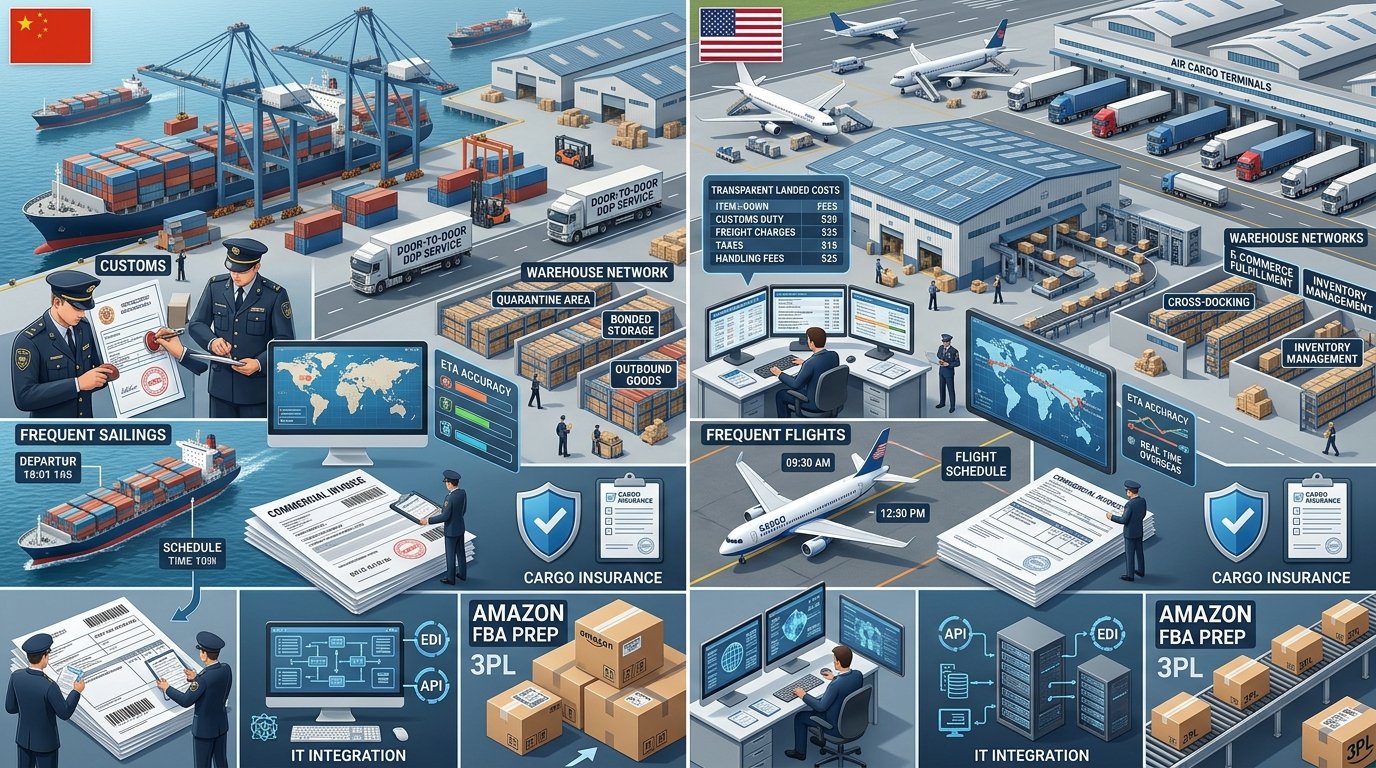
Moving products from China to the USA is more than booking cargo space on a ship or plane. You need a freight forwarder who can handle customs clearance, manage documentation, track shipments, and deliver goods to your final destination—ideally, without surprise costs or delays.
The right freight forwarder becomes a critical partner in your supply chain, affecting everything from your landed costs to your ability to meet customer delivery promises. When comparing China to USA freight forwarders, you really have to look beyond basic shipping rates. Consider things like customs expertise, warehouse networks, tracking capabilities, and how well they integrate with your business systems.
Making this decision based on price alone? That often leads to hidden fees, missed deadlines, and operational headaches that end up costing way more than any initial savings.
Customs brokerage expertise and U.S. entry experience
Understanding the differences between customs brokers and freight forwarders helps you pick the right partner for your imports. A customs broker handles the legal side of importing and makes sure your goods meet U.S. Customs and Border Protection rules.
Not all freight forwarders offer customs brokerage services. Some just arrange transportation, while others provide full customs support.
When you compare forwarders, check if they have licensed customs brokers on staff. Your forwarder needs to know current U.S. import regulations and tariff classifications.
They should file accurate entry documents and handle duty payments correctly. Experience with U.S. ports matters too—a forwarder with strong relationships at major entry points can solve problems faster when issues pop up.
Ask about their track record with CBP compliance. Errors in customs documentation can cause delays, fines, or cargo holds. The right customs brokerage partner should minimize these risks through accurate filing and proactive communication.
Look for forwarders who explain the customs process clearly and keep you in the loop about regulatory changes that could affect your products.
Door-to-door DDP service availability
Not every freight forwarder offers genuine DDP door-to-door shipping from China to USA. Make sure your forwarder handles every step of the process under a single contract.
DDP means Delivered Duty Paid. The forwarder takes care of customs clearance, import duties, taxes, and final delivery to your address.
You pay one price and don’t need to deal with customs brokers or trucking companies separately. Some forwarders only offer port-to-port service—they get your cargo to a U.S. port, but then you’re on your own for the rest.
Others claim DDP service but outsource parts of it, which can cause delays and finger-pointing when something goes wrong. When you compare forwarders, ask if they manage customs clearance, ISF filing, drayage, and last-mile delivery directly.
Check whether their quote includes all fees or if you’ll get hit with surprise charges later. True DDP specialists have established networks in both China and the USA. They should provide tracking throughout the journey and handle customs issues themselves, not push problems back to you.
Transparent total landed cost (including duties, fees, and surcharges)
You need to know your total landed cost from China to USA before you commit to any shipment. This includes your product cost, freight charges, insurance, customs duties, and delivery fees.
Many forwarders quote low base rates but hide extra charges. You might see cheap ocean freight—then get surprised by port fees, documentation charges, and fuel surcharges.
Ask each forwarder for a complete breakdown. The calculation should include duties and tariffs, customs brokerage fees, port handling, and final delivery to your warehouse.
Some forwarders offer DDP (Delivered Duty Paid) pricing, so one price covers everything from the Chinese factory to your door. DDP makes budgeting a lot easier and eliminates surprise costs.
Compare quotes carefully. A forwarder charging $100 more upfront but including all fees might actually cost less than one with hidden charges. Always request itemized quotes that show each fee separately so you can compare apples to apples.
Warehouse network in China and U.S. (origin consolidation and U.S. distribution)
When comparing forwarders based on warehouse network coverage, look at both their China and U.S. locations. A strong network in China lets you consolidate shipments from multiple suppliers before they leave the country.
This cuts shipping costs and makes customs clearance simpler. Look for forwarders with warehouses near major manufacturing hubs like Shenzhen, Guangzhou, or Shanghai.
On the U.S. side, you want distribution points that match where your customers live. A China warehouse positions your inventory between manufacturers and international customers, letting goods arrive from suppliers in 2-3 days within China.
But you also need U.S. warehouses for faster delivery to American buyers. The best forwarders offer both origin consolidation and destination distribution.
They store your products in China until you need them, then ship to U.S. warehouses for quick delivery to customers. This setup gives you flexibility without forcing you to ship everything at once.
ETA accuracy and real-time shipment tracking tools
You need accurate delivery estimates when shipping from China to the USA. The best forwarders use advanced tracking technology to give you reliable ETAs throughout your shipment’s journey.
Real-time shipment tracking tools can improve ETA accuracy by 30 to 50 percent with GPS tracking and IoT sensors. These systems monitor your cargo’s location and condition as it crosses the Pacific.
Basic forwarders only provide carrier scans and estimated dates. Advanced ones offer B/L-based tracking with container milestones and vessel delay notifications.
Your forwarder should give you automatic updates when exceptions happen. Modern freight tracking platforms pull data from multiple carriers to show you a complete view of your shipment.
Ask potential forwarders what tracking system they use. You want one that provides real-time visibility instead of updates only when you ask. The technology they use really affects how well you can plan inventory and manage customer expectations.
Frequency of sailings/flight options and transit time guarantees
You need to check how often your forwarder can ship your goods. Some companies offer daily departures, while others only have weekly options.
Ocean freight from China to the USA typically runs on fixed schedules. Ocean DDP transit times range from 20-25 days for standard service.
Your forwarder should tell you exactly which sailing dates are available each week. Air freight gives you more flexibility.
End-to-end air freight usually takes 5 to 10 business days to complete. You can often find daily flight options through major airports.
Transit time guarantees matter when deadlines are tight. Some forwarders promise specific delivery windows and compensate you for delays, while others only give estimates with no guarantee.
Ask your forwarder about backup options if a vessel or flight gets canceled. You want to know if they can quickly rebook your shipment without major delays. The best forwarders maintain relationships with multiple carriers so they can offer you reliable alternatives.
Commercial invoice and HS code classification support
Your freight forwarder’s skill with commercial invoices and HS codes can shape your import costs and customs clearance speed. The commercial invoice is the most important document in your China import shipment because US Customs uses it to determine duties and verify your entry details.
HS codes decide your product classification. This affects import duties, taxes, and customs clearance requirements.
Use the wrong code and you could pay a 25% tariff instead of 5%. China uses HS codes up to 13 digits, while the US sticks to 10-digit HTS codes.
Your supplier’s China HS code is just a starting point. You’ll need the correct US HTS code to get your duties right.
Good forwarders help you classify products correctly. They check that your product description, material, function, invoice value, and code all match up.
If these details don’t line up, customs brokers will ask for more information before processing your entry. Ask potential forwarders how they approach HS code classification for tricky products.
Find out if they review your commercial invoices before submission. This support can save you from costly delays and duty mistakes.
Cargo insurance options and claims handling track record
When comparing freight forwarders from China to the USA, check their cargo insurance offerings. Not all forwarders provide the same coverage or work with the same insurers.
Some forwarders only offer basic coverage for major losses. Others have all-risk policies that protect against damage, theft, and more from the factory to your warehouse.
Ask about coverage limits and exactly which risks are included. The claims process matters just as much as the policy itself.
A forwarder with a solid track record will help you file claims quickly and get things sorted without endless delays. Ask about their average claims processing time and success rate.
China’s cargo insurance market has gotten more complicated as freight volumes have grown. You have more options, but you’ll need to do more homework.
Request references from other importers who’ve filed claims with the forwarder you’re considering. Check if the forwarder handles claims themselves or sends you to a third party.
Direct handling usually means a faster resolution. Dealing with a middleman can drag things out.
IT integration and EDI/API connectivity for order visibility
Your freight forwarder’s technology decides how well you can track shipments in real time. Chinese and American forwarders take different approaches to system integration.
Most US forwarders offer modern API integration for real-time data exchange. You get instant updates on shipment status through direct system connections.
Many also keep EDI systems for partners who need them. Chinese forwarders usually rely more on traditional EDI systems, which work through batch processing instead of instant updates.
You might wait hours for status changes to show up in your system. A hybrid API and EDI integration strategy combines both technologies, and some larger Chinese forwarders now offer this option.
You keep EDI reliability and get some API flexibility. The integration method really affects your order visibility.
API connections give you faster tracking data. EDI systems are reliable but just slower.
Your choice depends on your business needs. If you want instant updates, go for forwarders with strong API capabilities.
If your systems already use EDI, either route works. It’s really about what fits your workflow best.
Handling of Amazon FBA requirements and 3PL prep services
When you ship products from China to Amazon FBA, meeting Amazon’s requirements is critical. Amazon has detailed specifications for labeling, packaging, and shipping that you have to follow before products reach fulfillment centers.
China-based forwarders often include prep services at warehouses near your factory. This lets you inspect, label, and prepare products before they ship overseas.
Using a China FBA prep center helps you catch quality problems early and cuts transit time. USA-based forwarders usually partner with 3PL prep centers or offer their own prep services after your goods arrive.
Routing through a prep center can help you cut placement fees and make sure you’re compliant. FBA prep services include FNSKU labeling, poly-bagging, carton labeling, and palletization.
Some forwarders only handle transport, while others provide full prep support. You need to check which services each forwarder offers and if they actually understand Amazon’s current rules.
Overview of International Freight Forwarding
Freight forwarders act as go-betweens for shippers and carriers. They coordinate the movement of goods across borders using different transportation modes.
They handle documentation, customs clearance, and logistics planning. Their job is to get your cargo to its destination efficiently, or at least that’s the goal.
Key Concepts in Global Logistics
International freight forwarding means moving goods from one country to another using various shipping methods. You’ve got ocean freight, air freight, and express courier services.
Ocean freight is the cheapest for big shipments but takes longer. Air freight costs more but gets your urgent stuff there fast.
Incoterms define who pays for shipping and when ownership changes hands. FOB (Free on Board) means you take over once goods leave the port, while DDP (Delivered Duty Paid) means the forwarder handles everything—including customs and delivery.
Your total landed cost is the shipping rate plus duties, taxes, warehouse fees, and delivery charges. Many forwarders quote low base rates but tack on hidden fees later.
Always compare the full cost, not just the flashy shipping quote. Otherwise, you’ll get some nasty surprises.
Roles Played by Forwarders in Supply Chains
Freight forwarders pull together a bunch of services to move your cargo from China to the USA. They book space with ocean carriers or airlines and arrange pickup from your supplier’s warehouse.
They handle export documentation in China and manage customs brokerage in the USA. Your forwarder tracks shipments and keeps you posted on delays or issues.
They consolidate smaller shipments to cut costs and negotiate better rates with carriers because of their shipping volume. Specialized services include temperature-controlled shipping, Amazon FBA prep and delivery, and white glove handling for fragile stuff.
Some forwarders offer warehouse storage in both countries, so you can keep inventory near ports or distribution centers. That’s handy if you’re juggling a lot of moving parts.
Impact of Regulatory Compliance
Regulatory compliance shapes your shipping costs, delivery times, and legal risk when moving goods between China and the USA. Understanding compliance requirements helps you avoid penalties and customs delays that can cost thousands per shipment.
Customs Documentation Requirements
Your freight forwarder needs to handle several document types for China-USA shipments. These include commercial invoices, packing lists, bills of lading, and certificates of origin.
Each document needs accurate HS codes to determine duty rates and regulatory requirements. Chinese customs requires export declarations before goods leave the country.
US customs demands ISF (Importer Security Filing) at least 24 hours before cargo loads onto ocean vessels. Missing or incorrect paperwork triggers inspections that delay your shipment—sometimes by days or weeks.
When comparing forwarders, ask about their documentation accuracy rate and clearance success rate. A good forwarder checks all forms before submission and catches errors that could cause rejections.
They should also keep up with changing documentation rules. Requirements shift all the time, and you don’t want to get caught off guard.
Import and Export Control Differences
China and the USA each have their own export control lists that restrict certain products and technologies. Your forwarder needs to screen shipments against both sets of regulations before taking your cargo.
Chinese export controls focus on sensitive tech, rare earth materials, and dual-use items. US import controls include sanctions screening, Section 301 tariffs on Chinese goods, and product-specific rules from agencies like the FDA and CPSC.
Your forwarder has to classify products correctly and apply for any required licenses or permits. Regulatory changes impact your freight costs and transit times.
De minimis value thresholds, tariff exclusions, and compliance programs all affect your total landed cost. Staying on top of these details can make or break your margins.
Frequently Asked Questions
Choosing between China-based and USA-based forwarders means understanding how reliability, cost structures, compliance, customs processes, service quality, and carrier access all differ.
What criteria should be used to evaluate a freight forwarder’s reliability and on-time performance across China and the USA?
Look at verified on-time delivery rates, not just marketing claims. Warehouse size, staff count, and reorder rates help you judge a forwarder’s ability to handle your shipments consistently.
Ask for specific performance data for your shipping lane. Request the percentage of shipments delivered within the promised window over the past six months.
Track whether the forwarder provides accurate ETA updates during transit. Also, check how long the forwarder has worked on the China-USA route.
Experience on this corridor means they know the usual delays and can handle port congestion at places like Los Angeles and Long Beach. That’s worth a lot when things get hectic.
How do total landed costs typically differ between China-based and USA-based freight forwarding options for the same shipment lane?
China-based forwarders usually offer lower base freight rates thanks to direct relationships with Chinese carriers and warehouses. They negotiate better origin handling fees and consolidation pricing since they’re on the ground where your goods start out.
USA-based forwarders might charge more for ocean or air freight but sometimes include destination services at competitive rates. Their pricing advantage shows up in domestic trucking, final-mile delivery, and warehousing once your goods arrive in the US.
Hidden fees make the biggest difference in your final cost. China forwarders might tack on documentation fees, communication charges, or surprise surcharges you didn’t see in the initial quote.
USA forwarders typically offer more transparent pricing, but their quoted rates may leave out duties and customs fees unless you specifically ask for door-to-door DDP terms. Always dig into the details before you decide.
Which compliance requirements most often impact forwarder selection for shipments involving China and the USA?
Importer Security Filing rules matter most for ocean shipments. You need a forwarder who submits ISF documentation at least 24 hours before vessel loading, or you risk penalties from $5,000 up to $10,000 per violation.
Product-specific regulations add another layer of complexity. Forwarders moving electronics have to understand FCC compliance, while those shipping food need FDA registration experience.
Your forwarder should know if your goods require certifications from agencies like CPSC for consumer products or the EPA for certain chemicals. It’s not always obvious, and mistakes can get expensive.
Tariff classification accuracy directly affects your duty payments. A forwarder with strong customs knowledge helps make sure your products get the right HTS codes.
Misclassification can lead to overpaying, underpayment penalties, or even shipment holds. It’s a headache you’d rather avoid.
Country of origin marking rules require most imports to display where they were made. Your forwarder should check marking compliance before goods leave China to prevent customs rejections at USA ports.
How do customs clearance capabilities and broker partnerships compare between forwarders operating in China versus the USA?
USA-based forwarders usually have in-house customs brokers or work closely with licensed brokers at major ports. This setup gives you faster clearance and more direct communication with the folks filing your paperwork.
China-based forwarders often partner with USA customs brokers instead of hiring them directly. Some forwarders only handle basic transport while others offer warehousing, FBA prep, and customs support.
This extra layer can slow down issue resolution when customs questions pop up. It’s not always a disaster, but it adds uncertainty.
The location of broker relationships affects clearance speed. If your goods land at a port where your forwarder lacks strong broker connections, you might wait while they coordinate with unfamiliar partners.
Your forwarder’s experience with U.S. entry procedures shapes how well they handle examinations, holds, and duty disputes. USA-based providers usually navigate CBP processes more smoothly since they deal with these agencies every day on home turf.
What service-level differences should be expected in tracking visibility, documentation accuracy, and customer support between China and USA forwarders?
China-based forwarders sometimes don’t have real-time tracking systems that update automatically. You might get manual updates by email or messaging apps instead of a portal where you can check shipment status whenever you want.
USA-based forwarders usually invest more in tracking technology. They’ll give you login credentials to platforms showing your cargo’s location, customs status, and delivery appointments—no need to ask for updates every time.
Documentation accuracy depends on the forwarder’s familiarity with USA import requirements. China forwarders might prepare commercial invoices and packing lists that meet Chinese export standards but leave out details USA customs needs.
This can cause delays if CBP requests corrections. It’s a frustrating snag you don’t want to hit late in the process.
Customer support responsiveness really depends on time zones and language. China forwarders operate 12-15 hours ahead of USA business hours, so urgent questions sent during your workday might not get answered until the next morning.
USA-based teams respond during your business hours but may not have direct access to origin facilities in China. There’s always a tradeoff somewhere, isn’t there?
How do capacity access and carrier relationships affect pricing and transit time when using China-based versus USA-based forwarders?
China-based forwarders usually secure better space during peak seasons. They book directly with carriers at origin.
When container shortages hit or vessels fill up before major holidays, these forwarders get priority from shipping lines. Their high volume with certain carriers means they often snag preferential rates.
A big China forwarder might move thousands of containers each month with the same carrier. That kind of scale gives them negotiating power you just can’t get as a single shipper.
USA-based forwarders buy space from the destination side. They often pay higher rates when capacity gets tight.
Since they rely on allocations that favor bookings from Asia, they’re at a disadvantage when demand spikes. It can get frustrating if you need space and it’s just not there.
Transit times are usually similar when there’s enough capacity. But China forwarders can sometimes get your cargo on earlier vessels during those crazy booking periods.
Express services from carriers like DHL, FedEx, and UPS offer 1-5 day delivery for urgent shipments. For regular bulk freight, though, specialized forwarders tend to deliver better value.