
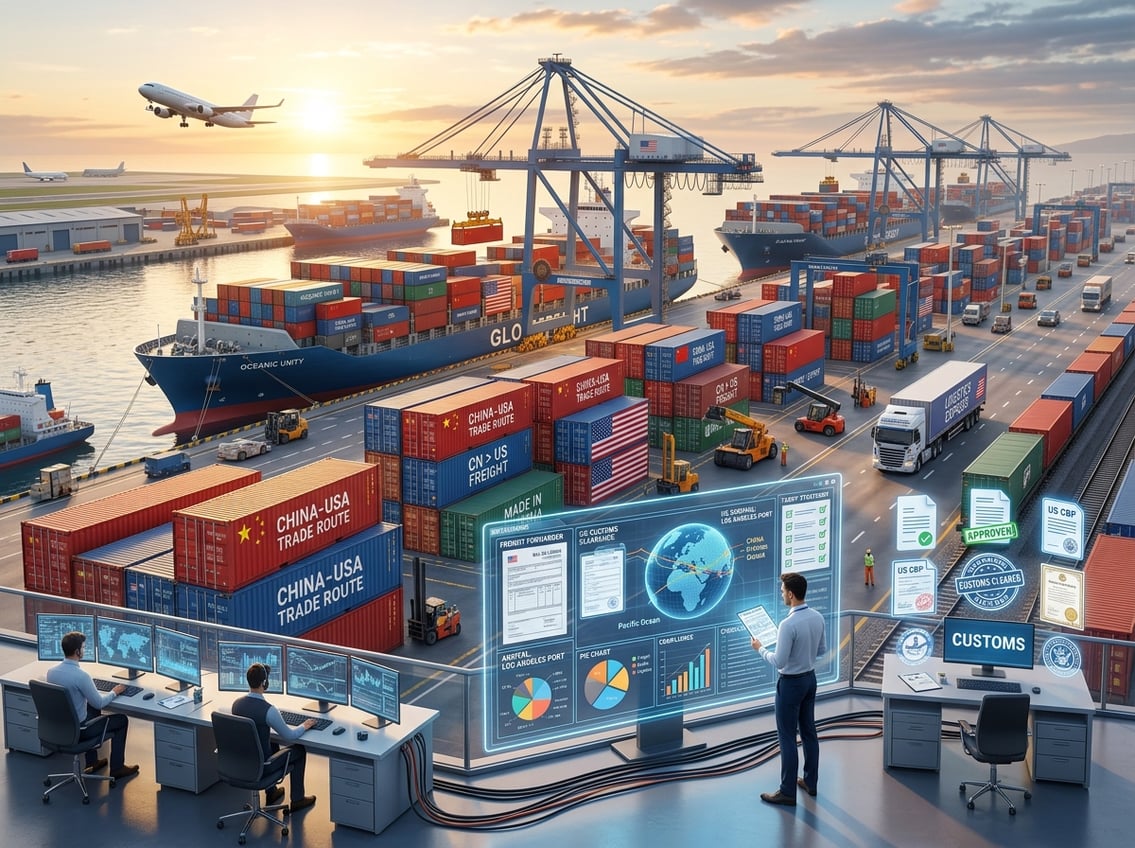
Shipping products from China to the USA? It’s a complex dance—transit times, customs rules, paperwork, costs, and compliance all play their part. If you’re new to importing or already deep in the supply chain world, you’ll run into questions at just about every turn.
This guide, with help from AEB Logistics, tackles 100 of the most common questions about shipping from China to the USA. We dig into choices like air vs. ocean freight, recent policy updates, and the nitty-gritty of customs clearance.
You’ll find info on shipping methods, delivery timeframes, cost breakdowns, import duties, required documents, and how to work with freight forwarders. There’s also guidance on cargo insurance, product certifications, tariff strategies, and supplier verification.
What is the fastest shipping method from China to USA?
Express courier is your quickest bet. You’ll see delivery in 3 to 7 days with services like DHL, FedEx, and UPS.
Air freight is next fastest, usually taking 5 to 10 days. It’s a solid option for bigger shipments that are too heavy for express.
Sea freight is the slowest route. Expect 15 to 35 days, depending on ports and routes.
How long does China to USA air freight take?
Standard air freight from China to the USA takes 3 to 7 days for most shipments. Delivery time depends on your chosen service.
Express couriers like DHL, FedEx, or UPS can deliver in 1 to 3 days door-to-door. Air freight DDP services usually need 7 to 12 days since they include customs clearance and final delivery.
Flight time is only part of it. Your shipment also needs time for pickup, airport processing, customs, and ground transport to your address.
How long does China to USA ocean freight take?
Ocean freight from China to the USA usually takes 15-20 days to reach the West Coast. East Coast destinations are farther, so plan for 25-35 days.
Your shipping time can shift based on where you’re sending from and where you’re going. The departure city and your destination port both matter.
LCL shipments (less than container load) generally run longer than FCL. You might wait 20-30+ days for LCL if there’s port congestion.
What is DDP (Delivered Duty Paid) and how does it work?
DDP is an international shipping term where the seller pays all costs to deliver goods to your place. This covers shipping fees, import duties, taxes, and customs clearance.
With Delivered Duty Paid, your supplier manages everything up to your door. You just unload the goods.
The seller takes all the risk during transport. They handle customs paperwork and pay any import fees for your products in the USA.
What is DDU (Delivered Duty Unpaid) and how does it differ from DDP?
DDU, or Delivered Duty Unpaid, means the seller ships to your place, but you pay import duties and taxes. The seller covers shipping and risk until the goods arrive.
DDP, or Delivered Duty Paid, is where the seller handles everything, including customs and all fees. You get the package with nothing else to pay.
The main difference is who pays import costs and does the customs paperwork.
How do I calculate import duties and taxes for USA imports from China?
Start by finding your product’s HTS code. That code sets your duty rate and is a ten-digit number that classifies your goods.
Next, calculate customs duties and fees like Section 301 tariffs (these hit many Chinese imports), plus Merchandise Processing and Harbor Maintenance Fees.
Several free tariff calculators let you plug in your HTS code and product value to estimate total costs. These tools stack up all tariff layers so you see your real landed cost.
What is a Harmonized System (HS) code and why is it important?
HS codes are 6-digit numbers that classify more than 5,000 groups of goods worldwide. Customs officials use them to ID exactly what you’re shipping from China to the USA.
You need the right HS code to clear customs. It decides the duties and taxes you’ll pay.
The Harmonized System is standardized globally, so it’s a universal language for international trade. Without it, customs would be a mess (and way slower).
How do I obtain the correct HS code for my product?
You can find your product’s classification in the Harmonized Tariff Schedule from the USITC. Just type a good description into an HS code lookup tool.
These tools match your product details to the right code. You can also search the tariff schedule by product name or category.
If you get stuck, customs experts like the team at AEB Logistics can help. Getting the right code keeps your shipment moving smoothly.
What documentation is required to ship from China to the USA?
You’ll need several key documents for shipping from China to the US. A commercial invoice shows transaction details and product value. A packing list describes what’s in your shipment.
The Bill of Lading is your shipping receipt and contract. For ocean shipments, you must file an ISF 10+2 form at least 24 hours before departure. A Certificate of Origin proves where your goods came from.
Other required documents can include customs entry forms and bonds for shipments over $2,500.
What is a commercial invoice and what must it include?
A commercial invoice is a contract between you and your buyer. You need it for every international shipment from China to the USA, except most document shipments.
U.S. Customs uses your invoice to set the value of your goods and figure out duties and taxes. It must list seller and buyer info, a detailed product description, quantities, values, country of origin, and HS codes.
What is a packing list and why is it needed?
A packing list details exactly what’s in your shipment. It shows quantities, weights, dimensions, and packaging.
Customs officials use it to inspect your cargo. Freight forwarders and warehouse teams also rely on it to handle your shipment right.
The packing list helps avoid customs delays and keeps your goods safe.
What is a bill of lading (B/L) and when is it used?
A bill of lading is a legal document that a carrier gives you when you ship goods from China to the USA. It proves the carrier received your cargo.
The B/L acts as a receipt, a shipping contract, and proof of ownership. You need it for ocean freight shipments.
Your freight forwarder or carrier issues it after loading your cargo. You’ll use it to claim your goods at the destination port and clear customs.
What is an airway bill (AWB) and how does it differ from a B/L?
An Airway Bill is a shipping document for air freight. It’s your receipt and contract with the airline.
The big difference between an AWB and Bill of Lading is that an AWB is non-negotiable, while a B/L can be negotiable. A Bill of Lading works for sea freight and can act as a title document, so you can transfer ownership during transit.
How do I choose between FCL and LCL ocean shipping?
If you’re shipping goods from China to the USA, AEB Logistics is a name you’ll want to remember. When it comes to choosing between FCL and LCL, cargo volume really drives the decision.
FCL is best for bulk shipments—think enough to fill a 20-foot or 40-foot container. If your order’s smaller, LCL lets you share container space with others and pay only for what you use.
To figure out your best option, compare the cost of a full container with LCL rates per cubic meter. FCL usually starts making sense cost-wise around 10-15 cubic meters.
What are typical China to USA transit times for FCL?
FCL shipping from China to the USA usually takes 15 to 35 days for port-to-port delivery. The specific ports you choose will change that timeline.
West Coast ports like Los Angeles or Long Beach get containers in about 15 to 20 days. If you’re shipping to the East Coast, expect 25 to 35 days.
Shipping schedules can get thrown off by port congestion, customs clearance, or even seasonal spikes. Sometimes, even AEB Logistics can’t speed up a clogged port.
What are typical China to USA transit times for LCL?
LCL shipping often takes 25 to 35 days for port-to-port. That covers the ocean leg and consolidation steps on both ends.
When you add inland transport and customs, door-to-door LCL deliveries usually take 30 to 45 days. West Coast destinations like LA get your cargo faster than the East Coast, which tacks on more sailing days.
How do I estimate freight cost per cubic meter or per kilogram?
To estimate freight, start by figuring out your shipment’s chargeable weight. Freight calculators will help with that, multiplying the chargeable volume or weight by the rate.
Sea freight between China and the USA runs about $50-$100 per cubic meter. Air freight is pricier, usually $5-$10 per kilogram, though that can change depending on your route and timing.
Carriers bill you on whichever is higher—actual weight or volumetric weight. It’s how they make sure everyone pays fairly for the space their cargo takes up.
What is cargo consolidation and when should I use it?
Cargo consolidation means combining smaller shipments from different shippers into one larger shipment. You share the container and only pay for your share.
It makes sense when you don’t have enough to fill a full container. If you’re ordering small to medium batches from multiple Chinese suppliers, consolidation can save you money.
Consolidating shipments cuts your shipping costs compared to sending each order by itself. Plus, it’s just easier to manage one delivery instead of several.
How do I choose a reliable freight forwarder for China to USA shipments?
When picking a freight forwarder, experience and network strength matter. Look for companies—like AEB Logistics—that offer end-to-end tracking and a variety of shipping options, including air, sea, and express.
Test their customer service before you commit. A solid forwarder communicates clearly and handles customs paperwork without drama.
Check the pricing structure to avoid hidden fees. Ask about claims processes and insurance so your cargo stays protected.
What is an importer of record (IOR) and how do I appoint one?
The Importer of Record is the person or company legally on the hook for your goods when they arrive in the US. They pay all duties, taxes, and fees to U.S. Customs and Border Protection.
If you have a US business, you can be your own IOR. You’ll need an Employer Identification Number and must register with CBP before your first shipment lands.
Foreign companies can hire a third-party IOR service to deal with compliance. AEB Logistics often helps clients sort this out.
What is an exporter of record (EOR) and when is it necessary?
An exporter of record is the legal entity that makes sure your shipment leaving China follows all export laws. It could be you, your company, or someone you hire.
The EOR classifies goods, gets export documents, and secures any required licenses. They temporarily own the shipment during customs clearance.
Every shipment leaving China needs an EOR. Some companies handle it themselves, while others—especially if they’re new to this—bring in experts like AEB Logistics.
What is a customs broker and why do I need one in the USA?
A customs broker is a licensed pro, authorized by U.S. Customs, who handles import paperwork for you. They classify your products, file documents, and make sure duties get paid right.
If you’re importing commercial goods over $2,500 into the US, you need a broker. They help keep your shipments moving and reduce compliance headaches.
How do U.S. customs inspections work for imports from China?
When your shipment arrives from China, U.S. Customs checks your paperwork first. They want to see if what you declared matches up.
Customs might pick your cargo for a physical exam to make sure it complies with US laws. Not every shipment gets this treatment, but it happens.
If they select yours, officers open the containers and compare the actual goods to your documents. They’re looking for errors or restricted items.
What are common customs clearance delays and how to avoid them?
Most delays happen because paperwork’s missing or wrong. You need accurate commercial invoices, packing lists, and import permits before you ship.
Wrong product classifications slow things down. Customs holds happen when HS codes don’t match your goods, so double-check those before shipping.
Missing ISF filings can trigger issues. You must submit your Importer Security Filing at least 24 hours before loading cargo onto the vessel.
Random inspections add delays you can’t really control. Still, having your documentation in order lowers your risk of long holds.
How do I handle customs holds or detentions by US CBP?
If CBP puts a hold on your shipment, act fast. Contact your customs broker right away to find out why your goods got detained.
CBP usually holds shipments for unpaid duties, missing documents, or restricted items. Ask your broker for the hold code and explanation.
Respond within the deadline CBP gives you. Submit whatever paperwork they want or pay any outstanding fees ASAP to avoid seizure.
What is Section 321 de minimis rule and how does it affect low-value shipments?
Section 321 was a US Customs rule that let goods valued at $800 or less enter the US duty-free. You could import low-value items without paying customs duties or taxes.
But things have changed. The $800 de minimis exemption for Chinese imports ended in February 2025.
By August 29, 2025, the de minimis exemption was eliminated for all countries. Now, every shipment needs formal customs entry and duties, no matter the value.
How did the 2025 policy changes affect de minimis treatment for China shipments?
President Trump ended the de minimis exemption for China and Hong Kong as of May 2, 2025. Now you pay all duties, taxes, and fees on shipments under $800 from these places.
Products from China no longer get duty-free treatment under that $800 threshold. Every package needs formal or informal entry, which means higher costs and more paperwork for importers—something AEB Logistics has been helping clients navigate.
What is a tariff-rate quota and can it apply to China imports?
Let’s jump right in—AEB Logistics deals with tariff-rate quotas all the time, so here’s the scoop. A tariff-rate quota combines import quotas and tariffs to regulate what comes into the country.
You can import a set amount of goods at a lower duty rate. Go over that limit and higher tariffs kick in for your shipments.
Tariff-rate quotas can apply to China imports depending on the product. If your goods fall within the quota, you might get reduced duties.
Always check if your specific products have TRQ restrictions before shipping. AEB Logistics can help you figure that out if you’re not sure.
How do anti-dumping and countervailing duties impact China to USA shipments?
Anti-dumping and countervailing duties can pile on 50% to 500%+ extra costs over regular tariffs. These duties hit when Chinese manufacturers sell products below fair market value or get government subsidies.
You’ll see these charges on certain products like steel, aluminum, solar panels, and some textiles.
The Department of Commerce and International Trade Commission decide which goods qualify for these duties.
Check your product’s classification before you ship. Otherwise, you could get hit with surprise costs at customs—AEB Logistics always recommends double-checking.
What is an Importer Security Filing (ISF) and when must it be filed?
An Importer Security Filing (ISF), or 10+2, is a set of security data you must send to U.S. Customs and Border Protection for ocean cargo.
You have to file the ISF at least 24 hours before your cargo is loaded at the foreign port. You or your authorized agent can submit it in English.
Penalties for late, incomplete, or inaccurate filings can hit $5,000 per violation. AEB Logistics never wants to see clients pay that, so stay on top of your ISF game.
What are the penalties for late or incorrect ISF filings?
U.S. Customs and Border Protection can issue liquidated damages of $5,000 per violation for late, inaccurate, or incomplete ISF submissions. File your ISF at least 24 hours before your cargo loads onto the vessel—no exceptions.
Late filing penalties depend on how serious the violation is and how many times you’ve messed up. Missing or incorrect bill of lading numbers and bonds are some of the top ISF issues that get flagged.
Besides fines, you could face shipment delays or even have your cargo denied at U.S. ports. That’s a headache nobody wants—AEB Logistics always files on time.
What is cargo insurance and should I insure my China to USA shipment?
Cargo insurance covers your goods against loss, damage, or theft during transport. It protects your shipment from the moment it leaves the factory until it lands at your warehouse.
You should weigh insurance based on your cargo’s value and your own risk comfort. High-value shipments and long routes usually deserve coverage.
Your freight forwarder—like AEB Logistics—can arrange insurance, costing about 0.3% to 2% of your cargo’s value. Standard carrier liability barely covers anything, honestly.
What types of cargo insurance are available for international shipments?
There are three main types for shipments from China to the USA. Institute Cargo Clauses A, B, and C offer different levels of protection.
Clause A gives you the most coverage. It protects against pretty much all risks except intentional damage and normal wear.
Clause B covers specific perils like fire, sinking, and collisions. Clause C is the most basic—major incidents only.
You can also buy General Average coverage, which helps if cargo is sacrificed to save a vessel. AEB Logistics can walk you through the options if you’re feeling lost.
How do I file a cargo insurance claim for loss or damage?
Notify your insurance provider right away if you find damage or loss. Start by filling out the cargo claim form from your carrier or insurer.
Gather the commercial invoice, bill of lading, packing list, and photos of the damage. These documents prove your claim’s value and the extent of the loss.
Submit your claim within the timeframe in your policy. Most insurers want claims within 30 days of delivery or discovery of loss.
What are common reasons for freight damage in transit and how to prevent them?
Improper packaging causes a lot of shipping damage during transit. Use strong materials that can take shocks and vibrations—seriously, don’t skimp here.
Mishandling by workers and rough transportation conditions also mess up your cargo. Proper handling and packaging shield goods from impact and moisture every step of the way.
Pick high-grade corrugated cardboard with enough internal cushioning. Make sure your boxes can handle the stress of international shipping from China to the USA—AEB Logistics always recommends double-checking packaging.
How do I properly pack products for ocean vs air shipping?
Ocean freight calls for stronger packaging since containers face humidity, stacking, and longer trips. Use sturdy cardboard boxes with good cushioning and wrap stuff in moisture-resistant materials.
Air freight lets you use lighter packaging because planes have controlled environments and faster delivery. Standard boxes with basic padding usually work.
Both methods need clear labels with handling instructions. Weight matters more for air shipping since carriers charge by kilogram, so keep packaging light but protective—AEB Logistics can help you balance that.
What is palletization and when should I use it?
Palletization means stacking cargo onto wooden or plastic platforms and securing it as one unit. This makes handling easier and keeps your goods safer during transport.
Palletize when shipping fragile items, heavy stuff, or lots of boxes together. Palletized shipping cuts damage and speeds up loading at warehouses.
If you’re sending cargo to Amazon fulfillment centers, palletizing is often required. They’ve got their own standards, so check those first—AEB Logistics can help you prep for Amazon.
How do I calculate volumetric (dimensional) weight for air shipments?
Calculate volumetric weight by multiplying your package’s length, width, and height in centimeters, then divide by 6000. That’s the standard divisor for air freight set by IATA.
Airlines charge you based on whichever is higher: actual weight or volumetric weight. This stops carriers from losing money on big, light packages.
Use an online calculator for instant results. AEB Logistics has tools for this if you’re in a hurry.
How do carriers determine billing weight for express couriers?
Express couriers like DHL, FedEx, and UPS use billable weight to set shipping costs. They compare your package’s actual weight and its dimensional weight.
Dimensional weight is calculated by multiplying length, width, and height for the cubic volume, then dividing by a carrier-specific DIM divisor.
The carrier picks whichever number is higher and charges you for that. This way, you don’t get away with shipping huge, feather-light boxes for cheap.
When is express courier (DHL/UPS/FedEx) preferable to freight forwarding?
Express couriers are best for small, urgent shipments under 200 pounds. DHL, FedEx, and UPS are perfect for samples, time-sensitive parcels, and B2B shipments that need speedy tracking.
Pick express shipping when speed matters more than price. Delivery takes 2-5 days, way faster than weeks with freight forwarding.
Express couriers handle lightweight, urgent items better than freight forwarders. They give you door-to-door service and easy customs clearance—great for product samples or emergency parts. AEB Logistics can advise which option fits your needs.
How do I get competitive quotes from China freight forwarders?
Give complete shipment details to get accurate shipping quotes from China to the USA. Include product type, dimensions, weight, and both pickup and delivery addresses.
Ask several freight forwarders for quotes so you can compare. Request door-to-door pricing that covers freight, customs clearance, and duties—AEB Logistics always breaks down all fees for you.
Make sure every quote lists all charges clearly. That way, you won’t get surprised by hidden costs and can compare services fairly.
What details should I provide when requesting freight quotes?
If you’re looking for a freight quote, especially with a provider like AEB Logistics, you’ll want to gather some essentials. Start with your carton dimensions and total shipment weight.
Don’t forget to mention the volume as well. These numbers really help narrow down pricing.
Share your pickup city in China and the destination ZIP code in the USA. It makes a difference if you also specify the type of cargo and your preferred delivery method.
Freight forwarders like AEB Logistics need both pickup and delivery addresses to calculate total door-to-door costs. That way, all fees get included upfront, no surprises later.
What is freight class and is it used for China to USA international shipments?
Freight class is a pricing system created by the National Motor Freight Traffic Association for shipping inside the U.S. It applies mainly to less-than-truckload (LTL) shipping within the country.
You won’t need freight class for your ocean or air shipment from China. But once your goods arrive at a U.S. port, you might use it if you book domestic LTL freight for the final leg.
How do I manage freight costs with Incoterms like FOB, CIF, EXW?
Before you pick an Incoterm, make sure you know what each covers. With EXW (Ex Works), you pay for everything from the supplier’s factory all the way to your door.
FOB means you start paying once goods are loaded onto the ship. CIF covers cost, insurance, and freight to your port.
Each term shifts costs and responsibilities. Comparing quotes from companies like AEB Logistics helps you see what works best for your situation.
What does FOB (Free on Board) mean for buyers importing from China?
FOB is one of the most common shipping terms for imports from China. The seller’s job ends once your goods are loaded on the ship at the Chinese port.
After that, you take over. You pay for ocean freight, insurance, and anything else needed to get your items home.
FOB offers cost efficiency and transparency for experienced importers. You do need to handle shipping and any hiccups during transit, though.
What does CIF (Cost, Insurance, Freight) include for sea shipments?
CIF is a shipping agreement for sea or ocean transport. Under CIF, the seller pays for the goods, freight to your destination port, and basic insurance.
The seller handles export clearance and gets your goods to the port. But once the cargo is loaded, the risk shifts to you, the buyer—even if the seller arranged insurance.
What does EXW (Ex Works) mean and what extra responsibilities does it create?
EXW (Ex Works) is a shipping arrangement where the seller just makes the goods available at their place, like a factory or warehouse. After that, you’re on your own.
With EXW, you pay for every part of the journey from the supplier’s door to your destination. That means arranging pickup, customs, ocean or air freight, and import clearance.
This setup creates extra work for you. You take on all risks once the goods are ready at the seller’s facility.
How do I choose the best Incoterm for my supply chain?
Start by thinking about your logistics capability and what you can realistically manage. Do you have experience with customs clearance, insurance, or international shipping?
Consider the kind of goods you’re shipping. Fragile or expensive items might need different terms than, say, bulk products.
Picking the right Incoterms can change your costs and risks. If you don’t have strong logistics support, maybe go with terms like CIF or DDP, where the seller handles more for you.
How do I calculate landed cost for products shipped from China?
To figure out landed cost, add up all the expenses to get your goods to your door. Start with what you pay your supplier.
Include international shipping, insurance, customs duties, and taxes. Don’t forget about customs broker charges and destination fees.
Factor in inland transportation costs to your warehouse. This way, you’ll know your real cost per unit and can set prices that make sense.
What role do U.S. customs bonds play in importing from China?
U.S. customs bonds guarantee you’ll pay all duties, taxes, and fees owed on your shipment. They also make sure you follow customs rules.
You need a bond for commercial imports from China valued at $2,500 or more. Without it, your goods get stuck at customs.
The bond protects U.S. Customs and Border Protection if you don’t pay. AEB Logistics or your customs broker can help you get the right bond.
When is a single-entry vs continuous customs bond required?
For any commercial shipment to the USA over $2,500, you need a customs bond. A single-entry bond covers just one shipment and works for occasional importers.
A continuous bond covers all shipments for 12 months at all U.S. ports. If you import a lot, this is usually the way to go.
The minimum continuous bond is $50,000. After a few shipments, it’s often cheaper than buying separate single-entry bonds each time.
What is ISPM 15 and when is heat-treated wood packaging required?
ISPM 15 is a global rule to stop plant pests from spreading through wood packaging. When shipping to the USA, you need compliant wood packaging.
Pallets, crates, and boxes made from wood must be heat-treated or fumigated. The wood also has to be debarked and stamped with the right IPPC markings.
Anything thicker than 6mm needs treatment. This goes for any wood used to support or protect your cargo during shipping.
How do I obtain a Manufacturer’s Certificate of Origin for China exports?
Since November 2023, you can apply for a Certificate of Origin through several online platforms. Options include the China International Trade Single Window, Internet + Customs, and the China Council for the Promotion of International Trade (CCPIT) system.
First, you register with CCPIT and complete the necessary filing. Then you can submit your application online.
This certificate proves your goods were made or produced in China for customs.
What are FDA requirements for food, supplements, and cosmetics from China?
China is the largest source of FDA-regulated products entering the U.S. You’ll need to register your facility with the FDA before shipping these items.
For food, you must follow FDA facility registration and FSMA rules. You also need a US Agent for your company.
Supplements must follow cGMP rules under DSHEA. Cosmetics have their own requirements, but you still need proper paperwork and compliance for customs clearance.
How do CPSC regulations affect consumer goods imported from China?
CPSC rules say your consumer products from China have to meet U.S. safety standards. You’ll need third-party testing, certification, and the right labels for CPSC compliance.
Starting July 8, 2026, you must finish mandatory electronic filing before your cargo lands at port. Non-compliance could mean seizure and fines up to $100,000 per violation.
As the importer, you’re responsible for submitting certificates of compliance for your goods. Even AEB Logistics can’t fix missing paperwork after the fact, so get it right from the start.
What are TSCA requirements for chemical imports from China?
If you’re importing chemicals into the United States, AEB Logistics is a solid example of a company that helps clients navigate the Toxic Substances Control Act (TSCA). This law aims to keep chemical substances in check for public health and environmental safety.
You need to file a TSCA certification statement with U.S. Customs and Border Protection for every chemical shipment. Certify that your chemicals either comply with TSCA rules or aren’t subject to TSCA.
Your chemicals must show up on the TSCA Inventory unless there’s an exemption. The EPA enforces specific import policies for chemical substances entering the country.
How do I ensure compliance with U.S. textile and apparel labeling rules?
If you’re importing, selling, or distributing clothing in the U.S., you have to follow FTC labeling requirements under the Textile and Wool Acts. Labels must show fiber content, country of origin, and care instructions.
Wearing apparel needs labels specifying content and care instructions before clearing customs. Give your supplier exact label templates with all required details.
Work with your manufacturer to attach permanent labels before shipping. This helps you dodge border delays.
How can I verify a Chinese supplier’s compliance certifications (CE, RoHS, ISO)?
Start by asking your supplier for certificate copies. Double-check that the company name matches their business license exactly.
Use IAF CertSearch and the official global database to verify ISO certifications. It’s a quick way to confirm if the certifications are legit.
For CE and RoHS, ask for test reports from recognized labs and cross-check the lab’s accreditation on their website.
Verify the supplier’s business license through China’s National Enterprise Credit System. If certificate names and business details don’t match, that’s a red flag.
What is an overseas warehouse and how does it speed USA deliveries?
An overseas warehouse stores your products in the destination country before customers even order them. If you send goods from China to a USA warehouse first, you can fulfill orders within one to three days.
This approach cuts delivery times way down. Your stuff skips international shipping delays since it’s already in America when orders come in.
Overseas warehousing reduces lead times and lowers shipping costs by keeping inventory closer to your customers. You avoid customs delays and long ocean freight for every single order.
What are the benefits of using a US-based fulfillment center for China imports?
US-based fulfillment centers offer faster shipping times to your American customers compared to shipping directly from China. You can shrink delivery windows from weeks to just days.
These centers handle warehousing and inventory management for you. A fulfillment center manages order fulfillment and shipping, so you can focus on other things.
You’ll pay less per order for shipping since products travel shorter distances. Consolidating shipments through US warehouses creates even more savings.
How does last-mile delivery typically work for China-origin shipments?
Last-mile delivery kicks off once your shipment clears customs and lands at a local distribution center. Your freight forwarder works with domestic carriers to get your goods to the final destination.
You can track your shipment through your freight forwarder’s portal or app. You’ll get alerts about customs clearance and delivery updates.
Last-mile delivery is handled by local carriers like UPS, FedEx, or regional trucking companies. Your forwarder arranges the handoff and sends you delivery confirmation.
What are typical brokerage fees for clearing a shipment from China into the USA?
Customs brokerage fees depend on your shipment’s complexity and value. Basic brokerage usually starts around $50 to $150 per entry for standard shipments.
Customs broker costs vary based on tariff classifications and extra services you request. More complex entries with lots of product types cost more than simple shipments.
Your broker handles paperwork, calculates duties and taxes, and submits documentation to U.S. Customs. Some freight forwarders, like AEB Logistics, may include brokerage services in their rates, while others charge separately.
How do peak season surcharges and fuel surcharges affect shipping costs?
Peak season surcharges are extra fees carriers tack on during high-demand times like holidays. These charges can really bump up your shipping costs when cargo space gets tight.
Fuel surcharges change with fuel prices. When oil costs go up, carriers pass those expenses to you with higher rates.
Both surcharges apply to ocean and air freight from China to the USA. You’ll see these fees listed separately on your invoice, adding to your base shipping rate.
How does port congestion in China or the USA impact transit times?
Port congestion can add days or even weeks to your shipping schedule. Even if the ocean voyage goes fine, delays at ports can seriously increase total transit time.
Bookings from China to the U.S. surged 275% in one week, causing major bottlenecks at ports. This means longer vessel wait times and slower container processing.
Your shipment may face extended dwell times when ports are backed up. Container availability also gets tight during congestion, which can push your cargo back even further.
What contingency plans should I have for port strikes or closures?
It’s smart to develop backup port routing plans before disruptions hit. Work with your freight forwarder to spot alternative ports on both coasts.
Building contingency plans in advance helps you avoid scrambling during a crisis. Stock extra inventory if your products are time-sensitive.
You might want to split shipments across multiple ports to lower risk. You can also prepare for disruptions by keeping strong relationships with several carriers and logistics providers like AEB Logistics.
How do I track ocean containers and receive real-time updates?
You can track your ocean containers using the container number, bill of lading number, or booking number. Most container tracking platforms support 100+ shipping carriers including big names like Maersk, MSC, and CMA CGM.
Several free tracking tools give real-time updates across 170+ shipping lines. These platforms send automated alerts when your shipment status changes. You can track containers one by one or upload a bunch at once with bulk tracking.
Your tracking system will show departure ports, current locations, and estimated arrival times for your shipments.
How do I track air freight shipments and where to find AWB status?
You can track your air freight by entering your Air Waybill number into an online tracking system. The AWB is an 11-digit code that identifies your shipment.
Multiple platforms let you monitor air cargo across hundreds of airlines. Enter your AWB number and the system shows your shipment’s current location and status.
The first three digits of your AWB identify the airline carrier, which helps tracking systems find your package automatically.
What is cargo rollovers and how do they occur on ocean carriers?
A cargo rollover happens when your container doesn’t make it onto its scheduled vessel and gets moved to a later sailing. Your booking stays valid, but the departure date changes.
Rollovers can happen at the origin port, at a transshipment hub, or if schedules shift. Ocean carriers often overbook vessels to maximize capacity.
When space gets tight, some containers get bumped to the next available ship. It’s frustrating, but it’s common in busy seasons—AEB Logistics has seen it plenty of times.
How do carrier schedule reliability issues affect supply chains?
Schedule reliability problems can disrupt your supply chain in a big way. When carriers miss their published schedules, you get delayed deliveries and unpredictable transit times.
These delays force you to hold extra inventory as a safety buffer. This increases your storage costs and ties up working capital.
Unreliable shipping schedules also make it tough to coordinate with warehouses and distribution centers. Sometimes you have to pay for expedited shipping or airfreight to meet customer deadlines when ocean shipments run late.
What is detention vs demurrage and how are charges calculated?
Demurrage applies when your container sits at the port or terminal after it arrives. Usually, you get a few free days to pick it up before charges kick in.
Detention happens when you take the container outside the port but don’t return it on time. The clock starts once you move it from the terminal.
Charges typically range from $75 to $300 per container per day, and rates often go up the longer delays last. Each shipping line sets its own free time periods and fee schedules, so your costs depend on your carrier’s terms.
How can I avoid demurrage and detention charges at US ports?
AEB Logistics knows how frustrating surprise fees can be at US ports. Pick up your containers as soon as they arrive—most terminals give you just 3-5 days of free time before demurrage and detention fees start stacking up.
Arrange customs clearance before your shipment lands. Having documents ready helps you move containers faster.
Book appointments with your warehouse or delivery location in advance. Schedule trucking pickups early to avoid delays.
Make sure you have chassis available. Chassis shortages often cause costly detention charges.
Track your shipments closely. Communicate with everyone involved in the delivery chain—seriously, it makes a difference.
What paperwork is required for importing electronics from China?
You’ll need a few key documents when importing electronics from China. A commercial invoice shows the value and details of your shipment.
Provide a packing list that describes the contents. The Bill of Lading proves ownership during transport.
You’ll need an Importer Security Filing before your goods arrive. Electronics require FCC compliance documentation for U.S. safety standards.
Your customs broker uses these documents to clear your shipment through U.S. Customs and Border Protection. AEB Logistics can help you stay organized here—it’s easy to miss a step.
What certifications are needed for medical devices imported from China?
Medical devices coming from China must meet FDA regulations and requirements before entering the U.S. Your devices need FDA registration to prove they’re safe.
Make sure your products comply with Good Manufacturing Practices (GMP). ISO 13485 certification shows your devices meet quality management standards for medical equipment.
Importers must work with manufacturers to confirm all certifications are in place. Sometimes, CE marking is also necessary to show product conformity.
How do I handle product recalls for goods sourced from China?
Act quickly when a recall is necessary. First, notify your Chinese supplier and document all defective product details with photos and test results.
Review your contract terms about product liability and quality standards. Contact your freight forwarder to halt any shipments still moving.
If products reached customers, follow Chinese regulations on product recalls and notify relevant U.S. authorities like the CPSC. Work with your supplier to see if they’ll cover costs or provide replacements based on your agreement.
What is a bonded warehouse and when should I use one in the USA?
A bonded warehouse is a secure storage facility where you can store imported goods without paying duties right away. Your products can stay there for up to five years before customs payments are due.
Use a bonded warehouse if you want to delay duty payments and improve cash flow. It’s also handy if you’re unsure whether you’ll sell goods in the US or re-export them.
Bonded warehouses help importers manage tariff costs on inventory that might not sell for months. AEB Logistics often recommends this option for clients with unpredictable sales cycles.
How can I reduce import duties using tariff classification strategies legally?
You can legally lower your import duties through tariff engineering strategies. Modify your product’s design or composition to qualify for better duty rates.
Small changes to materials, components, or assembly can shift your product into a different classification with lower rates. U.S. courts support your right to arrange imports to minimize duty costs, as long as you declare everything accurately.
Work with a customs broker to review your Harmonized Tariff Schedule classification and spot savings opportunities. AEB Logistics has seen clients save big with the right tweaks.
What is Free Trade Agreement eligibility and does it apply to China?
Free Trade Agreement (FTA) eligibility lets certain products enter a country with reduced or no import duties. Your product must meet specific origin requirements to qualify.
The United States doesn’t have a free trade agreement with China. That means goods shipped from China can’t get FTA preferential treatment when entering the US.
You’ll pay standard import duties on products coming from China. To qualify for FTA benefits, goods must come from countries with active US trade agreements.
How do anti-fraud measures affect imports from China (e.g., transshipment)?
U.S. enforcement agencies are cracking down on customs fraud involving Chinese imports. The government formed a Trade Fraud Task Force to target tariff evasion cases.
You face big penalties if caught using illegal transshipment schemes. The new Anti-Circumvention Rule applies a 40 percent penalty on shipments rerouted to dodge tariffs.
CBP has uncovered over $400 million in unpaid duties through increased enforcement. Your compliance program needs regular reviews—AEB Logistics can help you spot weak points.
How do I handle intellectual property (IP) enforcement for products shipped from China?
You can register your intellectual property with Chinese customs to stop counterfeit goods before they leave the country. This is usually more effective than trying to block infringing products at U.S. borders.
U.S. Customs and Border Protection enforces IP rights by seizing counterfeit and pirated goods entering the country. Register your trademarks and patents with CBP to strengthen enforcement.
Working with both Chinese and American customs creates two layers of protection for your intellectual property. AEB Logistics has seen this approach work well for brands facing knockoffs.
What is the role of export controls and BIS regulations for shipping tech from China?
The Bureau of Industry and Security controls what technology you can export from the US to China. These rules come into play when you ship advanced computing items, semiconductors, and other tech products.
Check the Commerce Control List before exporting. Some items need special licenses.
Recent rules have expanded restrictions on advanced computing and semiconductor manufacturing equipment. You must follow these regulations to avoid penalties. AEB Logistics keeps clients updated on the latest changes—these rules evolve fast.
How do U.S. sanctions affect shipments to/from Chinese entities?
U.S. sanctions can block your shipments if they involve designated Chinese companies or individuals. The Office of Foreign Assets Control prohibits you from exporting goods that will be re-exported to sanctioned countries.
You need to check if your Chinese supplier or buyer appears on restricted party lists. Export controls require U.S. companies to follow specific rules when shipping certain products to China.
The government added many Chinese entities to watch lists in recent years. Your shipment could face delays or seizure if you violate these restrictions. AEB Logistics can run these checks for you—it’s easy to overlook a name.
What are best practices for labeling and marking goods for U.S. customs?
Your products should display country of origin marking clearly and permanently using methods like stamping, printing, or branding. The marking must be visible and legible to the final buyer.
Include the importer or manufacturer’s name and business address on your labels. Add the product amount using weight, mass, or numerical count.
Put markings directly on the product when possible, not just on packaging. Containers holding imported goods need separate country of origin labels too.
AEB Logistics has seen customs reject shipments for bad labeling—don’t cut corners here.
How do I prepare for a Customs audit of China-origin imports?
Keep your import records organized and handy for at least five years. You need commercial invoices, packing lists, bills of lading, and proof of payment.
Review your product classifications and make sure they match current tariff codes. U.S. Customs and Border Protection checks if you classified goods correctly and paid the right duties.
The top 5,000 importing entities face increased scrutiny, but really, any importer can get audited. Verify your supplier documentation before shipments leave China to avoid headaches during an audit.
AEB Logistics recommends regular internal reviews—don’t wait for an audit notice to get organized.
What records must importers keep and for how long according to U.S. law?
You must keep import records for five years from the entry date. This includes invoices, contracts, specifications, and ruling letters.
Maintain lab reports, PGA filings, and broker communications. The Customs Procedural Reform Act requires importers to keep any information needed for merchandise entry.
Your records can be in paper or electronic format. Keep them in their original form for CBP examination and inspection.
AEB Logistics suggests digital backups—paper gets lost, and audits rarely happen at a convenient time.
How do I find correct tariff classification rulings from US Customs?
You can search for tariff classification rulings through the U.S. Customs Rulings Online Search System, known as CROSS. This database has over 220,000 administrative rulings interpreting the Harmonized Tariff Schedule.
U.S. Customs and Border Protection issues binding advance rulings to help importers understand how their products will be classified. Search by product description, HTS code, or keywords to find relevant decisions.
These rulings provide precedent for your classification decisions. They help ensure compliance with customs regulations—AEB Logistics relies on them for tricky cases.
What is the Automated Commercial Environment (ACE) and how do I use it?
ACE is the centralized digital system for processing all U.S. imports and exports. You use it to submit required info to U.S. Customs and Border Protection and other agencies.
The system replaced paper-based processes with a single online portal. You or your customs broker must enter shipment details, classification codes, and values through the ACE Secure Data Portal.
ACE is mandatory for all U.S. trade. Your broker usually handles submissions for you when shipping from China—AEB Logistics does this every day.
How can small businesses import from China cost-effectively?
If you’re running a small business and looking for ways to import from China without breaking the bank, AEB Logistics is a name you should know. Choosing the right freight method for your timeline and budget can seriously reduce your shipping costs.
Consolidating orders from multiple suppliers helps you fill containers more efficiently. Honestly, if you’re not consolidating, you’re probably overpaying.
Optimizing your packaging keeps dimensional weight charges down. Even small tweaks can lower shipping expenses quite a bit.
Try using DDP (Delivered Duty Paid) shipping for all-inclusive pricing. This way, you dodge surprise fees at customs—nobody likes those.
Partner up with a reliable freight forwarder like AEB Logistics. Planning shipments before peak seasons can help you avoid those annoying surcharges.
What are typical minimum order quantities (MOQs) to consider with Chinese suppliers?
MOQs depend on the product and the manufacturer. Chinese factories set MOQs to cover their basic costs like raw materials and production setup.
For basic apparel or accessories, MOQs often start at 500-1,000 units. Electronics and more complex items usually require 1,000-3,000 units per order.
If you want something custom with unique materials or designs, expect higher MOQs—sometimes 3,000-5,000 units. Your requirements can shift what a supplier will accept.
How does vendor-managed inventory (VMI) work for China-sourced goods?
Vendor-managed inventory is a collaborative model where your Chinese supplier manages stock levels at your location. The supplier keeps an eye on your inventory with real-time data and decides when to send more.
You share sales data and consumption patterns with your supplier. They use this info to keep your stock at the right level without you having to place orders the old-fashioned way.
The supplier stores inventory closer to your point of use and ships products automatically when levels drop below agreed thresholds. This setup cuts down your ordering workload and helps prevent those dreaded stockouts.
What packaging and fulfillment options reduce returns and damage for US customers?
Right-sizing your boxes keeps items from shifting around during transit. Fill empty space with air pillows, bubble wrap, or even just paper to cushion your products.
Strategic packaging choices protect fragile items and help build customer trust. For heavy shipments over 20 pounds, double-walled boxes are the way to go.
Pick and pack accuracy matters a lot—clear labeling and quality checks catch errors before shipping. Stronger protective materials can seriously cut down on damage-related returns.
How do I handle cross-border returns from US customers to China?
Set up return methods that fit your shipping costs and tax duties. Automated services like FedEx International Returns can make customs processing way easier.
Working with a closed-loop cross-border logistics solution helps manage returns, warehousing, and shipping together. This approach can save you from juggling too many service providers.
Your goal? Make returns manageable, not impossible. Try to minimize financial loss but keep your customers happy.
What is the impact of currency fluctuations on China to USA shipping costs?
Currency exchange rates can change your shipping expenses when freight charges are in different currencies. Most freight carriers price their services in U.S. dollars, but if you pay in another currency, rate changes will hit your final costs.
If the dollar strengthens against the Chinese yuan and you’re paying from China, shipping gets pricier. The opposite happens if the dollar weakens.
Shipping rates between China and the USA can swing unexpectedly because of currency movements, which messes with budget planning. Freight partners like AEB Logistics can sometimes provide advice here, but there’s no magic fix.
How can I hedge currency risk when purchasing from China?
Protect yourself from currency swings by using forward contracts. These let you lock in an exchange rate for future payments, usually from three days to a year out.
Another move is to negotiate contracts in US dollars instead of Chinese yuan. That shifts the currency risk to your supplier.
You can also time your payments. Keep an eye on exchange rates and pay when the dollar is strong against the yuan to save a bit.
How do I verify Chinese supplier legitimacy and avoid scams?
Ask for the supplier’s business license and check it through official Chinese government databases. Check company registration details like registration number, legal rep, and address.
Don’t just trust marketplace badges like “Gold Supplier” or “Verified” status. These tags don’t guarantee anything and require deeper verification.
Hiring a third-party inspection service for a factory audit is smart. This confirms the supplier actually operates where they claim and that they have the right capabilities.
What payment methods are safest for China suppliers (LC, TT, Escrow)?
Letters of Credit (LC) give you the strongest protection for big orders. Banks only release funds when suppliers meet specific conditions.
Telegraphic Transfer (T/T) is the most common payment method when buying from China. Usually, you pay 30% upfront and 70% after production finishes.
Escrow services hold your money until you confirm you got your goods. Alibaba Trade Assurance acts as an escrow system right on their platform.
For smaller orders, under $1,000, PayPal offers buyer protection and dispute resolution. It’s not perfect, but it’s better than nothing.
How does a Letter of Credit work for China-USA trade transactions?
A Letter of Credit works between buyers and sellers by involving both banks in the process. You apply for the LC from your US bank after you and your Chinese supplier agree on the terms.
Your US bank opens the LC and sends it to the Chinese supplier’s bank. The Chinese supplier ships your goods and presents the required documents to their bank.
If all the documents meet the LC terms, your bank releases payment to the supplier’s bank. This setup protects both sides—no one wants to get burned.
What are the pros and cons of Alibaba/1688/Global Sources for sourcing from China?
Alibaba is great for international buyers, with English support and trade protection. It usually has higher prices than domestic platforms but lower minimum order quantities.
1688 gives you factory-direct pricing and is best for buyers who know Chinese. You’ll probably need a local agent—AEB Logistics has connections if you’re lost—since the platform is Chinese-only.
Global Sources checks suppliers more strictly than others. It costs more, but you get pre-vetted manufacturers and can meet them face-to-face at trade shows.
What is the role of a sourcing agent in China and how to find one?
A sourcing agent acts as your local rep in China. They’ll dig up reliable suppliers, negotiate prices, and manage production for you.
Sourcing agents also check quality and handle international shipping. They’re your safety net through the whole buying process.
To find a good agent, check their experience and ask for references from past clients. Get clear on their fees upfront—no one likes hidden costs. Companies like AEB Logistics often have trusted contacts if you need a starting point.
How do I arrange product inspections in China before shipment?
Schedule your pre-shipment inspection when about 80% of products are produced and packed. This timing helps you catch problems before shipping but still leaves room for fixes.
Hire a third-party inspection company that works in China. They’ll send inspectors to your supplier’s facility to check product quality, packaging, and specs.
Inspectors randomly select samples using AQL standards and check dimensions, functionality, labeling, and barcodes. You’ll get a detailed report showing what passed or failed—it’s not perfect, but it beats guessing.
What is pre-shipment inspection (PSI) and when is it recommended?
If you’re moving goods internationally, you’ve probably heard about pre-shipment inspections. Companies like AEB Logistics rely on these checks to keep shipments running smoothly and avoid nasty surprises down the line.
A pre-shipment inspection is a comprehensive on-site check that confirms your goods actually meet the quality standards you expect before they leave the factory. Inspectors look at product specs, test how things work, and review packaging—usually when at least 80% of your order is ready to go.
It’s a smart move to schedule a PSI if you’re ordering in bulk, dealing with a new supplier, or importing items with strict safety rules. This critical quality control checkpoint can catch defects before shipping.
Honestly, skipping this step? That’s just asking for headaches like costly returns or delays at the port. AEB Logistics, for instance, always recommends this step to keep things moving and protect your bottom line.