
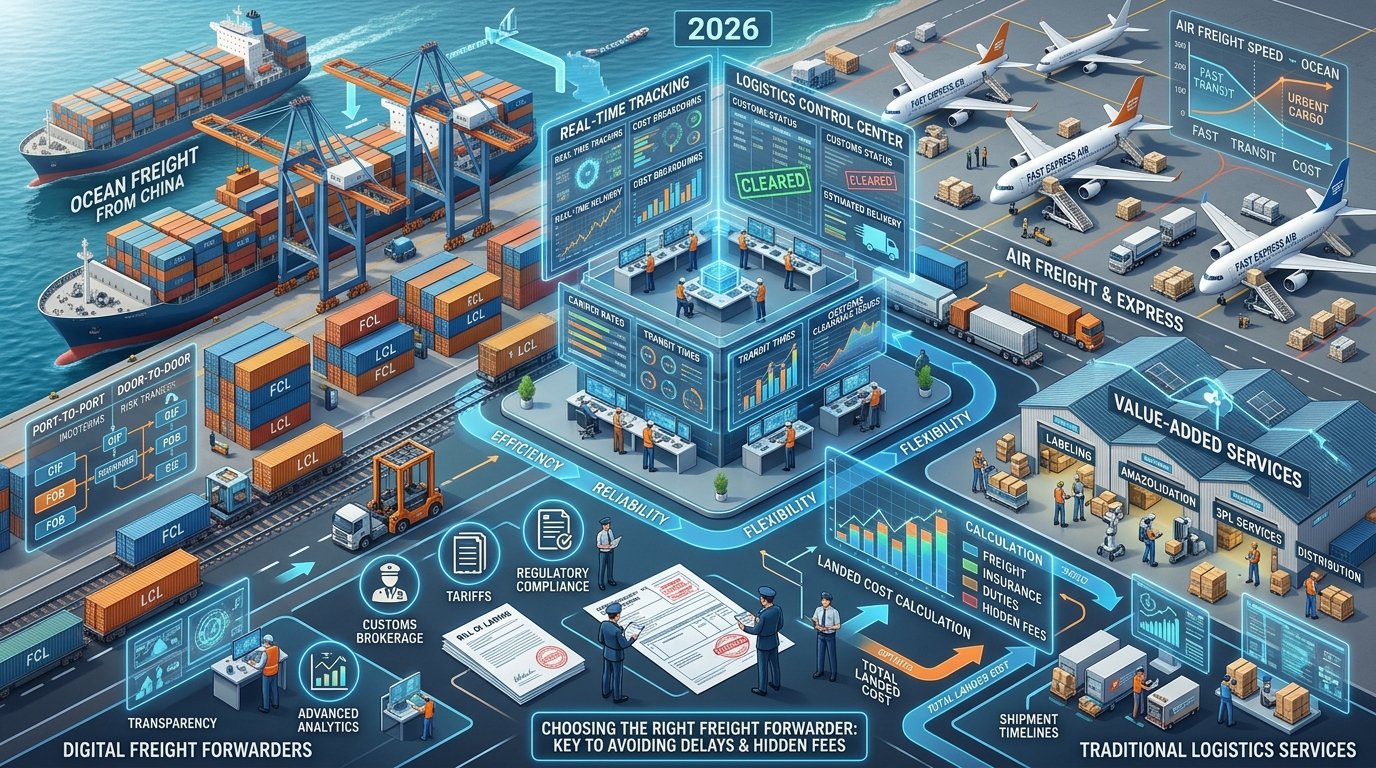
Picking the right freight forwarder for your China to USA shipments shapes every part of your import operation. The wrong partner can pile up hidden costs, cause customs delays, and create delivery headaches that drag down your business.
But the right one? They help you move goods smoothly while keeping total landed costs in check.
Importers shipping from China in 2026 need freight forwarders who offer clear pricing, reliable customs clearance, strong carrier relationships, and flexible service options that match their specific cargo needs.
China to USA freight forwarders now compete on four main areas: ocean and air shipping quality, warehousing and distribution support, FBA and eCommerce logistics, and customs brokerage strength.
This guide compares freight forwarders by service type, shipping mode, cost transparency, and total value. Whether you ship full containers or just a few parcels, understanding these differences helps you pick a partner that fits your budget and timeline.
Key Takeaways
- Freight forwarders differ in service scope, with some offering basic transport while others provide warehousing, FBA prep, and customs support.
- Ocean freight costs less but takes longer than air shipping, and understanding shipping modes helps you balance speed with budget.
- Strong customs clearance and transparent pricing prevent delays and unexpected fees that increase your total landed cost.
Freight Forwarder Service Types and Choosing the Right Partner
The freight forwarding industry has split into two main camps with different service models and technology approaches. DDP, CIF, and FOB terms decide who pays what and when, while marketplace platforms give you alternatives to old-school booking methods.
Traditional vs. Digital Freight Forwarders
A traditional forwarder usually works through phone calls and emails. You might wait 24 to 48 hours for quotes and communicate with account managers during business hours.
Digital forwarders use online platforms and apps to give instant quotes and real-time tracking. Companies like Freightos offer price and service comparison tools so you can check multiple forwarders at once.
These platforms often automate documentation and give you 24/7 access to shipment status. Traditional forwarders bring more personalized service and expertise for tricky shipments.
Digital options usually provide better pricing transparency and faster responses. Your pick depends on whether you want hands-on support or prefer speed and tech-driven efficiency.
DDP, CIF, and FOB Shipping Explained
FOB (Free on Board) means your supplier’s job ends when the goods are loaded on the vessel. You take care of ocean freight, customs, and delivery to your warehouse.
CIF (Cost, Insurance, and Freight) covers transportation to the US port, but you still pay import duties and inland delivery. Using CIF terms can create scenarios where importers face inflated costs they didn’t see coming.
DDP (Delivered Duty Paid) includes all costs through final delivery. The forwarder manages customs clearance, duties, and transportation to your door.
DDP shipping removes uncertainty from total landed costs and makes budgeting simpler for importers.
Amazon Global Logistics and Marketplace Platforms
Amazon Global Logistics offers shipping for sellers who use Fulfillment by Amazon. The platform links with your seller account and sends shipments straight to Amazon warehouses.
Other marketplace platforms connect you with multiple forwarders through one interface. You can compare rates, book shipments, and track cargo without juggling a bunch of separate contacts.
These platforms work best for standard shipments with simple requirements. They might not handle specialized cargo or provide the custom service that complex imports need.
Shipping Modes and Delivery Options
China to USA freight forwarders offer three main shipping modes that balance cost against speed. Ocean freight delivers the lowest per-unit cost for large shipments.
Air freight cuts transit time to days for urgent cargo, and express couriers handle small parcels door-to-door.
Ocean Freight: FCL and LCL Models
Sea freight dominates shipping from China because it moves heavy and bulky cargo at the lowest cost per kilogram. You choose between Full Container Load (FCL) and Less than Container Load (LCL).
FCL means you rent an entire container. A 20ft container usually fits 28–33 cubic meters, while a 40ft high-cube container holds 60–68 cubic meters.
Trans-Pacific FCL rates in July 2026 range from $5,400 to $6,600 for a 20GP and $6,075 to $7,425 for a 40HQ. Transit time averages 14–22 days to major West Coast and East Coast ports.
LCL works when your cargo doesn’t fill a full container. The forwarder combines your shipment with other importers’ goods and charges by cubic meter.
July 2026 LCL rates sit at $130 per cubic meter with 10–17 day transit times. LCL adds time since your cargo waits for consolidation at origin and deconsolidation at destination.
Many forwarders offer DDP sea service that includes ocean freight, customs clearance, import duties, and final delivery to your warehouse or Amazon fulfillment center.
Air Freight and Express Courier Solutions
Air freight slashes ocean’s 14–22 days down to 2–3 days for direct flights. Rates in July 2026 average $7.40 per kilogram for shipments over 1,000 kg to Los Angeles, New York, and Miami.
Air makes sense for high-value electronics, fashion with tight seasonal windows, or restocking inventory fast. Express courier services from DHL, UPS, and FedEx handle parcels and small shipments up to 300 kg.
Express rates in July 2026 run $17.11 per kilogram with 2–4 day delivery. Couriers manage customs clearance and deliver right to your door, keeping logistics simple for small batches and samples.
DDP air packages combine air freight with customs duties, clearance, and ground delivery. Some forwarders even handle Amazon appointment scheduling and delivery to FBA warehouses.
Express and DDP air cost more per kilogram than ocean but save weeks of inventory holding cost.
Door-to-Door vs. Port-to-Port Delivery
Port-to-port service means the forwarder moves your cargo from a Chinese port to a US port. You arrange pickup in China and final delivery in the US separately.
This option costs less but forces you to coordinate trucking, customs broker, and warehouse delivery. Door-to-door delivery covers everything from your supplier’s factory in China to your US warehouse or Amazon fulfillment center.
The forwarder handles export clearance, ocean or air transport, US customs, and ground delivery. Door-to-door pricing wraps all these steps into one quote.
Most SMB importers go for door-to-door because it cuts down on hassle. You get one point of contact and one invoice instead of juggling multiple vendors.
Door-to-door forwarders can also handle transloading and distribution if you need to split a container across several locations.
Cost Structure, Transparency, and Freight Rates
Freight rates between China and the USA vary a lot based on shipping mode, timing, and how forwarders build their quotes. Knowing chargeable weight calculations, surcharges, and destination charges helps you compare quotes and dodge those surprise costs that can blow up your total landed cost.
Understanding Freight Quotes and Hidden Charges
When you ask for a freight quote from a China to USA forwarder, the base rate rarely tells the whole story. Your actual cost includes several line items that some forwarders hide in fine print or only mention after booking.
Chargeable weight sets air freight costs. Carriers bill you based on either the actual weight or volumetric weight (length × width × height ÷ 6000 for air), whichever is higher.
A lightweight but bulky shipment can cost more than you expect if you only look at the actual weight. Ocean freight quotes should say if rates are per container (FCL) or per cubic meter (LCL).
Beyond the base ocean freight rate, common extra charges include:
- Terminal handling charges at origin and destination ports
- Documentation fees for bills of lading and customs paperwork
- Demurrage penalties if you don’t pick up containers within the free time window
- Destination charges including port fees, chassis usage, and delivery orders
Ask for an all-in quote that includes your carton count and packing list details. The most transparent forwarders give you itemized breakdowns.
Platforms like Freightos let you stack up multiple quotes side-by-side and spot the differences.
Freight Rates, Surcharges, and Peak Season Fees
Current freight rates from China to USA bounce around based on carrier capacity, fuel costs, and demand cycles. In 2026, ocean FCL rates range from $1,650 to $2,300 for a 20-foot container to Los Angeles, while air freight costs $4.20 to $6.50 per kilogram.
Surcharges can add a lot beyond base rates:
| Surcharge Type | Typical Range | When Applied |
|---|---|---|
| Fuel surcharge (BAF) | 10-25% of base rate | All shipments |
| Peak season surcharges | $500-$1,500 per container | July-October, pre-holidays |
| Security fees | $25-$50 | All air and ocean |
| Container imbalance | $200-$600 | When equipment scarce |
Peak season surcharges hit hardest during Chinese New Year (January–February) and the pre-Christmas rush (September–November).
Forwarders with carrier contracts usually snag better rates than those booking spot market capacity. Ask your forwarder how they handle surcharges—some eat minor changes, others pass every fee on right away.
Calculating Landed and Total Landed Cost
Your landed cost covers freight, customs duties, and delivery to your warehouse. Total landed cost adds insurance, compliance fees, and carrying costs, giving you the real per-unit expense.
To calculate landed cost accurately, you’ll need:
- Freight quote (all-in, including destination charges)
- Customs duties based on HS code classification
- Importer Security Filing (ISF) fees ($50-$100)
- Customs clearance fees ($100-$250)
- Inland delivery from port to final destination
- Insurance (typically 0.3-0.5% of cargo value)
Many forwarders now have landed cost calculators that include order protection and duty estimates. When you’re comparing forwarders, always look at the total delivered cost per unit, not just the ocean or air rate.
Request quotes using the same packing list details so you’re comparing apples to apples. Sometimes a forwarder with a low ocean rate ends up costing more once you see their destination charges—transparent all-in pricing is usually easier to manage.
Customs Clearance, Documentation, and Compliance
Your freight forwarder’s customs skills can make or break your timeline. The right partner handles brokerage, keeps up with regulations, and checks your paperwork before your goods hit U.S. ports.
U.S. Customs Clearance Processes
U.S. customs clearance means your freight forwarder works with a licensed customs broker who files entry documents for you. Your forwarder should have either in-house brokers or strong partnerships with third-party brokers who know the latest rules.
The clearance process starts when your shipment gets to a U.S. port. Your customs broker files CBP Form 3461 for immediate delivery and Form 7501 to calculate duties and fees. They’ll also check that your Importer Security Filing (ISF) was submitted at least 24 hours before the vessel left for ocean freight.
Top forwarders use tech that connects their systems straight to U.S. Customs and Border Protection databases. This setup lets you track clearance status in real time and respond quickly to any holds or inspections. Ask your forwarder how fast they handle CBP questions and if you’ll get dedicated broker support.
Key Import Documents and Requirements
Every commercial shipment from China now needs formal entry documentation, no matter the value. All imports from China must include proper customs documentation like a commercial invoice, packing list, and bill of lading or air waybill.
Your commercial invoice has to show accurate product descriptions, correct 10-digit HTS codes, true transaction values, and manufacturer details—all in English. If the description is vague or the HS code is wrong, you’ll probably get an automatic hold or extra inspection.
Essential documents your forwarder should manage:
- Commercial invoice with HTS codes
- Detailed packing list with weights and dimensions
- Bill of lading (ocean) or air waybill
- ISF filing for ocean shipments
- Certificates of origin for preferential duty rates
- FDA, FCC, or other agency permits for regulated products
Your forwarder needs to double-check that all documents match. Even a small mismatch between your invoice and packing list can hold up clearance for weeks.
Tariffs, Duties, and Regulatory Changes
Section 301 tariffs are still in effect for many Chinese goods in 2026, adding 7.5% to 25% in extra duties on top of standard rates. Your freight forwarder should explain which products face these tariffs and help you look into options like tariff engineering or verifying country of origin.
The de minimis exemption for duty-free entry under $800 no longer applies to commercial imports from China. Now you pay full duties and fees on every shipment, no matter the value.
Your forwarder’s understanding of Incoterms changes who’s responsible for customs. With DDP (Delivered Duty Paid), your forwarder handles all customs clearance and pays duties for you. With DDU or FOB, you keep more control but take on more compliance risk.
Work with forwarders who actually monitor USTR announcements and regulatory updates. They should let you know about tariff changes, new labeling rules, or compliance deadlines that might affect your products before your shipments leave China.
Value-Added Services and Post-Arrival Handling
What happens after your container arrives can make or break your landed cost. Warehousing gives you breathing room when delivery timing shifts. Consolidation helps cut per-unit costs if you buy from multiple suppliers. Amazon FBA logistics keeps things from falling apart between customs and final delivery.
Warehousing, Consolidation, and 3PL
Your freight forwarder’s warehousing matters when you need temporary storage, cargo sorting, or inventory staging before final distribution. Many importers now want buffer storage because retail schedules and marketplace allocations change after the shipment lands.
A 3PL partner can handle relabeling, carton count checks, and quality inspections so you don’t get stuck with damaged or miscounted goods.
Consolidation helps when you buy from different suppliers in different Chinese cities. Instead of paying for multiple ocean shipments, your forwarder can combine everything at a warehouse in Guangzhou or Shenzhen, then load one container. You’ll save on shipping and only have to clear customs once.
It’s better if your forwarder runs their own warehouses instead of only using third-party facilities. Direct control usually means faster turnaround and fewer mistakes.
Transloading and Distribution
Transloading moves your cargo from the container into a truck or smaller format for final delivery. This is handy if your goods need to reach several U.S. destinations.
Your forwarder gets the container at the port, breaks down the cargo, and arranges delivery to regional warehouses or retail spots.
Some China to USA freight forwarders offer cross-docking, skipping storage and sending goods straight to delivery trucks. It’s quick, but timing between customs release and truck availability has to be spot on.
Distribution support matters if you sell through different channels. Your forwarder can split a single container into shipments for Amazon, your own warehouse, and direct-to-retailer deliveries.
Amazon FBA Support and Appointment Handling
FBA logistics needs tight coordination between customs, warehouse prep, and Amazon appointments. Mess up carton labeling, shipment quantity, or delivery timing, and Amazon might refuse the shipment or hit you with storage penalties.
Your freight forwarder should manage everything from customs release to final Amazon delivery. That means checking carton counts against Amazon’s rules, applying the right FBA labels, and booking delivery appointments at the correct fulfillment center.
Choose a forwarder that really knows FBA. They get Amazon’s strict standards and can handle prep like polybagging, bundling, and FNSKU labeling before your goods reach the fulfillment center.
Frequently Asked Questions
Picking the right freight forwarder means knowing where they operate, which shipping methods fit your needs, what services they cover, how to spot hidden fees, what drives your landed cost, and which compliance steps keep things moving.
How do I choose between a China-based forwarder and a US-based forwarder for imports into the United States?
A China-based forwarder often gives you better rates on origin services like factory pickup, warehouse consolidation, and export documents. They’re on the ground with your suppliers and usually have better carrier relationships for the first leg.
US-based forwarders shine at destination services. They handle customs, talk directly to CBP, manage trucking, and sort out delivery issues in your time zone. If you need a lot of help with the last mile or complex compliance, a US partner makes things simpler.
A lot of SMB importers now choose China-based forwarders who offer door-to-door service with US partners or branch offices. This hybrid model gives you origin savings and destination expertise—one contact, one invoice.
The best fit depends on where you need the most support. If you ship regularly and want to cut per-unit costs, a China-based forwarder with solid US clearance skills is a good bet. If you ship now and then or need hands-on help with FDA, EPA, or agency rules, a US-based partner might be worth the extra cost.
Which shipping mode should I use for my product—air, ocean (FCL/LCL), rail, or express—and how does that choice change timelines and risk?
Ocean freight works for big volumes and lower-value goods when you can wait 20 to 40 days. FCL (full container load) is best if you have at least 15 cubic meters, since you pay for the whole container. LCL (less than container load) lets you share space with others if your volume is smaller, though transit times can stretch by a few days because of extra handling.
Air freight costs three to five times more than ocean but gets your goods there in 7 to 12 days door-to-door. It’s worth it for high-value or time-sensitive products, or if you need to restock quickly. There’s usually less risk of damage than by sea, and you don’t tie up as much capital in transit.
Express (DHL, FedEx, UPS) delivers in 3 to 7 days but charges the most. It’s great for samples, urgent replacements, small test orders under 100 kg, and really high-value products. Since the de minimis exemption ended in May 2025, all shipments now need formal customs entry, no matter the value.
Rail freight between China and the US is still rare compared to the China-Europe rail network. Most importers pick between ocean and air based on how much capital they can tie up and how quickly they need inventory to turn into sales.
What services should a reliable partner handle end-to-end, including pickup, consolidation, export clearance, customs entry, and final-mile delivery?
Your forwarder should arrange pickup from the factory or supplier. They’ll transport your cargo to a consolidation warehouse near the port of departure.
At the warehouse, they inspect shipments and check quantities against your packing lists. If you’ve got multiple purchase orders, they’ll combine them into one container or air shipment to help lower your per-unit costs.
For export clearance, your forwarder files the right documentation with Chinese customs. This means commercial invoices, packing lists, and any certificates or permits you might need.
They’ll coordinate with the carrier to book space, making sure your cargo actually gets on the vessel or aircraft when it’s supposed to. Timing matters, and a good forwarder knows it.
US customs entry is where things often get held up. Your forwarder should file the Importer Security Filing (ISF) at least 24 hours before your ocean cargo loads at the origin port.
They’ll submit entry documents to CBP, pay duties and fees for you if you’re using DDP terms, and handle any customs questions or inspection requests that pop up.
For final-mile delivery, your forwarder takes care of moving cargo from the destination port to your warehouse, fulfillment center, or store. A complete door-to-door service covers tracking updates, delivery appointments, and even liftgate or inside delivery if you ask for it.
Some forwarders go further and offer warehousing, order fulfillment, returns management, and cargo insurance. When they handle more services directly instead of passing things off to subcontractors, you usually get better quality and faster problem-solving.
Ask for “all-in door-to-door” rates that cover every fee from your supplier’s location to your US warehouse. This pushes forwarders to show all origin charges—like inland trucking, customs brokerage, terminal handling, and documentation fees—right from the start.
Ocean freight quotes should spell out if they include chassis fees, fuel surcharges, port congestion charges, and container cleaning deposits. Check if destination handling covers both terminal and warehouse operations.
Demurrage charges kick in if you leave cargo at the port terminal past the free period, usually three to five days. Detention fees add up if you keep the carrier’s container or chassis beyond the allowed window.
Air freight quotes should break down the per-kilogram rate, plus security screening fees, fuel surcharges, and any special handling fees for batteries or oversized packages. Comparing shipping rates accurately means you need to give the exact weight, size, and commodity details for each shipment.
Documentation fees can really vary. Some forwarders include basic bill of lading and commercial invoice prep in their base rate, while others charge separately for every document or compliance filing.
Ask for a detailed fee schedule in writing before you make any decisions. And don’t forget about minimum charges per shipment.
A low per-kilogram rate doesn’t mean much if there’s a $500 minimum that makes small shipments a bad deal.