
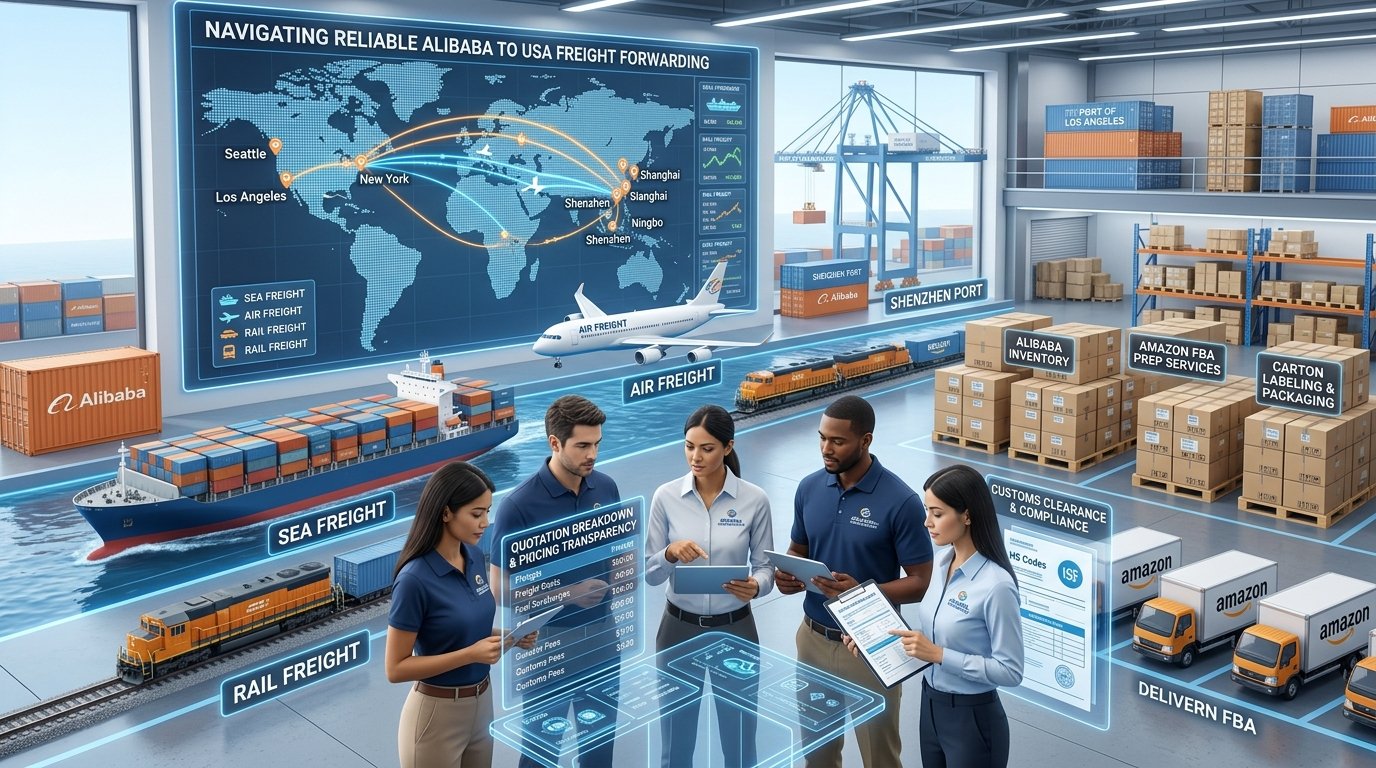
Importing from Alibaba to the United States means you need a freight forwarder who manages international shipping, clears customs, and delivers on time. Many small and medium businesses get stuck because pricing is murky and communication falls apart when it matters most.
The right China to USA freight forwarder should offer transparent costs, strong customs clearance support, and straight-up communication from pickup at the factory to delivery at US ports or Amazon FBA warehouses.
Your choice of freight forwarder really shapes your profit margins and how happy your customers are. A China-based forwarder with Alibaba experience can coordinate with suppliers, handle export documents, and deal with US import rules.
Bad service leads to surprise fees, late shipments, and inventory headaches that cut into your business.
This guide helps you compare freight forwarding services based on what actually matters for your imports. You’ll see how to check pricing structures, verify customs know-how, and figure out which shipping methods fit your products and deadlines.
Key Takeaways
- Compare freight forwarders for pricing transparency, customs clearance skills, and how well they communicate before you pick one
- Sea freight works for big shipments, air freight is for urgent or high-value goods—each shipping method serves a different need
- Make sure your forwarder knows US import compliance and can handle documents from Chinese suppliers to American ports
Key Criteria for Selecting Reliable Forwarders
The right logistics partner needs the right qualifications to handle China-based shipments without drama. Focus on trade lane experience, legal credentials, support quality, and warehouse capabilities when you compare options.
Experience With China–USA Trade Lane
Your freight forwarder should have real relationships with carriers and agents in major Chinese ports like Shanghai, Shenzhen, and Ningbo. Pick companies that ship this route often—not just generic international movers.
Ask forwarders for their average transit times from Chinese factories to US ports. The experienced ones know how to dodge common delays at both ends.
Check if they have offices or partners in China who can inspect cargo before it ships out. That way, you catch problems before the goods leave the factory.
A freight forwarder with China expertise can coordinate pickups directly from Alibaba suppliers and handle quality checks. Request references from importers shipping similar products on the same trade lane—their stories tell you more than any brochure.
Regulatory Compliance and Credentials
Your freight forwarder must have the right licenses to operate in the US. The Federal Maritime Commission requires ocean freight providers to register as an NVOCC (Non-Vessel Operating Common Carrier).
Check their NVOCC number in the Federal Maritime Commission’s online database. Licensed forwarders also carry cargo insurance and surety bonds to protect your shipment.
Look for these credentials:
- FMC NVOCC License: Needed for ocean freight
- TSA Certification: For air cargo security
- Customs Broker License: To file with US Customs
- IATA Accreditation: If you’re shipping by air
A properly licensed freight forwarder handles compliance details you might miss. They keep up with changing tariff codes, trade agreements, and import restrictions.
Ask about their customs clearance process and error rates. Mistakes on invoices, packing lists, or certificates of origin cause expensive delays at the port.
Communication and Customer Support
You need clear answers when things go sideways. Test their response times before you commit—ask detailed questions about their services and see how quickly they reply.
Good providers assign you a dedicated account manager who gets to know your business. This person becomes your main contact instead of some faceless support queue.
Companies like AEB Logistics, Guided Imports, and Flexport all have different support models. It’s worth comparing them.
Check these communication factors:
- How fast do they answer emails and calls?
- Are they available during Chinese business hours?
- Do you get real-time tracking portal access?
- Will they warn you about delays before you have to ask?
- Do they have multilingual staff for supplier coordination?
Your forwarder should explain costs without hiding fees in the fine print. Transparent pricing and reliable service help you avoid budget surprises.
Ask how they handle emergencies like port strikes or customs holds. Their crisis management process reveals how they’ll treat your urgent situations.
Warehousing and Amazon FBA Prep
Amazon has strict rules for products entering their fulfillment centers. Your freight forwarder needs a warehouse that handles FBA prep or partners with facilities near major ports.
Look for these Amazon FBA logistics skills:
- Carton labeling to Amazon standards
- FNSKU sticker application
- Polybagging and bundling
- Inspection and repackaging
- Direct delivery to multiple FBA warehouses
An Amazon FBA forwarder with their own warehouse can consolidate shipments from multiple suppliers before sending to fulfillment centers. That saves you money over separate deliveries.
Check their warehousing location and storage fees. West Coast facilities are best for shipments from China, cutting transit by days. East Coast works if you mainly sell there.
Ask about their appointment booking with Amazon. Missed delivery windows mean rejection fees and extra storage costs. The right partner manages this scheduling for you.
Some forwarders charge separately for FBA prep, others include basic services. Get detailed pricing for labeling, inspection, and storage so you can compare total costs without surprises.
Comparison of Shipping Methods and Services
Freight forwarders offer different transport modes and service levels, and these directly impact your shipping costs, delivery speed, and flexibility. Knowing how sea freight, air freight, rail, and express stack up helps you match the right method to your order size, budget, and timeline.
Sea Freight, Air Freight, Rail, and Express Options
Ocean freight is still the most cost-effective choice for large Alibaba imports. A full container load usually takes 20-35 days from China to US ports, while less-than-container loads add a few days for consolidation.
Sea freight pricing is per cubic meter for LCL or per container for FCL. Air freight cuts transit to 5-10 days but costs a lot more per kilogram.
Air is best for high-value or urgent inventory when you need to keep storage costs low and cash flowing. Rail freight via China-Europe doesn’t help with US destinations.
Express couriers like DHL, FedEx, and UPS deliver in 3-7 days with door-to-door tracking and built-in customs clearance. But rates get crazy expensive for shipments over 100 pounds.
| Method | Transit Time | Best For | Typical Cost Range |
|---|---|---|---|
| Ocean (FCL) | 20-35 days | Bulk orders over 15 CBM | $2,000-$6,000 per container |
| Ocean (LCL) | 25-40 days | 1-15 CBM shipments | $80-$180 per CBM |
| Air Freight | 5-10 days | Urgent, lightweight goods | $4-$8 per kg |
| Express Courier | 3-7 days | Samples, small parcels | $15-$30 per kg |
LCL, FCL, and Small Parcel Solutions
Full container load gives you the lowest per-unit shipping rate if you can fill a 20-foot or 40-foot container. Standard containers hold about 28-30 CBM and 58-60 CBM.
LCL works for smaller orders where you share container space with others. Your freight forwarder combines shipments at origin, then splits them at the destination port. This adds some handling time but saves you from paying for empty space.
Small parcel shipping with express couriers or postal services fits samples, prototypes, or test orders under 150 pounds. These services handle customs and delivery confirmation, but dimensional weight pricing can make bulky items pricey even if they’re light.
You’ll usually break even between LCL and FCL around 15 CBM, but the exact point depends on current rates and your route. Many China to USA freight forwarders offer calculators to help you compare.
Door-to-Door, DDP, and FBA Delivery Services
DDP (Delivered Duty Paid) shipping means your freight forwarder or supplier handles everything—including customs, duties, and final delivery. You get a single all-in quote and your goods arrive ready to use.
FOB (Free on Board) and EXW (Ex Works) terms make you arrange main carriage and handle customs. FOB means the supplier delivers to the port in China; EXW means you pick up from their factory. CIF (Cost, Insurance, and Freight) covers basic ocean freight and insurance but stops at the destination port.
Amazon FBA prep services bundle customs clearance, labeling, polybagging, and direct delivery to Amazon warehouses. Your freight forwarder receives your shipment, applies FNSKU labels, and creates shipping plans that meet Amazon’s rules.
Last-mile delivery options include liftgate for residential addresses, inside delivery, and appointment scheduling. Standard commercial deliveries assume you have a loading dock and forklift.
Pricing Transparency and Cost Considerations
Clear pricing separates professional freight forwarders from those who tack on surprise charges after your goods are already en route. Understanding the full cost structure upfront protects your margins and keeps you from getting tripped up by unpaid fees.
Understanding Quotes and Hidden Fees
Request itemized quotes from several China to USA freight forwarders that break down every charge. A solid quote should list origin handling, documentation, customs clearance, and delivery fees.
Watch for vague terms like “approximate” or “subject to change” in contracts. These phrases often hide fuel surcharges, peak season adjustments, or admin fees that show up later.
Common hidden fees include chassis split fees, container cleaning charges, and bill of lading amendments. If you’re shipping to a home address, ask about residential delivery surcharges.
Compare at least three providers using the same shipment details. Give each forwarder the same weight, dimensions, origin port, and destination to get real apples-to-apples quotes.
Cost Breakdown: Freight, Duties, and Destination Charges
Freight charges are just one slice of your total landed cost. Ocean freight from Shanghai to Los Angeles usually runs $1,500 to $3,000 for a 20-foot container, while air freight is $4 to $8 per kilo.
Destination charges add a big chunk after your cargo lands. Think terminal handling fees ($200-$400 per container), customs bonds ($50-$150), and delivery to your warehouse or Amazon FBA logistics center.
Import duties depend on your product’s HS code. Your forwarder should figure these out based on cargo value and the right tariff rates.
CIF pricing (Cost, Insurance, and Freight) bundles some charges but can still leave out destination fees. Always check which costs are included and what you’ll pay on arrival.
Insurance, Demurrage, and Detention
Cargo insurance usually costs 0.3% to 0.5% of your shipment’s declared value. Most forwarders cap their liability at $2 or $3 per kilo unless you buy extra coverage, so insurance is a must for high-value goods.
Demurrage charges hit when containers sit at the port past the free period, usually 3 to 5 days. Fees start around $75 per day and climb fast.
Detention charges kick in if you hold the shipping line’s container at your place past the allowed time. Expect $100 to $150 per day until you return the empty container to the depot.
Storage fees pile up if you don’t clear customs or arrange pickup quickly. Plan your receiving schedule or you’ll get stuck with costs that can outpace your original shipping rates.
Customs Clearance, Compliance, and Documentation
Your freight forwarder needs to handle ISF filing deadlines, classify products under the right HS codes, and work with licensed customs brokers to dodge penalties that can hit $5,000 per violation. They also need to sort out paperwork for agencies like FDA, FCC, and CPSC depending on what you’re importing.
Customs Broker Role and Import Requirements
A licensed customs broker represents you with U.S. Customs and Border Protection. They prep and file your entry docs, calculate import duties, and keep your shipment moving without delays.
Your freight forwarder should have in-house customs brokers or partner with a solid customs brokerage firm. Ask if brokerage fees are baked into their rate or billed separately.
Key documents your customs broker needs:
- Commercial invoice with clear product descriptions and values
- Packing list showing contents, weights, and dimensions
- Bill of lading or airway bill
- Certificates of origin for duty preference programs
For importing from Alibaba, you’ll need supplier invoices that match your purchase terms. Missing or wrong docs cause customs holds that can delay your shipment for days or weeks.
Your broker handles duty payment and keeps records for five years in case of customs inspection or audits.
Managing HS Codes, ISF, and Import Security Filings
The Harmonized System code decides your duty rate and whether you need extra permits. Your forwarder should use the correct 10-digit HTS code instead of guessing.
ISF filing means submitting ten data points 24 hours before the ocean vessel loads. If you file late or submit bad info, you’re looking at $5,000 fines per shipment.
Critical ISF data elements:
- Manufacturer name and address
- Seller and buyer info
- Container stuffing location
- Six-digit commodity HS code
- Country of origin
Your forwarder should file ISF before cargo leaves China. They ought to confirm filing and send you the ISF number for your records.
Amazon FBA shipments need special care because wrong HS codes affect landed costs and your profit margins. When shipping to USA from China, classification mistakes found during customs inspection can trigger duty adjustments and interest charges.
Regulatory Compliance With US Agencies
Besides U.S. Customs, your products might need clearance from agencies like FDA for food and supplements, FCC for electronics, or CPSC for consumer goods.
Your freight forwarder should flag these requirements early. Electronics need FCC statements. Children’s products require CPSC certificates. Food items need FDA prior notice and registration numbers.
Common agency requirements:
| Product Type | Agency | Key Requirement |
|---|---|---|
| Food, supplements | FDA | Prior notice, facility registration |
| Electronics | FCC | Equipment authorization |
| Consumer products | CPSC | General conformity certificate |
| Wood packaging | USDA | Heat treatment certification |
Your forwarder should check that you’ve got the right permits before booking. Missing regulatory approvals cause customs holds that can drag on for weeks while you scramble for paperwork.
For compliant freight forwarding, make sure your forwarder keeps up with regulatory compliance updates. Import rules change often, and experienced forwarders stay on top of what affects your products.
Frequently Asked Questions
Picking the right forwarder means asking about location, service scope, shipping terms, FBA needs, customs skills, and cost structure. These areas help you spot reliable partners and weed out those who cause delays or sneak in hidden fees.
What should I look for when comparing forwarders based in China versus forwarders based in the United States for inbound shipments?
China-based forwarders usually offer lower pickup fees and faster factory coordination since they’re close to your suppliers. They handle export docs and container loading without extra relays.
US-based forwarders give you easier communication during your business hours and stronger customs support. They know US rules better and can fix delivery hiccups faster once your cargo lands.
The best pick depends on where you need the most help. If your supplier relationship is new or tricky, a China-based forwarder can manage inspections and quality checks before loading. If customs compliance keeps you up at night, a US forwarder with licensed brokers can prevent classification and duty errors.
Some importers use both. A China agent handles pickup and export; a US partner manages customs and final delivery.
When does it make sense to use a freight forwarder for an Alibaba order instead of relying on the supplier’s shipping arrangement?
Your supplier’s shipping quote often hides markup and gives you zero control over carrier or timing. Suppliers also bake shipping costs into product prices, so it’s tough to figure out your real landed cost.
Use your own forwarder if you’re shipping multiple orders from different suppliers. A forwarder can combine shipments into one container, cutting per-unit freight by 30 to 50 percent through consolidation.
Forwarders are also a must for Amazon FBA shipments that need appointments, labeling, and prep. Suppliers rarely know FBA rules well enough to avoid delays or rejection fees.
You get more control over insurance, tracking, and claims when you book with a forwarder. Supplier-arranged shipping usually leaves you stuck if there’s damage or loss in transit.
How do I compare DDP, DAP, and FOB options for door-to-door deliveries to the U.S., and what costs are typically excluded?
FOB means you pay for everything after the goods load onto the vessel in China. You arrange ocean freight, customs, duties, and delivery to your warehouse.
DAP covers transport to your US address but skips import duties and taxes. Your forwarder handles shipping and delivery, while you pay customs fees.
DDP wraps up all costs through final delivery, including freight, duties, clearance, and door delivery in one price. This option cuts surprise charges and makes budgeting a bit easier for most importers.
But even DDP usually leaves out some costs. Storage after free time, address changes, and residential surcharges often show up as extras. Forwarders also don’t cover costs tied to cargo inspection, product testing, or regulatory holds—those depend on CBP decisions.
Ask for a written breakdown showing exactly what each shipping term covers. The best forwarders spell out who pays for terminal handling, documentation, and trucking before you book.
What questions should I ask to confirm a forwarder can handle Amazon FBA appointment delivery, labeling, carton requirements, and prep services?
Ask if they manage appointment scheduling with Amazon warehouses or if you have to do it. Reliable FBA forwarders handle this step and confirm delivery windows before your shipment leaves China.
Find out if they apply FBA labels at their warehouse or expect pre-labeled cartons from your supplier. The best forwarders print and apply FNSKU, case, and shipment labels as part of their prep.
Check if they know Amazon’s current carton size and weight limits. FBA rejects boxes over 25 inches on any side or heavier than 50 pounds unless marked as team-lift. Your forwarder should catch these violations before delivery.
Ask about poly bagging, bubble wrap, and bundling if your items need extra protection or grouping. Some forwarders charge per unit for prep; others include basics in their FBA delivery rate.
Verify they can split shipments to multiple Amazon warehouses if needed. Amazon often assigns three or four fulfillment centers, and your forwarder needs systems to handle multi-destination delivery without delays.
How can I verify a forwarder’s customs clearance support, including HTS classification guidance, ISF filing, and duty/tax handling?
Ask if they employ licensed customs brokers in-house or if they outsource brokerage to third parties. In-house brokers usually respond faster to CBP holds and questions during clearance, which is a real lifesaver when things get stuck.
Request their process for HTS code classification. Good forwarders actually review your product descriptions and suggest the correct 10-digit codes before filing entry documents.
Wrong classification can trigger audits and penalty fees. Nobody wants that headache, so it’s worth double-checking how they approach this step.
Confirm they file ISF forms at least 24 hours before vessel departure for ocean shipments. Late ISF filing brings $5,000 penalties from CBP, and believe it or not, some forwarders skip this step or file incorrectly.
Check how they handle duty and tax payments. DDP forwarders should advance these costs and include them in your invoice.
With DDU arrangements, you pay CBP directly or go through a separate broker. Make sure you know which setup you’re dealing with before your shipment lands.
Ask for examples of how they solved past clearance problems. The best forwarders will actually tell you about times they worked through FDA holds, missing certificates, or tariff disputes—without major delays. That’s the kind of experience you want on your side.
What are the most reliable ways to assess pricing transparency and communication quality before booking a shipment?
Ask at least three forwarders for itemized quotes using the same shipment details. Compare every line—ocean freight, terminal fees, documentation, customs clearance, and delivery.
The best forwarders list every fee up front. They’ll also explain what triggers extra charges, which is honestly a relief.
If a quote just says things like “port charges” or “handling fees” and skips the actual numbers, that’s a red flag for hidden markup. I’d walk away from that.
Try sending detailed questions through their main communication channel. See how fast they respond—most reliable forwarders reply within four business hours.
Pay attention to whether they give you specific answers or just generic stuff. That difference tells you a lot.
See if they offer online tracking and real-time shipment updates. Having a platform that shows container location, customs status, and delivery progress can save you from endless email chains.
Ask for client references who import products similar to yours. Chat with those importers about billing accuracy and how quickly the forwarder solved any issues.