Posted on

Freight Forwarders from China to USA: Top 10 Specialists for Complex Customs Clearance

Freight Forwarders from China to USA Top 10 Specialists for Complex Customs Clearance

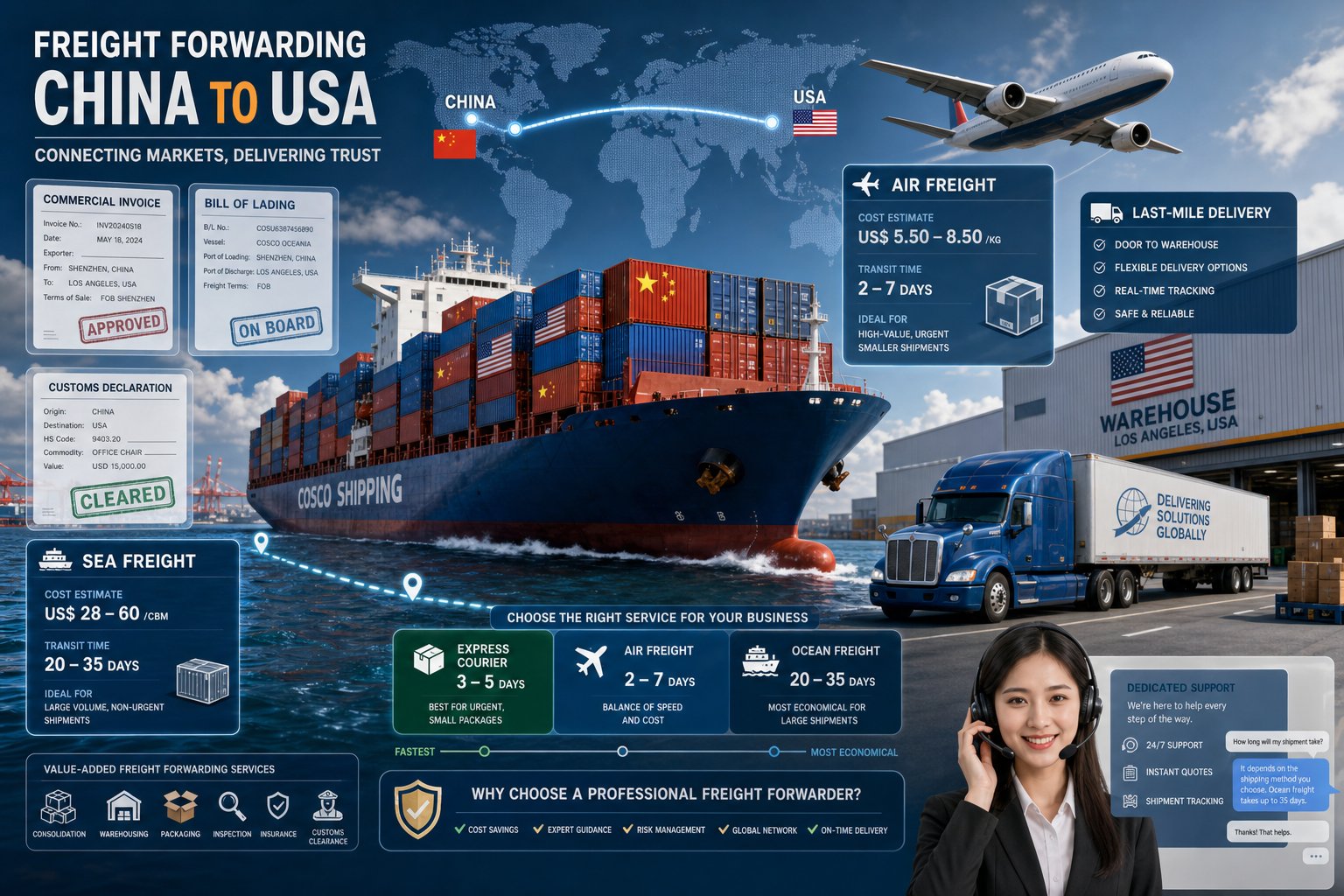
Shipping goods from China to the United States isn’t just about moving containers across the ocean. Complex customs regulations, tariff classifications, and compliance requirements can delay shipments or add unexpected costs if you don’t handle them right.

Choosing the right freight forwarder with strong customs expertise helps you avoid costly delays and makes sure your imports clear U.S. Customs smoothly.

The best freight forwarders do more than just basic shipping. They offer customs brokerage support, transparent pricing, and real experience handling China to USA shipping challenges.

This guide compares ten forwarders based on their customs clearance strengths, service range, and fit for your import logistics needs.

AEB Logistics

AEB Logistics focuses on China to USA shipping, especially for small and medium-sized businesses. You get transparent pricing that lists all fees before you commit.

Their team handles customs brokerage in-house, so you stick with the same company from start to finish. They manage documentation reviews and duty calculations for different types of products.

AEB offers both air and ocean freight options. You can pick LCL consolidation if your load isn’t big enough for a full container.

They also offer warehousing support and order management systems as part of their supply chain coordination. Customer service feels hands-on, with dedicated account reps who keep you updated throughout the process.

Instead of tracking everything yourself, you get updates as your shipment moves. They help with compliance for FDA-regulated products and other restricted goods.

AEB works well for importers needing guidance through complex customs processes. Their pricing makes sense for businesses shipping regularly from China rather than just once.

Freight Right (Los Angeles) — China‑USA lane specialists

Freight Right is an FMC-licensed NVOCC focused on the China to USA corridor. They offer air freight, FCL and LCL ocean shipping, and customs clearance designed for this trade lane.

With a Los Angeles base, you get West Coast port access for goods arriving from Chinese manufacturing hubs. Freight Right takes care of dangerous goods and time-sensitive cargo, so they’re a good fit if you’re importing restricted or regulated products.

They provide consolidation services and use top-tier carrier contracts to help control freight costs. You’ll benefit from their customs brokerage knowledge, especially when your shipments need complex classification or compliance work.

Freight Right’s reach covers 180+ countries and 900,000 origins, but their real specialty is trans-Pacific shipping. If you want a forwarder with China-USA lane experience and LA-area operations, they have the infrastructure and licensing for regular import programs with varying complexity.

Flexport — cloud-forwarder with customs compliance team

Flexport runs a freight forwarding platform for ocean, air, and trucking shipments from China to the USA. They use AI-powered tools to help classify products and calculate duties.

You get licensed customs brokers working right inside the platform. That means you can track your shipment and talk to your broker in one place—no need to juggle multiple systems.

Flexport’s customs services focus on trade compliance and duty optimization. The platform gives you real-time updates on your cargo’s customs clearance status.

Their team helps keep you compliant with U.S. import rules. You’ll see what documentation you need and get alerts if something’s missing before your shipment arrives.

The cloud system lets you manage lots of shipments at once. You can compare quotes, review invoices, and look up past shipments whenever you want. It’s handy if you import often and want to spot trends in shipping costs and transit times.

Kuehne+Nagel China‑US Priority Customs Solutions

Kuehne+Nagel is one of the world’s biggest freight forwarders, with about 85,000 employees and nearly 1,300 locations. They’ve got solid infrastructure in both China and the United States.

You can ship by air or ocean from China. Their team manages customs clearance at major US ports using their own brokerage staff.

Customs clearance services help you handle international trade without surprise fees. They focus on cost-efficient and compliant approaches to trade flows. You can use their customs services even if you don’t book your transport with them.

Kuehne+Nagel serves 400,000 customers worldwide through its global network. They combine logistics know-how with data-driven insights for end-to-end supply chain solutions.

Your shipments benefit from their strong presence in China’s manufacturing regions and their US distribution center connections. They handle documentation, compliance, and port procedures as part of the standard package.

Sinotrans International Customs Clearance (China‑US)

Sinotrans is one of China’s biggest logistics companies. They handle ocean and air freight forwarding, plus customs clearance for China–U.S. shipments.

You get access to their network of offices in both countries, which helps with documentation and compliance in both customs systems.

Their brokerage team manages classification codes, duty calculations, and regulatory filings. Sinotrans can handle standard imports and shipments needing special permits or FDA clearance.

You can pick sea or air options, with LCL consolidation for smaller loads or full containers for bigger ones. Their air freight division offers expedited customs processing for urgent cargo.

Sinotrans has online tracking tools so you can check your shipment and customs status. Their customer service teams speak English and Chinese, which helps resolve documentation issues fast.

Their pricing covers forwarding, customs brokerage, and delivery at the destination. It’s smart to get a detailed quote to compare their rates with other providers for your shipping lanes and product types.

DHL Global Forwarding — U.S. import customs experts

DHL Global Forwarding is the world’s largest customs broker, combining local know-how with a global network. You get their DHL TradeConnect platform, which breaks down customs requirements and speeds up your decisions.

Their customs team handles tough clearance issues for importers moving goods from China to the USA. You can count on their experience with regulatory compliance and duty management.

DHL offers end-to-end supply chain solutions including air, ocean, and road transport. Their services cover customs clearance, warehousing, distribution, and transportation.

They simplify customs clearance no matter where you trade. You benefit from their proven systems and deep U.S. import knowledge.

For urgent shipments, DHL specializes in fast options. Their air freight usually delivers in 3-7 days, while sea freight takes 15-30 days from China to U.S. ports.

China‑US Freight — dedicated China‑to‑USA operator

China-US Freight focuses only on shipping between China and the United States. They’ve specialized in this single lane since 2008.

They don’t handle shipments to Europe, South America, or other areas—just China to USA. You get a forwarder who knows China-to-USA routes, port procedures, and customs requirements inside and out.

Their focused approach is different from big global forwarders. When you work with a specialist, you usually get more attention on the unique challenges of US import rules and Chinese export paperwork.

They handle air and ocean freight, can arrange door-to-door delivery, and manage customs clearance—especially helpful for first-time importers.

If your business ships only from China to the US, a specialist like this might fit you better than a general logistics provider. You won’t pay for global infrastructure you never use, and their team really understands US Customs and Border Protection’s requirements.

Expeditors International — complex customs and compliance unit

Expeditors is a Fortune 500 global logistics company with over 18,000 employees in more than 100 countries. The company runs a dedicated customs and compliance unit that navigates tough regulatory environments.

You get access to professionals who know trade regulations and actually apply them locally. Expeditors’ customs expertise is respected worldwide, and they join advanced pilot programs in multiple countries.

They offer industry-specific expertise in aerospace and defense, healthcare, automotive, and technology sectors. This really matters if you’re importing products with tricky regulatory requirements.

Expeditors covers airfreight, ocean freight, customs brokerage, warehousing, and distribution. Their network reaches over 100 countries, so you get steady support during the China to USA shipping process.

Their customs team handles documentation, classification, and compliance issues that can slow down clearances. You benefit from their experience with U.S. Customs and Border Protection and their grasp of Chinese export rules.

Bolloré Logistics China‑US Customs & Regulatory Advisory

Bolloré Logistics works in more than 100 countries and brings strong regulatory know-how to China-USA trade. You get specialists who actually understand both Chinese export rules and U.S. customs requirements.

Their customs advisory team helps you navigate HTS classification, duty drawback programs, and FDA regulations. They deal with complex categories like electronics, textiles, and food that need extra documentation.

Bolloré offers pre-shipment compliance reviews to catch problems before your goods leave China. This can save you from delays at U.S. ports. Their team keeps an eye on regulatory changes that could impact your imports.

You can use their tech platform to manage documents and track clearance status in real time. The system alerts you if authorities flag your shipments for inspection.

Their advisory services are best for importers handling regulated goods or high-value shipments. You’ll pay more than basic forwarding rates, but you get compliance support that helps reduce the risk of fines and seizures.

Bolloré keeps offices in major Chinese cities like Shanghai, Beijing, and Shenzhen. This local presence helps them work with Chinese authorities when you need export permits or certificates.

CJ Logistics (formerly CJ Korea Express) China‑USA customs handling

CJ Logistics is a global logistics company based in Seoul, South Korea and has built a presence in both China and the United States. They entered the Chinese market in 2004 and have grown steadily since then.

Their service lineup includes customs brokerage as well as air and sea forwarding. The customs team works to clear your goods through U.S. customs and follows all required laws.

CJ Logistics provides import and export services covering ocean freight, air freight, and customs clearance. You can tap into their network connecting China manufacturing regions to U.S. ports.

The company offers integrated supply chain solutions instead of customs-only services. You get warehousing, transportation, and customs bundled together. This works well if you need full logistics support beyond just clearance.

CJ Logistics positions itself as a general freight forwarder, not a specialist in complex customs scenarios. If your shipments involve regulated products or FDA requirements, you may want a provider with deeper customs expertise.

Key Regulatory Considerations in Cross-Border Shipping

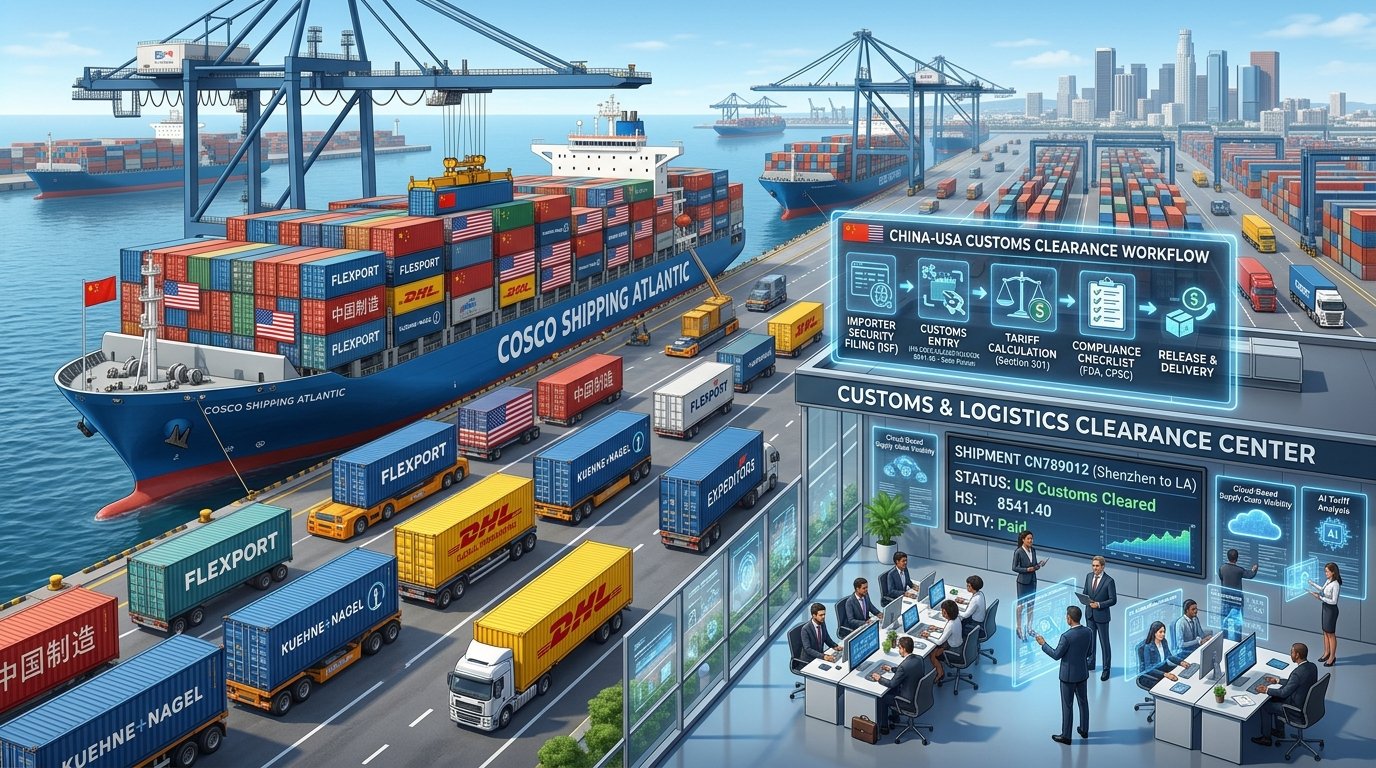
U.S. Customs and Border Protection stepped up enforcement in 2026, so accurate documentation and tariff classification are now essential to avoid delays and penalties. Freight forwarders with strong customs know-how help you stay compliant and manage cost swings from changing trade policies.

Understanding Compliance Requirements

Your shipments must meet strict CBP standards for customs clearance. You need an Importer of Record (IOR) who takes legal responsibility for goods entering the U.S. This person or entity needs a valid IRS number and proper bond coverage.

U.S. Customs and Border Protection issues binding advance rulings that clarify how your products will be classified at the border. Getting these rulings before you import can prevent costly surprises.

Your freight forwarder should double-check that all documents are accurate and complete. This includes commercial invoices, packing lists, and certificates of origin. Missing or incorrect paperwork leads to delays, storage fees, and lost sales.

CBP now uses AI-driven inspections to flag shipments for review. You need customs brokers who get current enforcement priorities and file your entries correctly the first time.

Navigating Changing Tariffs and Trade Policies

Tariff rates change based on product classification, country of origin, and current trade deals. The Harmonized Tariff Schedule (HTS) code you use decides what duty rate you pay. Even a single digit difference in classification can swing your costs by thousands.

Your forwarder should track tariff changes and help you find legal ways to cut duties. This might mean using trade preference programs or shifting your supply chain routing.

Cross-border shipping regulations keep getting more complex as enforcement tightens and trade deals shift. Costs can swing week to week, making budgeting a headache.

You need partners who track regulatory updates in real time. The best freight forwarders send alerts when new rules hit your products and suggest ways to limit the financial fallout.

Best Practices for Optimizing Import Logistics

Real-time visibility and coordinated customs clearance can reduce delays by 30-40% and lower demurrage fees for shipments from China to the USA. These two things have a direct impact on your costs and delivery timing.

Leveraging Digital Tracking Tools

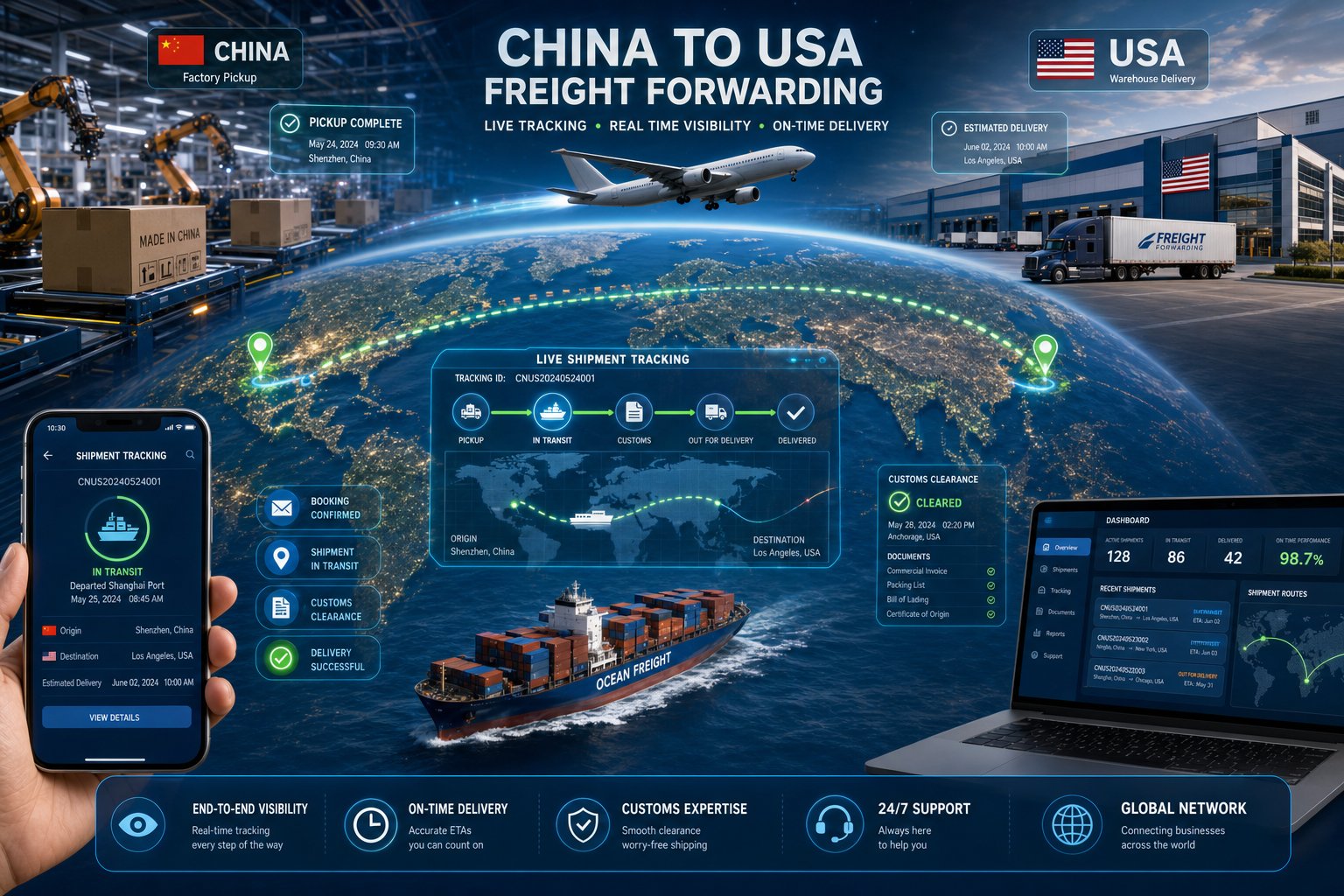
Modern freight platforms let you see container-level details with GPS tracking and automated milestone updates. You can follow your shipment from factory pickup in Shenzhen to port departure, ocean transit, and arrival at U.S. customs.

Key tracking features to look for:

  • Real-time GPS updates every 4-6 hours
  • Automated alerts for departure, arrival, and customs holds
  • Estimated arrival times based on current conditions
  • Document upload portals for bills of lading and invoices

Portal access lets your team share tracking data with customers and colleagues without endless email chains. This transparency helps you spot bottlenecks before they turn into expensive problems.

Many forwarders now offer API integrations that push tracking data into your warehouse management system or ERP. This automation saves you from manual status checks and keeps inventory planning on track.

Coordinating Customs Brokerage with Supply Chain Management

Your customs broker should talk directly with your freight forwarder and warehouse team to avoid clearance delays. When these groups don’t coordinate, paperwork mistakes and missed pickups can lead to costly detention charges.

Best coordination practices:

  • Share your harmonized tariff schedule codes with your forwarder before shipping
  • Give your broker supplier packing lists 48 hours before vessel arrival
  • Set up a single contact who manages both forwarding and brokerage communications
  • Use automated alerts when ISF filings are done or need changes

Pre-clearance strategies work especially well for repeat shipments. Your broker can review product classifications and documentation weeks before your cargo ships, so you can fix issues early.

Direct warehouse delivery coordination means your cleared goods move right from the port to your facility. When your forwarder schedules drayage pickup based on actual customs release times, you avoid storage fees at container freight stations.

Frequently Asked Questions

Importers moving goods from China to the U.S. often need help with customs processes, costs, and service options. These questions cover common concerns about documentation, delays, pricing, and picking the right shipping terms.

Which companies reliably handle complex customs clearance when importing from China to the United States?

AEB Logistics manages complex customs scenarios with dedicated compliance teams. They handle classifications, FDA holds, and tariff engineering for regulated products.

Freight Right in Los Angeles specializes in the China-USA lane and works directly with CBP officers to resolve exam holds. Their team reviews HTS codes before filing to lower penalty risk.

Flexport blends technology with licensed customs brokers who manage prior disclosure filings and quota categories. Their platform flags missing documents before your shipment hits the port.

Kuehne+Nagel runs a Priority Customs Solutions desk for China-US imports. They handle antidumping cases, Section 301 exclusions, and bond reviews.

Sinotrans International Customs Clearance bridges Chinese export rules with U.S. import requirements. Their bilingual teams coordinate compliance for electronics, textiles, and medical devices.

How do I compare providers on customs expertise, compliance support, and end-to-end service scope for China–U.S. shipments?

Ask each forwarder how many China-USA entries they filed in the last year. High volume usually means they know CBP procedures and local port rules.

Request examples of how they handled exam holds or penalty notices. Good providers will walk you through their escalation process and average resolution time.

Check if they offer HTS classification reviews before you ship. This catches errors early and prevents costly reclassifications at the border.

Confirm whether customs brokerage is bundled or billed separately. Some forwarders include clearance with freight, while others charge per-entry fees that add up fast.

Review their tech for tracking and documentation. Cloud platforms that store ISF filings, invoices, and certificates save time during audits.

What shipping documents and product data are required to avoid holds, exams, or penalties at U.S. customs?

You need a commercial invoice with clear product descriptions, HTS codes, and declared values. Vague terms like “parts” or “accessories” trigger exams.

The Importer Security Filing must reach CBP at least 24 hours before ocean cargo loads at the Chinese port. Late ISF filings can mean $5,000 fines for each violation.

Certificates of origin prove where your goods were made and set duty rates under trade agreements. China shipments may need Form A for GSP claims or USMCA certificates if parts move through North America.

FDA products need prior notice filings and sometimes extra compliance statements. Electronics with FCC logos require test reports and supplier declarations.

Packing lists must match container counts and weights exactly. Any mismatch between your packing list and what CBP finds during inspection will delay your release.

How can I estimate total landed cost for China-to-U.S. imports, including freight, duties, taxes, and brokerage fees?

Start by getting a freight quote for ocean or air transport from the Chinese port to your U.S. destination.

Ocean shipments usually cost $1,500 to $4,000 per container. Air freight? That’ll run you $4 to $8 per kilogram.

To estimate duties, multiply your product value by the HTS code rate. Some electronics get a zero percent rate, but goods hit by Section 301 tariffs might face 25 percent or even more.

Add the Merchandise Processing Fee. It’s 0.3464 percent of your shipment value, but there’s a minimum of $27.75 and a cap at $538.40 per entry.

This CBP fee hits almost every commercial import. It’s just one of those things you can’t really avoid.

Customs brokers typically charge $125 to $300 per entry for standard clearance. If your shipment’s complicated—say, with FDA holds or quota management—fees can jump to $500 or more.

Don’t forget inland trucking from the port to your warehouse. Drayage from Los Angeles ports to nearby facilities lands between $300 and $600.

Cross-country trucking adds $2,000 to $5,000. Yeah, those miles add up fast.

What are the most common causes of delays for China-to-U.S. shipments, and how can they be prevented or mitigated?

Late or incorrect ISF filings cause cargo holds at the first U.S. port. It’s best to submit your ISF with verified data at least 48 hours before the vessel departs.

Missing or incomplete commercial invoices trigger exams that tack on three to seven days. Double-check that your descriptions match HTS codes and that all values reflect actual transaction prices.

FDA and other agency holds slow down perishables, supplements, and medical devices. File prior notice early, and make sure your facility is registered with the right agency.

Customs exams can happen randomly or if CBP suspects valuation errors. You can’t dodge random exams, but solid documentation helps lower your chances of a targeted inspection.

Port congestion at Los Angeles and Long Beach can stretch dwell times during peak seasons. Sometimes, routing shipments through less crowded ports like Savannah or switching to air freight for urgent cargo makes a real difference.

When should an importer choose DDP versus FOB or EXW for China-to-U.S. shipments with complex clearance requirements?

Go with DDP if you want your Chinese supplier to cover every cost and risk all the way to your door. They’ll pay for freight, duties, and customs, so you just get the goods—no last-minute fees popping up.

DDP’s a lifesaver for smaller importers who don’t want to mess with customs headaches. Your forwarder will handle ISF filings, product classifications, and talk to CBP for the Chinese shipper.

FOB, on the other hand, hands you the wheel for the ocean leg and U.S. customs. You pick the forwarder, haggle over freight rates, and tell your broker exactly how to handle classifications or duty drawback claims.

If you’re importing stuff with strict regulations, like FDA or quotas, FOB lets you coordinate the compliance steps directly. It’s way easier to manage FDA registrations, quota tracking, or antidumping paperwork when you’re in charge.

EXW puts all responsibility on you the minute goods leave the Chinese factory. This option only really makes sense if you have people in China or a solid forwarder who can deal with export clearance, trucking to port, and Chinese customs paperwork.

Honestly, I’d skip EXW for tricky clearances unless you know Chinese export rules inside out. If you miss an export license or botch the shipping marks, your U.S. customs broker won’t be able to fix it later.
Posted on

China to USA Freight Forwarders: Top 10 Services for E-Commerce Brands

China to USA Freight Forwarders Top 10 Services for E-Commerce Brands

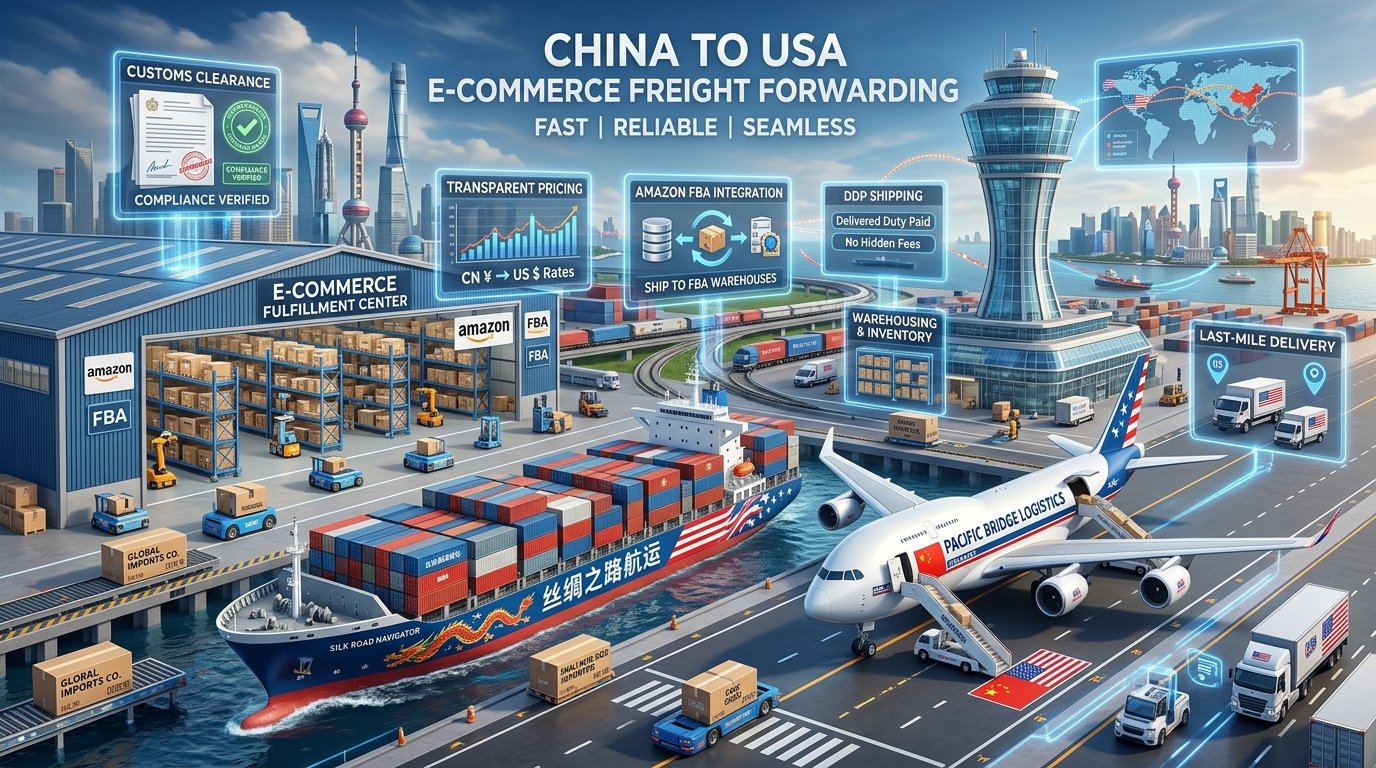
Shipping products from China to the USA means you need a freight forwarder who gets e-commerce. The best partners do more than just move boxes—they handle customs, offer warehousing, and support your Amazon FBA needs while keeping costs predictable.

Choosing the right China to USA freight forwarder can make or break your operations. International shipping logistics just keeps getting more complicated, and e-commerce brands really need specialists in DDP shipping and customs clearance.

This guide compares ten freight forwarders based on their e-commerce logistics strengths, pricing transparency, and how they serve small to mid-size importers.

AEB Logistics

AEB Logistics focuses on DDP shipping from China to the USA, catering to e-commerce brands. They’re big on transparent pricing and give you dedicated support the whole way through.

The team handles customs, warehousing, and final delivery to your customers or Amazon FBA. They’ll manage paperwork and compliance, so you don’t have to get lost in import regulations.

For small and medium-sized businesses, AEB provides hands-on coordination. You get clear communication about costs upfront, which helps you budget without surprises.

They offer end-to-end supply chain support designed for SMB importers. If you need a forwarder who gets e-commerce timelines and Amazon’s strict delivery rules, AEB is worth a look.

You can choose air or sea freight depending on your budget and timing. They focus on service quality and quote transparency, so if you want predictable costs and reliable delivery, they’re a solid pick.

Flexport

Flexport is a digital freight forwarder from China to USA with tech-driven services. Their online platform lets you track shipments in real time and see your supply chain at a glance.

They handle ocean freight, air freight, and customs for e-commerce brands. You can compare shipping options and book cargo space right from their system.

Flexport offers Amazon FBA prep services at their warehouses. Products can be inspected, labeled, and prepped for fulfillment centers before delivery.

Their pricing includes platform fees on top of freight costs. You’ll need to request quotes for each shipment, since rates change with volume and shipping method.

If you care about tech integration and want data-driven insights, Flexport’s a strong choice. Larger shippers get dedicated account managers, but even smaller brands benefit from their platform.

Flexport also offers customs brokerage in-house, so you can handle compliance and documentation digitally instead of juggling multiple vendors.

DHL Global Forwarding (China to USA services)

DHL Global Forwarding is one of the biggest freight forwarding networks out there. You get access to their infrastructure connecting major Chinese manufacturing hubs with US distribution centers.

Their air and ocean freight services handle everything from small parcels to full containers. Sea freight takes about 15-30 days, and air freight usually arrives in 3-7 days from China to the USA.

DHL offers customs clearance support and tracking systems that can plug into your current operations. Their tech platform lets you monitor shipments in real time and manage documents online.

They work with e-commerce brands needing Amazon FBA prep and warehousing, but their pricing is aimed more at established businesses. First-time importers with small volumes might find it less accessible.

DHL Global Forwarding suits medium to large e-commerce operations that care about speed and reliability. Their global reach and customs relationships help cut down on delays at US ports.

Kuehne+Nagel China–USA Freight

Kuehne+Nagel is one of the largest global freight forwarders, with big infrastructure in China and the USA. You get both air and ocean freight options and strong customs clearance at major US ports.

Their digital platform, KN Login, lets you track shipments and handle documents online. You can request quotes and see your cargo status in real time.

Kuehne+Nagel handles full and less-than-container loads for all business sizes. Warehousing is available in both countries if you need storage before final delivery.

They do work with e-commerce brands, but honestly, they focus more on large enterprise clients. If you’re shipping high volumes, their services probably fit better than if you’re just testing the waters.

Pricing is quote-based, not published online, so you’ll need to reach out to get specifics. They provide customs brokerage and know the regulatory ropes for US imports.

Sinotrans (China–US ocean & air)

Sinotrans became the world’s largest ocean freight forwarder in 2025, moving 4.872 million TEU. This Chinese state-owned giant offers both ocean and air freight between China and the USA.

You get access to a huge network of Chinese ports and warehouses. Services include customs clearance, cargo insurance, and door-to-door delivery.

Sinotrans is a good fit for larger shipments and businesses chasing competitive ocean rates. They’re used to handling bulk cargo and full containers.

On the downside, their customer service might not be as personal as smaller, niche forwarders. Their systems aren’t always tailored for e-commerce or Amazon FBA compared to specialists.

Their pricing can get complicated, so it’s smart to ask for detailed quotes and double-check transit times. If you move high volumes or need access to big Chinese ports, Sinotrans provides strong infrastructure and competitive rates for ocean freight.

China-US Freight

China-US Freight has focused only on shipping from China to the U.S. since 2008. They aren’t distracted by global routes like some other forwarders.

This specialization can make a difference for your Amazon FBA business. They work as tier-1 partners with major shipping lines, which can mean better rates and reliable space during busy seasons.

You’ll find both sea and air freight options. Their services include customs clearance and delivery right to Amazon warehouses across the U.S.

Because they only run the China-USA route, their team really knows the regulations and requirements for importing to America. That focus helps avoid a lot of common customs headaches.

They offer door-to-door service, so you don’t have to coordinate with several companies. Your cargo goes from your Chinese supplier straight to your U.S. destination.

Their website has tools for quotes and tracking. You can manage logistics without endless phone calls or email chains.

Dingshang Logistics

Dingshang Logistics specializes in shipping from China to the United States. Their base is Ningbo, China, but they have offices and warehouse partners in Shanghai, Shenzhen, Los Angeles, Dallas, and New York.

You can ship full containers or less than container loads. The freight forwarder provides door-to-door solutions, including factory pickup, export handling, and delivery to your final destination.

Their network covers major Chinese ports like Ningbo, Shanghai, and Shenzhen, and they reach US locations through established partners. Dingshang started with a mission to connect Chinese manufacturers with American businesses, so they really know the ins and outs of this route.

You work with a forwarder that handles both FCL and LCL shipments, giving you flexibility on order size and budget. Their presence in multiple US cities helps with final delivery, which is a big plus if you need nationwide coverage.

CJ Logistics (China–USA solutions)

CJ Logistics stands out as a major South Korean logistics provider with strong networks in both China and the United States. The company handles ocean freight, air freight, and multimodal shipping options for e-commerce brands.

You get access to customs clearance support and warehousing through their USA facilities. CJ Logistics integrates with major e-commerce platforms and manages Amazon FBA shipments.

Their pricing structure runs on a quote basis instead of giving upfront rates online. You’ll have to contact them directly for specific shipping costs based on your cargo and route.

CJ Logistics provides tracking systems so you can monitor shipments from China to USA destinations. They handle both full container loads and less-than-container loads depending on your business size.

The company serves small, medium, and large enterprise clients. Their service range includes door-to-door delivery and DDP options that cover duties and taxes before your goods enter the USA.

If you want a larger freight forwarder with solid infrastructure in both countries and don’t mind requesting custom quotes, CJ Logistics is worth a look.

Expeditors International (China–USA)

Expeditors International is a global logistics company with strong networks in China and the United States. You get access to their relationships with ocean and air carriers, which can help you secure competitive freight rates.

Their customs clearance services cover standard entry processes and ISF filing. You can work with their licensed customs brokers who handle documentation and communication with CBP for you.

Expeditors offers warehousing and distribution services at major U.S. ports. You’re able to store inventory temporarily before moving it to your final destination or fulfillment center.

They offer technology platforms for tracking shipments and viewing documentation online. Your team can monitor cargo status and access reports through their web portal.

The company serves a range of industries, including retail and e-commerce importers. They handle both LCL and FCL shipments from Chinese ports to U.S. destinations.

Pricing comes through custom quotes based on your specific shipping needs. You’ll need to contact their sales team directly to discuss rates and service options for China to USA routes.

Freightos (China to USA freight marketplace)

Freightos is an online freight shipping marketplace where you can compare quotes from several forwarders in one place. Just enter your shipment details and get instant pricing from different providers.

This platform works well when you want to compare rates quickly. You can see air and ocean freight options side by side, and the booking system lets you manage shipments digitally—no endless email chains.

For e-commerce brands, Freightos gives you visibility into shipping costs before you commit. You can filter results by transit time and price, and the platform includes customs clearance services through partner forwarders.

The main draw is price transparency. You’ll see what different forwarders charge for the same route, making it easier to make informed shipping decisions.

But you’re still working with third-party forwarders through the platform. Service quality depends on who you pick. Some e-commerce sellers prefer direct relationships with forwarders, especially for tricky Amazon FBA shipments.

Freightos fits best if you ship occasionally and want competitive pricing. It’s not ideal if you need dedicated account management or specialized FBA prep services.

Essential Criteria for Choosing a Freight Forwarder

Your freight forwarder should handle customs paperwork correctly, show you all costs upfront, and work smoothly with your selling platform. These three things really decide whether your shipments arrive on time and within budget.

Customs Compliance and Documentation

Your forwarder needs to understand both Chinese export rules and USA import regulations. They should handle commercial invoices, packing lists, bills of lading, and customs bonds so you don’t have to chase them down.

Look for forwarders with licensed customs brokers on staff. They need to classify your products under the correct Harmonized Tariff Schedule codes. If they misclassify, you risk delays, fines, or extra duties.

Key documents your forwarder should manage:

  • ISF (Importer Security Filing) submitted 24 hours before vessel departure
  • Entry documentation filed with CBP
  • FDA, EPA, or other agency clearances if required
  • Certificate of origin for duty reduction programs

Ask about their error rate and average clearance time. When you compare China-USA freight forwarders, focus on regulatory compliance and actual total landed costs—not just the shipping quote.

Transparent Pricing Models

You should see every fee before you commit to a shipment. Hidden charges eat into your profits and make pricing a headache.

Ask for a detailed quote that breaks down ocean or air freight, fuel surcharges, customs clearance, destination handling, and delivery fees. Some forwarders tack on extras for document prep, container loading, or warehouse pickups in China.

Compare these cost elements:

  • Base freight rate per container or kilogram
  • Customs brokerage fees
  • Terminal handling charges
  • Fuel and security surcharges
  • Delivery to your warehouse or fulfillment center

DDP (Delivered Duty Paid) pricing bundles everything into one rate, including duties and taxes. This makes budgeting easier for small importers who want predictable shipment costs.

Integration With Amazon FBA and E-Commerce Platforms

Your forwarder should ship directly to Amazon warehouses using FBA-compliant labeling and packaging. That saves you time and skips the need for a middleman warehouse.

Check if they offer FBA prep services like polybagging, FNSKU labeling, and pallet prep that meets Amazon’s strict standards. If Amazon rejects your shipment, you’ll pay storage fees and face delays.

Look for technology integration too. The best forwarders connect with your WMS or give you tracking dashboards with real-time status. You need to know where your goods are at every stage.

Ask about their experience with Amazon’s carrier requirements and appointment scheduling. Some freight forwarders for USA imports from China specialize in e-commerce and have dedicated FBA teams.

Optimizing Shipping Strategies for E-Commerce Brands

Smart shipping choices can cut your costs by up to 30% and speed up delivery times. The right mix of customs handling, warehousing, and freight options really helps you compete with bigger sellers.

Utilizing DDP Shipping Services

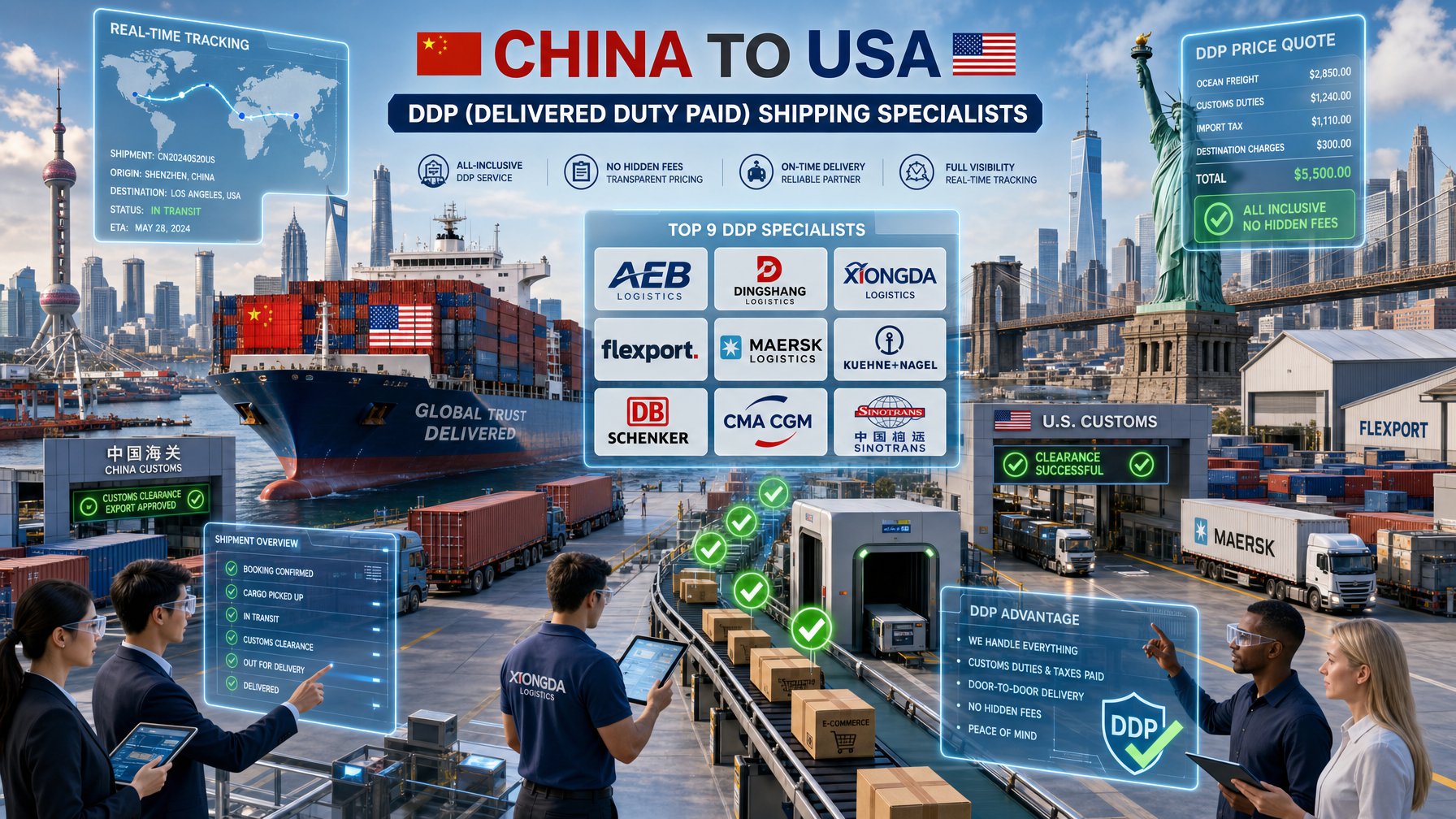
DDP (Delivered Duty Paid) shipping means your forwarder handles all customs clearance, duties, and taxes before your goods reach the USA. You pay one flat rate that covers everything from your supplier’s door in China to your warehouse or FBA center.

This method eliminates surprise fees at customs. Your forwarder takes care of calculating duties, filing paperwork, and making sure you comply with US import rules.

DDP shipping works best when you want one coordinated workflow for freight and customs. You get predictable costs and usually faster customs processing since experienced forwarders know how to classify products properly.

The big perk? Simpler accounting. Instead of juggling multiple invoices for freight, duties, and broker fees, you get one consolidated bill. That makes budgeting and product pricing so much easier.

Warehouse and Inventory Management Solutions

Many freight forwarders offer warehousing near major US ports or close to Amazon fulfillment centers. These staging facilities let you inspect products, store inventory, and prep shipments for FBA or direct-to-consumer orders.

LA-based staging warehouses are a popular choice for China imports. You can consolidate shipments from multiple suppliers into one FBA delivery, which cuts your per-unit shipping costs.

Some forwarders provide inventory management software that tracks your stock in real-time. You’ll know what’s in transit, what’s in the warehouse, and what’s already delivered to Amazon or your customers.

Look for services that include FBA prep like labeling, bundling, and poly-bagging. That way, you don’t need to hire a separate prep center and can keep your supply chain under one roof.

Balancing Speed, Cost, and Reliability

Air freight delivers in 3-7 days but costs 5-10 times more than ocean shipping. Sea freight takes 25-35 days but offers the lowest per-unit cost for bulk orders.

Your choice really comes down to your product margins and inventory needs. Fast-moving, high-margin items often justify air freight. Slower sellers with lower margins are better suited for ocean freight.

Shipping method comparison:

Method Transit Time Best For
Air Express 3-7 days New launches, restocks, high-value items
Standard Air 7-12 days Medium-priority shipments
Ocean FCL 25-35 days Large volume, established products
Ocean LCL 28-40 days Smaller quantities, test orders

You can split shipments to balance risk. Send 70% by sea for lower costs and 30% by air to keep stock levels healthy. Track your inventory turnover rate to fine-tune reorder timing and shipping methods.

Frequently Asked Questions

Choosing the right forwarder means understanding costs, customs, and service options that directly affect your delivery speed and actual landed costs. There’s no perfect answer, but asking the right questions helps.

How do I choose a reliable freight forwarder for shipping from China to the United States?

Check if the forwarder has physical offices or warehouse facilities in both China and the USA. This means they can handle your cargo directly instead of passing it around to other companies.

Look for forwarders that offer transparent pricing with detailed quotes. You want to see a clear breakdown of ocean or air freight, destination charges, customs fees, and any terminal handling costs.

Hidden fees can eat into your margins fast. Reviews from other e-commerce importers help, and you should ask for client references too.

Make sure your forwarder has experience with your product type and shipping volume. It really makes a difference.

Check if they provide real-time tracking and assign you a dedicated account manager. Good communication helps you avoid delays and keeps you updated about your shipment.

What is the typical cost to ship goods from China to the USA by air versus ocean freight?

Ocean freight usually costs between $500 to $3,000 per container, depending on the route, season, and size. If you don’t fill a 40-foot container, a 20-foot container often costs less per cubic meter.

Air freight runs from $3 to $8 per kilogram for standard service. Express air can hit $8 to $15 per kilogram but delivers in three to five days.

Transit time matters a lot. Ocean freight takes 15 to 35 days, while air freight arrives in five to 10 days for standard service.

Your product’s value, weight, and urgency decide which mode makes sense. High-value, lightweight items usually justify air freight, while bulky or heavy goods work better by ocean.

Which shipping option is best for Amazon FBA inbound shipments from China, and what requirements should I plan for?

DDP (Delivered Duty Paid) service is the go-to for Amazon FBA. Your forwarder handles customs clearance and delivers right to Amazon warehouses, which keeps you compliant with Amazon’s strict rules.

You need accurate carton labeling with FBA barcodes, shipment IDs, and proper product labeling before your goods leave China. Amazon rejects shipments that don’t meet their prep standards, so double-check everything.

Many China to USA freight forwarders offer FBA prep services like labeling, inspection, and direct appointment booking with Amazon fulfillment centers. This saves you the headache of juggling multiple vendors.

Plan for appointment scheduling at Amazon warehouses, which can add three to seven days to your timeline. Your forwarder should handle this process and make sure your shipment arrives when it should.

What is the difference between DDP and DAP/FOB, and when is DDP the better choice for importers?

DDP means your forwarder handles all shipping costs, customs duties, and delivery to your final destination. You pay one total price and get your goods at your warehouse or Amazon FBA center—no surprises.

FOB (Free on Board) means you only pay to get goods loaded onto the ship in China. After that, you arrange and pay for ocean freight, customs clearance, duties, and inland delivery yourself.

DAP (Delivered at Place) covers shipping to a US port or airport, but you handle customs clearance and final delivery.

DDP works best when you want predictable costs and don’t have experience with import customs clearance. First-time importers usually benefit most from DDP because it reduces compliance risks.

Choose FOB or DAP if you have a good customs broker and want more control over the clearance process. These options can save money for experienced importers with high volumes.

How can I evaluate customs clearance support and reduce the risk of delays, exams, or unexpected duties?

See if your forwarder employs licensed customs brokers in the USA or partners with established brokerage firms. Licensed brokers really know tariff classifications and can legally minimize your duty payments.

Ask how they handle Harmonized Tariff Schedule (HTS) code classification for your products. Wrong codes mean delays, penalties, or higher duties than you need to pay.

Request info about their exam rate and average clearance time. Forwarders with strong compliance records face fewer exams from US Customs and Border Protection.

Make sure they provide complete commercial invoices, packing lists, and any required certificates before your shipment arrives. Missing documents cause automatic delays and storage fees at the port—nobody wants that.

What warehousing and last-mile delivery options should I look for to support fast US fulfillment for e-commerce orders?

Start by finding forwarders with warehousing and distribution support in big US cities like Los Angeles, New York, and Chicago.

When you spread your inventory across several locations, you can cut down shipping times for your customers. This approach just makes sense if you want to stay competitive.

Ask if they offer value-added services like quality inspection, relabeling, kitting, or returns processing. These extras really help you manage inventory without having to lease your own warehouse space.

See whether they connect with your e-commerce platform or 3PL software. If they’ve got API connections, you get automatic order routing and real-time inventory updates—super handy.

Check out their last-mile carrier partnerships for both residential and commercial delivery. If they’ve got strong ties with FedEx, UPS, or regional carriers, you’ll probably get better rates and faster delivery for your customers.

Posted on

Freight Forwarding Services: Comparing China–USA Providers

Freight Forwarding Services Comparing China–USA Providers

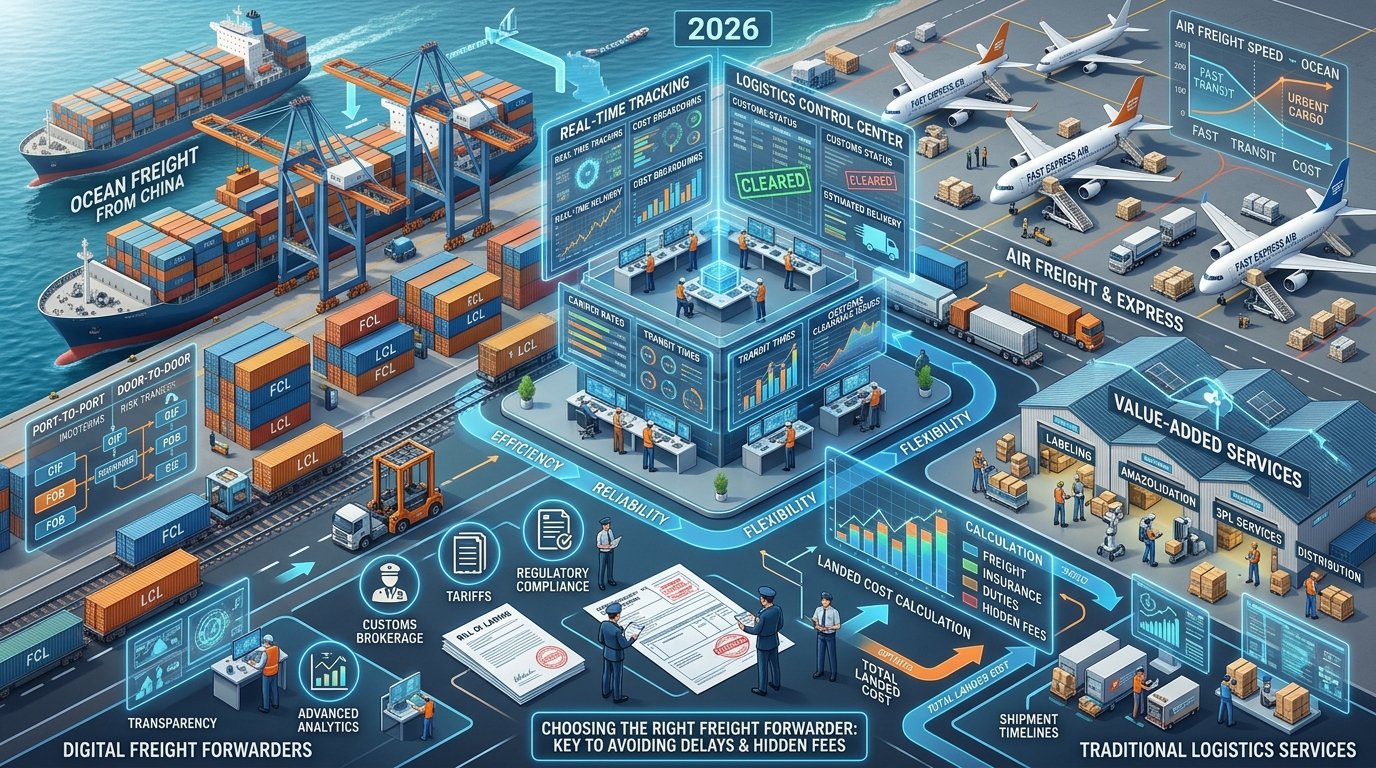
Picking the right freight forwarding services for China to USA shipments isn’t just about finding the lowest price. It’s about matching your business needs with a provider who can actually handle your shipment type, timeline, and destination—without headaches down the road.

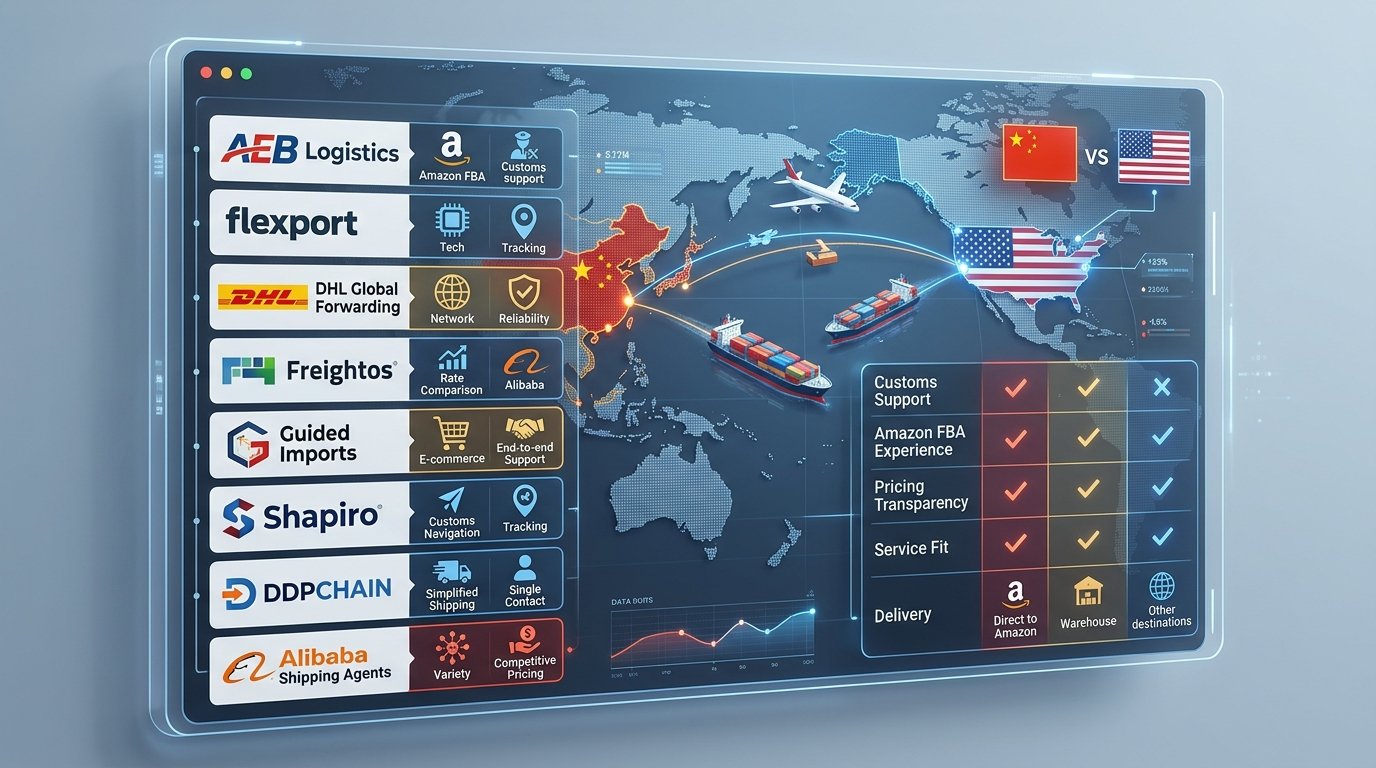
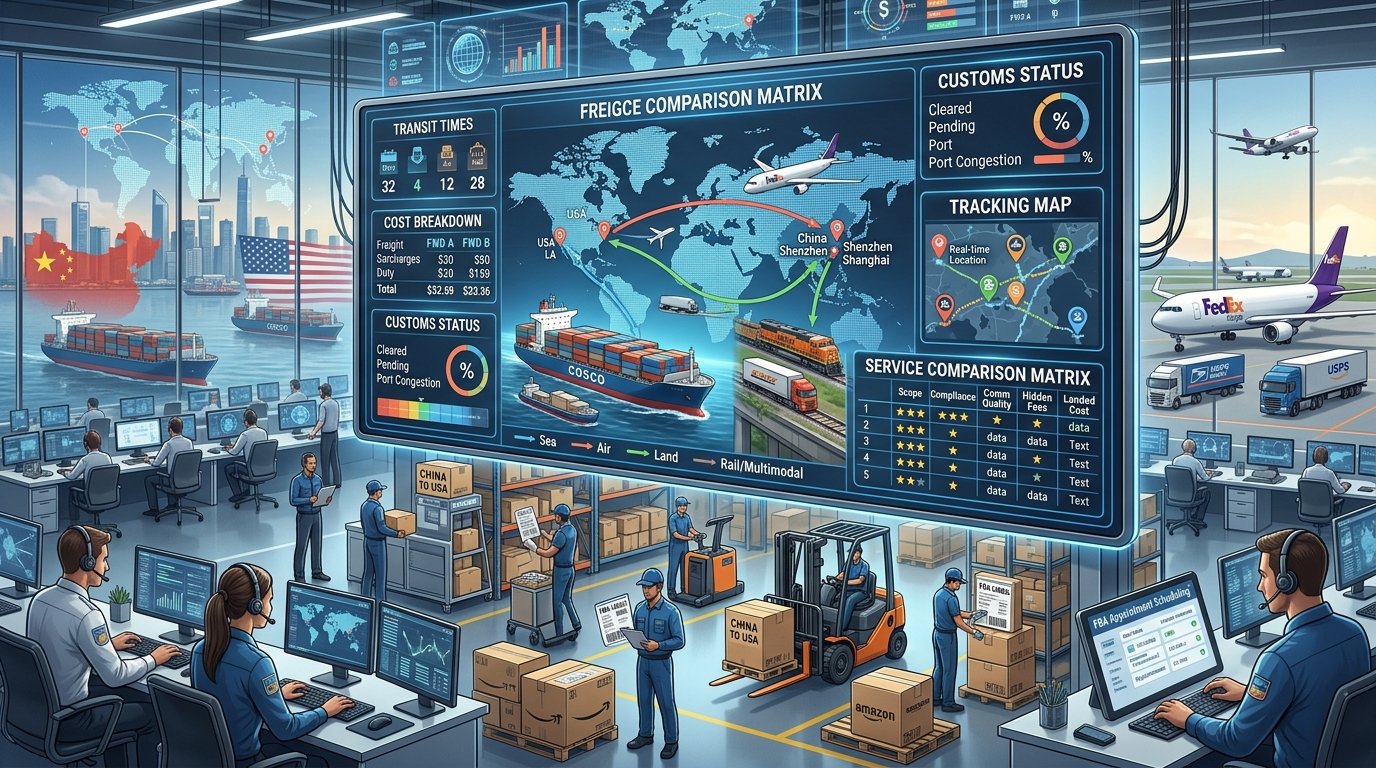
A good freight forwarder comparison should focus on service scope, regulatory compliance, communication quality, and the real total landed costs—not just the initial freight quote.

Plenty of importers lose money by choosing shipping from China to USA partners based on price alone. Then they get hit with surprise fees, customs delays, or poor factory coordination once their cargo is already moving.

This guide walks you through what to compare when you’re evaluating logistics companies for your imports. You’ll see which factors really matter for different shipment scenarios, how to spot red flags during the quoting process, and what to ask before you commit to a freight forwarding partner.

Key Takeaways

  • Don’t compare freight forwarders on price alone—look at service capability, regulatory status, and transparency
  • Specialized experience matters for Amazon FBA or time-sensitive air freight shipments
  • Ask about customs handling, excluded fees, and communication before you book

Core Comparison Criteria for Freight Forwarding Partners

Strong freight forwarders do more than just book cargo space. They manage customs bonds, coordinate warehouses, verify HS codes, and help you avoid hidden fees that eat into your margins.

Evaluating Customs Clearance Expertise and Compliance

Customs clearance often separates reliable freight forwarders from the ones that cause expensive delays. Ask if the provider has an in-house customs brokerage or if they rely on outside partners.

In-house teams usually resolve holds faster. They control your commercial invoice, packing list, and ISF filing—no handoff delays.

Make sure your freight forwarder understands compliance for your specific products. Some goods need USDA, FDA, or other agency reviews before Customs and Border Protection will release your shipment.

Ask for examples of how they handle customs inspections. A good customs broker explains exam types, manages redelivery, and coordinates with CBP so you’re not left clueless.

Check if they can secure customs bonds that fit your import volume. Ship regularly? You’ll want a continuous bond instead of paying for single-entry bonds on every shipment.

See if the provider is registered with the Federal Maritime Commission when acting as an ocean transportation intermediary. That registration protects you under US law when shipping from China to USA.

Assessing Transit Times and Tracking Capabilities

Transit time matters when it affects inventory or sales. Always compare door-to-door transit times, not just the air or ocean leg.

Ask how each provider defines transit time. Some only quote port-to-port, which skips origin pickup, export clearance, import clearance, and final delivery. That can hide days—or weeks—of real lead time.

Request real-time tracking with milestone updates. Basic tracking just says “departed” or “arrived.” Better systems show container pickup, gate-in at port, vessel departure, arrival, customs release, and delivery appointment confirmation.

How do they handle delays? Rollings, blank sailings, port congestion, and customs holds all stretch transit times. The best logistics providers are proactive when exceptions happen.

Try their tracking on a test shipment. Note when you get each update and if it’s accurate. If you only hear about a delay after the fact, their tracking isn’t helping your supply chain.

Analyzing Pricing Transparency and Hidden Fees

Hidden fees can turn a good quote into a nasty surprise. Comparing international freight forwarding companies means looking beyond just the air or ocean freight line.

Ask for a full cost breakdown—origin charges, destination charges, documentation fees, accessorials. Watch for chassis splits, fuel surcharges, terminal handling, and waiting time.

Get a sample invoice from a similar shipment. It shows what “normally” gets billed and exposes fees that never made it into the original quote.

Confirm how demurrage, detention, and per diem charges are calculated. These hit when containers sit too long at terminals or on chassis. Your forwarder should explain free time allowances and help you dodge these costs with better warehouse coordination.

Ask how currency fluctuations and fuel surcharges are handled. Some providers lock rates for 30 or 60 days, others change weekly, which can make budgeting a pain.

Check if cargo insurance is included or optional. Many quotes skip insurance, leaving you exposed if something gets damaged in transit.

Reviewing Warehouse Support and Supply Chain Solutions

Warehouse support gives you more control over inventory once goods reach the USA. If you sell on Amazon, you’ll want a provider with real Amazon FBA support and FBA prep know-how.

Ask if the freight forwarder offers warehousing and distribution. Some just deliver to your address, while others handle short-term storage, cross-docking, and even order fulfillment.

Make sure the warehouse can handle your product type. Hazmat, temperature-sensitive, and oversized goods need special facilities and certifications.

Check their ability to prep shipments for final delivery. Amazon FBA shipments need specific labeling, case packs, and appointments. Mess up any of those and you risk refusals or extra fees.

Ask how they coordinate between customs clearance and warehouse delivery. Delays between customs release and warehouse gate-in just rack up storage costs at container yards.

If you source from multiple countries, review their global supply chain coverage. Consolidating forwarding services and warehousing under one roof can simplify communication and accountability.

Service Models and Shipping Methods for China–US Trade

Freight forwarders offer a mix of service models and shipping methods depending on your cargo size, urgency, and where it needs to go. The right combo depends on your shipment size, budget, and whether you need factory pickup or Amazon FBA delivery.

FCL, LCL, and Consolidation Services

FCL (Full Container Load) means you rent a whole container for your goods. A 20ft container fits about 28 cubic meters, while a 40ft holds around 58 cubic meters.

This works best if you can fill at least 80% of a container. You pay a flat rate, no matter how much space you actually use inside.

LCL (Less-than-Container Load) lets you share a container with other importers. You pay only for the cubic meters your cargo takes up.

LCL usually costs more per cubic meter than FCL. But for smaller volumes, it can make sense if you don’t have enough for a full container.

Consolidation services combine shipments from multiple suppliers into one container. Many logistics companies handle consolidation at warehouses near big ports like Shenzhen or Shanghai.

This saves money if you’re buying from different factories. It also makes customs clearance easier since you get one shipment, not a bunch of small ones.

Comparing Air, Sea, and Express Shipping Options

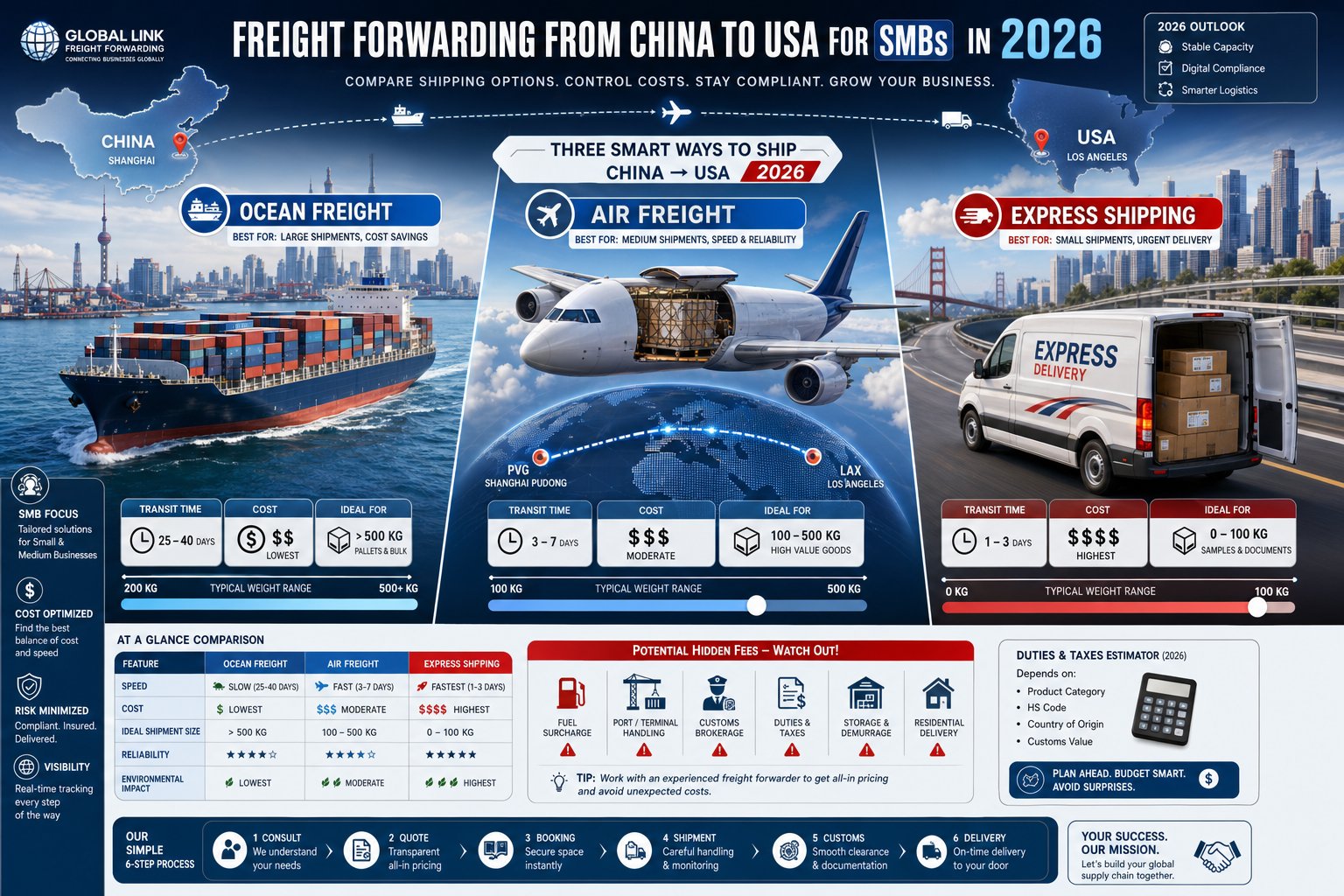
Sea freight is the most economical for heavy or bulky cargo. Transit times from China to US ports range from 15 to 35 days, depending on the route and port congestion.

Ocean shipping handles about 90% of China–US trade volume. Rates change with container availability and seasonal demand.

Air freight costs a lot more, but delivers in 3 to 8 days. Carriers charge by actual weight or volumetric weight—whichever’s higher.

It’s a good option for urgent orders, high-value products, or items with short shelf lives. Electronics and fashion often move by air during peak seasons.

Express shipping with DHL, FedEx, or UPS delivers in 2 to 5 days. Express works for samples, documents, or small urgent shipments under 100 kg.

The per-kilo price is highest with express, but built-in customs clearance and door delivery make it easy for smaller businesses.

Door-to-Door and Amazon FBA Support

Door-to-door delivery means the forwarder handles everything—from factory pickup in China to final delivery at your US address. DDP (Delivered Duty Paid) includes customs duties and taxes in the quoted price.

This takes the complexity off your plate, especially if you’re new to logistics. You get one contact and a predictable total cost.

Amazon FBA shipments need special labeling, packaging, and delivery appointment scheduling. Experienced forwarders who know Amazon FBA support requirements prevent rejections at fulfillment centers.

FBA shipments require proper carton labels, pallet specs, and advance booking at Amazon warehouses. Miss any of these and you’ll face delays or extra fees.

Some forwarders offer FBA prep services—labeling, quality inspection, and direct delivery to multiple Amazon facilities across the US.

Land, Rail, and Multimodal Logistics

Rail freight from China to the US is still pretty limited compared to Asia–Europe rail. Most China–US rail means domestic trucking within each country, not direct transcontinental trains.

Road freight (trucking) covers the first and last miles. In China, trucks move containers from factories to ports. In the US, they take goods from ports to your warehouse or address.

Reliable forwarders use their own trucking networks for factory pickups. That helps avoid delays from suppliers missing container loading deadlines.

Multimodal logistics mixes different shipping methods in one journey. A common example: truck from a Chinese factory to port, ocean freight to LA, then rail or truck to your US warehouse.

Experienced forwarders design multimodal solutions to balance cost and speed. They also coordinate between carriers and transport modes so you don’t have to.

Key Players and Logistics Providers to Consider

U.S. importers have several options for logistics providers when shipping from China. Large international forwarders, China-based specialists, NVOCCs, and carriers each offer different strengths, depending on your shipping volume, service needs, and delivery requirements.

Leading International and China-Based Freight Forwarders

Large global providers like DHL Global Forwarding, Kuehne + Nagel, and Expeditors International run massive networks and have strong carrier relationships. These companies handle a ton of volume and keep things pretty standardized.

They’re a good fit for enterprises with steady shipping patterns and their own logistics teams. If you need scale and predictability, these big names usually deliver.

Sinotrans, one of China’s biggest state-owned logistics companies, brings deep know-how in export procedures and factory coordination. This sort of China-based freight forwarder often offers sharper origin costs and smoother communication with suppliers.

Digital platforms like Flexport blend tech with traditional forwarding. Their online dashboards and easy booking tools appeal to mid-sized importers who want more control and transparency.

Smaller specialists such as AEB Logistics and DocShipper focus on China-to-USA lanes. These providers usually give more personalized service and faster replies than the giants.

When you’re evaluating anyone, check their FMC registration for ocean shipments. Ask about their experience with your type of cargo—details matter.

Role of Third-Party Logistics and NVOCCs

NVOCCs (Non-Vessel Operating Common Carriers) issue their own bills of lading and consolidate cargo from multiple shippers. They have to register with the Federal Maritime Commission, so there’s some regulatory oversight and basic financial protection for you.

Third-party logistics providers (3PLs) do more than just freight forwarding. They might handle warehousing, order fulfillment, and inventory across locations.

This gets valuable if you need warehouse capabilities tied in with your shipping schedule. Some NVOCCs even run their own consolidation warehouses in major Chinese port cities, which lets them offer competitive LCL rates and flexible departures.

Ask your potential provider if they handle cargo consolidation themselves or use intermediaries. It can affect both cost and control.

Carrier Relationships and Last-Mile Solutions

Direct carriers like UPS, FedEx, and DHL manage both international transport and final delivery in the US. They’re great for time-sensitive shipments and offer integrated tracking, but their door-to-door rates tend to be higher than using a forwarder with bulk contracts.

Freight forwarders with solid carrier relationships can grab better container space during peak times. They also get priority when equipment’s tight.

You should ask how long a forwarder has worked with particular ocean lines or airlines. Those connections can make a real difference.

Last-mile delivery is crucial for Amazon FBA support, where delivery windows are strict. Forwarders with FBA experience coordinate with Amazon fulfillment centers and know all the labeling rules.

They set up delivery appointments and double-check that pallets meet Amazon’s specs before anything leaves China. It’s a level of detail you don’t want to skip.

About AEB Logistics

AEB Logistics is a China-based freight forwarder specializing in shipping from China to USA. The company runs offices in major Chinese manufacturing and port regions, giving them direct access to factories and export hubs.

They’re FMC licensed and hold NVOCC registration for ocean freight. That means they can legally arrange container shipping and issue their own bills of lading.

Core services include:

  • Ocean freight (FCL and LCL)
  • Air freight and express shipping
  • Door-to-door delivery with DDP terms
  • Customs brokerage and clearance
  • Amazon FBA prep and delivery
  • Warehouse consolidation in China

AEB Logistics provides transparent pricing with itemized quotes that break down origin charges, ocean freight, destination fees, and customs costs. You see what you’re paying for before you commit.

The team handles ISF filing, HS code classification, and Section 301 tariff compliance for US-bound imports. They keep licensed customs brokers on staff to file formal entries with US Customs and Border Protection.

For ecommerce sellers, AEB Logistics coordinates Amazon FBA shipments with labeling, carton prep, and direct delivery to Amazon warehouses. They track shipments from pickup in China through final delivery at your warehouse or fulfillment center.

Cost Structures, Documentation, and Contingency Planning

Freight costs go way beyond just the base ocean rate. How forwarders calculate charges, handle compliance, and react to disruptions can really impact your bottom line and delivery reliability.

Freight Rate Calculations and Chargeable Weights

Your forwarder should explain how they calculate chargeable weight, since that’s what you’ll pay. Ocean freight charges by CBM (cubic meter), while air freight uses whichever is higher: actual weight or volumetric weight (length × width × height ÷ 6,000 for air).

If your forwarder helps you optimize packaging density, you can cut billable volume. Always ask for itemized quotes that separate ocean freight, fuel surcharges, CFS fees, and destination charges.

Fuel surcharges change monthly with bunker prices and can tack on 15-30% to base rates. Compare at least two or three providers with transparent pricing to dodge hidden fees at destination.

Ask if freight forwarding services include terminal handling, documentation, and customs filing. Some bundle these, others split them out, so you need a full cost breakdown to compare apples to apples.

Managing Duties, Taxes, and Total Landed Cost

Total landed cost covers freight, duties, taxes, insurance, and handling. Your forwarder should help you forecast this before you sign with a supplier.

Understanding Incoterms—especially FOB (Free on Board)—makes it clear when ownership and cost responsibility move from seller to buyer. Work with a forwarder who knows HS code classification and tariff engineering.

Misclassification can cause penalties or shipment delays. A savvy provider finds duty-saving moves using programs like Section 321 (de minimis) or First Sale rules.

When shipping from China to USA, tariffs might be anywhere from 0% to over 25% depending on your product and current policy. Your forwarder should keep an eye on regulatory changes and adjust landed cost models as needed, especially when trade policy gets shaky.

Navigating Peak Seasons and Port Congestion

Peak seasons—usually July through October for holiday inventory—push up rates and shrink available space. Find out if your forwarder offers contract rates or priority booking when things get busy.

Spot rates can double during crunches. Port congestion on the West Coast or weather delays mean you need a backup plan.

Ask how quickly your forwarder can reroute shipments or switch carriers. Providers with strong carrier ties can still get space even when it’s tight.

For Amazon FBA shipments, late arrivals in Q4 can kill your revenue. Pick a forwarder who builds buffer time into schedules and tells you about delays before they mess with your inventory planning.

Documentation, Compliance, and Risk Management

Accurate paperwork—commercial invoice, packing list, bills of lading, and ISF filing—keeps customs holds at bay. Your forwarder should double-check that carton labeling meets Amazon FBA requirements, like FNSKU labels and suffocation warnings, before shipping from China.

Customs clearance expertise really matters. A good forwarder files ISF 10+2 at least 24 hours before vessel departure and handles AMS and entry filings with US Customs and Border Protection.

They should manage FDA, CPSC, or other regulatory needs for your product, too. Risk management means cargo insurance, compliance audits, and backup carriers.

Ask if your provider offers All Risk marine insurance and how they handle damaged or missing goods. Solid Amazon FBA support includes prep services, inspections, and repacking to cut down on chargebacks from receiving centers.

Frequently Asked Questions

Comparing freight forwarders isn’t just about price. Check licenses, tracking records, customs skills, and warehouse systems. The right questions help you spot who handles paperwork right, delivers on time, and gets your fulfillment needs.

What criteria should I use to compare different forwarding partners for China-to-USA shipments?

Start by checking that each provider has a valid freight forwarder license and customs broker bond. Licensed forwarders have to register with the Federal Maritime Commission for ocean freight or operate as indirect air carriers for air.

Look at their network coverage in both China and the US. You want partners with offices or agents close to your suppliers and near your US delivery points.

Ask for references from clients with similar cargo and volume. A forwarder that’s great with full containers might not be the best for small parcel consolidation or temperature-sensitive goods.

Compare their tech platforms for booking, docs, and tracking. Digital systems give you real-time visibility and faster answers than old-school phone-and-email setups.

Check out their carrier relationships and contract rates. Freight forwarders with strong partnerships can get better pricing and space during peak times.

How can I verify whether a provider has reliable customs brokerage and compliance support for U.S. entry?

Ask if the forwarder has licensed customs brokers in-house or uses third-party brokers. In-house teams usually respond faster to CBP holds and document requests.

Request their process for HTS code classification and duty calculation. Accurate classification saves you from expensive reclassifications and delays at the port.

Find out if they monitor regulatory changes that could affect your products. Providers with strong compliance teams track Section 301 tariffs, FDA rules, and other agency requirements before your shipments land.

Test their response time by asking specific questions about your products. Reliable brokers answer customs questions within hours—not days—and give you written guidance you can refer to later.

Which service-level metrics best predict on-time delivery and consistent transit times on the China–U.S. lane?

On-time delivery rate shows what percentage of shipments arrive within the promised window. The top forwarders usually hit 95% or higher for ocean freight and 98% for air shipments.

Average transit time isn’t as important as consistency. A forwarder who always delivers ocean shipments in 18-20 days is better than one who sometimes takes 14 days and sometimes 28.

Ask for data on customs clearance speed. Shipping from China to USA needs smooth customs processing, so find out how many of their shipments clear CBP within 24 hours of arrival.

Check their detention and demurrage rates. If fees are high, that usually means poor coordination between ocean arrival, customs clearance, and final delivery pickup.

Ask about their backup plans when things go wrong. Forwarders with several carrier options and flexible routing can rebook your cargo quickly if vessels get delayed or canceled. Not all forwarders have that kind of agility, frankly.

What documents and data should a forwarder manage to reduce clearance delays and unexpected fees?

Your forwarder needs to handle the Importer Security Filing at least 24 hours before vessel departure. Late ISF filings get you an automatic $5,000 penalty per shipment, which is just painful.

They should prepare commercial invoices with clear product descriptions, correct HTS codes, and accurate declared values. If the descriptions are vague or the codes are wrong, CBP will probably hold your shipment for review.

Ask them to check that all documents match before filing. If your invoice, packing list, and bill of lading don’t line up, it creates red flags and slows clearance.

The forwarder should track certificates of origin, compliance permits, and agency approvals for regulated products. If you’re missing FDA, FCC, or other required certificates, your goods will get stuck at the border.

Ask how they handle duty payment and bond coverage. Some forwarders front duties through continuous bonds, while others want you to pay before release. That can affect your cash flow more than you’d expect.

How do I assess a provider’s warehouse options, including consolidation, labeling, and inventory handling before export and after arrival?

Visit or ask for detailed info about their China-side warehouse locations. Warehouses close to your suppliers can cut domestic trucking costs and speed up export processing.

See if they offer consolidation services that combine shipments from multiple suppliers into one container. Logistics companies comparison suggests consolidation can slash ocean freight costs by 30-50% compared to shipping small quantities separately.

Ask about their USA warehouse capabilities for deconsolidation, storage, and final-mile delivery. Having warehouse space in the US gives you more flexibility when retail delivery windows shift or you need to split containers across multiple destinations.

Request their quality control and inspection procedures. Good forwarders check carton counts, verify product labeling, and document damage before cargo leaves China—it’s just a smart move.

Make sure they can handle any special labeling, repackaging, or kitting your products need. Some warehouses only do basic palletizing, while others offer full value-added services like retail compliance labeling and display assembly. Not every provider goes the extra mile here, so it’s worth asking.

What capabilities should I look for to ensure smooth deliveries into Amazon fulfillment centers, including appointment booking and packaging requirements?

Your forwarder really needs to know Amazon’s strict receiving and packaging rules. Every fulfillment center has its own box labeling, pallet stacking, and appointment scheduling requirements, and breaking those rules can get your shipment rejected.

See if they offer FBA prep services like FNSKU labeling, poly-bagging, bubble wrapping, and case pack configuration. These steps have to be done before your shipment shows up at the fulfillment center—no shortcuts here.

Ask about their approach to booking appointments at Amazon warehouses. The best providers keep an eye on delivery windows, schedule appointments automatically, and reschedule quickly if Amazon changes up the receiving times (which, honestly, happens more than you’d expect).

Make sure they can deliver to multiple fulfillment centers from a single consolidated shipment. Amazon FBA support often means splitting containers and coordinating deliveries across different states, which isn’t always simple.

Find out how they handle Amazon fee disputes and chargebacks. Experienced FBA forwarders document every step with photos and delivery receipts, so they can push back against unfair receiving fees or rejection claims if needed.

Posted on

China to USA Freight Forwarding: Top 7 Forwarders for Small and Mid-Sized Businesses

China to USA Freight Forwarding Top 7 Forwarders for Small and Mid-Sized Businesses

Moving products from China to the United States takes careful planning and the right shipping partner. If you run an Amazon store or a small online business, you need freight forwarders who actually understand FBA requirements, handle customs, and deliver on time.

Pick the wrong company and you might end up with delays, surprise fees, or inventory headaches that could really hurt your business. This guide compares seven freight forwarders that specialize in China to USA shipping for small and medium-sized importers.

Each forwarder brings something different to the table—some focus on DDP shipping, others shine at customs clearance or warehousing. You’ll see what each one offers and can check out their official websites for quotes.

Whether you ship full containers or just a few cartons, the right freight forwarder makes importing a lot less stressful. These companies really focus on helping e-commerce and Amazon FBA sellers get goods from Chinese suppliers to U.S. buyers.

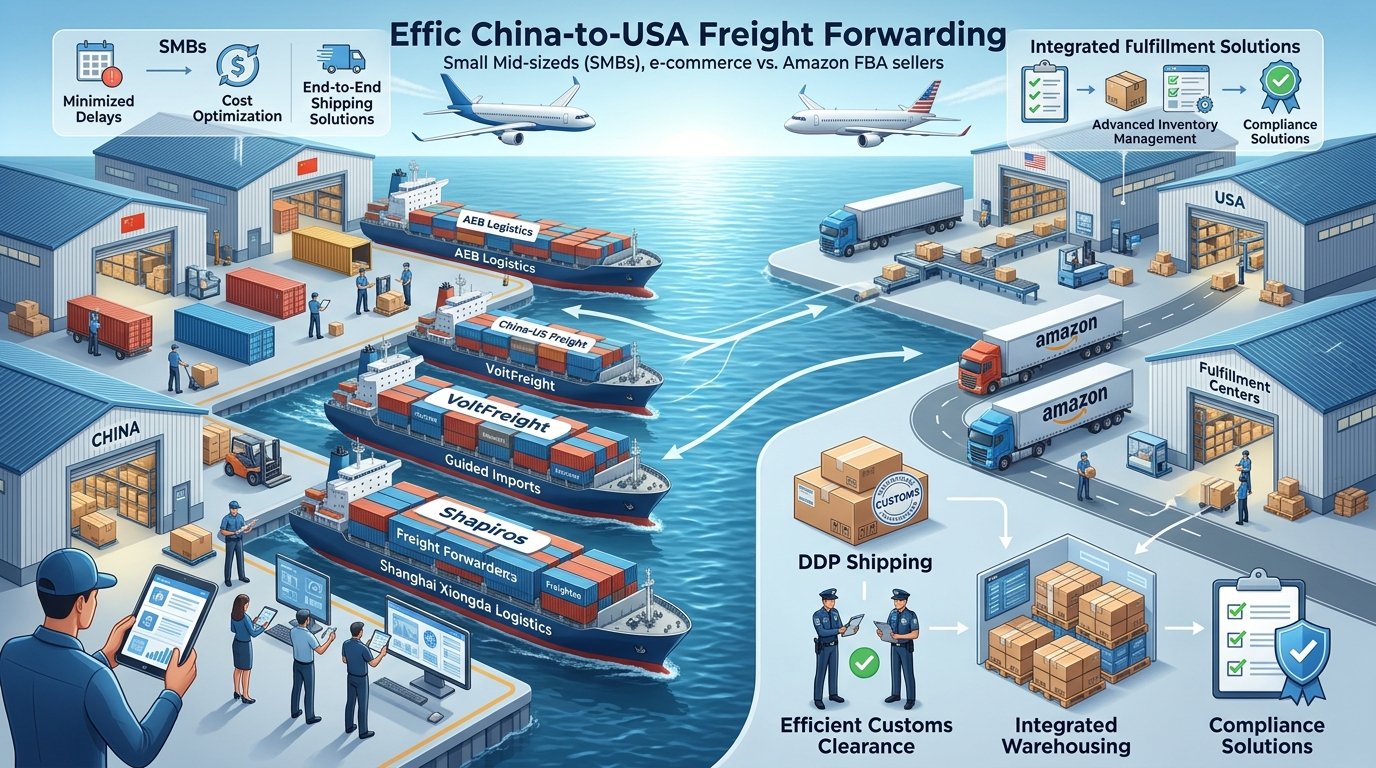
AEB Logistics

AEB Logistics specializes in shipping from China and works closely with small and mid-sized businesses to manage their supply chains. They offer both air and ocean freight options for importers moving products to the U.S.

You get access to customs clearance, warehousing, and distribution support. AEB provides freight forwarding from China to USA with clear guidance on incoterms and pricing so you’re not hit with unexpected costs.

They’ve built up real expertise working with Amazon FBA sellers. The team knows how to handle labeling, prep services, and those tricky FBA delivery schedules.

AEB Logistics can arrange DDP shipping where they pay duties and taxes for you. That way, you just get a single all-in price—no juggling payments at different steps.

Their online platform lets you track shipments and talk directly to your account manager. You can request quotes and compare air versus ocean shipping based on what your inventory needs.

China-US Freight (China to USA dedicated forwarder)

China-US Freight has focused only on shipping from China to the U.S. since 2008. They aren’t distracted by global routes like some other forwarders.

This specialization can make a difference for your Amazon FBA business. They work as tier-1 partners with major shipping lines, which can mean better rates and reliable space during busy seasons.

You’ll find both sea and air freight options. Their services include customs clearance and delivery right to Amazon warehouses across the U.S.

Because they only run the China-USA route, their team really knows the regulations and requirements for importing to America. That focus helps avoid a lot of common customs headaches.

They offer door-to-door service, so you don’t have to coordinate with several companies. Your cargo goes from your Chinese supplier straight to your U.S. destination.

Their website has tools for quotes and tracking. You can manage logistics without endless phone calls or email chains.

VoltFreight (China to USA ocean & air forwarding)

VoltFreight offers China freight forwarding with 24/7 support for both air and ocean shipping. They focus on helping small and medium businesses import from China to the U.S.

You can pick from sea freight, air freight, or express courier. VoltFreight provides DDP and DDU shipping plus door-to-door delivery for Amazon sellers and e-commerce brands.

Their platform lets you compare freight routes from China to the U.S. They’ll handle supplier pickup and cargo consolidation at origin.

You get customs-aware DDP options that take a lot of the hassle out of importing. VoltFreight supports Amazon FBA delivery right to fulfillment centers.

They organize final delivery by ZIP code across the country. The company also provides landed-cost planning tools so you can get a grip on your total import expenses.

VoltFreight targets importers, wholesalers, and B2B companies who want a reliable shipping partner. You get support from pickup in China all the way to your U.S. doorstep.

Guided Imports

Guided Imports specializes in freight forwarding and FBA prep services for retail, e-commerce, and Amazon brands shipping from China. You can use their network of warehouses in both China and the U.S.

They offer product inspections, quality control, and FBA prep work. You can also consolidate shipments from multiple suppliers to save money.

The team handles customs clearance and delivers right to Amazon warehouses. Guided Imports gives you both air and sea freight options—sea is cheaper, air is faster if you need to restock urgently.

They manage the entire import process from factory pickup to final delivery. You get tracking updates along the way, and they handle all documentation and customs stuff.

Their services fit small and mid-sized businesses who need reliable China to USA shipping. Pricing depends on shipment size and frequency. You can get quotes on their website for your specific needs.

Shanghai Xiongda Logistics (FCL/LCL sea freight to USA)

Shanghai Xiongda International Logistics specializes in sea freight from China to the United States. They’ve been around since 2006 and now offer a full range of logistics services.

You can pick full container load (FCL) or less-than-container load (LCL) shipping. Xiongda runs 12 branches across China in cities like Shanghai, Shenzhen, Qingdao, Chengdu, and Changsha.

They offer Amazon FBA logistics services with direct shipping to fulfillment centers. Their U.S. warehouses in Los Angeles handle storage, sorting, and labeling.

You get real-time tracking during the shipping process. Xiongda works with major shipping lines like MATSON, ZIM, EVERGREEN, MSC, COSCO, and CMA, so they can offer competitive rates from China to the U.S.

The company handles customs clearance and offers door-to-door delivery. They ship both light and heavy cargo, and you can pay by weight or volume depending on your situation.

Shapiro

Shapiro has handled customs brokerage and freight forwarding since 1915. Their experienced team specializes in China to USA shipments for Amazon FBA sellers.

They offer ocean and air freight with full customs support. You can count on their customs know-how to deal with import regulations and the paperwork.

Shapiro runs warehousing and distribution at several U.S. locations. This helps you store inventory before sending it to Amazon fulfillment centers.

Their tech platform gives you shipment visibility. They handle both LCL and FCL shipments from China, and you’ll work with account managers who know ecommerce and FBA rules.

They’ll coordinate pickup from your Chinese supplier and delivery to your U.S. destination. Shapiro provides DDP shipping that covers duties and taxes, so you get one landed cost.

Their long history means they’ve built strong relationships with carriers and customs officials.

Freightos

Freightos runs a digital freight marketplace that connects you with multiple carriers and forwarders for China to USA shipments. You can compare real-time quotes from different providers right on their platform.

They offer both air and ocean freight for your Amazon FBA inventory. Their booking tools let you manage shipments without endless phone calls or emails.

You get customs clearance coordination and door-to-door delivery. Their dashboard lets you track your cargo at every step.

Freightos partners with established carriers and forwarders, so you can pick based on price, transit time, and service level for your needs.

The quote comparison makes it easy to weigh different shipping routes and methods. Estimated delivery times and pricing sit side-by-side so you can make the call for your FBA shipments.

They design their system for importers who want clear freight costs. You see itemized breakdowns—no nasty surprises when your shipment arrives.

Key Freight Forwarding Services for SMBs

Small and mid-sized businesses need forwarders who handle Amazon’s strict requirements, manage import taxes upfront, clear customs quickly, and keep inventory close to customers. These services really decide if your shipments show up on time and ready to sell.

Amazon FBA Compliance Solutions

Amazon cares a lot about how products show up at their warehouses. Your freight forwarder has to get labeling, carton specs, and shipping notices right.

FBA shipments have strict box size and weight rules. Most Amazon warehouses won’t accept boxes over 25 inches on any edge or heavier than 50 pounds, unless it’s a single oversized item.

Your forwarder should prep your cargo to fit these standards before it even leaves China. If they don’t, you’ll probably run into headaches later.

Critical FBA services include:

  • FNSKU label printing and application
  • Polybagging for apparel and soft goods
  • Case pack verification and reboxing
  • Pallet preparation following Amazon’s guidelines
  • Appointment scheduling with Amazon fulfillment centers

Freight forwarders with Amazon FBA experience know that missed appointments or wrong labels can mean refusal fees up to $500 per shipment. They work directly with Amazon’s carrier compliance system to dodge these penalties.

DDP Shipping Explained

DDP stands for Delivered Duty Paid. Your freight forwarder pays all import taxes, customs duties, and fees in China before your goods ship.

You get one all-in price that covers everything from the factory door in China to the Amazon warehouse in the U.S. There are no surprise bills when your shipment lands.

DDP shipping includes:

  • Import duties and tariffs
  • Merchandise processing fees
  • Customs bond costs
  • Destination port charges
  • Final mile delivery to FBA warehouses

DDP door-to-door shipping makes sense for SMBs because it takes away financial surprises and makes accounting easier. You’ll know your exact landed cost before you ever order from your supplier.

The forwarder takes care of all paperwork with U.S. Customs and Border Protection. They use their own customs bond and importer of record services, so you don’t have to set up those costly requirements yourself.

Efficient Customs Clearance Processes

Customs clearance decides how quickly your products move from port to Amazon’s warehouses. Slow clearance racks up storage fees and can mean missed sales.

Good forwarders file entry documents with customs 72 hours before your ship arrives. This early filing lets customs review paperwork and catch issues ahead of time.

Most shipments clear within 24 hours when filed right. Your forwarder needs a licensed customs broker in big U.S. ports like Los Angeles, New York, and Seattle.

These brokers know the latest import rules and talk directly to customs officials to resolve holds fast.

Key clearance capabilities:

  • ISF filing 24 hours before vessel departure
  • HTS code classification for accurate duty rates
  • FDA and other agency clearances for regulated products
  • Response to customs examinations and holds

Strong U.S. customs clearance capability keeps your inventory moving and your cash free. Experienced forwarders keep compliance records that speed up your next shipments.

Integrated Warehousing and Distribution

Many SMBs need short-term storage between the port and Amazon warehouses. Integrated warehousing lets you combine shipments, inspect products, or redirect inventory as needed.

Warehouses near big U.S. ports give you options that direct-to-FBA shipping just can’t. You can hold goods until Amazon opens up receiving appointments, or split shipments across several fulfillment centers.

Warehousing services for e-commerce:

  • Quality inspection and product photography
  • Inventory management systems with real-time tracking
  • Order fulfillment for direct-to-consumer sales
  • Returns processing and product refurbishment
  • Cross-docking to reduce handling time

Forwarders with their own warehouse networks usually charge less than third-party logistics providers. They can prep and send your goods to Amazon without extra transfer fees or delays.

Some forwarders also offer hybrid fulfillment, storing backup inventory and automatically topping up your FBA stock. This helps you avoid stockouts during busy seasons without paying Amazon’s long-term storage fees.

Optimizing Transit Times and Shipping Costs

Picking between ocean and air freight really affects your delivery speed and landed costs. It helps to know what causes delays so you can plan shipments that hit your inventory deadlines without overspending.

Comparing Ocean and Air Freight Options

Ocean freight from China to the U.S. takes about 20-25 days for DDP door-to-door service. It’s way cheaper than air freight, so it’s great if you have flexible timelines and bigger shipments.

Air freight arrives in 5-8 days but costs three to five times more than ocean shipping. Go with air if you need urgent restocks, have high-value lightweight items, or if storage fees are eating into your margins.

Ocean DDP shipping times include customs clearance and final delivery to your warehouse or Amazon. Express courier services deliver in 3-5 days, but they’re best for shipments under 500 pounds.

LCL vs FCL ocean freight:

  • LCL (Less than Container Load): Share container space, pay for just your volume, and it’s ideal for under 10 cubic meters
  • FCL (Full Container Load): Rent the whole container, better rates for over 15 cubic meters, and faster port processing

Minimizing Import Logistics Delays

Customs clearance is usually the biggest cause of delays in China-to-USA shipments. You need accurate invoices, correct HS codes, and full product documentation before your shipment hits the port.

When you work with freight forwarders that handle DDP shipping, they manage customs bonds, duties, and clearance for you. This takes the compliance stress off your team and saves you from detention fees.

Port congestion can add 2-7 days during peak times, like before the holidays. Book shipments early and try less crowded ports if you can swing it.

Common delay causes:

  • Missing or incorrect customs paperwork
  • FDA or other regulatory holds for specific products
  • Peak season port backlogs
  • Incorrect addresses or recipient info for final delivery

Your forwarder should give you real-time tracking and heads-up alerts about possible delays. With that visibility, you can tweak inventory plans and set better expectations for your customers.

Frequently Asked Questions

Importers always want clear answers about customs processes, cost breakdowns, carrier options, and warehouse services when moving products from Chinese suppliers to U.S. fulfillment centers.

Which freight forwarders offer end-to-end delivery to Amazon fulfillment centers in the United States?

AEB Logistics offers true door-to-door service, including pickup from your Chinese supplier, customs clearance, and final delivery to Amazon warehouses. They’ll handle FBA prep like labeling and packaging to match Amazon’s rules.

China-to-USA freight forwarders specializing in Amazon FBA can book appointments at fulfillment centers. VoltFreight manages both air and ocean shipments with direct delivery to multiple Amazon warehouse locations across the country.

China-US Freight focuses on the China-to-USA route and handles delivery scheduling for FBA destinations. guidedimports.com helps sellers who want hands-on support throughout the shipping process.

How do I compare air, ocean, and express options when shipping goods from China to the U.S.?

Ocean freight takes 25-35 days but is way cheaper per kilogram than air shipping. It’s best if you have four to six weeks before you need stock at your warehouse.

Air freight delivers in 5-10 days and works for urgent restocks or high-value, low-weight products. Express services like DHL or FedEx can get your shipment there in 3-5 days, but the price only makes sense for small, time-sensitive packages.

Always compare total costs by asking for quotes that include every fee, not just the base freight rate. Work out your cost per unit, think about how long your inventory will be in transit, and consider the risk of stockouts when picking your shipping method.

What factors most influence total landed cost, including duties, taxes, and destination fees?

Your product’s Harmonized System (HS) code sets the duty rate you’ll pay when goods enter the U.S. Different categories have duty rates from 0% to 37.5%, so getting the classification right really matters.

The customs value is the price you paid for goods plus international shipping and insurance. U.S. Customs and Border Protection calculates duties on this total, not just the supplier’s invoice price.

Destination charges can add up fast and include terminal handling, container pickup, and delivery to your warehouse. DDP shipping rolls all these costs into one number, so you know your total expense before your goods arrive.

Which services should I require to ensure smooth customs clearance for U.S. imports?

You need a licensed customs broker to file your entry documents with U.S. Customs and Border Protection. This broker should check your HS codes, calculate duties, and submit certifications before cargo arrives at a U.S. port.

Request Import Security Filing (ISF) service—your broker must submit this at least 24 hours before ocean freight leaves China. Late or wrong ISF filings can mean penalties starting at $5,000 per violation.

Your forwarder should help with commercial invoices, packing lists, and bills of lading that fit U.S. customs rules. They should also track your shipment’s customs status and tell you right away if CBP needs more info or wants an inspection.

How can I verify a forwarder’s reliability, licensing, and cargo insurance before booking?

Check the Federal Maritime Commission website to make sure your forwarder has a valid Ocean Transportation Intermediary license for ocean shipments. For air freight, see if they’re a registered Indirect Air Carrier with the TSA.

Ask for their cargo insurance certificate and check if the coverage matches your shipment value. Standard coverage usually protects up to $500 per package, but you can buy extra insurance for pricier goods.

Get references from other Amazon FBA sellers or e-commerce companies shipping similar products. Look up reviews on independent sites, and ask for a sample tracking portal login to see how their tech and communication actually work before you commit.

What warehousing, labeling, and appointment-booking support is available for U.S.-bound shipments?

Freight forwarders for Amazon FBA offer prep services like applying FNSKU labels, polybagging, bundling, and carton labeling. They handle all that according to Amazon’s requirements, which is honestly a relief for anyone shipping in bulk.

Shanghai Xiongda Logistics does this work at their U.S. warehouse facilities before sending out your stuff for final delivery. It’s a pretty smooth setup, especially if you don’t want to deal with last-minute chaos.

Third-party logistics providers near major ports give you short-term storage if you need to split large shipments into several Amazon appointments. This kind of warehousing helps you dodge long-term storage fees at Amazon and gives you more control over your inventory flow.

Professional forwarders take care of the whole appointment booking process with Amazon’s carrier rules and delivery windows. They coordinate with Amazon’s warehouse teams and pick the right carrier for you.

They’ll make sure your shipment shows up during your scheduled time slot, so you don’t get hit with rejection or rescheduling fees. It’s not always perfect, but it beats trying to wrangle it all on your own.

Posted on

China to USA Freight Forwarders: Top 9 DDP Specialists Ranked by Service Quality and Quote Transparency

China to USA Freight Forwarders Top 9 DDP Specialists Ranked by Service Quality and Quote Transparency

Moving products from China to the United States isn’t simple—you need careful planning and a reliable shipping partner. Choosing the right China to USA freight forwarder can make the difference between your goods arriving on time and on budget, or getting stuck with surprise customs fees.

If you’re a U.S. importer or ecommerce seller, it’s worth understanding DDP (Delivered Duty Paid) services. The way each company handles international shipping can have a real impact on your costs and headaches.

Freight forwarding from China to USA isn’t just about moving cargo across the ocean. You need a partner who handles customs clearance, manages import logistics, and doesn’t hit you with hidden fees.

The right forwarder streamlines your supply chain. They can help avoid delays and keep your costs predictable.

This guide takes a close look at nine established freight forwarders, focusing on DDP expertise, service quality, and support for American importers. You’ll see what makes each company different, which factors matter most when evaluating DDP shipping providers, and how to match your shipping needs with the right logistics partner.

AEB Logistics

AEB Logistics zeroes in on shipping from China to the USA, mainly for small and medium-sized businesses. They offer both ocean and air freight, with clear pricing that’s easy to understand.

When you work with AEB, you get customs brokerage support and warehousing options. Amazon sellers can use their FBA prep services, and they’ll handle supply chain coordination from end to end.

Their DDP shipping covers duties, taxes, and delivery straight to your door. You can track your shipments online and talk directly to account managers—no endless bots or canned replies.

AEB focuses on quality shipping, warehousing, and customs brokerage. They’re a good fit if you want reliable transit times and straightforward communication throughout the process.

If you like having a real person on your side, their hands-on support is a plus. You’ll get dedicated help from someone who actually understands your business.

Dingshang Logistics

Dingshang Logistics works as a freight forwarder specializing in full container and less-than-container shipments from China to the U.S. They’re based in Ningbo, with offices in Shanghai and Shenzhen for pickups.

They’ve got warehouse partners in Los Angeles, Dallas, and New York for delivery. Door-to-door service includes factory pickup and export documentation—covering the basics you’ll need to get goods from your supplier to your U.S. warehouse.

Dingshang focuses on both FCL and LCL shipping. Full container loads work for large shipments, while less-than-container is better for smaller orders.

You can get deliveries on both coasts. If you want faster transit, shipping to Los Angeles on the West Coast is usually quicker; New York and Dallas work well if your customers or warehouses are there.

For quotes and transit times, you’ll need to reach out directly. Their approach suits importers looking for standard freight forwarding, not so much those needing specialized DDP or FBA services.

Xiongda Logistics (Shanghai Xiongda)

Shanghai Xiongda International Logistics has shipped between China and North America since 2006. They run 12 branch offices in major Chinese port cities, including Shanghai, Shenzhen, Ningbo, Xiamen, and Qingdao.

US-based warehouses support Amazon FBA logistics and fulfillment services. They’ll take care of warehousing, sorting, labeling, and returns for ecommerce sellers.

You can ship by sea or air, and track your cargo in real time. Their customs clearance services report low inspection rates, which helps avoid port delays.

Xiongda sticks to trans-Pacific routes. This focus means you’re working with a team that knows the ins and outs of China-to-USA shipping.

They offer door-to-door delivery for both full containers and smaller shipments. Their clients range from small ecommerce sellers to big importers who need regular shipping capacity.

Flexport

Flexport is a digital freight forwarder that mixes technology with old-school shipping for your China to USA cargo. You can manage everything through their online platform, which offers real-time tracking and visibility at every step.

Their DDP services include customs clearance, duty payment, and delivery to your warehouse or fulfillment center. You can pick between ocean and air freight based on your timeline and budget.

Flexport works well for ecommerce sellers and larger importers who want transparency in pricing and shipment status. Quotes come through their digital system, though prices can shift depending on volume and service details.

You can add cargo insurance and warehousing at their facilities. If your order is small, they’ll consolidate it with other cargo to save you money.

They have a customer support team with licensed customs brokers who handle paperwork and compliance. You can reach your account team through the platform or talk directly if things get complicated.

Maersk Logistics (China to USA services)

Maersk Logistics is one of the world’s biggest container shipping companies. You can tap into their vast network of ocean freight routes between major Chinese ports and U.S. destinations.

Their DDP services include customs clearance, inland transport, and final delivery to your warehouse. Dedicated account managers help with documentation and compliance.

Maersk’s digital platform lets you track your shipment status and get updates at each stage. Pricing depends on container size, route, and season, so you’ll want to request a quote online or talk to their sales team.

They offer both full container load (FCL) and less than container load (LCL). Air freight is available for urgent shipments, but ocean freight is their main thing.

Maersk has offices in Shanghai, Shenzhen, Ningbo, and other Chinese manufacturing hubs. Their U.S. network covers key ports like Los Angeles, New York, and Savannah.

Kuehne+Nagel China–USA

Kuehne+Nagel is one of the largest global freight forwarders, with offices all over China and the U.S. You get both ocean and air freight, plus DDP service if you need it.

They’ll handle customs clearance, duty payment, and final delivery to your warehouse. Their digital platform lets you track shipments and manage paperwork online.

Kuehne+Nagel is a good fit for big importers. You’ll need to request quotes directly, since they don’t post prices online.

Their network covers major Chinese hubs like Shenzhen, Shanghai, and Ningbo. They offer warehousing and storage at both ends.

You can bundle in cargo insurance and quality inspection. Dedicated account managers help if you’re importing regularly.

Response times can vary—smaller importers may deal with minimum volume requirements or slower quotes compared to China-focused forwarders.

DB Schenker China to USA

DB Schenker is one of the top global freight forwarders, with networks in China and the U.S. You can use their ocean and air freight, plus DDP shipping that covers customs clearance and final delivery.

Their platform offers real-time tracking. Account managers coordinate your cargo from Chinese factories to your U.S. warehouse or distribution center.

DB Schenker handles full container and less-than-container loads. Their customs brokerage team manages your import paperwork and compliance for the U.S.

They’re set up for medium to large importers who need steady capacity and established routes. If you’ve got oversized cargo, temperature-sensitive goods, or hazardous materials, they’ve got specialized divisions for that.

Pricing works best if you ship regularly. Smaller importers might find their quotes higher than China-focused forwarders. You’ll have to request pricing directly, since they don’t post rates online.

DB Schenker keeps warehouses in major U.S. ports like Los Angeles, Long Beach, and New York.

CMA CGM Logistics (China–USA)

CMA CGM Logistics runs as the freight forwarding arm of one of the world’s top container shipping lines. When you ship from China to USA ports, you get direct access to their huge vessel network.

The company offers both LCL and FCL ocean freight options. If you need quicker transit, their air freight services can help.

You can set up door-to-door delivery with their DDP programs, which take care of customs clearance and get your goods right to your warehouse. It’s a less stressful way to move shipments across borders.

CMA CGM keeps offices in major Chinese manufacturing cities like Shanghai, Shenzhen, and Ningbo. That means you get local support for cargo pickup and all the paperwork headaches.

Their online tracking system lets you monitor shipments in real time, from start to finish. It’s honestly reassuring to see where your cargo is at any moment.

CMA CGM handles cargo insurance, warehousing, and distribution across the USA. You can coordinate your whole supply chain through their integrated platform.

Their customs brokerage team manages tariff classification and duty payments for imports. It takes a lot off your plate if you’re not a customs expert.

Large importers usually get the most value here because of the container shipping focus. If you’re a smaller ecommerce seller, you might want to look at providers that specialize in DDP for smaller shipments.

Sinotrans USA Freight Services

Sinotrans is one of China’s biggest state-owned logistics providers, and they’ve got established U.S. operations. You can move both air and ocean freight through their network, and their pricing structures are pretty consistent.

Their DDP services include customs clearance and final delivery to your warehouse or fulfillment center. Sinotrans maintains offices in major U.S. ports like Los Angeles, New York, and Chicago.

You get reliable transit times on the standard shipping lanes. Sinotrans works well for importers moving regular container loads who want predictable schedules.

Their online quoting system gives you basic rate info, but you’ll usually need to talk to an account manager for a detailed quote. Their customer service feels a bit more formal than what you get from smaller forwarders.

Sinotrans offers warehousing and distribution if you need to store goods before final delivery. Their size allows competitive rates on full containers, though less-than-container shipments might not get the same price breaks.

Sinotrans is a good fit for established importers who want steady service from a big, stable forwarder with strong roots in China’s logistics scene.

Key Factors Influencing DDP Shipping Performance

When you’re checking out China to USA freight forwarders, don’t just focus on shipping rates. You’ll want to consider delivery speed, customs expertise, and cost transparency to avoid slowdowns and surprise charges.

Transit Time and Reliability

Transit time changes a lot depending on your shipping method and the forwarder’s carrier relationships. Air freight usually takes 5-8 days door-to-door, while ocean freight can run 18-35 days depending on which ports you use and how quickly customs clears your cargo.

Your forwarder’s reliability actually matters more than whatever they promise for transit times. Companies that offer real-time tracking and stick to delivery windows are worth their weight in gold.

Typical Transit Times by Method:

  • Express air: 3-5 days
  • Standard air: 7-10 days
  • Ocean LCL: 25-35 days
  • Ocean FCL: 18-28 days

Port congestion and customs delays sometimes tack on 3-7 extra days for ocean shipments. Forwarders with solid connections at big U.S. ports like Los Angeles, Long Beach, and New York can help shave off those delays.

Customs Compliance and Documentation

Your DDP forwarder takes care of all customs clearance under this shipping term. They need to classify your goods with the right HTS codes, figure out duties and tariffs, and submit everything to U.S. Customs and Border Protection.

Section 301 tariffs on Chinese goods can get tricky, so your forwarder should know the rules, spot exemptions, and give you a clear landed cost before you ship.

You’ll need commercial invoices, packing lists, bills of lading, and certificates of origin. If paperwork is missing or wrong, shipment holds can drag on for weeks.

Pick forwarders with licensed customs brokers and experience in your product category. They should be upfront about documentation needs and flag compliance risks early.

Hidden Charges and Pricing Transparency

DDP pricing should cover freight, customs duties, import taxes, terminal handling, and final delivery. Some forwarders leave out things like fuel surcharges, security fees, or residential delivery charges, though.

Always ask for itemized quotes that break down every cost. Don’t just look at the bottom line—check what’s actually included in the DDP rate.

Common fees to verify:

  • Destination port charges
  • Customs examination fees
  • Storage and demurrage
  • Lift gate or inside delivery
  • Documentation fees

Your forwarder should give you a binding quote that only changes if you adjust shipment details. Variable fuel surcharges are fine if they’re upfront about them. Be wary of companies that lure you in with low rates and then pile on extra charges later.

How to Evaluate Freight Forwarders for U.S. Importers

A solid freight forwarder really gets U.S. customs rules, gives you real-time shipment visibility, and offers support that fits your business model. These three things make the difference between a reliable partner and a source of headaches.

Assessing Experience with U.S. Market Requirements

Your freight forwarder should have real experience with U.S. customs and compliance. Look for companies that handle ISF filings, know FDA and CPSC rules, and have solid relationships with U.S. customs brokers.

Ask how they handle tariff classifications and duty calculations. The best forwarders will walk you through their process for managing Section 301 duties and other China-specific trade rules.

Check if they’ve got U.S.-based staff who know local delivery quirks. If a forwarder has offices or partners in big U.S. ports, they can sort out customs holds and last-mile delivery issues way faster.

Ask for case studies or references from clients in your industry. Companies that ship products like yours know the right documentation and compliance steps for your cargo type.

When looking at top freight forwarders for USA imports from China, check their record with DDP shipments where they handle duties and taxes up front.

Technology Adoption and Tracking Capabilities

Modern forwarders offer digital platforms for real-time visibility into your shipments. You should be able to track containers, check customs status, and grab shipping docs without chasing emails or phone calls.

Look for platforms that can hook into your current systems. The best forwarders offer API connections to your inventory or ecommerce platform.

Key tech features to check out:

  • Real-time GPS tracking for ocean and air
  • Automated milestone notifications
  • Digital doc management and customs paperwork
  • Instant quote tools
  • Analytics dashboards for shipping costs and transit times

Ask for a demo of their tracking system before you sign up. See how fast you can find shipment status, download bills of lading, and pull proof of delivery docs.

Customer Support for Ecommerce Businesses

Ecommerce sellers need quick, responsive support. Your forwarder should assign you an account manager who gets your products, shipping habits, and business goals.

Test their response times before you commit. Shoot over questions by email and phone, and see if their answers are clear and helpful.

Freight forwarders for Alibaba imports to the USA should know how to manage pickups from multiple suppliers and consolidate shipments.

Look for support hours that fit your schedule. If you work evenings or weekends, having China-based teams available during U.S. off-hours can make a real difference when problems pop up.

Ask about their escalation process for urgent issues. You’ll want a clear way to reach senior staff if shipments get delayed or customs problems threaten your sales.

Frequently Asked Questions

Importers want straight answers about DDP pricing, customs paperwork, shipping mode selection, and spotting hidden costs before they sign anything. Here are the questions that come up most when picking forwarders for China-to-USA shipments.

Which factors matter most when comparing forwarders for duty-paid delivery into the United States?

Prioritize experience with U.S. Customs classification and tariff calculations. A forwarder handling DDP shipping from China to USA should calculate duties accurately using Harmonized Tariff Schedule codes before your goods leave China.

Check if the forwarder runs their own bonded warehouses at major U.S. ports. Direct control over warehousing means fewer handoff delays and better visibility when your cargo clears customs.

Ask about payment terms for duties and taxes. Some forwarders want you to pre-fund duty payments, while others cover costs up front and bill you later with a small margin.

How can importers verify that quoted prices include duties, taxes, and all destination charges before booking?

Ask for a detailed line-item quote that separates freight, insurance, customs brokerage, duties, and inland delivery. A solid DDP quote will list estimated duty rates based on your product’s HS code and declared value.

Compare the forwarder’s duty estimate with the U.S. International Trade Commission’s tariff database. If their estimate seems suspiciously low, they might be underquoting just to win your business.

Get a written statement that the quote covers all costs to your warehouse door. The best shipping companies from China to USA will confirm in writing that there won’t be extra fees unless you ask for special services.

What paperwork and importer-of-record responsibilities should be clarified to avoid customs delays on U.S. arrivals?

First, confirm who’s going to act as the importer of record for your shipments. Under DDP terms, the forwarder usually takes on the IOR role, but you still need to provide accurate product descriptions and follow all U.S. regulations.

Double-check your commercial invoice. Make sure it lists complete product details, country of origin, and the right HS codes. If you leave out information or keep things vague, customs will probably hold your shipment—no matter who’s handling clearance.

Ask if your forwarder needs a power of attorney to file entries for you. Most U.S. Customs entries require POA authorization. Getting this sorted before your first shipment can save you a lot of hassle down the line.

When is air freight versus ocean freight the better option for shipping consumer goods from China to the U.S.?

Go with air freight if your product’s value-to-weight ratio is over $10 per kilogram and you need delivery in about a week. Electronics, fashion accessories, and medical supplies often fit this profile, and the speed really does offset the higher shipping cost.

Ocean freight works better for shipments over 500 kilograms—if you can plan for 30 to 40 days in transit. Bulky items like furniture, appliances, and big inventory restocks just cost way less by sea, even if you have to wait longer.

If you want something in between, look into ocean freight with express release. Some forwarders offer priority unloading and faster customs clearance, which can cut standard ocean transit by about a week or so for a reasonable extra fee.

What service levels and tracking features should ecommerce sellers expect from a reliable door-to-door provider?

You should get tracking updates at every key step—pickup, port departure, customs clearance, and final delivery. Top China to USA freight forwarders for SMBs usually send automated notifications by email or SMS, so you don’t have to keep checking a portal.

There should be a real-time dashboard showing your cargo’s current location and estimated delivery date. Ideally, you’ll see customs status separately, so you can tell if a delay is because of clearance or just transportation.

Find out if the forwarder gives you a dedicated account manager. Having one person who really knows your shipping patterns can speed up problem-solving way more than a general support line ever will.

What common red flags indicate a forwarder may add hidden fees or misclassify cargo to reduce the initial quote?

Watch out for quotes that list duties as “TBD” or “estimated upon arrival” instead of giving you a clear, calculated number. That’s a sign something’s off. Freight forwarders from China to USA who actually know DDP should tell you the duty cost upfront, before you commit to anything.

If a forwarder suggests you describe your products vaguely or use a different HS code just to get a lower duty rate, that’s a big red flag. Customs can hit you with fines, hold your cargo, or even take away your import privileges if they catch misclassification.

Also, be skeptical if a forwarder demands full payment before picking up your goods and doesn’t offer milestone-based billing. Most legit providers just ask for a deposit, then collect the rest after customs clearance or delivery. If they’re pushing for all the money up front, something’s probably not right.

Posted on

China to USA Freight Forwarders: 2026 Comparison, Costs, and Best Services

China to USA Freight Forwarders 2026 Comparison, Costs, and Best Services

Picking the right freight forwarder for your China to USA shipments shapes every part of your import operation. The wrong partner can pile up hidden costs, cause customs delays, and create delivery headaches that drag down your business.

But the right one? They help you move goods smoothly while keeping total landed costs in check.

Importers shipping from China in 2026 need freight forwarders who offer clear pricing, reliable customs clearance, strong carrier relationships, and flexible service options that match their specific cargo needs.

China to USA freight forwarders now compete on four main areas: ocean and air shipping quality, warehousing and distribution support, FBA and eCommerce logistics, and customs brokerage strength.

This guide compares freight forwarders by service type, shipping mode, cost transparency, and total value. Whether you ship full containers or just a few parcels, understanding these differences helps you pick a partner that fits your budget and timeline.

Key Takeaways

  • Freight forwarders differ in service scope, with some offering basic transport while others provide warehousing, FBA prep, and customs support.
  • Ocean freight costs less but takes longer than air shipping, and understanding shipping modes helps you balance speed with budget.
  • Strong customs clearance and transparent pricing prevent delays and unexpected fees that increase your total landed cost.

Freight Forwarder Service Types and Choosing the Right Partner

The freight forwarding industry has split into two main camps with different service models and technology approaches. DDP, CIF, and FOB terms decide who pays what and when, while marketplace platforms give you alternatives to old-school booking methods.

Traditional vs. Digital Freight Forwarders

A traditional forwarder usually works through phone calls and emails. You might wait 24 to 48 hours for quotes and communicate with account managers during business hours.

Digital forwarders use online platforms and apps to give instant quotes and real-time tracking. Companies like Freightos offer price and service comparison tools so you can check multiple forwarders at once.

These platforms often automate documentation and give you 24/7 access to shipment status. Traditional forwarders bring more personalized service and expertise for tricky shipments.

Digital options usually provide better pricing transparency and faster responses. Your pick depends on whether you want hands-on support or prefer speed and tech-driven efficiency.

DDP, CIF, and FOB Shipping Explained

FOB (Free on Board) means your supplier’s job ends when the goods are loaded on the vessel. You take care of ocean freight, customs, and delivery to your warehouse.

CIF (Cost, Insurance, and Freight) covers transportation to the US port, but you still pay import duties and inland delivery. Using CIF terms can create scenarios where importers face inflated costs they didn’t see coming.

DDP (Delivered Duty Paid) includes all costs through final delivery. The forwarder manages customs clearance, duties, and transportation to your door.

DDP shipping removes uncertainty from total landed costs and makes budgeting simpler for importers.

Amazon Global Logistics and Marketplace Platforms

Amazon Global Logistics offers shipping for sellers who use Fulfillment by Amazon. The platform links with your seller account and sends shipments straight to Amazon warehouses.

Other marketplace platforms connect you with multiple forwarders through one interface. You can compare rates, book shipments, and track cargo without juggling a bunch of separate contacts.

These platforms work best for standard shipments with simple requirements. They might not handle specialized cargo or provide the custom service that complex imports need.

Shipping Modes and Delivery Options

China to USA freight forwarders offer three main shipping modes that balance cost against speed. Ocean freight delivers the lowest per-unit cost for large shipments.

Air freight cuts transit time to days for urgent cargo, and express couriers handle small parcels door-to-door.

Ocean Freight: FCL and LCL Models

Sea freight dominates shipping from China because it moves heavy and bulky cargo at the lowest cost per kilogram. You choose between Full Container Load (FCL) and Less than Container Load (LCL).

FCL means you rent an entire container. A 20ft container usually fits 28–33 cubic meters, while a 40ft high-cube container holds 60–68 cubic meters.

Trans-Pacific FCL rates in July 2026 range from $5,400 to $6,600 for a 20GP and $6,075 to $7,425 for a 40HQ. Transit time averages 14–22 days to major West Coast and East Coast ports.

LCL works when your cargo doesn’t fill a full container. The forwarder combines your shipment with other importers’ goods and charges by cubic meter.

July 2026 LCL rates sit at $130 per cubic meter with 10–17 day transit times. LCL adds time since your cargo waits for consolidation at origin and deconsolidation at destination.

Many forwarders offer DDP sea service that includes ocean freight, customs clearance, import duties, and final delivery to your warehouse or Amazon fulfillment center.

Air Freight and Express Courier Solutions

Air freight slashes ocean’s 14–22 days down to 2–3 days for direct flights. Rates in July 2026 average $7.40 per kilogram for shipments over 1,000 kg to Los Angeles, New York, and Miami.

Air makes sense for high-value electronics, fashion with tight seasonal windows, or restocking inventory fast. Express courier services from DHL, UPS, and FedEx handle parcels and small shipments up to 300 kg.

Express rates in July 2026 run $17.11 per kilogram with 2–4 day delivery. Couriers manage customs clearance and deliver right to your door, keeping logistics simple for small batches and samples.

DDP air packages combine air freight with customs duties, clearance, and ground delivery. Some forwarders even handle Amazon appointment scheduling and delivery to FBA warehouses.

Express and DDP air cost more per kilogram than ocean but save weeks of inventory holding cost.

Door-to-Door vs. Port-to-Port Delivery

Port-to-port service means the forwarder moves your cargo from a Chinese port to a US port. You arrange pickup in China and final delivery in the US separately.

This option costs less but forces you to coordinate trucking, customs broker, and warehouse delivery. Door-to-door delivery covers everything from your supplier’s factory in China to your US warehouse or Amazon fulfillment center.

The forwarder handles export clearance, ocean or air transport, US customs, and ground delivery. Door-to-door pricing wraps all these steps into one quote.

Most SMB importers go for door-to-door because it cuts down on hassle. You get one point of contact and one invoice instead of juggling multiple vendors.

Door-to-door forwarders can also handle transloading and distribution if you need to split a container across several locations.

Cost Structure, Transparency, and Freight Rates

Freight rates between China and the USA vary a lot based on shipping mode, timing, and how forwarders build their quotes. Knowing chargeable weight calculations, surcharges, and destination charges helps you compare quotes and dodge those surprise costs that can blow up your total landed cost.

Understanding Freight Quotes and Hidden Charges

When you ask for a freight quote from a China to USA forwarder, the base rate rarely tells the whole story. Your actual cost includes several line items that some forwarders hide in fine print or only mention after booking.

Chargeable weight sets air freight costs. Carriers bill you based on either the actual weight or volumetric weight (length × width × height ÷ 6000 for air), whichever is higher.

A lightweight but bulky shipment can cost more than you expect if you only look at the actual weight. Ocean freight quotes should say if rates are per container (FCL) or per cubic meter (LCL).

Beyond the base ocean freight rate, common extra charges include:

  • Terminal handling charges at origin and destination ports
  • Documentation fees for bills of lading and customs paperwork
  • Demurrage penalties if you don’t pick up containers within the free time window
  • Destination charges including port fees, chassis usage, and delivery orders

Ask for an all-in quote that includes your carton count and packing list details. The most transparent forwarders give you itemized breakdowns.

Platforms like Freightos let you stack up multiple quotes side-by-side and spot the differences.

Freight Rates, Surcharges, and Peak Season Fees

Current freight rates from China to USA bounce around based on carrier capacity, fuel costs, and demand cycles. In 2026, ocean FCL rates range from $1,650 to $2,300 for a 20-foot container to Los Angeles, while air freight costs $4.20 to $6.50 per kilogram.

Surcharges can add a lot beyond base rates:

Surcharge Type Typical Range When Applied
Fuel surcharge (BAF) 10-25% of base rate All shipments
Peak season surcharges $500-$1,500 per container July-October, pre-holidays
Security fees $25-$50 All air and ocean
Container imbalance $200-$600 When equipment scarce

Peak season surcharges hit hardest during Chinese New Year (January–February) and the pre-Christmas rush (September–November).

Forwarders with carrier contracts usually snag better rates than those booking spot market capacity. Ask your forwarder how they handle surcharges—some eat minor changes, others pass every fee on right away.

Calculating Landed and Total Landed Cost

Your landed cost covers freight, customs duties, and delivery to your warehouse. Total landed cost adds insurance, compliance fees, and carrying costs, giving you the real per-unit expense.

To calculate landed cost accurately, you’ll need:

  • Freight quote (all-in, including destination charges)
  • Customs duties based on HS code classification
  • Importer Security Filing (ISF) fees ($50-$100)
  • Customs clearance fees ($100-$250)
  • Inland delivery from port to final destination
  • Insurance (typically 0.3-0.5% of cargo value)

Many forwarders now have landed cost calculators that include order protection and duty estimates. When you’re comparing forwarders, always look at the total delivered cost per unit, not just the ocean or air rate.

Request quotes using the same packing list details so you’re comparing apples to apples. Sometimes a forwarder with a low ocean rate ends up costing more once you see their destination charges—transparent all-in pricing is usually easier to manage.

Customs Clearance, Documentation, and Compliance

Your freight forwarder’s customs skills can make or break your timeline. The right partner handles brokerage, keeps up with regulations, and checks your paperwork before your goods hit U.S. ports.

U.S. Customs Clearance Processes

U.S. customs clearance means your freight forwarder works with a licensed customs broker who files entry documents for you. Your forwarder should have either in-house brokers or strong partnerships with third-party brokers who know the latest rules.

The clearance process starts when your shipment gets to a U.S. port. Your customs broker files CBP Form 3461 for immediate delivery and Form 7501 to calculate duties and fees. They’ll also check that your Importer Security Filing (ISF) was submitted at least 24 hours before the vessel left for ocean freight.

Top forwarders use tech that connects their systems straight to U.S. Customs and Border Protection databases. This setup lets you track clearance status in real time and respond quickly to any holds or inspections. Ask your forwarder how fast they handle CBP questions and if you’ll get dedicated broker support.

Key Import Documents and Requirements

Every commercial shipment from China now needs formal entry documentation, no matter the value. All imports from China must include proper customs documentation like a commercial invoice, packing list, and bill of lading or air waybill.

Your commercial invoice has to show accurate product descriptions, correct 10-digit HTS codes, true transaction values, and manufacturer details—all in English. If the description is vague or the HS code is wrong, you’ll probably get an automatic hold or extra inspection.

Essential documents your forwarder should manage:

  • Commercial invoice with HTS codes
  • Detailed packing list with weights and dimensions
  • Bill of lading (ocean) or air waybill
  • ISF filing for ocean shipments
  • Certificates of origin for preferential duty rates
  • FDA, FCC, or other agency permits for regulated products

Your forwarder needs to double-check that all documents match. Even a small mismatch between your invoice and packing list can hold up clearance for weeks.

Tariffs, Duties, and Regulatory Changes

Section 301 tariffs are still in effect for many Chinese goods in 2026, adding 7.5% to 25% in extra duties on top of standard rates. Your freight forwarder should explain which products face these tariffs and help you look into options like tariff engineering or verifying country of origin.

The de minimis exemption for duty-free entry under $800 no longer applies to commercial imports from China. Now you pay full duties and fees on every shipment, no matter the value.

Your forwarder’s understanding of Incoterms changes who’s responsible for customs. With DDP (Delivered Duty Paid), your forwarder handles all customs clearance and pays duties for you. With DDU or FOB, you keep more control but take on more compliance risk.

Work with forwarders who actually monitor USTR announcements and regulatory updates. They should let you know about tariff changes, new labeling rules, or compliance deadlines that might affect your products before your shipments leave China.

Value-Added Services and Post-Arrival Handling

What happens after your container arrives can make or break your landed cost. Warehousing gives you breathing room when delivery timing shifts. Consolidation helps cut per-unit costs if you buy from multiple suppliers. Amazon FBA logistics keeps things from falling apart between customs and final delivery.

Warehousing, Consolidation, and 3PL

Your freight forwarder’s warehousing matters when you need temporary storage, cargo sorting, or inventory staging before final distribution. Many importers now want buffer storage because retail schedules and marketplace allocations change after the shipment lands.

A 3PL partner can handle relabeling, carton count checks, and quality inspections so you don’t get stuck with damaged or miscounted goods.

Consolidation helps when you buy from different suppliers in different Chinese cities. Instead of paying for multiple ocean shipments, your forwarder can combine everything at a warehouse in Guangzhou or Shenzhen, then load one container. You’ll save on shipping and only have to clear customs once.

It’s better if your forwarder runs their own warehouses instead of only using third-party facilities. Direct control usually means faster turnaround and fewer mistakes.

Transloading and Distribution

Transloading moves your cargo from the container into a truck or smaller format for final delivery. This is handy if your goods need to reach several U.S. destinations.

Your forwarder gets the container at the port, breaks down the cargo, and arranges delivery to regional warehouses or retail spots.

Some China to USA freight forwarders offer cross-docking, skipping storage and sending goods straight to delivery trucks. It’s quick, but timing between customs release and truck availability has to be spot on.

Distribution support matters if you sell through different channels. Your forwarder can split a single container into shipments for Amazon, your own warehouse, and direct-to-retailer deliveries.

Amazon FBA Support and Appointment Handling

FBA logistics needs tight coordination between customs, warehouse prep, and Amazon appointments. Mess up carton labeling, shipment quantity, or delivery timing, and Amazon might refuse the shipment or hit you with storage penalties.

Your freight forwarder should manage everything from customs release to final Amazon delivery. That means checking carton counts against Amazon’s rules, applying the right FBA labels, and booking delivery appointments at the correct fulfillment center.

Choose a forwarder that really knows FBA. They get Amazon’s strict standards and can handle prep like polybagging, bundling, and FNSKU labeling before your goods reach the fulfillment center.

Frequently Asked Questions

Picking the right freight forwarder means knowing where they operate, which shipping methods fit your needs, what services they cover, how to spot hidden fees, what drives your landed cost, and which compliance steps keep things moving.

How do I choose between a China-based forwarder and a US-based forwarder for imports into the United States?

A China-based forwarder often gives you better rates on origin services like factory pickup, warehouse consolidation, and export documents. They’re on the ground with your suppliers and usually have better carrier relationships for the first leg.

US-based forwarders shine at destination services. They handle customs, talk directly to CBP, manage trucking, and sort out delivery issues in your time zone. If you need a lot of help with the last mile or complex compliance, a US partner makes things simpler.

A lot of SMB importers now choose China-based forwarders who offer door-to-door service with US partners or branch offices. This hybrid model gives you origin savings and destination expertise—one contact, one invoice.

The best fit depends on where you need the most support. If you ship regularly and want to cut per-unit costs, a China-based forwarder with solid US clearance skills is a good bet. If you ship now and then or need hands-on help with FDA, EPA, or agency rules, a US-based partner might be worth the extra cost.

Which shipping mode should I use for my product—air, ocean (FCL/LCL), rail, or express—and how does that choice change timelines and risk?

Ocean freight works for big volumes and lower-value goods when you can wait 20 to 40 days. FCL (full container load) is best if you have at least 15 cubic meters, since you pay for the whole container. LCL (less than container load) lets you share space with others if your volume is smaller, though transit times can stretch by a few days because of extra handling.

Air freight costs three to five times more than ocean but gets your goods there in 7 to 12 days door-to-door. It’s worth it for high-value or time-sensitive products, or if you need to restock quickly. There’s usually less risk of damage than by sea, and you don’t tie up as much capital in transit.

Express (DHL, FedEx, UPS) delivers in 3 to 7 days but charges the most. It’s great for samples, urgent replacements, small test orders under 100 kg, and really high-value products. Since the de minimis exemption ended in May 2025, all shipments now need formal customs entry, no matter the value.

Rail freight between China and the US is still rare compared to the China-Europe rail network. Most importers pick between ocean and air based on how much capital they can tie up and how quickly they need inventory to turn into sales.

What services should a reliable partner handle end-to-end, including pickup, consolidation, export clearance, customs entry, and final-mile delivery?

Your forwarder should arrange pickup from the factory or supplier. They’ll transport your cargo to a consolidation warehouse near the port of departure.

At the warehouse, they inspect shipments and check quantities against your packing lists. If you’ve got multiple purchase orders, they’ll combine them into one container or air shipment to help lower your per-unit costs.

For export clearance, your forwarder files the right documentation with Chinese customs. This means commercial invoices, packing lists, and any certificates or permits you might need.

They’ll coordinate with the carrier to book space, making sure your cargo actually gets on the vessel or aircraft when it’s supposed to. Timing matters, and a good forwarder knows it.

US customs entry is where things often get held up. Your forwarder should file the Importer Security Filing (ISF) at least 24 hours before your ocean cargo loads at the origin port.

They’ll submit entry documents to CBP, pay duties and fees for you if you’re using DDP terms, and handle any customs questions or inspection requests that pop up.

For final-mile delivery, your forwarder takes care of moving cargo from the destination port to your warehouse, fulfillment center, or store. A complete door-to-door service covers tracking updates, delivery appointments, and even liftgate or inside delivery if you ask for it.

Some forwarders go further and offer warehousing, order fulfillment, returns management, and cargo insurance. When they handle more services directly instead of passing things off to subcontractors, you usually get better quality and faster problem-solving.

How can I compare quotes accurately to avoid hidden charges like origin fees, destination handling, demurrage, detention, and documentation costs?

Ask for “all-in door-to-door” rates that cover every fee from your supplier’s location to your US warehouse. This pushes forwarders to show all origin charges—like inland trucking, customs brokerage, terminal handling, and documentation fees—right from the start.

Ocean freight quotes should spell out if they include chassis fees, fuel surcharges, port congestion charges, and container cleaning deposits. Check if destination handling covers both terminal and warehouse operations.

Demurrage charges kick in if you leave cargo at the port terminal past the free period, usually three to five days. Detention fees add up if you keep the carrier’s container or chassis beyond the allowed window.

Air freight quotes should break down the per-kilogram rate, plus security screening fees, fuel surcharges, and any special handling fees for batteries or oversized packages. Comparing shipping rates accurately means you need to give the exact weight, size, and commodity details for each shipment.

Documentation fees can really vary. Some forwarders include basic bill of lading and commercial invoice prep in their base rate, while others charge separately for every document or compliance filing.

Ask for a detailed fee schedule in writing before you make any decisions. And don’t forget about minimum charges per shipment.

A low per-kilogram rate doesn’t mean much if there’s a $500 minimum that makes small shipments a bad deal.

Posted on

Top 8 Freight Forwarders for Alibaba Imports to the USA: Complete 2026 Comparison Guide

Top 8 Freight Forwarders for Alibaba Imports to the USA

Importing products from Alibaba to the USA means you’ll need a reliable freight forwarder who can manage international shipping, customs clearance, and final delivery. Many importers get stuck at the start—they’re not sure where to look or how to pick the right partner.

Choosing the right freight forwarder can save you money, cut down on delays, and help you avoid customs headaches.

This guide compares eight trusted freight forwarders that know the China-to-USA route inside out. You’ll see what makes each provider unique, what kind of shipping services they offer, and how to sidestep common mistakes when importing from Alibaba.

Understanding your choices gives you more control—and maybe a bit more peace of mind—when your supply chain depends on smooth shipping.

AEB Logistics

AEB Logistics focuses on shipping from China to the USA, especially for small and medium-sized businesses. They handle Alibaba imports with both air and ocean freight options.

You’ll get customs clearance and warehousing services as part of their logistics package. They also offer distribution services for moving your products after they land in the USA.

If you’re selling on Amazon, AEB Logistics acts as an Amazon FBA forwarder. They’ll ship your Alibaba goods straight to Amazon warehouses, so you don’t have to touch the inventory yourself.

They’re pretty upfront about costs—transparent pricing means you won’t get blindsided by hidden fees. Their team provides hands-on support from start to finish.

AEB Logistics takes care of shipping documentation and coordinates with different logistics partners. They make shipping Alibaba orders across the Pacific a whole lot less stressful.

flexport.com

Flexport is a digital freight forwarder that uses technology to manage your shipments from China to the USA. Their platform combines freight forwarding and supply chain management tools in one dashboard.

You can track your Alibaba imports online and see exactly where your shipments are. The system gives you real-time updates from pickup in China all the way to your US warehouse.

Flexport offers international freight forwarding for both air and ocean cargo. Their platform automates a lot of the communication and paperwork that usually bogs things down.

You get door-to-door service, so they handle everything from the factory in China to your final destination. Their tech focus aims to cut costs and speed up deliveries.

To get pricing, you’ll need to request a quote on their site. Flexport works with all kinds of businesses—from small importers to massive companies with complicated supply chains.

DHL Global Forwarding

DHL Global Forwarding is one of the biggest freight forwarders for China-to-USA shipments. The company formed in 2005 after DHL merged with Danzas, so they bring a lot of muscle to global logistics.

You can tap into their full menu of cargo and freight services—both air and ocean. They offer door-to-door express logistics that can make your Alibaba imports smoother.

DHL specializes in multimodal services, so you get air, ocean, and ground transport all rolled into one. Their network covers over 190 countries, offering broad coverage for your imports.

They move a huge volume of shipments every year, which helps them handle customs clearance more efficiently. You also get real-time tracking to keep an eye on your cargo.

DHL’s rates are usually higher than the smaller guys, but you’re paying for strong infrastructure and steady service. If you’re importing from Alibaba regularly, DHL gives you the reliability you need to keep inventory flowing.

Freightos.com

Freightos is an online marketplace where you can compare shipping rates from several freight forwarders. You’ll get instant quotes for air, ocean, and truck freight—no need to email each company.

The platform lets you book shipments right after comparing prices. You can manage everything through their digital interface, which really streamlines shipping from China to the USA.

With Freightos, you work with verified carriers and forwarders in their network. The marketplace model means you can pick based on price, speed, or whatever matters most to you.

Freightos even partners with Alibaba to offer freight services through the Alibaba platform. That integration makes it easier to arrange shipping for your Alibaba purchases all in one spot.

You get tracking tools to monitor your shipments. Their pricing is transparent—no sneaky fees—so you can budget more confidently.

guidedimports.com

Guided Imports serves retail, e-commerce, and Amazon brands shipping from China. They specialize in logistics for businesses importing from Alibaba suppliers.

You can use them for standard freight forwarding and FBA prep work. That’s especially handy if you’re selling on Amazon and need someone to prep your products for fulfillment centers.

They focus on helping brands move goods from China to destinations worldwide. Their services are designed for businesses that want reliable, ongoing shipping—not just one-off imports.

Guided Imports positions itself as a go-to for e-commerce sellers. They offer end-to-end support from your supplier in China to your doorstep.

If you run an Amazon business or online shop, Guided Imports knows the ins and outs of FBA shipments and can handle the prep work Amazon requires.

shapiro.com

Shapiro is a full-service logistics provider that manages freight forwarding and supply chain needs. They move shipments from Alibaba suppliers to your business locations across the USA.

Their team coordinates your products from factories in China through customs clearance and right to your door. You can pick between ocean or air freight depending on your timing and budget.

Shapiro handles all the import documentation—customs paperwork, compliance, and regulatory filings. That’s one less thing to worry about when bringing goods into the US.

You get access to tracking systems to see where your cargo is along the way. Their team steps in to resolve issues like delays or customs holds if they pop up.

Shapiro works for both single shipments and ongoing import programs. They serve businesses of all sizes needing reliable China-to-USA freight forwarding.

ddpchain.com

DDPCHAIN is a China-based freight forwarder focused on shipping to the USA. They offer DDP door-to-door services, which means they handle customs clearance and delivery to your final destination.

You’ll find them among freight forwarders on Alibaba. They provide both air and sea freight depending on your needs.

DDPCHAIN aims to guide importers looking for China-to-USA freight forwarding. Their service lineup includes standard shipping methods that most importers want.

The company manages the entire process—from pickup at your supplier’s door in China to final delivery in the US. You’ll work with their team to coordinate shipments and tracking.

DDPCHAIN’s business model is built for small to mid-sized importers who want a single point of contact. They quote prices based on your cargo and destination.

Freight forwarders at Alibaba marketplace

You can find freight forwarders right on Alibaba when sourcing from China. These shipping agents on Alibaba help move your cargo from Chinese suppliers to the USA.

The marketplace lists lots of logistics providers that handle international shipping. You’ll see options for sea and air freight at different service levels.

Many forwarders offer DDP (Delivered Duty Paid) and DDU (Delivered Duty Unpaid) shipping. They can either clear customs and deliver to your door, or just get your shipment to the port.

When browsing Alibaba logistics services, you’ll spot minimum order quantities and per-kilo pricing. Rates change based on shipping method and where you’re sending your goods.

Check each forwarder’s ratings and transaction history before deciding. Look at response times and customer feedback to judge reliability.

Keep in mind, using an Alibaba marketplace forwarder means you’re working with a third-party. You’ll want to verify their credentials and make sure their services fit your needs.

Summary: Skimmable Comparison of China to USA Freight Forwarders

  • AEB Logistics: Excellent for SMBs, hands-on customs support, clear pricing, and Amazon FBA expertise. Great fit if you want transparency and direct Amazon delivery.
  • Flexport: Tech-driven, strong tracking, and supply chain tools. Flexible for both small and complex importers, but you’ll need to request a quote.
  • DHL Global Forwarding: Massive network, consistent delivery, and robust customs clearance. Higher price, but rock-solid if you need reliability and global reach.
  • Freightos: Best for comparing rates and booking online. Transparent pricing, lots of choice, and Alibaba integration. Ideal for importers who want to shop around.
  • Guided Imports: Tailored for e-commerce and Amazon FBA sellers. Handles prep work and understands FBA requirements. Good if you want end-to-end support for online retail.
  • Shapiro: Full-service, good for ongoing import programs, and strong at navigating US customs. Reliable tracking and problem-solving for businesses of any size.
  • DDPCHAIN: Simple, DDP-focused shipping with a single point of contact. Designed for small to mid-sized importers who want customs and delivery handled together.
  • Alibaba Shipping Agents: Huge variety, direct on-platform options, and competitive rates. But, you’ll need to vet providers for reliability and fit.


When picking a freight forwarder for importing from China, weigh their customs support, Amazon FBA experience, service fit, and pricing transparency. The right choice depends on your business model, how much control you want, and whether you’re shipping direct to Amazon, your own warehouse, or somewhere else entirely.

Key Criteria for Selecting a Freight Forwarder

The best freight forwarder keeps your Alibaba shipments on track while making costs and delivery times predictable. Check their shipping options, customs knowledge, tracking tools, and coverage before you commit.

Shipping Methods and Transit Times

Your freight forwarder should offer both ocean and air shipping options for different budget and timeline needs. Ocean freight usually takes 25-40 days from China to US ports and costs a lot less per kilogram.

Air freight delivers in 5-10 days but charges premium rates. Having both choices lets you adapt to shifting deadlines or surprise inventory needs.

Look for forwarders that offer multiple service levels within each shipping method. Express ocean services can cut transit time by about a week compared to standard routes.

Some key factors when choosing a freight forwarder include their ability to offer flexible scheduling. This can be a lifesaver when production runs late or you need to reroute at the last minute.

Ask about port options on both ends. Forwarders with access to multiple Chinese ports and US destination cities give you routing flexibility.

This matters if your supplier ships from an inland factory or your warehouse sits far from major ports. Sometimes, a less obvious port can save days or hundreds of dollars.

Customs Clearance Expertise

Customs clearance can delay your shipment for weeks if handled incorrectly. Your forwarder needs proper licensing and experience with US Customs and Border Protection regulations.

They should hold Federal Maritime Commission Ocean Transportation Intermediary authorization and customs broker licenses. It’s not something you want to gamble on.

Experience with your product category matters a lot. Forwarders who regularly clear similar goods know classification codes, duty rates, and required documentation.

They catch errors before filing that could trigger inspections or penalties. That’s the kind of attention to detail you want on your side.

The best forwarders prepare all customs paperwork before your cargo arrives at US ports. This includes commercial invoices, packing lists, and certificates of origin.

They should explain duty costs upfront and handle any customs examinations without dragging you into the weeds. If they can’t, keep shopping.

Tracking and Transparency

Real-time shipment visibility prevents surprises and helps you plan inventory. Your forwarder should provide online tracking that shows container location, vessel schedules, and estimated arrival dates.

Updates should include customs clearance status and final delivery appointments. If you’re left guessing, that’s a red flag.

Technology separates modern forwarders from outdated ones. Look for companies with customer portals where you can access shipping documents, track multiple shipments, and review past invoicing.

Mobile apps add convenience for checking status updates anywhere. It’s not a luxury anymore—it’s expected.

Communication responsiveness matters just as much as tracking tools. Your forwarder should respond to questions within 24 hours during business days.

They need to alert you immediately about delays, customs issues, or extra fees. No one likes nasty surprises after the fact.

Insurance and Liability Coverage

Cargo insurance protects against loss or damage during transit. Your forwarder should offer marine cargo insurance that covers the full replacement value of your goods.

Standard coverage typically costs 0.3-0.5% of cargo value and covers you from loading through final delivery. It’s a small price for peace of mind.

Understand what their liability coverage actually includes. Most forwarders carry limited liability that covers only a few dollars per kilogram unless you buy extra insurance.

This default coverage rarely matches your actual product value. Honestly, skipping insurance is just asking for trouble.

Review their claims process before shipping valuable cargo. Ask how quickly they process damage claims and what documentation they require.

Companies with straightforward claims procedures and dedicated support teams resolve issues much faster than those treating claims as rare exceptions.

Common Challenges When Importing from Alibaba

Importers often run into problems with paperwork accuracy, confusion about shipping responsibilities, and surprise costs during the import process. These hassles can turn a simple shipment into a headache if you’re not prepared.

Documentation Errors

You need several documents to clear customs when importing from Alibaba. These include the commercial invoice, packing list, bill of lading, and certificate of origin.

Missing or incorrect info on any document can delay your shipment for days or weeks. Common errors include wrong product descriptions, incorrect values, mismatched quantities, and missing HS codes.

Your HS code must match your product exactly. An incorrect code can result in wrong duty calculations or customs holds.

Many shipping challenges stem from documentation mistakes that a careful review could have prevented. Double-check all paperwork before your supplier ships.

Make sure product descriptions are clear and accurate. Verify that all values match your actual purchase price and keep copies of every document for your records.

Incoterms Misunderstandings

Incoterms define who pays for what during shipping and when ownership transfers from seller to buyer. The most common terms for Alibaba imports are EXW (Ex Works), FOB (Free on Board), and CIF (Cost, Insurance, and Freight).

Under EXW, you handle everything from the supplier’s factory. With FOB, your supplier delivers goods to the port and you take over from there.

CIF means your supplier pays for shipping and basic insurance to your destination port. Sounds simple, but it’s easy to get tripped up.

Many importers don’t realize what they’re responsible for under each term. You might think shipping is included when it’s not, or pay twice for the same service because responsibilities weren’t clear.

Understanding Incoterms prevents costly mistakes when negotiating with suppliers. Always clarify exactly what your supplier will handle and what you must arrange yourself.

Unexpected Costs and Fees

Your product cost and shipping fee are just the starting point. You’ll also pay customs duties, which vary by product type and can range from 0% to 37.5% of your goods’ value.

Extra fees include customs clearance charges, terminal handling fees, delivery to your warehouse, and possible inspection costs. If your documents have errors, you’ll pay storage fees while your shipment sits at the port.

Common hidden costs:

  • Port congestion surcharges
  • Fuel surcharges that change monthly
  • Chassis split fees
  • Demurrage and detention charges
  • FDA or other regulatory agency fees

You should budget an extra 15-25% beyond your quoted shipping price for these additional expenses. Request an all-in quote from your freight forwarder that breaks down every fee.

This helps you avoid surprises and prevents the hidden costs that catch new importers off guard. Don’t assume your first quote covers everything—it rarely does.

Frequently Asked Questions

Choosing the right freight forwarder and understanding shipping logistics can get overwhelming. These are the questions most importers ask when bringing goods from China through Alibaba.

How do I choose a reliable freight forwarder for shipping from China to the USA?

You should verify a freight forwarder’s credentials by checking their Federal Maritime Commission (FMC) license number and looking for membership in organizations like the International Federation of Freight Forwarders Associations (FIATA).

Ask for references from other importers who ship similar products from China. If they can’t provide any, that’s a warning sign.

Check how long the company has been in business and whether they have physical offices in both China and the USA. A forwarder with 10 or more years of experience usually has strong relationships with carriers and customs brokers.

Request quotes from at least three different forwarders to compare pricing structures and services. Look for transparent pricing that breaks down all fees instead of quotes with hidden charges.

Read online reviews on platforms like Trustpilot or Google Business to see how the company handles problems and communicates with clients. Pay attention to complaints about delays, damaged cargo, or poor customer service.

Selecting a reliable freight forwarder means evaluating their response time to your questions and their willingness to explain complex shipping processes in plain English.

What shipping method is best for my Alibaba order: air freight, ocean freight, rail, or express?

Express courier services like DHL or FedEx work best for shipments under 200 pounds that you need within 3 to 5 days. This method costs the most per kilogram but includes door-to-door service and customs clearance.

Air freight makes sense for shipments between 200 and 1,000 pounds when you need delivery within 5 to 10 days. It costs less than express but more than ocean shipping.

Ocean freight is the most economical choice for shipments over 1,000 pounds or when you can wait 25 to 35 days for delivery. You can choose Less than Container Load (LCL) for smaller shipments or Full Container Load (FCL) when you have enough goods to fill a 20-foot or 40-foot container.

Rail freight from China to the USA isn’t a direct option since no railway connects the two countries. Some forwarders use rail to transport goods through Russia and Europe, but this adds complexity and extra transit time.

Your product type, order size, and deadline determine which method saves you the most money while meeting your timeline. Temperature-sensitive or high-value items often require air freight despite the higher cost.

What documents are required to import goods into the USA, and who is responsible for preparing them?

You need a commercial invoice that lists the product description, value, quantity, and Harmonized System (HS) code for every item. Your supplier typically provides this document.

A packing list details how your goods are packaged, including box dimensions, weights, and contents. The bill of lading serves as your receipt from the carrier and proves ownership of the cargo.

Your freight forwarder usually prepares the Importer Security Filing (ISF) that must be submitted to U.S. Customs and Border Protection at least 24 hours before your ocean shipment leaves China. You face penalties of $5,000 per violation for late or inaccurate ISF filings, so don’t skip this step.

Products like electronics, food, textiles, or children’s items may require extra certificates from agencies like the FDA, FCC, or CPSC. You’re responsible for researching which regulations apply to your specific products.

Professional freight forwarders handle logistics and prepare documents to ensure smooth customs clearance, but you must provide accurate product info and any special certifications your goods require.

How are freight costs calculated, including duties, taxes, and destination charges?

Freight forwarders calculate shipping costs based on either actual weight or volumetric weight, whichever is greater. Volumetric weight equals length times width times height in centimeters divided by 5,000 for air freight or 6,000 for ocean freight.

Ocean freight charges include the base rate per container or cubic meter, plus fuel surcharges, security fees, and documentation charges. A 20-foot container from China to a West Coast port typically costs between $1,500 and $3,000.

East Coast ports cost $500 to $1,000 more. Destination charges cover costs after your shipment arrives in the USA, including terminal handling fees, customs clearance, and delivery to your warehouse.

These fees can add $200 to $800 to your total cost. U.S. Customs calculates import duties as a percentage of your product’s declared value based on the HS code.

Most manufactured goods from China face duty rates between 0% and 25%, though certain products have higher tariffs. You must pay customs duties, plus a Merchandise Processing Fee of 0.3464% of the shipment value (minimum $27.75, maximum $538.40).

All imported goods are also subject to applicable state and local sales taxes. It’s a lot to track, but knowing the breakdown helps you budget accurately.

How long does shipping from China to the USA typically take, and what factors cause delays?

Express shipping usually takes about 3 to 5 days from pickup in China to delivery at your door. Air freight needs around 5 to 10 days, which covers customs clearance and ground transport.

Ocean freight to West Coast ports runs 14 to 18 days. If you’re shipping to the East Coast, expect 25 to 35 days. Those times kick in once the container is actually loaded onto the ship—not when you place your order.

Give your supplier an extra 3 to 7 days to manufacture and prep your shipment. Customs clearance is pretty standard at 1 to 3 days, but if inspectors select your cargo, it can drag out to two weeks.

Peak season, usually August through October, can tack on another 5 to 10 days to ocean transit because of port congestion. Chinese holidays like Lunar New Year? Factories basically shut down for 2 to 3 weeks.

Weather, equipment shortages, or labor strikes at ports can throw a wrench in the works. The most common snag? Missing or wrong paperwork, which can hold your shipment up for weeks at customs.

How can I reduce the risk of customs holds, inspections, or unexpected compliance issues?

Double-check that your shipment paperwork is accurate and complete. Make sure the product description matches exactly what you ordered.

Skip vague terms like “general merchandise” or “parts.” Customs tends to flag those for inspection, which nobody wants.

Posted on

Freight Forwarding China to USA: Best China to USA Freight Forwarders for New Importers

Freight Forwarding China to USA Best China to USA Freight Forwarders for New Importers

If you’re searching for the right freight forwarding China to USA solution, you’re definitely not alone. First-time importers face a maze of shipping options, customs forms, and logistics headaches—it’s a lot to take in.

Freight forwarders play a crucial role in China to USA shipping. They manage shipping routes, handle documentation, clear customs, and arrange delivery from your Chinese supplier all the way to your U.S. warehouse or fulfillment center.

Choosing the right freight forwarding China to USA partner can save you money and help you avoid frustrating delays. Shipping costs vary widely: sea freight usually runs $80 to $150 per cubic meter, while air freight jumps to $5 to $8 per kilogram. Express couriers can deliver in as little as 3 days, but ocean shipping can take up to 35.

So how do you pick the best freight forwarder? It depends on your product, shipment size, budget, and timeline. This guide ranks and compares top China to USA freight forwarders, focusing on pricing transparency, door-to-door services, warehouse coverage, customer support, and overall fit for first-time importers.

Key Takeaways

  • Freight forwarding China to USA services handle logistics, customs clearance, and delivery from supplier to U.S. destination.
  • Shipping costs and transit times depend on your choice of sea freight, air freight, or express courier.
  • Pick a freight forwarder based on your shipment size, product type, and whether you need customs brokerage or warehousing.

Understanding the Role of Freight Forwarders

Freight forwarders coordinate China to USA shipping by managing transportation, documents, and communication with multiple carriers. They’re not quite the same as customs brokers or NVOCCs, though sometimes those roles blur together.

Key Responsibilities and Services

A freight forwarder arranges the movement of your cargo but doesn’t typically own the ships or planes. Instead, they connect with ocean carriers, airlines, and trucking companies, building a shipping plan that fits your needs.

They’ll handle factory pickup in China, prepare export documents, and book cargo space. If your shipment is small, they’ll consolidate it with others and manage the whole transit process.

Once your goods reach the U.S., the freight forwarder works with customs brokers, arranges delivery to your warehouse, and keeps you updated with tracking info. China-based forwarders often have an edge with factory-side coordination because they’re right there in your supplier’s time zone.

They’ll also help with commercial invoices, packing lists, and bills of lading. Need advice on packaging or the best shipping method for your budget? A good forwarder covers that too.

Freight Forwarders vs. Customs Brokers vs. NVOCCs

These three players in import logistics do different things, though some companies offer all three services.

customs broker clears your goods through U.S. Customs, handling tariff codes, duties, and compliance. They need a license from U.S. Customs and Border Protection.

An NVOCC (Non-Vessel Operating Common Carrier) issues its own bills of lading and consolidates cargo for ocean shipments. They’re registered with the Federal Maritime Commission and act as a carrier to you, but as a shipper to the ocean carrier.

Freight forwarders coordinate the whole logistics process. Sometimes they’re also NVOCCs or partner with customs brokers, but not always.

Understanding these differences helps you figure out if your freight forwarding China to USA partner can truly handle everything—or if you’ll need to juggle multiple providers.

Why Experience Matters in Freight Forwarding China to USA

Working with an experienced logistics partner can really reduce shipping risks and unexpected costs. New importers often struggle with incomplete paperwork, surprise port charges, or poor coordination between carriers and suppliers.

A knowledgeable freight forwarder knows the China-USA trade lane inside out. They anticipate peak season congestion, know which carriers are reliable, and spot documentation problems before they become customs delays.

They’ll also communicate clearly across time zones, explain destination charges, and give realistic transit estimates. Inexperienced forwarders might look affordable at first, but hidden costs and mistakes quickly add up.

Popular Shipping Methods from China to the USA

First-time importers have several options for freight forwarding China to USA, each with its own pros, cons, and price tags. It’s important to understand the real-world differences between ocean freight, air freight, express couriers, and DDP door-to-door services.

Air Freight, Sea Freight, and Express Services Compared

Sea freight is the go-to option for most China to USA shipping because it’s cheapest for medium and large shipments. Transit time ranges from 15 to 35 days, depending on your ports. It’s best if you can plan ahead and don’t need goods in a rush.

Air freight is much faster—usually 3 to 8 days from China to the U.S.—but the price per kilogram is much higher. Still, it’s worth it for urgent orders, high-value items, or products with short shelf lives. Sometimes, speed is worth the premium.

Express services (think DHL, FedEx, UPS) deliver door-to-door in 2 to 5 days. It’s the fastest route and works well for small shipments, samples, or emergencies. These services include tracking and customs clearance, but you’ll pay for the convenience.

Don’t just default to the cheapest or quickest method—match your shipping method to your timeline, budget, and shipment size.

FCL vs. LCL: Which Suits Your Shipment?

With FCL (Full Container Load), you rent the whole container for your goods. LCL (Less than Container Load) means your cargo shares space with other importers’ shipments.

Choose FCL if your shipment fills at least half the container or you want faster port processing. A 20-foot container holds about 10 pallets (28 cubic meters), while a 40-footer holds 20 pallets (58 cubic meters). The cost is fixed, so filling it up saves money per unit.

LCL works for smaller shipments—you pay only for the space you use. However, LCL usually takes longer, since your goods must be consolidated at origin and deconsolidated at destination. More handling means more chances for delays.

Both options are part of ocean freight, but your shipment volume determines which one is best for your bottom line and schedule.

Door-to-Door and DDP Shipping Explained

Door-to-door shipping means your freight forwarder manages everything—from your supplier in China to your U.S. warehouse. You don’t have to arrange separate trucking or customs clearance.

DDP (Delivered Duty Paid) shipping takes it a step further. One all-inclusive rate covers pickup, ocean or air freight, customs duties, clearance, and final delivery. With DDP door-to-door, you know your total landed cost upfront. No surprise charges at the port.

DDP sea freight is cheaper but slower, while DDP air is much faster but pricier. Many new importers prefer DDP because it simplifies billing and shifts customs risks to the forwarder.

Always double-check what’s included in your DDP quote. Some fees—like terminal handling or residential delivery—can sneak up on you.

Amazon FBA Shipments and E-commerce Logistics

Shipping to Amazon FBA centers isn’t like regular freight. Your goods need specific carton labels, pallets, and advance shipping notifications to meet Amazon’s requirements.

Freight forwarders who know Amazon FBA rules will handle labeling, book appointments, and ensure your inventory arrives ready for check-in. They’ll manage the process from your Chinese supplier to the assigned fulfillment center.

E-commerce shipments tend to be smaller and more frequent than traditional wholesale orders. Instead of quarterly containers, you might ship weekly or monthly. Many forwarders offer e-commerce services that include quality checks, repackaging, and direct delivery to multiple Amazon warehouses.

Customs Clearance and Compliance for China to USA Shipping

U.S. customs clearance requires the right paperwork, proper product codes, and financial guarantees before your goods can enter the country. Knowing your HS codes, ISF filing deadlines, and bond requirements helps you avoid delays and penalties.

Must-Have Export and Import Documents

You’ll need a commercial invoice showing the value, product description, and buyer/seller details. The packing list breaks down what’s in each box, with weights and dimensions for inspection.

The bill of lading acts as your shipping contract and receipt. A certificate of origin proves where your products were made, which affects duty rates.

Professional freight forwarding China to USA services usually prepare these documents for you. They check everything before your shipment leaves China. Missing or wrong paperwork can stall your goods at U.S. ports and cost you money.

Some products need extra certificates. Food, cosmetics, and medical devices require FDA approval. Electronics with radio frequencies need FCC certification. A good freight forwarder will flag these requirements early so you don’t get caught off guard.

Freight Forwarding China to USA: HS Codes, Customs Bonds, and ISF Filing

If you’re new to freight forwarding China to USA, you need to get familiar with a few crucial requirements. The HS code, a 10-digit number, classifies your product for customs and determines your duty rate and whether you need special permits.

Classifying your goods incorrectly? That can lead to penalties or shipment holds—nobody wants that. You should also complete ISF filing at least 24 hours before your ocean container loads at the Chinese port.

This Importer Security Filing asks for 10 data elements about your cargo. If you file late or make mistakes, you’ll face fees starting at $5,000.

customs bond guarantees you’ll pay all duties and fees. Use a single-entry bond for one shipment, or a continuous bond for multiple imports during the year.

If you’re importing more than $2,500 in goods, a bond isn’t optional. First-time importers need to understand these requirements before placing orders—otherwise, you might get stuck with delays or extra costs.

Most customs brokers can get the bond and file ISF for you if you use their services. That’s one less headache to worry about.

Strategies for Successful U.S. Customs Clearance

Working with an experienced customs broker makes U.S. import regulations and customs compliance a lot less intimidating. These licensed professionals talk directly to customs officers and resolve issues fast.

Always declare accurate product values on every document. Undervaluing goods to save on duties? That’s a quick way to trigger customs inspections and even fraud charges.

The importer of record is legally responsible for honest declarations. Build in extra time for possible delays—port congestion, random inspections, and document reviews can all add days.

If you can, book shipments during off-peak months to avoid seasonal backlogs. Keep detailed records of every import transaction.

U.S. Customs requires you to hold onto invoices, bonds, and entry documents for five years. Good record-keeping protects you during audits and helps clear up disputes if they come up.

Freight Forwarding China to USA: Cost Structure and Pricing Transparency

Freight forwarding China to USA can get confusing, especially for new importers. Understanding how forwarders calculate charges, apply destination fees, and structure their pricing helps you avoid surprise expenses and budget more confidently.

Total Landed Cost and Cost Breakdown

Total landed cost covers everything from the supplier’s door in China to your warehouse in the USA. This includes ocean or air freight, customs duties, import taxes, insurance, and handling fees.

A transparent freight forwarder should give you a detailed cost breakdown for each component. Landed cost usually includes base freight rates, fuel surcharges, security fees, and documentation charges.

Don’t forget customs clearance, duty payments (based on your product’s HS code), and delivery to your final destination. Many new importers underestimate inland transportation costs in the USA, which can add $200 to $800 per container depending on the distance from the port.

Always request itemized quotes from several forwarders to compare pricing. Watch out for hidden fees buried in vague line items like “handling charges.”

A reputable forwarder breaks down every cost, so you can see exactly where your money goes. That’s the kind of transparency you want.

Common Destination and Destination Fees

Destination charges kick in once your cargo hits a USA port. Terminal handling charges (THC) usually run $400 to $600 per container.

If your shipment gets inspected, customs examination fees are typically $150 to $300. Port congestion surcharges change based on demand at key entry points like Los Angeles, Long Beach, and New York.

During peak season, surcharges might add $500 to $1,000 per container. Demurrage and detention fees stack up if you don’t pick up your container within the free time, often 3 to 5 days.

Chassis fees, document fees, and bills of lading can tack on another $100 to $300. Understanding freight rates from China to USA helps you anticipate these costs.

Ask your forwarder for a full list of destination fees before you book. It’s better to know upfront than get surprised later.

Incoterms and Their Impact on Pricing

Incoterms spell out who pays for each shipping stage and who takes the risk. FOB (Free on Board) means you pay all costs after goods leave the Chinese port, while your supplier handles export clearance.

CIF (Cost, Insurance, and Freight) covers ocean freight and insurance to the destination port, but you still pay destination charges. EXW (Ex Works) might look cheaper at first, but it pushes all responsibility onto you from the supplier’s facility.

This can mean higher total costs if you don’t control Chinese logistics. DDP (Delivered Duty Paid) covers everything, including customs and delivery, so you get price certainty—but usually at a premium.

Most new importers find FOB terms offer the best mix of control and simplicity. Your incoterm choice directly affects your shipping cost from China to the USA and your financial risk at each stage.

Volumetric and Chargeable Weight Considerations

Freight forwarders charge you based on whichever is greater: actual weight or volumetric weight. Volumetric weight is about package size—multiply length × width × height (cm), then divide by 5,000 for air freight or 6,000 for express.

Large, lightweight shipments get charged by volumetric weight, which can really bump up your costs. For example, a box measuring 100 × 80 × 60 cm weighs only 15kg but gets billed as 96kg for air freight.

That’s a big difference. Optimize your packaging to cut down on dimensional weight charges.

Consolidate small boxes into fewer large ones when you can. Sea freight usually doesn’t use volumetric calculations for full containers, making it more cost-effective for bulky goods.

Understanding chargeable weight helps you pick the right shipping method and packaging strategy for your China to USA shipping.

Freight Forwarding China to USA: Choosing the Right Freight Forwarder

Choosing a freight forwarder for China to USA shipping isn’t just about picking a big name. You should weigh operational reliability, service scope, and pricing transparency first.

How do different forwarders handle transit times, port congestion, and risk management? That’s what really matters for your import logistics.

Top-Rated Providers and Their Strengths

Big global companies like DHL Global Forwarding, Kuehne + Nagel, and Expeditors International have huge networks and standardized processes. They’re great for high-volume importers who need consistency across several trade lanes.

But their pricing is usually higher, and smaller accounts might not get the fastest responses. China-based providers like Sinotrans, SF Express, and Sino Shipping offer stronger factory coordination and often better rates.

They know Chinese export procedures inside and out, so they can fix origin-side issues quickly. Leeline Shipping and Winsky Freight focus specifically on China-USA routes, which is ideal if you want deep lane expertise.

Digital platforms like Flexport and Freightos have made booking and tracking easier for tech-savvy businesses. DFH Logistics does door-to-door DDP services, handling customs and delivery in one go.

DocShipper even adds product sourcing to the mix, which is handy if you need more than just transportation. Your best fit depends on shipment volume, service needs, and whether you value global reach or China-specific experience more.

Criteria for Comparing Providers

When you’re comparing freight forwarders, check their Federal Maritime Commission registration for ocean shipments. This is a must for any forwarder moving cargo to the USA.

Ask for detailed quotes that separate origin charges, freight costs, and destination fees. Hidden charges at US ports can wreck your budget if you only look at headline prices.

Ask directly about terminal handling, customs examination, and demurrage costs. Also, see if they offer customs brokerage or work with licensed brokers—this keeps your China to USA shipping compliant and on schedule.

Find out what shipment types they handle: FCL, LCL, air freight, Amazon FBA, etc. Communication is just as important as pricing—test their responsiveness early and ask how they manage time-zone differences.

Professional forwarders usually assign a dedicated contact, not a rotating cast of reps. That makes a big difference when things get complicated.

Managing Transit Times, Port Congestion, and Last-Mile Delivery

Ocean freight from China to USA ports usually takes 15-30 days, depending on the port pair and carrier schedule. Air freight shortens that to 3-7 days, but you’ll pay a lot more.

Ask your forwarder for realistic timelines based on current carrier schedules, not just the best-case scenario. Port congestion at big gateways like LA and Long Beach can add 5-10 days in peak season.

Experienced forwarders track congestion patterns and may suggest alternative ports or inland routes to avoid delays. Ask how they handle schedule changes if vessels miss departures or arrive late.

Last-mile delivery coordination is where good forwarders really shine. For Amazon FBA shipments, your forwarder should know labeling, pallet specs, and scheduling at fulfillment centers.

Standard deliveries need clear communication with your receiving warehouse about delivery windows and unloading equipment. Contract logistics providers like AEB Logistics and Ardi Logistics offer warehousing and distribution services for added flexibility after customs clearance.

Risk Management: Insurance, Real-Time Tracking, and Warehousing

Cargo insurance protects your goods if they’re lost or damaged. Most forwarders offer marine cargo insurance as an optional add-on.

Check coverage limits, deductibles, and exclusions before you sign up. Real-time tracking is now standard for China to USA shipping—your forwarder should provide container numbers, vessel schedules, and arrival estimates through an online portal or regular updates.

This kind of visibility helps you plan inventory and update your team or customers. Warehousing and distribution services come in handy if you need temporary storage before final delivery.

Some forwarders have their own facilities near major ports, while others work with third-party logistics providers. These services are great if you import large volumes but distribute to multiple locations or need to inspect goods before forwarding them.

Integrated supply chain solutions that combine freight forwarding with sourcing, quality control, and inventory management are available, but they usually require higher volume and longer commitments.

Frequently Asked Questions

First-time importers tend to have the same questions about shipping costs, transit times, documentation, and how to verify a freight forwarder for China to USA shipping. Getting a handle on these details can seriously reduce your risk and help you set realistic expectations.

How do I choose a reliable freight forwarder for my first shipment from China to the USA?

Start by checking if the freight forwarder is registered with the Federal Maritime Commission (FMC) for ocean freight. This confirms they’re authorized and regulated for China to USA shipping.

Ask about their experience with the China-USA trade lane. Just having international experience isn’t enough—they need to know U.S. customs, ISF filing, and the quirks at American ports.

Request references from other importers who ship similar products. A solid forwarder should connect you with clients or share case studies that show their experience with your type of cargo.

Pay attention to their communication during the quote process. If they respond quickly, provide clear answers, and ask thoughtful questions about your shipment, that usually reflects how they’ll handle things once your cargo is moving.

Freight Forwarding China to USA: Key Documents and Compliance Steps

If you’re dealing with freight forwarding China to USA, you’ll need to get your paperwork in order right from the start. A commercial invoice is essential and should list accurate product descriptions, values, and supplier details.

This invoice has to match the actual shipment. Otherwise, customs might delay your goods.

A packing list is also required. It shows what’s inside each carton or pallet, helping customs officers verify the shipment without opening every box.

Your freight forwarder or customs broker must file an Importer Security Filing (ISF) at least 24 hours before your ocean cargo is loaded onto the vessel. Missing this deadline can lead to penalties or cargo holds, so keep an eye on the clock.

You’ll need a customs bond to guarantee payment of duties and taxes. First-time importers usually go with a single-entry bond, while regular importers might prefer an annual bond.

Getting your product classification right using the correct HS code is critical. Your customs broker can help, but ultimately, the responsibility falls on you.

Freight Forwarder Comparison: Shipping Costs from China to USA

When it comes to freight forwarding China to USA, air freight usually runs between $4 and $8 per kilogram. The exact rate depends on volume, destination, and season, and urgent shipments during peak times will cost more.

Ocean freight pricing works differently. For full containers, a 20-foot container (FCL) typically costs between $1,500 and $4,000, depending on the ports and current market swings.

If you’re shipping less than a container load (LCL), expect to pay $50 to $150 per cubic meter. Carriers will charge based on whichever is greater—weight or volume.

These base rates only cover the freight itself. You’ll also have to budget for origin charges in China, destination terminal handling, customs clearance, and inland delivery in the USA.

Cheapest Shipping Methods: Small Orders vs. Full Containers

For small orders under 2 cubic meters, ocean LCL is usually the most affordable way to go. You share space with other shippers, so you only pay for what you use.

Sometimes, express courier services like DHL or FedEx compete with air freight for very small shipments under 100 kilograms. If you want speed and easy customs, these services often include door-to-door delivery.

Once your shipment hits around 15 cubic meters, booking a full 20-foot container makes more sense financially. The tipping point depends on current LCL versus FCL rates—always check before booking.

If you need quick delivery for shipments between 100 and 500 kilograms, standard air freight tends to offer better value than an express courier, yet it’s still faster than ocean shipping.

How Long Does Freight Forwarding China to USA Take?

Express courier services from China to the USA usually take 3 to 5 days door-to-door. This includes customs clearance and delivery straight to your address.

Standard air freight takes about 5 to 10 days from factory pickup to arrival at the U.S. airport. After that, add another 2 to 5 days for customs clearance and final ground delivery to your warehouse.

Ocean freight from major Chinese ports like Shanghai or Shenzhen to U.S. West Coast ports takes about 15 to 20 days at sea. If you’re shipping to the East Coast, expect another 10 to 14 days for a total of 25 to 35 days.

Once your ocean cargo arrives, plan for 3 to 7 more days for port processing, customs, and inland delivery. All in, door-to-door ocean shipping usually takes between 25 and 45 days, depending on your final destination.

What questions should I ask a freight forwarder about customs clearance, duties, and delivery terms before booking?

If you’re dealing with freight forwarding China to USA, it’s smart to get clear on customs clearance right away. Ask who actually handles U.S. customs clearance and if they use a licensed customs broker.

Some forwarders include brokerage as part of their service. Others just coordinate with outside brokers, so it’s worth digging into those details.

Always ask which charges show up in the quote and which ones sneak in later. Be specific—destination terminal handling fees, customs exam charges, and inland delivery costs can add up.

Get them to explain the Incoterms they’re quoting. For example, with FOB, you’re on the hook for costs and risks after the cargo leaves China. DDP means the forwarder manages everything, including duties and final delivery. It’s easy to get tripped up here if you don’t double-check.

Ask how they handle customs duty payments. Do they pay duties up front and bill you later, or do you need to set up your own customs bond and pay directly? It’s a hassle if you don’t know this in advance.

And what if customs wants more paperwork or decides to inspect your cargo? Make sure you know their process for these situations. Understanding customs procedures helps you prepare for possible delays and avoid headaches.

Posted on

China to USA Freight Forwarder With Live Tracking: Solutions, Services, and Technology

China to USA Freight Forwarder With Live Tracking

If you’re searching for a reliable China to USA freight forwarder, you’re likely worried about visibility, timing, and smooth delivery. Shipping goods from China to the US isn’t just about moving boxes—it’s about keeping your business running without surprises.

Every importer knows that without real-time tracking, things get stressful fast. Missed deadlines, lost inventory, and sudden delays can throw your entire operation off balance.

Freight forwarders from China to the USA with live tracking make it easier. Their online portals and mobile apps show you exactly where your shipment is, how customs clearance is going, and when you can expect delivery. Most offer both sea freight and air freight with automated status notifications built in.

These tools give you end-to-end shipping visibility—from factory pickup in China right through to your US warehouse. That means less worry and fewer unpleasant surprises during international shipping.

Choosing the right China to USA freight forwarder means looking for more than just good rates. You want someone who combines competitive pricing with advanced tracking technology, so you’re always in the loop.

Understanding how live tracking works, what features matter, and which freight companies offer the best systems puts you in control. That’s how you keep your supply chain running smoothly.

Key Takeaways

  • China to USA freight forwarders with live tracking show real-time shipment status from pickup in China to delivery in the USA.
  • China to US freight forwarders offer multiple shipping methods, including ocean and air freight, with tracking included in the base price.
  • Choosing a forwarder with strong tracking, customs expertise, and a US presence helps you avoid headaches and resolve issues faster.

Key Features of Live Tracking in China to USA Freight

China to USA freight forwarders now offer live tracking systems that keep you updated on your cargo’s location and status the whole way. These platforms use GPS, carrier integrations, and digital tools to give you full shipping visibility.

Benefits of Real-Time Shipment Visibility

With real-time tracking, you always know where your cargo is—at the port, on the ocean, or in customs clearance. That makes it easier to plan for inventory arrivals and avoid supply chain surprises.

If something gets delayed, you’ll know immediately. That means you can adjust your plans and update your customers with accurate delivery estimates instead of guessing.

Live tracking lets you spot problems early. If customs holds up a container or a flight gets stuck, you see it right away and can react before it becomes a crisis.

How Tracking Platforms Integrate With Logistics

Tracking platforms pull data from multiple carriers into one dashboard. No more jumping between ocean, air, and trucking websites—everything’s in one place and updates automatically.

Your freight forwarder’s digital platform should give you:

  • Container and airway bill tracking
  • Estimated arrival times for each stage
  • Alerts for status changes or delays
  • Easy access to bills of lading and customs docs

The best systems let you track all your shipments at once. No more copying and pasting tracking numbers over and over.

Technologies Enabling Live Updates

GPS devices on containers and trucks send location data every few hours. For ocean shipments, AIS (Automatic Identification System) tracks vessels in real time as they cross the Pacific. You can actually watch your ship move on a map.

Air freight moves faster, so airlines update status at each airport checkpoint. When your cargo lands, clears customs, or loads onto a truck, the system updates automatically.

Some forwarders use IoT sensors for sensitive goods, monitoring temperature and humidity the whole way. That kind of data gives you peace of mind that your products stay safe.

Tracking and Visibility for E-Commerce Shipments

E-commerce shipping from China to the USA demands precise tracking. Buyers expect to know exactly when their orders will arrive, so your China to USA freight forwarder should provide tracking numbers you can share.

Door-to-door shipping services for e-commerce track your goods from the Chinese warehouse to your customer’s door. You’ll get updates at every step, including the last-mile delivery. That’s the kind of shipping visibility that keeps customers happy.

For small shipments, express carriers like DHL and FedEx scan packages multiple times a day. Larger freight? LCL tracking shows when your cargo is consolidated, shipped, and separated at the destination port.

Comprehensive Freight Services and Shipping Methods

A good China to USA freight forwarder offers different transportation modes and service levels. You’ll want to match your cargo size, budget, and timeline to the right shipping option for each order.

Overview of Major Shipping Options

Ocean freight is usually the most affordable way to move big shipments from China to the USA. You can book FCL (Full Container Load) if you’ve got enough to fill a 20-foot or 40-foot container, or go with LCL (Less than Container Load) for smaller orders. LCL lets you share container space and pay only for what you use.

Air freight gets your goods to the US in 3-7 days, compared to 15-35 days by sea. It’s best for high-value, urgent, or small shipments where speed matters more than cost. Digital freight forwarders offer live tracking for both ocean and air shipments.

Rail freight is an in-between option for certain routes, balancing speed and cost. Road freight usually handles pickups and final deliveries between factories, warehouses, and ports.

Door-to-Door Delivery and Fulfillment Solutions

Door-to-door shipping takes care of everything—from the Chinese supplier’s door to your US warehouse or fulfillment center. Your freight forwarder handles pickup, export customs, ocean or air shipping, import customs clearance, and final delivery.

DDP (Delivered Duty Paid) services roll all shipping costs, duties, and taxes into one upfront price. That makes budgeting simpler and helps you avoid surprise bills at customs. E-commerce logistics providers can even deliver straight to Amazon FBA or other fulfillment centers.

Some China to USA freight forwarders even offer dropshipping support. They’ll store your products in US warehouses and ship out individual orders as they come in.

Express Courier Versus Standard Freight

Express courier services like DHL, FedEx, and UPS handle small packages up to 150 pounds, delivering in 2-5 days. You get door-to-door service, built-in customs clearance, and detailed tracking. Of course, you’ll pay premium rates based on weight and size.

Standard freight is more cost-effective for shipments over 150 pounds or when timing isn’t as critical. LTL (Less than Truckload) shares truck space for parcels between 150 and 10,000 pounds. FTL (Full Truckload) is for larger loads—10,000+ pounds or 6+ pallets—and dedicates a whole truck to your shipment.

Express freight is faster than standard LTL but cheaper than express couriers for bigger shipments. Sometimes you just have to weigh the pros and cons.

Freight Consolidation and Distribution

Consolidation services bundle multiple small shipments from different suppliers into one larger shipment. That cuts your per-unit shipping costs way down compared to sending lots of separate packages. Your China to USA freight forwarder collects goods from various manufacturers at their warehouse, then ships everything together.

Benefits of consolidation:

  • Lower shipping costs per unit
  • Simplified customs with just one entry
  • Less handling and paperwork
  • Easier tracking of multiple orders

Once your consolidated shipment arrives in the US, distribution services break it down and deliver to different warehouses, retail stores, or regional fulfillment centers. Handy if you’ve got customers all over the country.

Top Freight Forwarders From China to the USA

Picking the right China to USA freight forwarder isn’t always simple. There are big-name carriers, specialized logistics partners, and regional experts—all offering different strengths in pricing, transit times, and tracking.

Industry Leaders and Specialized Logistics Partners

DHL Global Forwarding is one of the largest international shipping companies, with strong coverage between China and the USA. They handle air and ocean freight, customs brokerage, and use advanced tracking systems. Flexport takes a digital-first approach, offering real-time visibility and transparent pricing.

Maersk leads in ocean freight, running its own ships and port networks. UPS and FedEx dominate air freight and express courier services.

Specialized providers like AEB Logistics focus on cross-border import logistics and tailor solutions for different industries. These companies often give you more personalized service and sometimes better rates. Chinese freight forwarders such as Sino Shipping and Winsky Freight know the local market and have direct ties with manufacturers and ports.

Comparing Services Among Key Providers

Each China to USA freight forwarder has its sweet spot. Air freight specialists get your goods there in 3-7 days but usually cost more. Ocean freight providers offer better rates, with transit times from 15-35 days, depending on service level.

Key Service Differences:

Provider Type Best For Average Transit Time Tracking Quality
Express Carriers Urgent shipments 3-5 days Real-time updates
Full-Service Forwarders Mixed cargo types 7-30 days Daily updates
Ocean Specialists Large volumes 20-35 days Milestone tracking

Some focus on Full Container Loads (FCL), while others are experts at LCL consolidation. Comparing China to USA freight forwarders means looking at which service types and features actually fit your business. There’s rarely a one-size-fits-all answer, but with the right partner, your import logistics just get easier.

Choosing the Right China to USA Freight Forwarder

Finding a reliable China to USA freight forwarder is crucial for importers looking to move goods efficiently and cost-effectively. Your choice impacts everything from international shipping rates to cargo tracking and shipping visibility.

Chinese freight forwarders work closely with local suppliers and manufacturing hubs. They often offer better rates for pickups within China and have strong ties with domestic trucking companies.

However, language barriers can sometimes complicate communication. On the other hand, international freight companies like DHL, UPS, and FedEx use standardized processes across their networks.

With these global providers, you get consistent service quality and integrated cargo tracking, no matter where your shipment starts or ends. While they usually charge more, you get predictable service and robust import logistics support.

China-based forwarders shine when it comes to factory pickups in remote regions and understanding local regulations. International forwarders, though, have the edge in customs clearance in the USA and broader door-to-door shipping options.

Best Freight Forwarders for E-Commerce

E-commerce sellers need fast delivery, affordable rates for smaller shipments, and dependable tracking. A China to USA freight forwarder that offers DDP door-to-door shipping can simplify things by handling customs duties and taxes upfront.

This approach is especially useful for Amazon FBA and direct-to-consumer shipments. Forwarders focused on e-commerce usually provide:

  • Warehouse consolidation to combine orders from multiple suppliers
  • Direct shipping to Amazon warehouses with correct labeling
  • Small parcel rates for samples or test inventory
  • Integrated tracking systems that sync with your sales channels

Some companies, like Flexport and other freight forwarders from China to the USA, have built tech platforms just for online retailers. They offer inventory management, automated customs paperwork, and discounts based on your monthly shipping volume.

About AEB Logistics

AEB Logistics stands out as a China to USA freight forwarder focused on making import logistics simple. Led by Alan Fan, who brings over 20 years of international shipping experience, the company knows the ins and outs of both markets.

AEB Logistics helps businesses of all sizes. You can choose from air freight, ocean freight, or express courier services, depending on what fits your needs best.

Core Services:

  • Air and ocean freight forwarding
  • Amazon FBA shipping solutions
  • Door-to-door delivery
  • DDP (Delivered Duty Paid) shipping
  • Customs clearance consulting
  • Real-time shipment tracking

AEB Logistics manages your shipment from pickup in China to delivery at your US address. You work with one point of contact, which means less hassle and more control.

Transparent pricing is a core value—they’ll send you a detailed quote within 24 hours. Their team coordinates documentation, customs, and carriers so you don’t have to chase anyone down.

AEB serves both eCommerce sellers and traditional importers. You can pick service levels that match your budget and delivery speed requirements.

They know how to navigate customs and optimize routes between China and the USA. With their tracking systems, you’ll always know where your shipment is along the way.

Customs Clearance, Compliance, and Risk Management

Shipping between China and the USA means dealing with complex customs regulations and lots of paperwork. Your China to USA freight forwarder should handle clearance, compliance, and help protect your cargo from risks.

US and Chinese Customs Regulations

Both countries enforce strict rules that impact your shipments. The US requires Importer Security Filing before cargo arrives, while China needs specific export declarations for outbound freight.

Your freight forwarder must understand tariff classifications and Harmonized System codes. These codes set the duty rates for your goods entering the US. Get them wrong, and you could face penalties or delays.

Key regulatory requirements:

  • Commercial invoices with clear product details
  • Packing lists that match your actual cargo
  • Country of origin paperwork
  • Trade agreement certificates, if needed
  • Compliance with Chinese export controls and US import restrictions

Managing global trade means keeping up with changing rules and documents in both countries. Your forwarder should watch for regulatory updates that could impact your shipments.

Customs Brokerage and Documentation Services

Customs brokers specialize in US import clearance and compliance. These licensed experts submit entry data to customs for you.

Your customs brokerage should check documents before filing, preventing errors that cause delays at the port. Brokers make sure your invoices, packing lists, and shipping docs are all accurate.

Many China to USA freight forwarders offer integrated customs brokerage, so you don’t have to juggle multiple companies. This keeps communication simple and aligns customs clearance with your shipping schedule.

Essential brokerage services:

  • Duty calculation and payment
  • Harmonized Tariff Schedule classification
  • Entry filing with US Customs
  • Responding to customs queries

Cargo Insurance and Quality Control

Cargo insurance protects your shipment’s value if something goes wrong. Standard carrier liability usually covers only a small part of your goods’ actual worth.

It’s smart to get all-risk cargo insurance covering marine perils, theft, and accidental damage. Insurance premiums usually run between 0.3% and 1% of your cargo’s value, depending on what you’re shipping.

Quality control should happen before your freight leaves China. Inspection services check that your products and packaging meet your standards. Pre-shipment inspections catch problems before cargo gets on the vessel or plane.

Ensuring Customs Compliance for Safe Delivery

Import customs clearance needs accurate product classification and proper valuation. Your compliance plan should include regular audits of your classifications and duty payments.

Customs brokers act as go-betweens for shippers and government authorities. They handle filings and help you spot compliance risks before your shipment arrives.

Keep detailed records of all your import transactions for at least five years. US Customs might audit your entries and issue penalties if duties are underpaid or items are misclassified.

Your China to USA freight forwarder should review your documents before clearance. Catching errors early means fewer customs holds and fewer headaches.

Warehousing, Supply Chain Management, and Logistics Optimization

Modern China to USA freight forwarders rely on integrated warehousing and distribution networks in both countries. Good inventory management and contract logistics help you cut costs while keeping delivery fast.

Warehouse Solutions in China and the USA

Your freight forwarder should offer warehousing facilities near major ports in China and the US. These warehouses act as hubs where cargo is sorted, stored, and prepped for final delivery.

Third-party logistics providers in China can handle picking, packing, and storage, cutting your shipping costs. You might store inventory in Shanghai or Shenzhen, then ship in bulk to save per-unit costs.

Warehouses in the US let you keep products closer to your customers, slashing delivery times from weeks to just days. Many China to USA freight forwarders have networks in cities like Los Angeles and New York.

Key warehouse features:

  • Temperature-controlled storage
  • 24/7 security
  • Inventory tracking
  • Cross-docking
  • Customs bonded warehousing

Inventory Management and Distribution Strategies

Solid inventory management keeps your products moving smoothly. Real-time tracking shows you exactly what’s in stock and where it is.

Your distribution strategy depends on your business model. Some importers ship directly from China for big orders, while others stock US warehouses for faster fulfillment of smaller ones. Warehousing and distribution services help you find the right balance.

Your China to USA freight forwarder can set up automated order management that syncs with your suppliers. These systems trigger shipments when inventory dips, so you avoid stockouts and excess costs.

Distribution options:

  • Full container loads (FCL) for large shipments
  • Less than container loads (LCL) for smaller quantities
  • Split shipments to multiple warehouses
  • Drop shipping direct to customers

Contract Logistics and Sustainable Practices

Contract logistics lets you access specialized services without building your own infrastructure. Your freight forwarder manages transportation, warehousing, and distribution under a long-term deal.

These contracts often include service level agreements, so you know what to expect on delivery times and handling. Predictable costs and performance metrics help you plan better.

Sustainable logistics can lower your environmental impact and sometimes your costs. Ocean freight creates less carbon per ton than air shipping, and consolidated shipments mean fewer trips.

Some freight forwarding platforms optimize routes to save fuel and cut emissions. You can even ask for carbon footprint reports if that’s important to you.

Global Shipping Network and Last-Mile Delivery

A strong global shipping network connects your products to customers worldwide through integrated transport modes. Your China to USA freight forwarder coordinates ocean, trucking, rail, and air to move cargo efficiently.

Global logistics providers work in over 100 countries with hundreds of locations, making sure your shipments clear customs and arrive on time.

Last-mile delivery is the final step from warehouse to customer. It’s often the most expensive part per mile, but it matters most for customer satisfaction. Your freight forwarder should team up with reliable carriers for both residential and commercial deliveries.

Urban delivery can be tough with traffic and tight delivery windows. Rural areas take longer and need special routing. Pick a provider with real-world experience handling both.

Freight Rates, Transit Times, and Quoting Process

Freight rates from China to the USA can swing a lot depending on shipping method, cargo size, and route. Transit times range from 24 hours for express air to 30-40 days for ocean freight.

Understanding how a China to USA freight forwarder calculates quotes and chargeable weight helps you budget and pick the best shipping option for your business.

China to USA Freight Forwarder: What Importers Need to Know

If you’re searching for a reliable China to USA freight forwarder, understanding how rates and shipping work is essential. Import logistics can get tricky, but knowing the basics helps you avoid surprises.

Your freight rates from China to US depend on several factors. These include shipping mode, cargo weight, dimensions, and exact pickup and delivery locations.

Express shipping usually costs about $5 per kilogram for packages up to 150 kg. Air freight tends to run $3.50 to $7.00 per kilogram and works best for shipments between 150 kg and 500 kg.

Ocean freight offers the most economical rates for larger shipments. FCL (full container load) pricing ranges from $1,500 to $5,000 per container, depending on market conditions.

LCL (less than container load) costs between $40 and $80 per cubic meter. International shipping isn’t one-size-fits-all, so it pays to shop around.

Key factors affecting your rates:

  • Route and distance between origin and destination ports
  • Cargo type and whether items are hazardous or temperature-sensitive
  • Season and market demand fluctuations
  • Fuel surcharges and peak season fees
  • Current tariffs on imports from China

Rates can change quickly as capacity and demand shift. Comparing multiple quotes is a must for competitive pricing.

Transit Time Estimates by Shipping Method

When choosing a China to USA freight forwarder, consider transit times. Transit times from China to the USA vary a lot depending on how you ship.

Express air freight delivers in 24 hours to 3 days, but it costs more than standard options. Standard air freight takes about 8-10 days door to door.

Ocean freight FCL usually takes 30-40 days for full delivery. LCL ocean shipping adds 1-2 weeks because of consolidation and deconsolidation at ports.

Expedited ocean services can shave off some time, but you’ll pay a premium. Import logistics always come down to balancing speed and cost.

Transit time comparison:

Shipping Method Typical Transit Time
Express Air 1-3 days
Standard Air 8-10 days
Ocean FCL 30-40 days
Ocean LCL 35-50 days
Regular Post 7-14 days

Weather, port congestion, and customs delays can all stretch these timeframes. A good China to USA freight forwarder should give you realistic estimates based on what’s happening right now.

Requesting a Shipping Quote

Ready to get a quote from a China to USA freight forwarder? You’ll need to provide full details about your shipment.

Include the pickup address in China and the delivery address in the USA. Don’t forget your cargo’s weight, dimensions, number of packages, and what’s inside.

Let your forwarder know if you want FOB, CIF, or DDP service. DDP (delivered duty paid) covers all costs to your door, while FOB only gets your goods to the origin port.

Request quotes from several freight companies to compare both pricing and service. Most now offer instant online quotes, but you can also call or email for more tailored pricing.

Ask about extra fees like fuel surcharges, customs clearance, destination handling, and insurance. These often aren’t included in the base rate, so double-check.

Calculating Chargeable and Volumetric Weight

China to USA freight forwarders charge for whichever is greater: actual weight or volumetric weight. This policy prevents carriers from losing out on lightweight but bulky shipments.

Your chargeable weight is what sets your final shipping cost. Calculate volumetric weight by multiplying length × width × height in centimeters, then dividing by a specific factor.

For air freight, divide by 6,000. Express couriers often use 5,000. For example, a box measuring 50cm × 40cm × 30cm equals 60,000 cubic cm, divided by 6,000 = 10 kg volumetric weight.

If that box actually weighs 5 kg, you’re billed for 10 kg. If it’s 15 kg, you pay for 15 kg. Ocean LCL usually charges by cubic meter unless your cargo is unusually dense.

Volumetric weight formula:

  • (Length × Width × Height) ÷ Dimensional Factor = Volumetric Weight

Optimizing your packaging can help cut down on wasted space and lower your volumetric charges. Sometimes just a few centimeters make a big difference.

Frequently Asked Questions

Importers often have questions about working with a China to USA freight forwarder. Here are some common ones, plus a few tips to help you along the way.

How does live shipment tracking work for freight moving from China to the United States?

Live tracking assigns a unique number to your shipment, which you enter on the carrier’s website or your forwarder’s portal. The system shows real-time updates as your cargo moves through each checkpoint.

Express couriers issue tracking numbers at pickup and email them to you. You can check these numbers on DHL, FedEx, or UPS websites to follow your shipment from start to finish.

Air freight uses two types of waybills. The Master Air Waybill tracks the shipment between airports, while the House Air Waybill covers your specific cargo inside a consolidated load.

Ocean freight tracking relies on the Master Bill of Lading from the shipping line and the container number. You enter these on carrier sites like Maersk, MSC, or COSCO to see vessel movements and port arrivals.

Which carriers and tracking numbers can be used to track deliveries that hand off to USPS in the U.S.?

China Post shipments use 13-character tracking numbers ending in CN. The prefix tells you the service type: RR for registered air mail, LX for ePacket, and EE for EMS.

You can track these numbers on 17track.net or the China Post site while the package is still in China. After it enters the United States, USPS handles the final delivery to your address.

Once you see “Item arrived at USPS facility” in the tracking, switch to usps.com for updates. The same China Post tracking number works on the USPS site for last-mile tracking.

What factors most affect the total shipping cost from China to the U.S., including price per kilogram?

Your shipping method creates the biggest cost difference. Express courier services take 3-7 days but cost more per kilogram than air or ocean freight.

Cargo weight and volume both matter. Carriers charge based on whichever creates a higher billable weight, so it pays to know the formula.

The origin and destination cities also affect pricing. Shipping from major ports like Shanghai or Shenzhen to Los Angeles or Long Beach costs less than smaller or inland routes.

Fuel surcharges, peak season rates, and customs duties add to the base freight cost. Ocean freight includes terminal handling and container fees, which vary by port.

How long does shipping from China to the U.S. typically take by air versus ocean freight?

Air freight usually takes 5 to 10 days door-to-door from China to the United States. This covers pickup, airport processing, flight time, customs clearance, and delivery.

Ocean freight takes much longer. Full container loads need 18 to 44 days, depending on whether you ship to the East or West Coast.

Less-than-container shipments require 22 to 45 days because they need extra time for consolidation and deconsolidation. West Coast ports like Los Angeles see vessels arrive faster than East Coast ones.

Express couriers offer the fastest option at 2 to 7 days. These services combine air transport with faster customs clearance and strong ground networks.

What documents and customs steps are required to avoid delays when importing goods into the United States?

Every shipment needs a commercial invoice with specific details. Make sure to include the Harmonized Tariff Schedule code, declared value, country of origin, and full product descriptions.

Ocean cargo needs an Importer Security Filing (ISF 10+2), submitted at least 24 hours before the vessel leaves China. Missing this filing brings holds and penalties from U.S. Customs and Border Protection.

Regulated products need extra approvals. The FDA regulates food, drugs, and medical devices, while the USDA controls agricultural and animal products.

Your customs broker handles entry filing and duty payment. Providing accurate documentation upfront prevents 5 to 14 day holds that happen when CBP finds errors or missing info.

Why Choose AEB Logistics as Your China to USA Freight Forwarder?

Choosing the right China to USA freight forwarder can make or break your import experience. AEB Logistics stands out by offering true door to door shipping, seamless customs clearance, and real-time cargo tracking—all in one place.

You get shipping visibility from start to finish. Their team keeps you informed, handles the paperwork, and helps you avoid common pitfalls that cost time and money.

With AEB Logistics, you work with a freight company that actually cares about your shipment. If you want hassle-free import logistics and responsive support, give them a try. Isn’t it time you stopped worrying about your next shipment?

What should I do if the tracking status stops updating or shows a delay after departure or customs clearance with a China to USA freight forwarder?

If you’re shipping with a China to USA freight forwarder, it’s pretty common to see a 7 to 12 day gap between vessel departure and arrival events for ocean shipments. Ships usually update tracking only when they reach major ports.

When tracking shows “In Customs Process” for more than 5 days, reach out to your customs broker and provide the entry number. Sometimes, delays happen because of missing invoice details, unpaid duties, or a hold on regulated goods.

Express parcels can be a little weird—they might show “Delivered” even before you actually get your package. Give it 24 hours, check with your neighbors or the front desk, and if nothing turns up, go ahead and file a claim.

If your air shipment hasn’t updated for over 3 days after showing “Departed Origin Country,” it’s time to contact your China to USA freight forwarder. They’ll usually reach out to the airline and track your cargo using the Master Air Waybill number.

Posted on

Freight Forwarding for SMBs: How to Compare China to USA Freight Options in 2026

Freight Forwarding for SMBs: How to Compare China to USA Freight Options in 2026

Freight forwarding for SMBs has become a crucial part of import shipping from China to the USA. Small business freight services face a maze of choices—different modes, costs, and compliance hurdles.

Every shipping mode, whether ocean, air, or express, comes with its own price tag, speed, and requirements. If you’re running a small business, understanding the real differences between these options is key. Freight forwarding comparison isn’t just about the sticker price—it affects customs, duties, landed cost, and even your sanity.

Most SMB importers use ocean freight for bigger shipments, while air freight makes sense when speed trumps savings. Got a 200-kg shipment? Air might be cheaper. Over 500 kg? Ocean usually wins.

It’s not easy to keep up with all the moving parts. Freight forwarding for SMBs means you need to know how to calculate true costs, pick the right route, and avoid those sneaky extra fees. Let’s dig into how you can compare options, keep costs down, and get your goods delivered without headaches.

Key Takeaways

  • Ocean freight is usually the best deal for shipments over 500 kg, while express works for packages under 150 kg.
  • Total shipping cost includes freight rates, customs duties, port fees, and documentation charges.
  • Choosing the right mode and route can cut your China to USA shipping costs by 30% or more.

Freight Forwarding for SMBs: Main Shipping Modes in 2026

SMBs have four main international shipping solutions for import shipping from China to the USA. Each one balances cost, speed, and cargo needs differently. Ocean freight stays king for big loads, but air and express can save the day when time’s tight.

Ocean Freight: FCL and LCL

Ocean freight splits into FCL (full container load) and LCL (less than container load). You pick FCL if you can fill at least 60-70% of a container—either a 20-foot or a 40-foot high-cube.

In June 2026, a 20GP container costs $4,307-$5,264 to major US ports. A 40HQ will run $5,018-$6,133. LCL, on the other hand, charges by cubic meter—about $110/cbm. Transit times? LCL takes 10-17 days, FCL runs 14-22 days.

Air Freight and Air Cargo

Air freight gets your goods from China to the US in just 2-3 days. You pay by weight, and rates drop as shipments get heavier. In June 2026, air cargo costs $7.73/kg for loads over 1,000 kg.

If you’re shipping high-value electronics or anything that can’t wait, air freight makes sense. It’s more stable and predictable than ocean, but you’ll need to pack carefully to meet airline rules.

Express Courier Solutions

Express couriers like DHL, UPS, and FedEx take care of door-to-door delivery, often in just 2-4 days. Express shipping costs $17.87/kg in June 2026. Yes, it’s pricey, but you get tracking, customs paperwork, and peace of mind.

Express is perfect for urgent orders, samples, or small high-value shipments under 200 kg. Most couriers offer DDP (delivered duty paid), so your recipient won’t get hit with surprise fees.

Multimodal and Hybrid Services

Multimodal shipping mixes two or more freight modes in one trip. The classic combo is sea-air—ship by ocean to somewhere like Anchorage, then finish by air to New York. It’s not as fast as pure air but much cheaper, and it trims a week off ocean time.

Freight forwarders often consolidate small LCL shipments to get better rates and efficiency. If you’re an SMB with smaller loads, this can stretch your budget further.

Freight Forwarding Comparison: What Drives Cost?

Freight forwarding for SMBs means juggling a lot of cost factors. Ocean or air charges, fuel surcharges, cargo size, routes, and even the time of year all play a part. If you want to avoid sticker shock, you’ve got to understand what’s behind those numbers.

Freight Rates and Surcharges

Base rates are just the start. For sea freight, you pay per container (FCL) or per cubic meter (LCL). Air freight always charges by kilogram.

Fuel surcharges, peak season fees, congestion charges, and handling fees can pile up fast. Always ask for an all-in quote with every fee listed. In June 2026, 20ft container rates jumped 74% month-over-month, while LCL rates stayed flat at $110/cbm.

Cargo Volume, Weight, and CBM Calculations

Carriers charge by whichever measurement makes them the most money. For LCL, it’s per CBM—length × width × height (in meters). Air freight uses chargeable weight, which is either actual or volumetric (length × width × height in cm ÷ 6,000), whichever is higher.

If you fill most of a container, FCL is usually cheaper per unit. Smaller loads? LCL lets you share space and save. Try a freight calculator to see if consolidating into a 40ft container beats splitting into two 20fts.

Transit Time and Route Selection

Transit times depend on the route and mode. West Coast sea freight takes 14–22 days, East Coast adds a week, and air freight lands in 2–3 days.

Direct sailings to LA or Long Beach are faster than routes with extra stops. Fewer ports mean fewer chances for delays. Express shipping is quickest but costs $17.87/kg (June 2026), while standard air freight is a bit slower and much cheaper.

Balance your need for speed against your budget. Air is great for high-value, time-sensitive goods. Bulky, low-value stuff? Stick with ocean.

Peak Season and Market Impacts

Rates spike before big shopping seasons like Black Friday and Christmas. Carriers add peak season surcharges and space gets tight. In June 2026, FCL rates surged 66–74% as demand outpaced supply.

Book early if you’re shipping in peak months. Lock in your quote for at least 2-3 weeks. If you can, shift non-urgent cargo to off-peak months for better rates.

Ports, Routes, and Delivery Choices for SMB Importers

Your choice of origin and destination ports can make or break your US import logistics plan. West Coast ports like LA and Long Beach are faster, but East Coast ports might save you on inland trucking, depending on where your warehouse is.

Top Chinese and US Ports

Shenzhen and Guangzhou lead southern China exports, shipping regularly to Los Angeles and Long Beach. Shanghai is the main hub for trans-Pacific routes, including the busy Shanghai to New York lane.

In the US, LA and Long Beach handle most container traffic from China. New York/New Jersey serve the Northeast, Savannah is booming for the Southeast, and Houston covers the Gulf Coast. Miami is a hub for Latin America and direct Chinese cargo.

Each port has its own terminal handling fees and labor rules. These can affect how fast you get your shipment and what you pay at the end.

West Coast vs East Coast Delivery

Freight forwarding for SMBs is all about making smart choices, especially when you import shipping from China to the USA. West Coast ports like LAX can deliver ocean freight in just 14-22 days, making them the fastest route for most Trans-Pacific shipments.

East Coast routes tack on another 7-14 days, thanks to the longer sailing distance or Panama Canal detours. Your final warehouse location really matters here.

West Coast ports work best for distribution centers in California, Nevada, and Arizona. If your goods stay east of the Mississippi River, East Coast ports like New York, New Jersey, and Savannah can help you cut inland trucking costs.

JFK handles air freight quickly for the New York metro area. Equipment availability changes between coasts—right now, West Coast ports are struggling with container shortages (as of June 2026), while the East Coast has a bit more box availability but higher destination charges overall.

Port Congestion and Terminal Handling

Terminal handling charges (THC) jump around by port and carrier, usually falling between $300-$600 per container at US ports. These fees cover the process of moving containers from the ship to the terminal yard.

Demurrage hits you if you leave containers at the terminal past the free window (normally 3-5 days). Detention racks up when you hold carrier-owned containers outside the port longer than allowed. Both can sting: $100-$150 per container per day is pretty standard.

Los Angeles and Long Beach have seen equipment delays this year due to a capacity surge. New York and New Jersey run steadier, but you’ve got to nail your ISF filing and paperwork or risk customs holds.

Savannah and Houston are usually less congested than mega-ports, but they might not have as many direct sailing options from smaller Chinese ports.

Door-to-Door and Final Delivery

Door-to-door service bundles ocean freight, customs clearance, and inland trucking into one neat rate. It’s much simpler than port-to-port pricing, though you’ll probably pay a bit more for the convenience.

Door-to-door delivery usually adds $400-$1,200 per container, depending on how far your warehouse is from the port. Los Angeles to inland California is cheaper than New York to the Midwest, for example.

Your forwarder arranges drayage (the short port haul), warehousing if you need it, and final truck delivery. Final delivery timing depends on how fast customs clears your goods and whether a trucker’s available—plan for 2-5 extra days after port arrival for door-to-door completion.

If you can’t take full containers right away, warehousing near major ports runs $8-$15 per pallet per week. Transloading at port-adjacent facilities lets you break bulk and ship to multiple destinations, which can save time and headaches.

US Customs, Duties, and Documentation Requirements

Freight forwarding for SMBs gets complicated when US Customs clearance enters the picture. You’ll deal with multiple fees, tariffs, and a mountain of paperwork that all impact your landed costs.

The de minimis exemption for Chinese goods disappeared in May 2025, so now nearly every shipment needs formal entry and full documentation.

Import Duties and Tariff Updates

Your import duty comes from the Harmonized Tariff Schedule (HTS code), which is a 10-digit number that sets your exact rate. The base Most Favored Nation (MFN) duty varies a lot—anywhere from 0% up to 37% or more, depending on what you’re importing.

Section 301 tariffs add another 7.5% to 25% for most Chinese products, and some items can get hit with rates as high as 100%. You’ve got to add up both the base HTS duty and any Chapter 99 tariffs to know your real cost.

Section 301 rates are still active in 2026, with 178 product exclusions extended until November 10, 2026. These exclusions cover certain medical devices, machinery, and some solar gear, but always check the latest rates at usitc.gov before you lock in your shipment costs.

Don’t forget the Merchandise Processing Fee (MPF) at 0.3464% of entered value and Harbor Maintenance Fee (HMF) at 0.125% for ocean cargo. These add up fast on big-ticket shipments.

Customs Clearance Best Practices

Working with a licensed customs broker makes clearance smoother and helps you avoid expensive mistakes. Your broker files entries, pays duties, and talks to US Customs for you.

File your Importer Security Filing (ISF 10+2) at least 24 hours before your ocean vessel loads. Late or wrong ISF filings can cost you $5,000 to $10,000 per violation. Make sure you’ve got your customs bond in place before your goods land.

Incoterms matter—a lot. With FOB terms, you handle customs clearance and duty payments yourself. DDP (Delivered Duty Paid) or DDP shipping means your supplier takes care of customs and duties, but you lose control over compliance decisions.

CIF covers freight and insurance, but customs is still your job. Most experienced importers prefer FOB or DAP terms with their own customs broker so they can keep things under control.

Required Documents and Compliance

Every shipment needs a full commercial invoice with detailed product descriptions, values, country of origin, and HTS codes. Your packing list has to match the invoice exactly—weights, dimensions, and carton counts included.

The bill of lading is your proof of ownership and shipping contract. You’ll get an ocean bill of lading for sea freight, or an air waybill for air shipments.

Regulated products bring extra paperwork. Medical devices need FDA registration. Chemicals require TSCA compliance and maybe EPA notices. Hazardous goods need detailed documentation and proper labels.

Keep records showing supplier due diligence for the Uyghur Forced Labor Prevention Act (UFLPA). US Customs can detain your goods if you can’t prove your supply chain is clean. Broker documentation fees usually run $100 to $300 per entry, depending on how complicated things get.

2026 De Minimis and Section 301 Changes

The de minimis exemption is gone for commercial shipments from China as of May 2, 2025. Shipments under $800 used to skip duties and customs, but now every import needs full entry processing, duty payment, and proper paperwork.

This shift killed off a lot of low-value parcel strategies that e-commerce sellers loved for avoiding duties and simplifying logistics. Now, you’ve got to budget for clearance costs and tariffs—no matter how small your shipment.

Section 301 tariffs keep evolving. Watch for updates from the Office of the US Trade Representative (USTR) about exclusions or rate changes. Some products might get temporary relief or a reclassification that lowers your duty rate.

Check your HS codes with your broker every quarter and see if new exclusions pop up. Even small tweaks can shave a few points off your tariff burden, especially on high-volume imports.

Strategies to Reduce Shipping Costs and Optimize Freight

Freight forwarding for SMBs isn’t just about picking sea or air for your import shipping from China. Smart moves like consolidation, the right insurance, timing your shipments, and using digital tools can cut your total landed costs by 15-30%.

Consolidation and Break-Even Calculations

Consolidation means combining several smaller shipments into one bigger container, slashing shipping costs. Instead of paying for a half-empty container, you share the space with other shippers using a consolidation service.

The break-even point usually lands when you’re shipping 5-10 cubic meters regularly. Under that, you’ll pay premium rates for less-than-container-load (LCL) shipments. Over that, you can negotiate better rates or just go full container.

When you consolidate, you split origin charges like terminal handling and documentation across more cargo, making each unit cheaper to ship. LCL consolidation works best for 1-8 cubic meters if you can wait a couple of days for cargo to be grouped at the origin warehouse.

To see if consolidation makes sense, divide total freight charges by the number of units. Compare that to individual shipment costs—sometimes it’s a no-brainer.

Insurance, Warehousing, and Value-Added Services

Cargo insurance is your safety net against loss or damage in transit. Basic carrier liability only covers $500-$750 per shipment, which is rarely enough. Full cargo insurance runs 0.3-0.5% of your shipment’s value but can save your business if disaster hits.

Warehousing at origin lets you store goods in China until you’ve got enough for a consolidated shipment. Storage runs $5-$15 per cubic meter monthly, but you might save more on freight by shipping bigger loads less often.

Origin charges—pick-up, customs clearance, port handling—don’t change much whether you ship one pallet or ten. Consolidating at a warehouse means you pay these fees once instead of over and over.

Value-added services like repackaging, labeling, or inspections cost $0.50-$3 per unit, but they can prevent returns and cut down on domestic handling costs once your goods arrive.

Seasonal and Compliance Considerations

Peak season surcharges can spike air freight rates by 20-50% during high-demand months. Think September-November and just before Chinese New Year in late January or early February.

Chinese New Year shuts down factories for 2-3 weeks, causing shipping backlogs before and after. Golden Week in October brings similar headaches. Book space 4-6 weeks early during these times, or try shipping in off-peak months for better rates.

Air freight charges skyrocket during peak season since fewer passenger flights mean less cargo space. Your air waybill will show these surcharges as separate line items.

Plan your inventory around these holidays to avoid last-minute, expensive shipments. Shipping in March-May or June-August usually gives you the lowest air freight rates and plenty of space.

Freight Calculator and Live Rate Tools

A freight calculator helps you estimate costs before you commit. Just plug in weight, dimensions, and route to compare sea, air, and express options side by side.

Enter your cargo’s chargeable weight (actual or volumetric, whichever is more) for accurate quotes. Volumetric weight for air freight is length × width × height ÷ 6000 (in centimeters).

Live rate tools pull real-time pricing from different carriers and freight forwarders. Rates change weekly with fuel, capacity, and demand. Tools that update daily give you the clearest picture of what you’ll actually pay.

Most freight optimization platforms let you filter by transit time, cost, or reliability. Always compare the total landed cost—including insurance, customs duties, and destination fees—not just the base freight rate you see on your air waybill.

Frequently Asked Questions

Freight forwarding for SMBs shipping from China to the USA can feel like a maze. Picking the right method means understanding when each option actually saves you money—and watching out for those sneaky hidden costs that can double your initial quote.

Transit times can swing by weeks, depending on your route. Rate changes in 2026? They’re mostly tied to fuel prices and seasonal demand, so you really have to keep an eye out.

What are the main freight shipping methods from China to the USA, and when should each one be used?

Ocean FCL is the go-to if you’re import shipping from China with at least 15 cubic meters of goods. You pay a flat rate for a whole container—usually a 20-foot, 40-foot, or 40-foot high-cube box.

Ocean LCL shipping fits best for shipments between 1 and 15 cubic meters. Your cargo shares space with other shippers, and you pay by the cubic meter instead of the whole box.

Need speed? Air freight is your answer when time matters more than price, or if your shipment’s too small for ocean. Charges are per kilogram of chargeable weight—whichever is higher, actual or volumetric.

Express courier services like DHL, FedEx, and UPS offer door-to-door delivery in under a week. It costs the most, but you get pickup, customs brokerage for low-value items, and final delivery all wrapped up.

How can I accurately compare total landed cost for air freight versus ocean freight from China to the USA?

First, calculate the chargeable weight or volume for each mode. For air freight, multiply length × width × height in centimeters, then divide by 6,000. Express couriers use 5,000 as the divisor.

Next, add all surcharges to your base rate. Ocean freight usually includes bunker adjustment factor, peak season surcharge, terminal handling charges at both ends, and documentation fees.

Air freight quotes often skip fuel surcharges, which run 20 to 35 percent of the base rate. Don’t forget to tack on security surcharges and airport handling fees too.

Think about your inventory carrying costs and risk of stockouts. Sometimes paying extra for air makes sense if it keeps your production line running or lets you jump on a hot market trend.

What are the typical transit times from China to the USA by air, ocean (FCL/LCL), and express courier in 2026?

Express courier usually delivers door-to-door in 3 to 5 business days from major Chinese cities to U.S. destinations. That includes customs clearance and final drop-off.

Air freight moves in 5 to 10 days airport-to-airport, but you’ll need to add 2 to 4 days on each end for pickup, trucking, and customs. It’s not as quick as courier, but sometimes it’s the sweet spot.

Ocean FCL from Shanghai to Los Angeles takes about 14 to 18 days port-to-port. West Coast routes are faster, while East Coast adds 7 to 10 days if you’re going through the Panama Canal.

LCL shipments take longer than FCL because of all the consolidation and deconsolidation. Expect 18 to 25 days for West Coast ports and up to 28 to 35 days for the East Coast.

What factors are driving freight rate changes from China to the USA in 2026, and how should shippers plan for volatility?

Carrier capacity on the China-USA lane has a direct impact on rates. If shipping lines add more vessels, rates drop; if they pull capacity, prices climb.

Bunker fuel prices feed into the bunker adjustment factor, which can change every month. When oil prices spike, your ocean freight bill goes up—even if the base rate doesn’t budge.

Chinese New Year always triggers rate spikes in late January as factories rush to ship before the holiday. Rates dip in March when demand falls, then climb again from July through October during peak season.

Book your shipments at least 7 days before sailing to dodge spot booking premiums of 5 to 15 percent. If you ship regularly, look into contract rates with freight forwarders—they can lock in pricing for 3 to 12 months and help with freight forwarding comparison.

How does U.S. customs clearance work for parcels and freight arriving from China, and where does clearance typically occur?

Ocean freight clears at the U.S. port of arrival before you can get your cargo. Your customs broker files your entry documents electronically with U.S. Customs and Border Protection.

Air freight clears at the airport where your goods first land in the U.S. For express courier shipments under $800, the courier handles clearance using the de minimis exemption.

You’ll need a customs bond for commercial shipments valued over $2,500. Single-entry bonds usually cost $100 to $200 per shipment, while continuous bonds run $400 to $500 per year and cover unlimited entries.

Your broker needs your commercial invoice, packing list, and bill of lading to file your entry. They also need the right HTS code for your products to figure out duty rates and any special requirements. It’s all part of US import logistics and small business freight services that keep things moving.

What fees beyond freight (duties, taxes, brokerage, port/terminal charges) should be included when comparing shipping quotes for freight forwarding for SMBs?

Freight forwarding for SMBs can get complicated, especially when you start looking at all the extra costs. Import duties depend on your product’s HTS classification and where it comes from.

Rates swing from 0 up to 37.5 percent of your cargo value, but most consumer goods land somewhere between 0 and 15 percent. That’s a wide range, so it’s worth digging into your specific product code before you budget.

Customs brokerage fees usually run $75 to $150 per entry for ocean freight. For air freight, you’ll see $50 to $100 per entry instead.

Express couriers might include basic brokerage for shipments under $800, though they’ll tack on extra charges for formal entries. It’s easy to overlook these, and they add up fast.

Terminal handling charges and port fees are another big piece, often adding $250 to $400 per container at both origin and destination. These cover moving your container from the ship to the terminal, then from the terminal out the gate.

If you need inland trucking to get your shipment from the port to your warehouse, expect to pay $200 to $800, depending on distance and whether you need a chassis rental. Those numbers can shift quite a bit, so always ask ahead.

And if you don’t pick up your container within the free time window—usually 3 to 5 days—you’ll get hit with detention and demurrage fees. It’s a hassle, but that’s just part of US import logistics for small business freight services.