Navigating the complexities of a Freight Forwarder from China to the USA is often the biggest hurdle for businesses looking to scale with products sourced from China. The journey from a factory in Shenzhen to a warehouse in Chicago is a complex maze of shipping lanes, customs paperwork, and confusing terminology. But it doesn’t have to be a barrier to your growth.
In this comprehensive guide, we will demystify the entire process. As logistics experts, we’ll provide you with a clear roadmap to navigate international shipping successfully. By the end of this post, you’ll have the confidence and knowledge to make informed decisions that save you time, money, and stress.
We’ll cover what a freight forwarder really does, break down your shipping options (air vs. sea freight), explain the critical customs clearance process, and provide a checklist for choosing the perfect logistics partner. Let’s dive in.
Key Points
Understanding the Role of a Freight Forwarder from China to the USA: A freight forwarder acts as a coordinator that manages the entire shipment process, leveraging their network and expertise to handle bookings, documentation, customs, warehousing, and tracking.
Core Benefits of Using a China to USA Freight Forwarder: A freight forwarder offers cost and time savings, expertise in customs compliance, risk management, and simplifies logistics for businesses by acting as a single point of contact.
Main Services in China-USA Freight Forwarding: These include air freight for speedy delivery, sea freight for cost-effective bulk shipping (FCL and LCL options), customs brokerage for legal entry, and warehousing and final mile delivery for complete supply chain management.
How to Choose the Best Freight Forwarder from China to the USA: Select a forwarder based on their experience, network strength, technological capabilities, communication, reputation, and ability to offer comprehensive services for end-to-end logistics.
Essential Tips for Shipping from China to the USA: Use sea freight for the cheapest rates, plan for transit times of 3-7 days via air or 4-6 weeks via sea, prepare accurate shipping documents, and partner with a reliable forwarder to navigate customs and delivery efficiently.
What Exactly Is a Freight Forwarder from China to the USA?
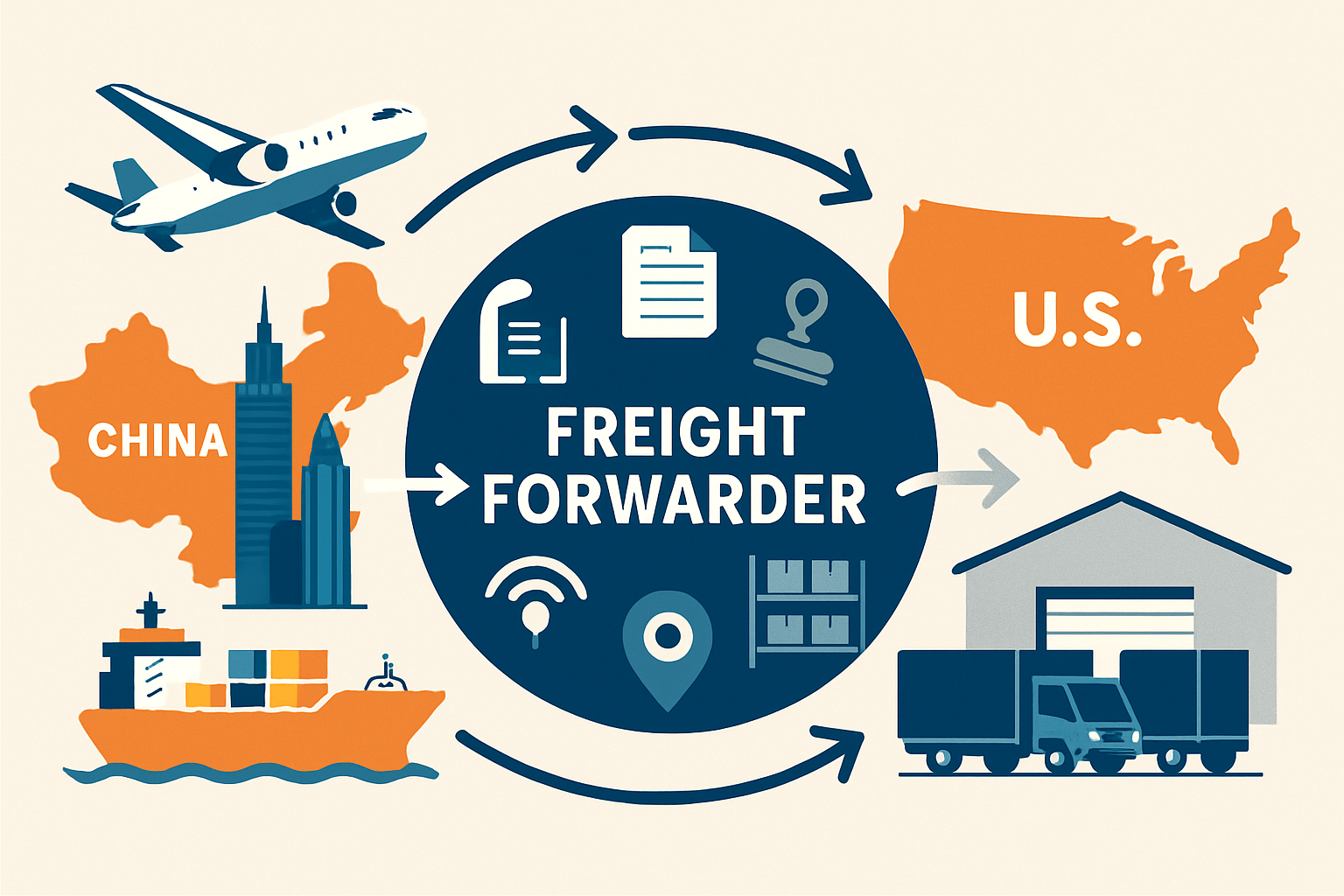
Think of a freight forwarder as the architect and general contractor for your international shipment. They don’t own the ships or planes themselves. Instead, a freight forwarder from China to USA is a specialized agent that organizes and manages the entire shipping process on your behalf. They leverage their vast network of carriers (air, sea, and land), their expertise in customs regulations, and their technological platforms to ensure your goods move from origin to destination seamlessly.
Their job is to handle the critical details you don’t have time for, including:
Booking cargo space with a carrier.
Negotiating freight charges to get you the best rates.
Preparing and handling all necessary shipping and customs documents.
Arranging for warehousing, packing, and final delivery.
Providing end-to-end visibility and tracking of your shipment.
In essence, they act as your single point of contact, transforming a multi-step, multi-vendor headache into one streamlined operation.
Why You Need a China to USA Freight Forwarder: The Core Benefits
Managing international shipping on your own is possible, but it’s rarely efficient or cost-effective. A dedicated China to US freight forwarder provides invaluable benefits that directly impact your bottom line.
Cost & Time Savings: Forwarders have access to bulk shipping rates that individual businesses can’t get. They can also consolidate shipments from multiple clients to reduce costs and find the most efficient route, saving you both money and transit time.
Expertise in Customs & Compliance: Navigating US Customs can be treacherous. A small mistake on a form can lead to costly delays, fines, or even seizure of your goods. Freight forwarders are experts in international trade regulations and ensure your shipment complies with all legal requirements.
Risk Management: What happens if a shipment is damaged, lost, or delayed? A good forwarder helps you arrange cargo insurance and has contingency plans in place to manage unforeseen disruptions in the supply chain.
Simplicity & Peace of Mind: Instead of juggling contacts for trucking companies, customs brokers, and shipping lines, you have one partner. This lets you focus on what you do best—growing your business.
The Core Services: Deconstructing China to USA Freight Forwarding
A full-service freight forwarder offers a suite of services that cover every step of the logistics journey. At AEB Logistics, we manage the entire process through a combination of key solutions.
Air Freight
When speed is your top priority, Air Freight is the answer. It’s ideal for high-value, time-sensitive, or lightweight goods. While it’s the most expensive option per kilogram, the transit time from a major Chinese airport to a US gateway can be as short as 3-7 days, including customs clearance.
Sea Freight
For larger, heavier, or less urgent shipments, sea freight is the most economical choice. It’s the backbone of global trade, and you generally have two main options:
FCL (Full Container Load): With FCL shipping, you book an entire container (typically 20ft or 40ft) for your exclusive use. This is the most cost-effective option when you have enough goods to fill a container and offers greater security as your container remains sealed until it reaches its destination.
LCL (Less than Container Load): If your shipment isn’t large enough to fill a full container, LCL shipping is perfect. Your goods are consolidated into a shared container with cargo from other shippers. You only pay for the volume or weight your goods occupy, making it a flexible and affordable solution for smaller businesses.
Customs Brokerage
This is arguably the most critical service. A licensed Customs Brokerage service ensures your shipment legally enters the United States. This involves preparing and submitting the correct documentation, calculating and paying duties and taxes, and communicating with government agencies like Customs and Border Protection (CBP).
Expert Tip: To prepare for US customs, ensure your supplier provides a detailed Commercial Invoice and Packing List. The invoice must clearly state the country of origin, a precise description of the goods, and their accurate value. Discrepancies here are the #1 cause of customs delays.
Warehousing & Final Mile Delivery
What happens after your goods clear customs? Your logistics needs don’t stop at the port. A comprehensive forwarder offers warehousing solutions for storage and distribution. They also manage the final leg of the journey through reliable trucking services to deliver your products directly to your warehouse, fulfillment center, or even an Amazon FBA facility.
How to Choose the Best China Freight Forwarder to USA: A Checklist
Not all forwarders are created equal. Choosing the right partner is crucial for your success. Use this checklist to vet potential candidates:
Experience & Specialization: Do they have proven experience with the China-USA trade lane? Look for a company that understands the specific challenges and nuances of this route.
Comprehensive Network: Do they have a strong presence and trusted agents in both China and the USA? This is vital for smooth handoffs and problem-solving on the ground.
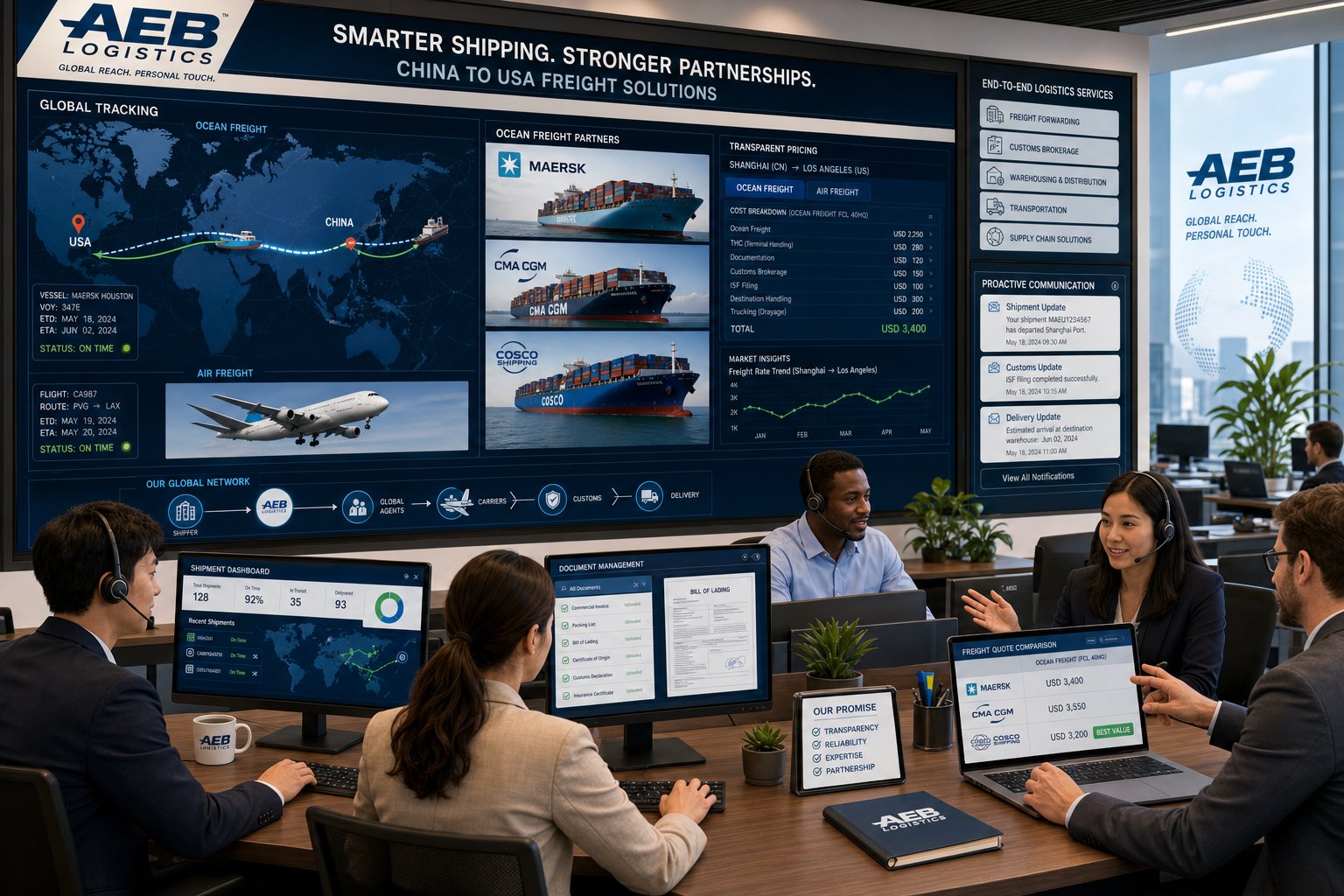
Technology & Transparency: Do they offer a modern online platform for getting quotes, booking shipments, and tracking your cargo in real-time? A digital-first approach, like the AEB Logistics Dashboard, is essential for visibility.
Clear Communication: Are they responsive, proactive, and easy to communicate with? Your forwarder should be a partner who keeps you informed every step of the way.
Stellar Reviews & Reputation: What are other customers saying? Check independent review sites. We’re proud of our reputation, which you can see on Trustpilot.
Full Range of Services: Can they handle everything from pickup and customs to warehousing and final delivery? An end-to-end provider simplifies your entire operation. For a deeper dive, check our support article on how to find the best forwarders.
Frequently Asked Questions (FAQ)
What is the cheapest shipping method from China to the USA?
By far, the cheapest method for shipping goods is Sea Freight. For smaller shipments (typically under 15 cubic meters), LCL (Less than Container Load) is the most economical. For larger shipments, booking an FCL (Full Container Load) container offers the lowest cost per unit.
How long does shipping take from China to the US?
Transit times vary significantly based on the mode of transport:
Air Freight: Typically 3-7 days for airport-to-airport transit.
Sea Freight: Port-to-port transit can take anywhere from 14-40 days, depending on the specific ports in China and the US (West Coast is faster than East Coast) and the carrier’s route. You should budget a total of 4-6 weeks for door-to-door sea shipments.
What documents do I need for customs clearance?
While requirements can vary, the standard essential documents include:
Commercial Invoice: Details the transaction between the seller and buyer.
Packing List (P/L): Lists the contents, weight, and dimensions of each package.
Bill of Lading (B/L) or Air Waybill (AWB): The contract between you and the carrier.
ISF (Importer Security Filing): This must be filed for ocean freight at least 24 hours before the cargo is loaded onto the vessel in China.
Finding the Best Freight Forwarder from China to the USA
Navigating the logistics of shipping from China to the USA may seem intimidating, but it doesn’t have to be. By understanding the process and partnering with an experienced and reliable shipping forwarder from China to USA, you can build a resilient and efficient supply chain that fuels your business’s growth. The right partner transforms a complex challenge into a competitive advantage.
What’s the biggest shipping challenge you’re facing right now? Share it in the comments below!
Ready to take the complexity out of your international logistics? Contact AEB Logistics today for a free, no-obligation quote and discover how our expertise can simplify your shipping from China.
Shipping from China to USA is the cornerstone of global trade for thousands of businesses, from ambitious e-commerce startups to established manufacturing giants. Yet, the journey from a factory in Shenzhen to a warehouse in Los Angeles is filled with complexities, regulations, and critical decisions. The single most important choice you’ll make in this process is selecting a reliable freight forwarder from China to USA. This partner acts as your navigator, your problem-solver, and your key to a cost-effective, efficient, and stress-free supply chain.
This definitive guide serves as your comprehensive resource. We will demystify the entire process of international shipping from China to USA, delve deep into the role of a shipping agent China to USA, compare all transport modes, and provide a clear framework for selecting the best partner for your business. By the end, you will be equipped with the knowledge to optimize your logistics, control costs, and ensure your goods arrive safely and on time.
Why You Absolutely Need a Professional Freight Forwarder from China to USA
Many importers initially consider coordinating their logistics directly with carriers. However, this approach is often fraught with hidden challenges and risks. A professional freight forwarder China to US does much more than just book space on a ship or plane. They are your strategic logistics partner.
Here’s what a top-tier China to USA freight forwarder does for you:
Expert Navigation & Compliance: They understand the intricate customs regulations for both China (export) and the USA (import). They ensure all documentation, like the ISF filing, is submitted accurately and on time to avoid costly fines and delays.
Multimodal Mastery: A good forwarder provides seamless solutions combining ocean, air, and land transport. They advise on the best route and method, whether it’s sea shipping from China to USA, air freight, or a combination (multimodal).
Cost Negotiation: Leveraging the volume of all their clients, a forwarder negotiates superior sea freight rates from China to USA and air cargo rates that are unavailable to individual shippers.
End-to-End Coordination: They manage the entire process: pickup from your supplier, origin port handling, customs clearance, ocean/air transit, destination port handling, and final trucking to your door. This makes the process of cargo from China to USA movement seamless for you.
Problem Solving: When disruptions occur—like port congestion, weather delays, or customs inspections—your freight forwarder China to USA is your single point of contact, working to resolve issues quickly.
Technology & Visibility: The best freight forwarders China to USA offer online platforms for real-time tracking, document management, and data analytics, giving you complete visibility over your freight from China to US.
Partnering with an expert like AEB Logistics transforms a complex logistical challenge into a streamlined, manageable process. You can learn more about their specific service approach on their dedicated China to USA shipping page.
Modes of Transport: Sea, Air, and Express Shipping from China to USA
Choosing the right mode of transport is a strategic decision balancing cost, speed, and cargo characteristics. Your shipping forwarder China to USA will advise you, but understanding the basics is crucial.
Ocean Freight: The Cost-Effective Backbone for Bulk Cargo
Ocean freight from China to USA is the most economical choice for heavy, high-volume, or non-time-sensitive goods. It’s the workhorse of international shipping from China to USA, handling over 80% of global trade by volume.
a) FCL (Full Container Load):
You rent an entire container (20ft, 40ft, 40ft High-Cube) exclusively for your goods. This is ideal if you have enough cargo from China to USA to fill at least half a 20ft container.
Pros: More secure, faster port transit (no consolidation), lower cost per unit for large volumes.
Cons: Requires a larger volume of goods, higher upfront cost.
Best for: Large, consistent shipments from a single supplier.
b) LCL (Less than Container Load):
Your goods are consolidated with other shippers’ cargo into a single container. This is the most accessible form of sea shipping from China to USA for SMEs.
Pros: Pay only for the space you use (per CBM), fantastic for smaller shipments, improves cash flow.
Cons: Longer transit times due to consolidation/deconsolidation, slightly higher risk of damage from more handling.
Best for: Small to medium-sized businesses, sample orders, and low-volume inventory.
Key Metrics for Ocean Freight:
Transit Time:Freight time from China to US via ocean is typically 25-40 days from port to port.
Cost Drivers:Sea freight rates from China to USA are influenced by fuel costs, peak season surcharges, port congestion, and the specific origin/destination ports.
Air Freight: Speed and Reliability for Urgent Shipments
Air freight is the premium option for high-value, time-sensitive, or perishable goods. While express shipping from China to USA (like DHL, FedEx) is part of this category, dedicated air freight is for larger palletized cargo.
Pros: Extremely fast (5-10 days door-to-door), highly secure, less handling, reliable schedules.
Cons: Significantly more expensive than ocean freight, subject to weight and size restrictions.
Best for: Electronics, pharmaceuticals, fashion samples, and urgent spare parts.
Express Courier (DHL, FedEx, UPS)
This is a door-to-door service ideal for very small, urgent packages and documents. While often grouped under express shipping from China to USA, it’s distinct from larger air freight shipments.
Pros: Extremely fast (2-5 days), simple to use, integrated tracking.
Cons: The most expensive option on a per-kg basis, not suitable for large or heavy shipments.
Best for: Documents, small samples, and e-commerce parcels under 70kg.
Breaking Down the Cost of Shipping from China to USA
Understanding the cost structure is vital for budgeting and identifying potential savings. The total cost of shipping from China to US cost is a sum of multiple components.
For Ocean Freight (FCL/LCL):
Origin Charges (China): Includes trucking, terminal handling, documentation, and export customs fees.
Ocean Freight Rate: The base cost of the sea voyage. This is where a good freight forwarder China to USA can secure you the best sea freight rates from China to USA.
Destination Charges (USA): Includes port fees, customs clearance (brokerage), security fees (AMS), and a customs bond.
Duties & Taxes: Calculated by U.S. Customs based on your goods’ value, description, and country of origin. This is separate from your freight invoice.
Inland Trucking (USA): The cost to transport the container from the US port to your final warehouse (drayage).
Insurance: Highly recommended to protect your cargo against loss or damage.
For Air Freight:
The structure is similar but replaces ocean-specific fees with air-specific ones like airline terminal handling charges and fuel surcharges.
A transparent China to USA freight forwarder like AEB Logistics will provide you with a detailed, all-inclusive quote upfront, so there are no surprises.
The Step-by-Step Process with Your China to USA Freight Forwarder
Here is a typical workflow when you partner with a professional for shipping from China to America.
Get a Quote & Book: You provide your cargo details (dimensions, weight, HS code) to your forwarder. They provide a comprehensive quote. Once approved, you book the shipment.
Cargo Pickup & Origin Handling: Your forwarder arranges trucking to pick up the goods from your supplier’s factory and transport them to the Chinese port or airport.
Export Customs Clearance (China): Your shipping agent China to USA or their partner handles the export declaration in China.
Loading and Transportation: Your cargo is loaded onto the vessel (for sea freight China USA) or aircraft. The carrier issues the Bill of Lading (B/L) or Air Waybill (AWB), the title document for the goods.
In-Transit Visibility: You receive tracking updates from your forwarder throughout the journey.
Import Customs Clearance (USA): This is a critical step. Before the cargo arrives, your forwarder’s customs broker submits the ISF and other required documents to U.S. Customs.
Destination Port Handling & Delivery: Once the cargo clears customs, it is unloaded. For LCL, it is deconsolidated. Finally, it is loaded onto a truck for final mile delivery to your designated address.
How to Choose the Best Freight Forwarder from China to USA
With so many companies claiming to be the best freight forwarder China to USA, how do you choose? Look for these key attributes:
Proven Experience & Specialization: Don’t just choose a general forwarder. Choose one with a proven track record as a freight forwarder from China to USA. They will have established relationships with carriers and agents, leading to better service and rates.
Transparent Pricing: Avoid forwarders who give vague quotes. The best shipping company from China to USA provides a clear, itemized breakdown of all costs.
Strong Communication: Your forwarder should be responsive, proactive, and speak your language (both literally and in terms of business needs).
Technology Platform: Look for a forwarder that offers an online portal for tracking, documentation, and analytics. This is a sign of a modern, efficient China to USA freight forwarding partner.
Compliance Expertise: Ensure they have in-house or strong partnerships with licensed US customs brokers. Proper compliance is non-negotiable.
Service Range: Can they handle both your current LCL needs and your future FCL requirements? A forwarder that offers a full range of services (sea freight, air freight, express, trucking) provides more flexible, long-term solutions.
When you evaluate potential partners, AEB Logistics exemplifies these qualities, making them a strong candidate for your china to usa freight forwarding needs.
Critical Documentation for Shipping from China to the USA
Accuracy in documentation is paramount. Any error can lead to massive delays, storage fees, or customs penalties. Your freight forwarder China to usa will guide you, but you are responsible for providing accurate information.
Commercial Invoice: The most important document. It states the value, description, and harmonized system (HS) code for each item. This is used by customs to assess duties.
Packing List: A detailed list of the contents of each package, including weight, dimensions, and package count.
Bill of Lading (B/L) for Sea or Air Waybill (AWB) for Air: The contract of carriage between the shipper and the carrier. The B/L is also a title document.
Certificate of Origin: A document certifying the country where the goods were manufactured.
ISF (Importer Security Filing) / “10+2”: Mandatory for all ocean shipments. Must be filed with US Customs at least 24 hours before loading in China.
Top Challenges in China to USA Freight Forwarding and How to Overcome Them
Customs Holds: Caused by incorrect documentation, misclassified HS codes, or restricted goods.
Solution: Work with a knowledgeable freight forwarder from China to USA who will audit your documents and ensure perfect compliance.
Port Congestion: Major US ports like LA/Long Beach can experience significant delays.
Solution: Your forwarder can advise on alternative routes (e.g., East Coast via the Panama Canal) and build buffer time into your schedule.
Volatile Shipping Costs:Sea freight rates from China to USA can fluctuate wildly due to demand, fuel prices, and global events.
Solution: A forwarder with strong carrier relationships can offer more stable pricing and lock in space even during peak seasons.
Cargo Damage: Especially a risk in LCL shipments.
Solution: Invest in robust packaging and purchase marine cargo insurance. A professional shipping company from China to USA will handle your cargo with care.
FAQs: Your Questions on Freight from China to USA Answered
What is the average freight time from China to US?
For ocean freight from China to USA, expect 25-40 days port-to-port. For air freight, 5-10 days door-to-door. These are estimates and can be affected by weather, port conditions, and routing.
How do I find the best freight forwarders China to USA?
Look for specialists with strong online reviews, transparent pricing, and excellent communication. Ask for references from businesses in your industry. You can start your search by evaluating established players like AEB Logistics.
What’s the difference between a freight forwarder and a shipping agent?
The terms are often used interchangeably. Generally, a freight forwarder from China to USA has a broader role, organizing the entire journey using various carriers. A shipping agent China to USA often acts on behalf of a specific carrier, but in practice, both can perform similar functions for an importer.
What are the current sea freight rates from China to USA?
Rates are highly dynamic. They depend on the origin/destination port, container type, and current market demand. The best way to get an accurate rate is to request a live quote from your forwarder with your specific cargo details.
Streamlining Your Supply Chain with the Right Partner
Mastering the process of shipping from China to USA is a powerful competitive advantage. It allows you to control costs, improve delivery reliability, and scale your business with confidence. While the landscape of international shipping from China to USA is complex, you don’t have to navigate it alone.
The key to success lies in selecting a professional, transparent, and experienced freight forwarder from China to USA. This partner becomes an extension of your team, providing the expertise and infrastructure to turn logistical challenges into a seamless, efficient, and reliable supply chain.
If you are looking for a partner that embodies all these qualities—offering expert guidance on sea freight from China to USA, air freight, and everything in between—consider reaching out for a consultation. Let a dedicated team handle the complexities so you can focus on growing your business.
Selecting the best freight forwarder china to usa is the single most critical decision you will make in ensuring your international supply chain is cost-effective, reliable, and efficient. In the complex world of global trade, a proficient freight forwarder china to usa does much more than just move boxes; they are your strategic partner, navigating customs, negotiating carrier rates, and mitigating risks. This definitive guide will provide you with everything you need to know about shipping from china to usa, the different modes of transport like sea shipping from china to usa, and a detailed framework for identifying a truly top-tier shipping agent china to usa for your business.
Why Your Choice of Freight Forwarder Matters More Than Ever
The route from China to the United States is one of the world’s busiest trade lanes, but it’s also fraught with potential pitfalls: port congestion, volatile sea freight rates from china to usa, complex customs regulations, and the constant pressure of managing lead times. A great china to usa freight forwarder acts as your shield against these challenges.
Here’s what a premier partner brings to the table:
Expertise and Compliance: They ensure flawless customs clearance in both China and the U.S., handling critical filings like the ISF (10+2) to avoid costly penalties.
Cost Negotiation: Leveraging volume, they secure the best possible ocean freight from china to usa and air freight rates, savings they pass on to you.
End-to-End Visibility: You get a single point of contact and real-time tracking for your cargo from china to usa, from factory floor to your warehouse door.
Risk Mitigation: They advise on and arrange marine cargo insurance, handle exceptions, and provide contingency plans when disruptions occur.
Strategic Advice: A good shipping forwarder china to usa will analyze your cargo and business needs to recommend the optimal mode—be it express shipping from china to usa for urgency or sea freight china usa for cost-saving.
Essentially, the right china freight forwarder to usa transforms a complex logistical puzzle into a streamlined, manageable process.
Modes of Transport: Sea, Air, and Express for Shipping from China to USA
Understanding the fundamental options for international shipping from china to usa is the first step in making an informed decision. Your choice will directly impact your budget, timeline, and supply chain flexibility.
Sea Freight: The Economical Backbone for Large Volumes
Sea shipping from china to usa is the most cost-effective method for moving large, heavy, or non-time-sensitive goods. When people inquire about freight from china to usa, they are most often referring to ocean transport.
Key Sub-Options:
FCL (Full Container Load): You rent an entire container (20ft, 40ft, 40ft High-Cube) for your goods alone. This is ideal for volumes exceeding 15 cubic meters (CBM). It’s more secure and generally faster at port terminals than LCL.
LCL (Less than Container Load): Your goods share container space with other shipments. This is perfect for smaller volumes (under 15 CBM), offering flexibility and improving cash flow by allowing for more frequent, smaller shipments.
Sea Freight Snapshot:
Transit Time: 25-40 days (Port to Port) for china to usa sea freight.
Cost: Lowest cost per cubic meter/kilogram. Sea freight rates from china to usa are volatile and depend heavily on fuel costs and demand.
Best For: Heavy machinery, bulk raw materials, furniture, large volumes of consumer goods, and anything where cost trumps speed.
Air Freight: The Speed Solution for Urgent Shipments
Air freight is the preferred choice for high-value, time-sensitive, or perishable goods. While the term express shipping from china to usa is often used interchangeably, true air freight is typically for larger palletized goods, while express is for smaller parcels.
Air Freight Snapshot:
Transit Time: 5-10 days (Airport to Airport).
Cost: Significantly higher than sea freight, often 4-6 times the price.
Best For: Electronics, pharmaceuticals, fashion samples, urgent spare parts, and high-value low-volume items.
International Express (DHL, UPS, FedEx)
This is the door-to-door solution for small, urgent packages and documents. It’s the simplest form of ship from china to usa for e-commerce businesses and individuals.
Express Shipping Snapshot:
Transit Time: 3-7 days (Door to Door).
Cost: Highest cost per kilogram, but incredibly efficient for small parcels.
Best For: Documents, samples, small e-commerce orders, and urgent small parts.
The Step-by-Step Process of Shipping Freight from China to US
A reliable freight forwarder china to us will manage this entire process seamlessly. Here’s what you can expect:
Initial Consultation & Quoting: You provide your cargo details (dimensions, weight, type) and the shipping from china to us cost is calculated based on the chosen mode (sea, air, LCL, FCL).
Booking & Cargo Pickup: Once you approve the quote, the forwarder books space with a carrier and arranges pickup from your supplier in China.
Origin Customs & Documentation (China): Your china forwarder to usa handles export customs clearance and ensures all documents (Commercial Invoice, Packing List, etc.) are perfect.
International Transportation: Your cargo is loaded onto the vessel, aircraft, or express network.
Destination Customs Clearance (USA): This is a critical step. The forwarder’s U.S. customs broker partner files all paperwork with U.S. Customs and Border Protection (CBP) and pays duties on your behalf.
Final Mile Delivery: Once cleared, your goods are transported from the U.S. port or airport to your final warehouse or delivery address.
How to Vet and Select the Best Freight Forwarders China to USA
With countless companies claiming to be the best shipping company from china to usa, how do you separate the best from the rest? Use this checklist.
1. Service Scope and Specialization
Do they offer a true end-to-end service, or are they just a middleman?
Do they have dedicated teams for ocean freight china to usa and air freight?
Look for a shipping agent china to usa that also handles customs brokerage, removing the need for you to find a separate partner.
2. Transparency in Pricing and Communication
Do they provide a clear, all-inclusive quote, or are there hidden fees?
Are they proactive in their communication? A good china to usa freight forwarding partner will update you before you have to ask.
Companies like AEB Logistics pride themselves on transparent pricing and proactive communication, ensuring you never face surprise charges.
3. Network and Partnerships
Do they have strong relationships with major carriers (Maersk, CMA CGM, COSCO) and airlines?
A strong network directly translates to better sea freight rates from china to usa and more reliable space allocation.
4. Technology and Tracking
Can you track your freight from china to the usa in real-time through a modern portal?
Do they offer digital document management? A tech-forward shipping forwarder china to usa provides efficiency and peace of mind.
5. Experience and Reputation
How long have they been in business specializing in this specific trade lane?
Look for verifiable testimonials and case studies. Seek out companies consistently mentioned among the best freight forwarders china to usa in industry forums and reviews.
Understanding the Real Cost of Shipping from China to USA
The question of shipping from china to us cost is complex. Beyond the base freight from china to us, you must account for a full suite of origin and destination charges.
A comprehensive quote for ocean freight will typically include:
Ocean Freight Charge: The base cost for the sea voyage.
Bunker Adjustment Factor (BAF): A fuel surcharge.
Terminal Handling Charges (THC): At both origin and destination ports.
Customs Clearance Fees: For both China (export) and USA (import).
ISF Filing Fee: A mandatory U.S. customs requirement.
Bill of Lading Fee:
Inland Trucking (Drayage): From port to your warehouse.
Duties & Taxes: These are paid to U.S. Customs and are based on your product’s value and HTSUS code.
Pro Tip: Always ask for a detailed cost breakdown. A reputable china to usa freight forwarder will have no problem providing this, ensuring you understand every line item.
Critical Documentation for a Smooth Shipment
Mistakes in documentation are a primary cause of customs delays. Your freight forwarder from china to usa should expertly manage these key documents:
Commercial Invoice: The foundation for customs valuation.
Packing List: Details the weight, dimensions, and contents of each package.
Bill of Lading (Sea) or Air Waybill (Air): The contract of carriage and title document.
Certificate of Origin: May be required to prove where goods were manufactured.
ISF (Importer Security Filing): Must be filed 24 hours before loading in China.
Top 5 Red Flags When Choosing a China to USA Forwarder
Vague or Unbelievably Low Quotes: If a quote seems too good to be true, it almost always is. This is a classic sign of lowballing with hidden fees to come.
Poor Communication: If they are slow to respond during the sales process, it will only get worse once they have your cargo.
Lack of Licensing: Ensure they are fully licensed as an Ocean Transportation Intermediary (OTI) by the U.S. Federal Maritime Commission (FMC).
No Physical Presence: A company with offices or strong partners in both China and the U.S. is far more reliable than a virtual-only operation.
Pressure to Sign Without Details: A trustworthy partner educates you and ensures you are comfortable before moving forward.
Why AEB Logistics is Your Ideal Partner for China to USA Shipping
In a crowded market, AEB Logistics has established itself as a leading name for businesses seeking a reliable and strategic freight forwarder from china to usa. Here’s why:
Deep Expertise: We specialize exclusively in the Trans-Pacific trade lane, giving us unparalleled knowledge of sea freight from china to usa and air freight dynamics.
All-in-One Service: We are your single point of contact for everything, from factory pickup in China and china to usa sea freight booking to U.S. customs clearance and final mile delivery. Explore our comprehensive service suite on our dedicated China to USA shipping page.
Transparent Pricing: We believe in no-surprises pricing. Our quotes are detailed and all-inclusive, so you can budget with confidence.
Technology-Driven: Our client portal provides real-time tracking and document management, giving you complete visibility over your freight china to usa.
Proactive Communication: We don’t just move your cargo, but as well manage your supply chain. We anticipate issues and communicate solutions, not just problems. AEB Logistics don’t just claim to be a top china to usa freight forwarder, they prove it through consistent performance and a client-first philosophy.
Partnering for Success
Navigating the complexities of shipping from china to america requires more than just a service provider; it requires a trusted advisor. The best freight forwarder china to usa will save you money, time, and immense stress, allowing you to focus on growing your core business.
By understanding the modes of transport, the true costs involved, and the critical criteria for selecting a partner, you are now equipped to make an intelligent choice. You need a forwarder with the expertise, network, and technological capability to handle the intricacies of international shipping from china to usa in 2024 and beyond.
Ready to experience a higher standard of freight forwarding? Contact the experts at AEB Logistics today for a personalized consultation and a transparent, competitive quote for your next shipment. Let us show you why we are consistently ranked among the best freight forwarders china to usa.
Let’s be real—moving products from China to the USA isn’t a walk in the park. There are so many steps, and it’s easy to get lost without some expert help. A shipping agent China to USA basically becomes your logistics wingman, handling freight, customs paperwork, and delivery from your Chinese supplier all the way to your door in America.
Shipping agent China to USA services strip away a lot of the stress by taking care of freight booking, customs clearance, and delivery coordination. You save time, dodge mistakes, and sidestep expensive headaches. These folks know import rules, how to pick between air and sea freight, and they usually negotiate better rates than most small businesses could dream of.
Whether you’re running a tiny online shop or importing at scale, working with experienced shipping agents keeps your supply chain humming. The right shipping agent China to USA will help you avoid delays, cut costs, and spot issues before they become big problems.
Key Takeaways
Shipping agent China to USA services manage freight, customs, and delivery, making imports way less complicated
Choosing air or sea freight comes down to your budget and how fast you need stuff
A shipping agent China to USA is your go-to middleman. They coordinate every step of moving goods from Chinese suppliers to your US address. A freight forwarder might offer broader logistics, like warehousing and consolidating cargo. Knowing when to use a shipping agent China to USA or a freight forwarder can save you a lot of headaches and cash.
Roles and Responsibilities of Shipping Agents
Shipping agent China to USA professionals stand between you and the carriers. They book space on ships or planes, based on your needs and budget.
Shipping agents China to USA handle all your customs paperwork—think invoices, packing lists, and bills of lading. They negotiate rates with carriers, arrange pickup at factories, and manage loading at Chinese ports or airports.
Your shipping agent China to USA will handle customs clearance both in China and when your cargo hits the USA. They’ll track your shipment, update you if something goes sideways, and usually arrange final delivery to your warehouse or door.
You get one point of contact instead of juggling carriers, customs brokers, and trucking companies. That’s a huge relief, honestly.
Shipping Agent vs Freight Forwarder
The terms shipping agent China to USA and freight forwarder China to USA get tossed around like they’re the same thing. They’re not. A shipping agent China to USA usually represents the shipper or the carrier, focusing on one shipment at a time. Freight forwarders offer more complete logistics, not just transportation.
Key Differences:
Aspect
Shipping Agent
Freight Forwarder
Scope
Handles one shipment at a time
Manages the whole supply chain
Services
Booking, paperwork, customs
Warehousing, consolidation, distribution
Contracts
May work for the carrier
Works for you, the shipper
Pricing
Commission or flat fee
Marks up all services
A China freight forwarder can bundle shipments, offer warehouse storage, and sometimes get you better cargo insurance. Freight forwarders work for you and usually have more leverage with carriers, thanks to bigger shipping volumes.
When to Use a Shipping Agent
Pick a shipping agent China to USA if you’re new to international shipping or customs rules. First-timers especially need help—one wrong document and your cargo could sit in limbo for weeks.
If you ship only now and then, you probably can’t negotiate decent rates on your own. Small businesses and e-commerce sellers save money by using shipping agent China to USA services with established carrier deals.
Shipping agent China to USA services are essential when your cargo needs special handling, like temperature control or fragile packaging. If your shipment involves multiple factories or consolidation points, a pro’s coordination is a must.
Companies moving high-value or urgent products rely on shipping agent China to USA tracking and quick fixes. Your agent keeps tabs on your shipment and sorts out problems before they get expensive.
Ocean freight is the budget-friendly choice for heavy or bulky shipments. Shipping agent China to USA services will help you choose between Full Container Load (FCL) and Less Than Container Load (LCL).
FCL is for when you fill a 20- or 40-foot container. You get the whole thing to yourself, which means less risk and sometimes faster transit. LCL is for smaller shipments; you share container space and only pay for what you use.
Sea freight transit times usually run 15 to 45 days, depending on ports. West Coast US ports like LA are faster than East Coast. DDP sea shipping can cover everything—customs, delivery, the whole lot.
Air Freight Services
Air freight gets your goods to the USA in 3 to 8 days. It’s perfect for time-sensitive or high-value shipments. Shipping agent China to USA services will tell you: it’s pricier than ocean freight, but you save on inventory holding and can react quickly to market changes.
You pay by actual or volumetric weight, whichever is higher. Airlines figure volumetric weight by multiplying length × width × height (cm), then dividing by 6,000. DDP air shipping covers customs, taxes, and final delivery.
Air freight is great for electronics, fast-fashion, or anything with a short shelf life. Higher cost, but sometimes you just need speed.
Express and Courier Shipments
Express services like DHL, FedEx, and UPS get packages to the US in 2 to 5 days, door to door, with tracking the whole way. They handle customs and guarantee delivery dates.
Express shipping agent China to USA services are for urgent documents, samples, or parcels under 150 lbs. It’s the most expensive per kilo, but it’s reliable and easy. Most express options offer DDP, so you see the full cost up front.
This method is a lifesaver for e-commerce sellers who need to ship fast or businesses sending prototypes for approval.
Rail and Road Freight Solutions
Direct rail freight from China to USA isn’t a thing—there’s no track across the Pacific. Sometimes, rail links with ocean freight via Europe or Russia, but that’s pretty rare for shipping agent China to USA jobs.
Road freight matters for the last leg in the USA. After customs clears your goods, trucks bring them to your warehouse or distribution center. Some shipping agents China to USA bundle this in the quote; others charge separately.
If you’re shipping to a city far from the port, expect extra road freight costs. Distance affects both your total price and delivery time.
Key Stages of Shipping from China to USA
Shipping agent China to USA services coordinate four main stages: supplier relationships, documentation, cargo collection, and consolidation before international transport starts.
Product Sourcing and Supplier Coordination
Start by finding reliable manufacturers—try Alibaba or hit up the Canton Fair. Always request business licenses and product samples before you make a big order.
Good communication with your supplier is everything. Nail down product specs, packaging, and timelines. Confirm if your supplier has export rights, since some small factories need your freight forwarder to handle export paperwork.
Key details to confirm with suppliers:
Minimum order sizes and unit prices
Production lead times and cargo-ready dates
Packing specs and labeling
Incoterms (EXW, FOB, CIF, or DDP)
Payment terms and deposit requirements
Third-party inspections can check quality before your goods leave China. Better safe than sorry when your shipment arrives in the USA.
Document Preparation and Packaging
Accurate paperwork keeps customs happy and avoids delays. Your commercial invoice needs seller/buyer info, HS codes, quantities, prices, and totals. The packing list shows package counts, weights, and dimensions.
Work with your supplier to optimize packaging for the trip. Cartons need to be strong enough to stack, and fragile items need extra padding. Wood packaging has to meet ISPM-15 rules for US imports.
Essential shipping documents include:
Document
Purpose
Commercial Invoice
Declares value and product details for customs
Packing List
Lists package contents and dimensions
Certificate of Origin
Proves where your goods were made
Product Certifications
Shows compliance (CE, FCC, FDA, etc.)
If you’re shipping batteries or dangerous goods, you’ll need extra paperwork—like UN numbers and safety data sheets. Your freight forwarder or shipping agent China to USA should review all documents before submitting them to Chinese customs.
Cargo Pickup and Warehousing
Your freight forwarder arranges pickup straight from the factory on your agreed cargo-ready date. The pickup team checks that quantities match your packing list and takes photos to document the condition of your goods.
Warehousing and distribution facilities in China offer temporary storage, which helps if you’re managing shipments from several suppliers. Most forwarders provide 15 to 30 days of free warehousing in cities like Shenzhen or Guangzhou.
During pickup, the team confirms final measurements and weights, which set your freight charges. Ask for photo proof of loaded goods—especially if you’ve got high-value shipments or Amazon FBA shipments that need special labeling.
The warehouse crew can relabel, repackage, or inspect your goods before export. It’s your last shot to catch mistakes with packaging or labeling before your products leave China.
Consolidation and Shipping
Consolidation means combining smaller shipments from different suppliers into one container or air shipment. This method really cuts per-unit costs compared to shipping each order separately, and it’s a core part of smart supply chain solutions.
Your freight forwarder books space with ocean carriers or airlines, depending on your chosen shipping method. They handle export customs clearance and arrange transport to the port or airport.
Freight forwarding services include tracking updates as your shipment moves internationally. Logistics operations at this stage involve:
Securing carrier space and sending booking confirmations
Filing export declarations with Chinese customs
Arranging container loading or palletizing air cargo
Providing a bill of lading or air waybill for tracking
Contract logistics providers manage everything from factory pickup to delivery in the U.S. If you choose DDP (Delivered Duty Paid), your forwarder handles customs clearance and pays duties for you—handy if you don’t have a U.S. import license.
Space gets tight during peak season, especially from August through October. Rates go up and capacity drops, so book early to lock in your costs and delivery schedule.
Customs Clearance and Compliance
Shipping Agent China to USA services must get customs clearance and documentation right to avoid delays, penalties, or even seizures. Knowing the clearance process, paperwork, duty calculations, and compliance details makes importing a whole lot smoother.
U.S. Customs Clearance Process
When your shipment from China lands in the USA, U.S. Customs and Border Protection (CBP) inspects it before release. Shipping Agent China to USA services like DHL, FedEx, UPS, and various freight forwarders or customs brokers can handle this process for you.
The timeline depends on your shipment type and product. Standard consumer goods usually clear in 2-5 days, electronics take 3-7 days, and food or chemicals can run 5-14+ days due to stricter checks.
To import commercially, you’ll need an Employer Identification Number (EIN). Don’t forget you need a customs bond for shipments over $2,500 or for certain regulated products. Single-entry bonds cost $50-100; continuous bonds covering all your annual imports run $50-500, depending on volume.
If you’re shipping by ocean, you must file an Importer Security Filing (ISF) at least 24 hours before the vessel leaves China. Miss that, and you could get hit with a $5,000 penalty per violation.
Customs Documentation Required
Getting customs paperwork right is crucial. You need a commercial invoice with detailed product descriptions, quantities, unit values, and total value. This must match your actual transaction and reflect real market prices.
Your packing list should break down all contents, listing weights, dimensions, and packaging details. Make sure shipping marks match the box labels.
The bill of lading (for ocean) or air waybill (for air) acts as your receipt and contract with the carrier. You’ll also need a certificate of origin for goods under trade agreements or those subject to antidumping duties.
Certain products need extra certifications:
Electronics: FCC certification
Food and beverages: FDA registration and prior notice
Medical devices: FDA approval
Chemicals: EPA and TSCA compliance docs
Textiles: Fiber content labels
Shipping Agent China to USA companies can help you prep these documents and make sure you’re set before your shipment arrives.
Duties, Taxes, and HS Codes
You’ll pay customs duties on most commercial imports from China. The U.S. has an $800 de minimis threshold under Section 321, so shipments under this amount usually enter duty-free—but that mostly covers personal stuff, not goods for resale.
Your duty rate depends on the Harmonized System (HS) code for your product. These codes classify goods and set tariff rates, which can range from 0% to 25% or more. If you misclassify, you risk paying the wrong duties and possibly facing penalties.
On top of duties, there’s a Merchandise Processing Fee (MPF) of 0.3464% of shipment value, with a minimum of $27.23 and a max of $528.33. Ocean freight adds a Harbor Maintenance Fee (HMF) of 0.125% of shipment value.
Knowing your total landed cost is key for pricing. This includes:
Cost Component
Description
Product cost
What you pay your supplier
Shipping fees
Freight charges from China to USA
Customs duties
Based on HS code classification
MPF and HMF
Processing and harbor fees
Customs bond
Single-entry or continuous bond fees
Brokerage fees
If using a customs broker
Ensuring Customs Compliance
Customs compliance means following all U.S. import rules and giving CBP accurate info. If you mess up, you could get hit with penalties, delays, or even import bans.
Don’t try to undervalue your goods to cut duties—customs checks market prices and can spot it. Penalties can reach four times the duties owed, plus possible criminal charges if you commit fraud.
Keep thorough records of all imports for at least five years. CBP can audit you and ask for documentation. Hold onto purchase orders, invoices, payment receipts, and supplier communication.
If you’re new to importing or handling complex goods, work with experienced customs brokerage services. Licensed brokers know the latest regulations, have CBP contacts, and can handle communications for you.
Stay up to date on trade policy changes, tariffs, and product restrictions. Shipping Agent China to USA requirements evolve, and what worked last year might not work now. Reliable freight forwarders keep tabs on these shifts and update their processes.
Top Shipping Agent and Freight Forwarder Companies
Plenty of established companies offer Shipping Agent China to USA services, each with its own strengths. Your choice depends on shipping volume, budget, and your specific logistics needs.
Overview of Leading Companies
Sinotrans is one of China’s biggest integrated logistics companies. Established in 2002 and listed on the Hong Kong Stock Exchange, they operate globally and cover sea freight, air freight, road and rail, and warehousing.
DocShipper works from Hong Kong and provides end-to-end supply chain solutions across five continents. They manage supplier sourcing, customs clearance, and 3PL services for SMEs and individuals.
Kuehne + Nagel brings over 130 years of experience, operating in nearly 100 countries. They focus on healthcare, tech, consumer goods, and e-commerce with sustainable logistics solutions.
DHL Global Forwarding serves large-scale operations and has a big environmental push. AEB Logistics focuses on Amazon FBA forwarding and has more than 20 years of experience.
Guided Imports out of Shenzhen specializes in e-commerce and FBA. Winsky Freight, started in 2007, handles hazardous goods like batteries and liquids.
Flexport offers tech-driven logistics from San Francisco. Smaller players like Ardi Logistics and Sino Shipping serve niche markets.
Criteria for Selecting a Reliable Shipping Partner
When picking a Shipping Agent China to USA, experience counts. Companies with over 10 years in the field know the ins and outs of customs and routes.
Look at their service range. Your forwarder should handle sea freight (FCL/LCL), air freight, customs clearance, and warehousing. Door-to-door and Amazon FBA prep services are a big plus for e-commerce.
Pricing transparency is a must. Get detailed quotes that break down freight, duties, and handling charges—nobody likes surprise fees.
Tracking capabilities and direct contact matter. You want to follow your shipment in real time and reach your account manager fast if something goes sideways.
Check their network and partnerships. A Shipping Agent China to USA with strong carrier relationships gets better rates and more reliable transit times. Having offices in both China and the USA usually means smoother operations.
Some forwarders specialize in certain industries or cargo types—look for one that fits your business if you ship e-commerce, hazardous goods, or need special handling.
Cost Factors and Transit Times
Shipping Agent China to USA rates depend on your shipping method, cargo specs, and destination port. Delivery speed can range from a few days to several weeks. Weight and rate structures directly impact your costs, so it pays to double-check the math.
Freight Costs and Rate Structures
Shipping Agent China to USA services come with several pricing models, depending on your cargo and how much you’re moving. Express courier services usually charge $8 to $15 per kilogram, with minimum fees between $25 and $50.
Air freight runs from $5 to $8 per kilogram, but minimums start at $100 to $200. Ocean freight, on the other hand, has two main structures.
Less than container load (LCL) shipments cost $40 to $80 per cubic meter, and you’ll need to ship at least one cubic meter. Full container load (FCL) rates range from $1,800 to $3,000 for a 20-foot container, and $2,500 to $4,200 for a 40-foot to West Coast ports.
Your Shipping Agent China to USA usually includes customs clearance, documentation fees, and fuel surcharges in the base rate. Some agents provide door-to-door pricing—expect $12 to $20 per kilogram, which covers everything from the supplier’s warehouse to your door.
Transit Times by Shipping Mode
Express shipping delivers in 2 to 5 days door-to-door. It’s fast, but you pay for that speed.
Air freight takes 5 to 10 days from start to finish. That includes 3 to 6 days in transit and 2 to 4 days for customs clearance.
Ocean freight takes more patience. FCL shipments need 15 to 28 days in total, with 12 to 22 days at sea plus 3 to 6 days for port handling and customs.
LCL shipments take 18 to 32 days because they need extra time for consolidation at both ends. West Coast deliveries move faster than East Coast routes.
Shipping Agent China to USA times vary: Shanghai to Los Angeles takes 15 to 25 days, while Shanghai to Newark can stretch from 30 to 40 days. It’s a big country, after all.
How to Optimize Shipping Costs
Consolidating several orders into one shipment cuts your per-unit costs. Full containers are almost always cheaper than sending multiple smaller loads over time.
Book with your Shipping Agent China to USA during off-peak seasons for better rates. Avoid Chinese New Year, Golden Week, and that wild pre-Christmas rush—prices go up, and space gets tight.
If you plan shipments 4 to 6 weeks ahead, you’ll usually land better deals. Picking the right container size also matters.
A 40-foot high cube container costs only a bit more than a standard 40-foot, but you get 10 extra cubic meters. That’s a nice bonus if you’re maxing out space.
Work directly with your Shipping Agent China to USA to classify products accurately. Get those commodity codes right—otherwise, you risk delays and higher duties.
Understanding Volumetric and Chargeable Weights
Carriers use volumetric weight by multiplying length × width × height in centimeters, then dividing by 5,000 for express or 6,000 for standard air freight. This tells them how much space your cargo eats up in a plane or truck.
Your chargeable weight is whichever’s higher: the actual weight or the volumetric weight. For example, a 10-kilogram box measuring 50 × 40 × 30 centimeters has a volumetric weight of 12 kilograms (50 × 40 × 30 ÷ 5,000). You pay for 12 kilograms, not 10.
Dense items, like machinery, usually go by actual weight. Lighter but bulky goods—think furniture or packaging—almost always get billed by volume.
Ask your Shipping Agent China to USA for quotes using both numbers. That way, you’ll know your real freight costs before you commit.
Delivery and Final Mile Logistics
Once your cargo clears customs and lands at a US port or airport, you still need to get it to your door. Final mile delivery means trucking from the port to your location, warehouse storage if you need it, and sometimes special handling for e-commerce sellers.
Last-Mile Delivery to Destinations in the USA
Last-mile delivery is the final step—moving your shipment from the port or airport to your address. Usually, this happens by truck and can take anywhere from 1 to 7 days, depending on distance and delivery type.
Your Shipping Agent China to USA handles pickup from the port and arranges ground transport to your warehouse or business. West Coast deliveries are usually quicker since most China shipments land in Los Angeles or Long Beach.
East Coast and inland spots take longer, thanks to the extra miles. You can pick standard or expedited service—standard costs less, but expedited gets your goods there faster (for a price).
For commercial addresses with limited receiving hours, delivery appointments are critical. Your freight forwarder schedules those windows to match your availability.
Residential deliveries need extra planning. Big trucks don’t always fit in neighborhoods, so your Shipping Agent China to USA sorts out the details.
Amazon FBA and E-commerce Shipments
Amazon FBA shipments are their own beast. Your products need to arrive at Amazon fulfillment centers with the right labels, packaging, and advance notice.
Shipping Agent China to USA pros who know FBA requirements prep your goods with FBA labels, split shipments if needed, and book delivery appointments through Amazon’s system.
Amazon charges receiving fees if your shipment isn’t prepped correctly. Your agent takes care of carton labeling, pallet setup, and all those packaging rules so you avoid those headaches.
E-commerce sellers can use prep services for inspection, repackaging, and barcode application. Some freight forwarders even offer direct-to-FBA shipping, sending your goods straight from port to Amazon.
Tracking and Warehousing Solutions
Real-time tracking lets you watch your shipment from China pickup to final delivery. Most professional Shipping Agent China to USA companies provide tracking systems showing container location, customs status, and delivery dates.
You’ll get updates when your cargo leaves China, arrives at the US port, clears customs, and heads out for delivery. GPS tracking on trucks shows you exactly where your shipment is in the final mile.
Warehousing helps if you can’t take delivery right away or need to store inventory. Short-term storage at port warehouses gives you flexibility with timing.
Long-term warehousing near your business lets you manage stock without filling up your own space. Distribution centers can help with picking, packing, and order fulfillment.
You can store bulk shipments and have smaller amounts delivered as needed. If you don’t have much storage, this is a lifesaver.
Trucking and Distribution Services
Trucking services handle the move from ports to inland destinations all over the US. Full truckload (FTL) means you rent the whole truck for your goods. Less than truckload (LTL) lets you share space with others to save money.
FTL makes sense for shipments over 10,000 pounds or when you want things delivered faster. You pay for the whole truck but get direct delivery with no stops.
LTL costs less for smaller shipments, but it takes longer since the truck makes more stops. Here are some common options:
Drayage – Short haul from port to a nearby warehouse
Cross-country trucking – Long distance to inland states
Intermodal rail – Train transport with truck delivery at both ends
Dedicated delivery – Scheduled routes for regular shipments
Distribution services split your shipment for delivery to multiple locations. If you sell to retailers or have several business spots, your Shipping Agent China to USA can split containers and deliver to each address. That saves you a lot of hassle.
Risk Management and Cargo Insurance
Protecting your shipment means understanding insurance coverage and what to do if something goes wrong. Insurance costs usually start at 0.3% of your cargo’s value, but it varies by shipping method and goods type.
Importance of Cargo Insurance
Cargo insurance shields you from financial loss if your goods get damaged, lost, or stolen. Without it, you’re on the hook for replacing any missing or broken items.
Carrier liability is limited—most freight companies cap responsibility at about $0.50 per pound. That’s hardly enough if you’re shipping high-value goods.
If you send electronics worth $50,000 that weigh 1,000 pounds, carrier liability pays just $500. That’s not going to cut it. Shipping Agent China to USA experts help you pick the right coverage and spot higher-risk routes or fragile product categories.
Insurance Options for Different Freight Types
Your insurance needs change depending on what and how you ship. Air freight usually costs more to insure because the cargo is worth more.
Sea freight insurance covers longer trips and risks like water damage or lost containers. Here are the main types:
All-risk coverage – Protects against most causes of loss or damage
Named perils – Covers only specific risks listed in your policy
Total loss only – Pays out only if your entire shipment is destroyed
Fragile items, like glassware or electronics, need higher coverage and special handling. Perishables require temperature control and insurance for spoilage.
Document any damage as soon as your shipment arrives. Snap photos of the packaging and damaged items before you open containers or toss anything out.
Contact your Shipping Agent China to USA within 24 hours if you spot damage or loss. They’ll walk you through the claims process and talk to the insurer for you.
Most policies require written notice quickly—often within 30 days. Hang on to all your shipping documents, including bills of lading, packing lists, and invoices.
You’ll need proof of your goods’ value and their condition before shipping. Sometimes, the insurance company sends an inspector to check the damage before they pay out.
Frequently Asked Questions
Shipping costs depend on weight, dimensions, and how you send your goods. Finding a reliable Shipping Agent China to USA means checking licenses and comparing quotes.
Transit times run from just a few days to several weeks, depending on your shipping choice. Most imports also face customs duties, so plan for that when budgeting with your Shipping Agent China to USA.
What factors influence the cost of shipping from China to the USA?
The weight and size of your shipment set the starting price. Carriers use either the actual weight or the volumetric weight—whichever ends up higher.
Your choice of shipping method changes the cost a lot. Express courier services usually run $5 to $12 per kilogram and get your stuff there in 3 to 7 days.
Air freight sits in the middle, costing $3 to $6 per kilogram and taking about 7 to 14 days. If you’re not in a rush, ocean freight is the cheapest way for big shipments.
Less-than-container loads go for $80 to $150 per cubic meter, while full containers can cost $1,500 to $3,500 for a 20-foot container. That’s a big difference if you’re moving a lot of goods.
Fuel surcharges and peak season fees can sneak up on you. Shipping Agent China to USA rates spike during Chinese New Year or right before major U.S. holidays.
Where your shipment starts and ends matters a lot too. Shipping Agent China to USA services from big ports like Shenzhen to Los Angeles tend to cost less than shipping to or from smaller, inland cities.
How can I find a reliable shipping agent to manage my freight from China to the USA?
First, check if the Shipping Agent China to USA you’re considering has the right licenses. Ocean freight agents should be registered with the Federal Maritime Commission, while air agents need IATA accreditation.
Always ask for detailed written quotes from at least three Shipping Agent China to USA providers. Make sure you give each one the same shipment details so you can compare apples to apples.
Look for Shipping Agent China to USA companies with strong U.S. customs experience. They should have licensed customs brokers who can handle commercial invoices, packing lists, and those tricky HS codes.
Test how quickly each Shipping Agent China to USA responds to your questions. Try calling, emailing, or even messaging on chat apps—speed and clarity matter.
Ask the Shipping Agent China to USA for references or case studies from businesses like yours. Good agents usually have testimonials or real shipment stories to share.
Be wary if a Shipping Agent China to USA offers prices that seem way too low, won’t provide a written contract, or dodges questions about their office address. That’s usually a red flag.
What are the typical transit times for air and sea shipping from China to the USA?
Express courier services like DHL, FedEx, and UPS usually deliver in 3 to 7 days. You’ll get tracking and customs clearance included, which is handy.
Air freight takes about 7 to 14 days from airport to airport. Don’t forget to add time for getting your goods to and from the airport.
Ocean shipping by less-than-container load usually takes 25 to 40 days. Full container loads can stretch out to 30–45 days, depending on which ports you use.
Delays happen. Port congestion, customs checks, or bad weather—like typhoons in Asia—can add days to your Shipping Agent China to USA timeline.
The route you pick makes a difference. Shipping Agent China to USA services from southern China to the U.S. West Coast usually arrive faster than shipments to the East Coast.
What are some recommended practices for working with a freight forwarder on Amazon FBA shipments from China to the USA?
Make sure your Shipping Agent China to USA knows Amazon’s rules. FBA shipments need the right labels, packaging, and scheduled delivery appointments.
Give your Shipping Agent China to USA accurate product details—dimensions, weight, HS codes—right from the start. That helps avoid surprise fees and paperwork headaches.
Consider using your Shipping Agent China to USA for pre-shipment inspections. It’s worth it to catch quality or packaging issues before your stuff leaves China.
Book Amazon warehouse appointments early. If your freight shows up without a slot, Amazon charges you detention fees—nobody wants that.
Keep your shipment records—like invoices, packing lists, and bills of lading—for at least five years. You might need them for audits or disputes with Amazon or customs.
Try consolidating orders through your Shipping Agent China to USA’s warehouse in China. It can lower your per-unit shipping costs and make Amazon’s receiving process smoother. Not everyone does this, but it’s worth asking about.
What should I expect in terms of duties and taxes when importing goods from China to the USA?
Customs duties depend on your product’s HS code. Rates swing from 0% up to 25% or more, depending on the item and the current trade situation.
If your shipment’s value is under $800, you usually skip duties for personal imports. Above that, you need to file formal customs entry and pay up.
Your Shipping Agent China to USA or customs broker figures out duties using your product’s declared value, shipping, and insurance costs. They’ll usually ask for payment before you get your goods.
There are extra fees, too—like the Merchandise Processing Fee (0.3464% of value) and Harbor Maintenance Fee for ocean freight. You can’t really avoid those.
Some products face more rules. Electronics, cosmetics, and toys might need extra compliance paperwork and fees for agencies like FDA, FCC, or CPSC.
Your customs broker files the Importer Security Filing at least 24 hours before your ocean shipment arrives. If they miss it, you’ll get hit with penalties, and that’s never fun for anyone shipping Agent China to USA.
How do volume and weight affect the price of shipping from China to the USA?
Shipping Agent China to USA rates depend a lot on both volume and weight. Carriers actually use dimensional weight pricing if your package takes up more space than its weight would suggest.
They figure out dimensional weight by multiplying length, width, and height in inches, then dividing by 139 for international shipments. You end up paying whichever is higher—actual weight or dimensional weight.
Ever tried shipping something light but huge, like pillows? Shipping Agent China to USA fees can get surprisingly high for those, even though they barely weigh anything.
Ocean freight is a different animal. For less-than-container loads, or LCL, Shipping Agent China to USA services charge by cubic meter.
That means if you can pack your stuff tighter, you pay less per unit. Full container loads, on the other hand, have flat rates—so you really want to fill them up as much as possible.
Shipping Agent China to USA providers will tell you: don’t waste space in a container, since you’re paying the same either way. Sometimes, breaking up your shipment into several smaller packages ends up costing more than just consolidating everything.
Your Shipping Agent China to USA can crunch the numbers for you. They’ll look at weight breaks and handling fees to see if splitting orders actually saves money.
If your shipment’s over 150 pounds, Shipping Agent China to USA air freight usually gets you a better per-pound rate. That’s where volume and weight really start to make a difference in your total cost.
In today’s globalized economy, finding a reliable freight forwarder China to USA has become a critical component for businesses engaged in international trade. Whether you’re an e-commerce entrepreneur, a manufacturing importer, or a large corporation, the complex logistics of moving goods across the Pacific require specialized expertise that can significantly impact your bottom line. The right freight forwarding partner does more than just transport goods—they navigate customs regulations, optimize shipping routes, manage documentation, and provide crucial insights into market trends. This comprehensive guide will walk you through everything you need to know about selecting and working with a freight forwarder for your China-to-USA shipping needs.
Why Partnering With a Specialist Freight Forwarder Matters
Freight forwarders act as intermediaries between shippers and various transportation services, creating an essential bridge between Chinese suppliers and American markets. They leverage their industry knowledge, established relationships with carriers, and logistical expertise to ensure your goods move efficiently from origin to destination. For the busy trade lane between China and the United States—one of the world’s most active shipping routes—this specialization is particularly valuable.
A proficient freight forwarder manages the entire supply chain process, including:
Selecting optimal shipping modes (air, sea, rail, or multimodal)
Negotiating competitive freight rates
Preparing and processing documentation
Arranging cargo insurance
Handling customs clearance both in China and the US
Coordinating inland transportation and final delivery
The value proposition extends beyond basic transportation. With shifting trade policies, fluctuating fuel costs, and evolving market dynamics, an experienced forwarder provides stability and predictability in an otherwise volatile landscape.
Current Market Trends: China-US Shipping in 2025
The freight industry between China and the United States continues to evolve rapidly in response to economic and political factors. Understanding these trends is essential for making informed shipping decisions.
Shipping Volume and Rate Fluctuations
Despite geopolitical tensions and trade policy adjustments, transpacific trade remains robust. Recent data shows that US containerized imports reached 2.52 million TEU in August 2025, representing a 1.6% increase compared to August 2024, though slightly lower (3.9%) than July 2025’s figures. This indicates sustained demand for Chinese goods in the American market.
Rate volatility has been a defining characteristic of the China-US shipping lane. As of September 2025, freight rates from China to the US West Coast were assessed at $2,157 per FEU, reflecting a significant 24% increase from the previous month. The route to the US East Coast, which includes Panama Canal transit costs, reached $3,375 per FEU—a 23% monthly increase.
Shifting Trade Patterns
An interesting development in 2025 is the changing composition of US imports. While China remains a crucial trading partner, its relative share has declined as American importers diversify their sourcing. Notably, EU exports to the US have surpassed those from China in both volume and value, with European exports totaling $287 billion compared to China’s $247 billion in 2024. This diversification strategy has implications for shipping capacity and rates on the China-US route.
Simultaneously, China has strengthened trade relationships with other partners, particularly India. Trade between these two Asian giants is growing above trend, with Indian port traffic increasing by 4.6% year-on-year in the April-August 2025 period. This reconfiguration suggests a gradual realignment of global trade networks rather than an overall reduction in container shipping volumes.
Comparing Shipping Methods: Ocean vs. Air Freight
Selecting the appropriate shipping method is one of the most critical decisions in international logistics. The choice between ocean and air freight involves balancing cost, speed, reliability, and the nature of your goods.
Ocean Freight: The Backbone of China-US Trade
Ocean shipping remains the most cost-effective option for moving large volumes of goods, handling the majority of containerized cargo between China and the United States.
Table: Ocean Freight Options from China to USA
Service Type
Typical Cost (2025)
Transit Time
Best For
FCL (20ft container)
$2,000–$3,500
15-20 days (West Coast)
Large shipments (>10 CBM)
FCL (40ft container)
$3,500–$6,000
25-35 days (East Coast)
High-volume goods
LCL (Less than Container)
$50–$80 per CBM
20-40 days
Smaller shipments (<10 CBM)
Full Container Load (FCL) is ideal when you have enough goods to fill an entire container. This option offers greater security, as your goods alone occupy the container, and typically faster transit times since there are no intermediate stops for consolidation. In 2025, a 20-foot container typically ranges from $2,000–$3,500, while a 40-foot container may cost between $3,500–$6,000, depending on the specific route and demand levels.
Less than Container Load (LCL) provides a cost-effective solution for smaller shipments that don’t require a full container. Your goods are consolidated with those of other shippers in a shared container. Rates are usually calculated by cubic meter (CBM), starting around $50–$80 per CBM, though additional handling fees can make LCL less predictable than FCL.
Air Freight: Speed and Efficiency for Time-Sensitive Goods
When delivery speed is prioritized over cost considerations, air freight becomes the preferred option. While significantly more expensive than ocean shipping, air transport offers dramatic time savings that can be crucial for perishable items, high-value products, or urgent shipments.
Table: Air Freight Options from China to USA
Service Type
Typical Cost (2025)
Transit Time
Best For
Standard Air Freight
$5–$8 per kg
5-10 days
Medium-urgency shipments
Express Courier
$8–$12 per kg
3-5 days
Small, urgent parcels
The air cargo market in 2025 faces certain challenges, with global air freight rates experiencing volatility. As of August 2025, major route rates averaged $2.82 per kilogram, representing an 8.3% year-over-year decrease. This decline is partly attributed to overcapacity in the market, with excess capacity reaching approximately 7%. Despite this oversupply, the projected growth for air cargo volume in 2025 is a modest 0.6%.
For businesses considering air freight, it’s important to understand that charges are based on chargeable weight—whichever is greater between the actual weight and volumetric weight. Oversized packages can quickly increase costs, so proper packaging optimization is essential.
Key Factors Influencing Shipping Costs in 2025
Several variables impact the final cost of shipping between China and the United States. Understanding these factors will help you budget accurately and identify potential savings opportunities.
Fuel Prices and Surcharges
Fuel costs represent a significant component of shipping expenses. Both ocean and air carriers implement fuel surcharges that fluctuate with global oil prices. These are typically calculated as a percentage of the base freight rate or as a fixed amount per weight or volume unit.
Seasonal Demand Fluctuations
Shipping costs vary throughout the year based on seasonal patterns. The period leading up to Chinese New Year typically sees a surge in shipments as factories close for celebrations. Similarly, rates often increase during the peak season (August-October) as retailers stock up for holiday sales. In 2025, industry observers note that “July is originally the peak season for US routes, and with the situation of previously held cargo, from late May, early June, including the entire July, is still within the range of rising freight rates”.
Trade Policy Impacts
Recent changes to US trade policy have created both challenges and opportunities for shippers. The adjustment of tariff policies has led to significant fluctuations in shipping volumes. Following announcements of tariff changes, there was a notable surge in demand, with container booking volumes skyrocketing 277% in one week, reaching 21,530 TEU. This sudden increase naturally drove up shipping rates, particularly for routes from China to the US East Coast, where rates for a 40-foot container reached $4,000-$4,200.
Route-Specific Considerations
The specific origin and destination points significantly impact both cost and transit time. Major Chinese ports like Shanghai, Shenzhen, and Ningbo typically offer more competitive rates and frequent sailings compared to smaller regional ports. Similarly, delivery to US inland destinations involves additional overland transportation costs beyond the port-to-port shipping charges.
Beyond Transportation: Value-Added Services
A superior freight forwarder offers services that extend well beyond basic transportation. These value-added services can streamline your supply chain and reduce hidden costs.
Customs Clearance Expertise
Navigating the complex customs regulations of both China and the United States requires specialized knowledge. Reputable forwarders maintain licensed customs brokers on staff who understand harmonized tariff codes, duty optimization strategies, and documentation requirements. They can help you avoid costly delays and penalties by ensuring accurate, complete submissions. For example, forwarders like AEB Logistics handle “export customs declaration/import customs clearance” as part of their comprehensive service offerings.
Cargo Insurance Protection
While freight carriers maintain limited liability for lost or damaged goods, this coverage is often insufficient for the actual value of your shipment. Cargo insurance typically costs 0.3%–0.5% of the shipment’s value—a small price for significant peace of mind. Quality forwarders work with reputable insurance providers to offer coverage options tailored to your specific needs.
Warehousing and Distribution
Many forwarders provide integrated warehousing solutions at both origin and destination. In China, this might include consolidation services—collecting goods from multiple suppliers into a single shipment. In the US, forwarders often operate distribution centers that can handle sorting, labeling, and final mile delivery to retailers or consumers. Some companies, like Zhonghe Supply Chain, operate extensive networks with “over 100,000 square feet of overseas warehouse space” in the US.
Selecting the Right Freight Forwarder: Key Considerations
With numerous providers in the market, choosing the right partner requires careful evaluation. Here are essential factors to consider:
Licensing and Certifications
Verify that any forwarder you consider holds appropriate credentials. For US-bound shipments, FMC (Federal Maritime Commission) registration is essential for ocean freight providers. The NVOCC (Non-Vessel Operating Common Carrier) license indicates the forwarder can act as a carrier in its own right. Additionally, certifications from organizations like the World Cargo Alliance (WCA) provide assurance of international standards.
Industry Experience and Specialization
Look for forwarders with demonstrated expertise in your specific industry and trade lane. A company that regularly handles shipments similar to yours will anticipate potential challenges and offer proven solutions. Specialized knowledge is particularly valuable for regulated products like electronics, textiles, or food items that may require additional certifications.
Technology Capabilities
In today’s logistics environment, digital visibility is non-negotiable. Your forwarder should provide a robust online platform for tracking shipments, managing documents, and accessing analytics. Real-time visibility into your supply chain allows for proactive problem-solving and better inventory management. Leading providers offer platforms where “customers can view the in-transit status of goods in real-time through the online platform”.
Communication and Customer Service
Responsive, transparent communication is essential when managing international shipments across time zones. Evaluate potential forwarders on their communication protocols, including designated account managers, availability outside standard business hours, and escalation procedures for urgent issues.
The Future of China-US Freight: Emerging Trends
As we look beyond 2025, several trends are likely to shape the future of freight forwarding between China and the United States.
Sustainability Initiatives
Both China and the United States are increasingly focused on creating greener and more sustainable freight systems. This includes promoting intermodal transportation that maximizes the use of rail and waterways where possible, investing in cleaner technologies, and implementing policies that reduce the environmental impact of freight movement.
Technology Integration
Innovations in artificial intelligence, blockchain, and IoT are transforming logistics operations. These technologies enable greater supply chain transparency, more accurate forecasting, automated documentation, and enhanced security. Forwarders who invest in technological capabilities will likely offer superior service and efficiency.
Supply Chain Diversification
While China remains a manufacturing powerhouse, many US importers are developing alternative sourcing strategies across Southeast Asia, India, and Eastern Europe. Forwarders with global networks beyond China will be well-positioned to support this diversification while maintaining seamless logistics management.
Optimizing Your China-US Supply Chain
Selecting the right freight forwarder China to USA is one of the most strategic decisions for businesses engaged in transpacific trade. The ideal partner combines logistical expertise, market knowledge, and technological capabilities to navigate the complexities of international shipping while optimizing for cost, speed, and reliability.
As trade dynamics continue to evolve, maintaining flexibility and working with forwarders who offer comprehensive solutions—from factory floor to final destination—will be key to competitive advantage. Companies like AEB Logistics exemplify the integrated approach required for success in today’s challenging logistics landscape.
By understanding current market conditions, shipping options, and the value-added services available, you can make informed decisions that strengthen your supply chain and support your business growth objectives in the dynamic China-US trade corridor.
Shipping from China to America is a critical component of international trade, with billions of dollars worth of merchandise crossing the Pacific annually. Whether you’re an e-commerce entrepreneur sourcing products, an established business managing supply chains, or exploring import opportunities, understanding your shipping options is essential for success.
This comprehensive guide breaks down everything you need to know about China-to-USA shipping, including real costs, transit times, carrier options, and strategic insights to help you make informed decisions. AtAEB Logistics, we’ve helped thousands of businesses navigate these waters successfully, and we’re sharing our expertise to help you optimize your shipping strategy.
Key Points
Primary Shipping Methods from China to America: There are three main transportation options: express shipping for urgency, air freight for balance between cost and speed, and ocean freight for bulk, cost-effective shipping with longer transit times.
Cost Expectations for Different Shipping Sizes and Modes: Shipping costs vary based on weight and mode, with express courier rates ranging from $12-65 per kg, air freight from $2.5-8 per kg, and ocean freight priced per cubic meter or container, with rates fluctuating based on market conditions.
Transit Times by Route and Method: Express shipping generally delivers in 2-4 days for major routes, while air freight takes about 5-12 days, and ocean freight can range from 12 to over 28 days depending on the route and whether FCL or LCL is used.
Choosing the Right Carrier and Container Types: Select carriers like DHL, FedEx, or UPS for fast delivery, and utilize standard, high cube, or specialized containers such as reefers or open-tops depending on cargo specifications and needs.
Best Practices and Avoiding Common Shipping Mistakes: Ensure accurate documentation, proper packaging, adequate lead time, and compliance with customs requirements to avoid delays, penalties, and unnecessary costs during the China to USA shipping process.
Understanding Your Shipping Options: A Strategic Overview
When shipping from China to America, you have three primary transportation methods, each with distinct advantages depending on your specific needs:
Express Shipping offers the fastest delivery (3-5 days) with door-to-door service and comprehensive tracking. This premium option works best for urgent shipments, high-value goods, or small packages where speed justifies the higher cost.
Air Freight provides a balanced approach with moderate transit times (8-10 days) and competitive pricing for medium-weight shipments. It’s ideal when you need faster delivery than ocean freight but don’t require express service premium.
Ocean Freight delivers the most cost-effective solution for large or heavy shipments, with transit times of 30-40 days. This method offers significant savings for bulk goods where timing is less critical.
Real Shipping Costs: What You Can Expect to Pay
Express Shipping Rates (DHL, FedEx, UPS)
Small Packages (Under 10kg):
Document express: $45-65 per kg
Standard express: $35-50 per kg
Economy express: $25-35 per kg
Medium Shipments (10-50kg):
Premium service: $20-30 per kg
Standard service: $15-25 per kg
Economy service: $12-20 per kg
Large Shipments (50-200kg):
Express service: $8-15 per kg
Standard service: $6-12 per kg
Note: Dimensional weight pricing applies when size exceeds actual weight ratios.
Air Freight Costs
Standard Air Cargo Rates:
Small shipments (under 100kg): $4-8 per kg
Medium shipments (100-500kg): $3-6 per kg
Large shipments (500kg+): $2.5-5 per kg
Premium Air Services:
Add 20-40% to standard rates for expedited handling
Guaranteed space allocation during peak seasons
Ocean Freight Pricing
Less than Container Load (LCL):
Volume-based pricing: $40-80 per cubic meter
Minimum charges typically apply ($150-300)
Additional port handling fees: $50-150
Full Container Load (FCL) – Major Routes:
20-foot Container:
Shanghai to Los Angeles: $1,200-2,500
Shenzhen to Long Beach: $1,100-2,300
Ningbo to Seattle: $1,300-2,600
40-foot Container:
Shanghai to Los Angeles: $1,800-3,500
Shenzhen to Long Beach: $1,600-3,200
Ningbo to Seattle: $1,900-3,600
40-foot High Cube:
Shanghai to Los Angeles: $1,900-3,700
Shenzhen to Long Beach: $1,700-3,400
Ningbo to Seattle: $2,000-3,800
Rates fluctuate based on season, fuel costs, and market demand.
Transit Times by Route and Method
Express Shipping Timelines
Major Chinese Cities to US Destinations:
Origin → Destination
DHL
FedEx
UPS
Shanghai → New York
2-3 days
3-4 days
3-4 days
Shenzhen → Los Angeles
2-3 days
2-3 days
3-4 days
Guangzhou → Chicago
3-4 days
3-4 days
4-5 days
Beijing → Miami
3-4 days
4-5 days
4-5 days
Air Freight Transit Times
Port to Port + Customs Clearance:
Route
Standard Air
Expedited Air
Shanghai → LAX
7-10 days
5-7 days
Shenzhen → JFK
8-11 days
6-8 days
Guangzhou → ORD
8-12 days
6-9 days
Ningbo → SEA
9-12 days
7-9 days
Ocean Freight Transit Times
FCL (Full Container Load):
Origin Port
Destination Port
Transit Time
Shanghai
Los Angeles
14-18 days
Shanghai
Long Beach
14-18 days
Shanghai
Seattle
12-16 days
Shanghai
New York
24-28 days
Shenzhen
Los Angeles
12-16 days
Shenzhen
Houston
26-30 days
Ningbo
Los Angeles
15-19 days
Qingdao
Long Beach
13-17 days
LCL (Less than Container Load): Add 3-7 days to FCL times for consolidation and deconsolidation processes.
Carrier Comparison: Choosing the Right Service
Express Carriers Deep Dive
DHL Express:
Strongest network in Asia-Pacific region
Best for documents and small packages
Premium pricing but excellent reliability
Restrictions: Limited lithium battery shipping, weight limits vary by destination
FedEx International:
Excellent US domestic integration
Strong customs clearance capabilities
Multiple service levels (Priority, Economy, Ground)
Restrictions: Hazardous materials limitations, size restrictions for certain services
Additional fees may include: ISF filing ($25-75), port storage, exam fees
Choosing the Right Shipping Method for Your Business
E-commerce and Amazon FBA Sellers
Small, frequent shipments:
Express shipping for test orders and samples
Air freight for regular inventory replenishment
Ocean LCL for seasonal stock builds
Bulk inventory:
Ocean FCL for cost efficiency
Plan 45-60 days lead time including customs
Consider expedited ocean for time-sensitive launches
Manufacturing and B2B
Raw materials and components:
Ocean freight for regular, predictable needs
Air freight for production-critical items
Express for emergency replacement parts
Finished goods distribution:
Ocean freight for standard inventory
Air freight for market-responsive products
Mixed mode strategies for supply chain optimization
Understanding Hidden Costs and Fees
Ocean Freight Additional Charges
Port and Terminal Fees:
Container handling: $200-600 per container
Documentation fees: $50-150
Customs examination (if selected): $300-800
Demurrage (late pickup): $150-300 per day after free time
Inland Transportation:
Port to warehouse delivery: $200-800 depending on distance
Warehouse handling and storage: $50-200 per pallet
Appointment delivery fees: $50-150
Air Freight Surcharges
Seasonal Peak Surcharges:
October-January: 15-40% rate increases
Chinese New Year period: Significant capacity constraints
Back-to-school season: Moderate increases for consumer goods
Fuel and Security Surcharges:
Fuel surcharge: 10-25% of base rate
Security screening: $25-75 per shipment
Dimensional weight penalties for light, bulky items
Strategic Advantages of Working with AEB Logistics
Crisis Management and Supply Chain Resilience
Global supply chains face unprecedented challenges, from pandemic disruptions to geopolitical tensions.AEB Logistics provides strategic support that goes beyond simple freight forwarding:
Supply Chain Consulting:
Alternative routing options during port congestion
Inventory optimization strategies
Risk assessment and mitigation planning
Real-time market intelligence and rate forecasting
China-Based Advantages:
Direct relationships with Chinese suppliers and manufacturers
Local expertise in Chinese regulations and procedures
Competitive rates through established carrier partnerships
Quality control and inspection services at origin
Technology and Transparency
Modern freight forwarding requires sophisticated tracking and communication systems:
Real-Time Visibility:
GPS tracking for ocean containers
Milestone notifications via email and SMS
Online portal access to all shipment documentation
Proactive exception management and resolution
Digital Documentation:
Paperless processing reduces delays and errors
Electronic customs filing and clearance
Digital bill of lading and cargo release
Automated invoice and payment processing
Common Mistakes to Avoid
Documentation Errors
Incorrect Commercial Invoices:
Undervaluing goods can trigger customs delays and penalties
Incomplete or vague product descriptions cause classification issues
Missing country of origin information leads to duty complications
Inadequate Packaging:
Poor packaging increases damage risk and insurance claims
Non-compliant marking and labeling cause delivery delays
Insufficient protection for fragile items results in total loss
Timing and Planning Issues
Inadequate Lead Time Planning:
Not accounting for Chinese holidays and factory closures
Underestimating customs clearance time requirements
Failing to plan for seasonal capacity constraints and rate increases
Poor Inventory Management:
Ordering too much inventory ties up working capital
Ordering too little creates stockout risks and rush shipping costs
Not diversifying suppliers increases supply chain vulnerability
Customs Clearance: What You Need to Know
US Customs Requirements
Importer Security Filing (ISF):
Required for ocean shipments 24 hours before vessel departure
Contains 10 data elements about the shipment
Late or incorrect filing results in $5,000+ penalties
Cost: $25-75 when filed by customs broker
Entry Filing Process:
Must be filed within 15 days of cargo arrival
Requires accurate product classification and valuation
Triggers duty and tax assessment
Professional broker filing reduces error risk and delays
Duty and Tax Calculations
Determining Duty Rates:
Based on Harmonized Tariff Schedule (HTS) classification
Rates vary from 0% to 35%+ depending on product and country
Additional Section 301 tariffs may apply to Chinese goods
Trade agreements and preferences can reduce rates
Common Import Taxes:
Merchandise Processing Fee: 0.3464% of value (minimum $27.23, maximum $528.33)
Harbor Maintenance Fee: 0.125% of value for ocean shipments
State and local sales taxes may apply at destination
Industry-Specific Considerations
Electronics and Technology
Special Requirements:
FCC certification for electronic devices
Battery shipping restrictions and documentation
Anti-dumping duties on certain electronic components
Intellectual property compliance verification
Recommended Shipping:
Air freight for high-value, time-sensitive items
Express shipping for prototypes and samples
Ocean freight for bulk consumer electronics
Textiles and Apparel
Regulatory Compliance:
Textile fiber labeling requirements
Country of origin marking for quota purposes
Flammability standards for children’s clothing
Import quotas for certain textile categories
Shipping Strategy:
Ocean freight for seasonal inventory builds
Air freight for fashion-forward, quick-turn items
Express shipping for samples and fit sessions
Food and Beverages
FDA Requirements:
Prior Notice filing for all food shipments
Food facility registration for importers
Nutritional labeling compliance
HACCP and food safety certifications
Shipping Considerations:
Refrigerated ocean containers for shelf-stable products
Air freight for fresh or short shelf-life items
Temperature monitoring throughout transit
Seasonal Planning and Rate Management
Peak Season Strategies
October through February:
Book space early as capacity becomes constrained
Expect 20-50% rate increases for ocean freight
Consider air freight alternatives for critical shipments
Plan inventory builds before peak season begins
Chinese New Year Impact:
2-3 week factory closures in January/February
Severe capacity constraints in weeks leading up to holiday
Plan shipments to arrive before or after holiday period
Confirm supplier production schedules early
Rate Management Techniques
Volume Commitments:
Negotiate better rates through guaranteed monthly minimums
Secure space allocation during peak periods
Develop preferred shipper status with carriers
Consider annual service contracts for predictable savings
Flexible Routing:
Use multiple ports to avoid congestion delays
Consider alternative gateways for better rates
Evaluate inland point intermodal (IPI) services
Monitor rate spreads between different routing options
Environmental and Sustainability Considerations
Carbon Footprint Comparison
Ocean Freight:
Lowest carbon emissions per unit shipped
Most environmentally friendly option for large shipments
Slow steaming reduces fuel consumption and emissions
Consider carbon offset programs for environmental goals
Air Freight:
Highest carbon emissions per unit shipped
10-50 times more CO2 than ocean freight equivalent
Reserve for truly time-sensitive or high-value items
Evaluate consolidated air freight to reduce impact
Sustainable Shipping Practices
Packaging Optimization:
Right-size packaging to reduce dimensional weight charges
Use recyclable and biodegradable packaging materials
Optimize container loading to reduce empty space
Consider reusable packaging for repeat shipments
Working with AEB Logistics: Your Strategic Partner
Choosing the right freight forwarder can make the difference between smooth operations and costly disruptions.AEB Logistics offers comprehensive China-to-USA shipping solutions backed by years of experience and deep market knowledge.
Local Expertise, Global Reach: Our China-based operations team provides direct oversight of your shipments from origin, ensuring quality control and proactive communication. Combined with our US customs brokerage services, we offer seamless door-to-door solutions.
Technology-Driven Service: Real-time tracking, automated notifications, and online documentation access keep you informed throughout your shipment’s journey. Our digital platform streamlines the shipping process and reduces administrative burden.
Proactive Problem Solving: Supply chain disruptions are inevitable, but our experienced team anticipates challenges and develops contingency plans. From alternative routing during port congestion to expedited customs clearance, we keep your goods moving.
Getting Started: Your Next Steps
Ready to optimize your China-to-USA shipping strategy? Here’s how to begin:
Assess Your Current Shipping Needs: Evaluate your volume, frequency, and timing requirements to determine the most cost-effective approach.
Get Multiple Quotes: Compare rates and services from different providers to ensure competitive pricing and service levels.
Plan Your Documentation: Ensure all required paperwork is accurate and complete to avoid customs delays and additional fees.
Consider Total Landed Costs: Factor in all expenses including duties, taxes, and additional fees to make informed decisions.
Partner with Experts: Work with experienced professionals who can navigate complex regulations and provide strategic guidance.
Contact AEB Logistics today for a free consultation and quote. Our team of shipping experts will analyze your specific needs and recommend the most cost-effective and reliable solutions for your China-to-USA shipping requirements.
Whether you’re shipping your first container or managing complex supply chains, we’re here to help you succeed in international trade. Let us handle the logistics while you focus on growing your business.
Ready to streamline your China-to-USA shipping operations?Visit AEB Logistics to learn more about our comprehensive freight forwarding services and get your free shipping quote today.
FAQs:
What are the primary shipping methods from China to America and how do they differ?
The primary shipping methods from China to America are express shipping, air freight, and ocean freight, each offering different speed and cost options. Express shipping is the fastest, typically delivering in 2-4 days and is suitable for urgent shipments; air freight takes about 5-12 days and balances speed with cost for medium-weight consignments; ocean freight is the most cost-effective for bulk goods, with transit times of 12 to over 28 days, making it ideal for large shipments where time sensitivity is lower.
How are shipping costs calculated for different modes and shipment sizes?
Shipping costs vary based on the mode of transport and the shipment size. Express courier rates for small packages (under 10kg) range from $45-65 per kg, air freight costs between $2.5-8 per kg depending on weight, and ocean freight is priced per cubic meter or container, with rates fluctuating based on market conditions. Larger shipments generally benefit from discounted rates per kilogram for express and air freight, while ocean freight charges are determined by volume or container type.
What are the typical transit times for shipping routes from China to the US via different methods?
Express shipping from China to the US generally takes 2-4 days for major routes, with air freight about 5-12 days depending on the route. Ocean freight can take from 12 days for FCL shipments to over 28 days, depending on the origin and destination ports, as well as whether the shipment is FCL or LCL. These times can vary due to customs, weather, and logistical factors.
What factors should I consider when choosing the right carrier and container type?
When selecting a carrier, consider the speed, reliability, and service offerings; top carriers include DHL, FedEx, and UPS for fast delivery, and specialized freight or airline companies for cargo-specific needs. Container options depend on cargo type and volume, with standard containers like 20-foot and 40-foot units for general freight, and specialized containers such as reefers for temperature-sensitive goods or open-top containers for oversized cargo. Compatibility with your cargo’s requirements and budget should guide your choice.
What are some best practices and common mistakes to avoid in the China to USA shipping process?
Best practices include accurate documentation, proper packaging, allowing adequate lead time for planning, and compliance with customs regulations. Avoid common mistakes such as undervaluing goods on invoices, insufficient or poor packaging, not accounting for holidays or transit delays, and incomplete or incorrect customs paperwork. Engaging experienced customs brokers and using modern tracking and documentation systems can also prevent delays and reduce costs.
The global engine of commerce runs on the seamless movement of goods, and for countless American businesses, that journey begins in China. But bridging the 7,000-mile gap between a factory in Shenzhen and a warehouse in Los Angeles is a monumental task. This is where the expertise of a professional freight forwarder from China to USA or a dedicated shipping agent China to USA becomes not just valuable, but absolutely essential.
If you’re importing goods, you’ve likely searched for terms like “shipping from China to USA,” “sea freight from China to USA,” or “best freight forwarder China to USA.” This comprehensive guide is designed to be your ultimate resource. We will demystify the entire process, break down the costs, and provide you with the knowledge you need to choose the perfect shipping agent China to USA for your unique needs.
Why You Can’t Afford to Get Your China to USA Shipping Wrong
Navigating international logistics alone is a high-stakes gamble. The complexities of customs regulations, volatile sea freight rates from China to USA, carrier negotiations, and documentation can sink an unprepared business.
Financial Risks: Incorrect paperwork can lead to massive customs fines, storage demurrage fees, and even seizure of your cargo.
Operational Risks: Unforeseen delays can lead to stockouts, halting your production lines or leaving your e-commerce shelves empty, directly impacting revenue and customer trust.
Reputational Risks: Late or damaged deliveries erode the trust you’ve built with your customers.
A specialist China to USA freight forwarder acts as your shield against these risks. They are not just movers of boxes; they are your strategic partner in global trade, ensuring your supply chain is a source of competitive advantage, not stress.
Freight Forwarder vs. Shipping Agent: Understanding the Key Partner for Your Shipment
You’ll see the terms “freight forwarder” and “shipping agent China to USA” used often. While closely related, there’s a subtle difference.
A Freight Forwarder is a broader term for a company that organizes and coordinates the entire shipment on your behalf. They act as an intermediary between you and various transportation services (ocean carriers, airlines, trucking companies).
A Shipping Agent often specifically refers to a company’s representative in a foreign port who handles the carrier arrangements and port operations on behalf of the ship owner or charterer.
For you, the importer, the result is the same: you hire a company—a freight forwarder China to US—to manage the complex logistics of getting your goods from point A to point B. They consolidate your expertise into a single point of contact, handling everything from booking cargo space to customs clearance and final delivery.
Modes of Transport: Choosing Between Air, Sea, and Express Shipping from China to America
The single most important decision you’ll make (with guidance from your forwarder) is choosing the mode of transport. The choice hinges on a balance of cost, speed, and the nature of your goods.
Ocean Freight: The Cost-Effective Backbone for Volume Shipping
When people search for “sea shipping from China to USA” or “ocean freight China to USA,” they are looking for the most economical way to move large volumes. This is the workhorse of international trade.
Transit Time: Typically 25-40 days from port to port. Factors like weather, port congestion, and the specific routes (e.g., Shanghai to Los Angeles vs. Shanghai to New York) affect this.
Cost: The most affordable option on a per-unit basis for heavy or large shipments.
Best For: Heavy goods, large volumes, non-perishable items, and businesses with flexible timelines.
Within Ocean Freight, you have two options:
FCL (Full Container Load): You rent an entire container (20ft, 40ft, 40ft High Cube) for your goods alone. This is more secure and faster at terminals as it doesn’t require consolidation.
LCL (Less than Container Load): Your goods share container space with other shippers. You pay for the volume you use (per cubic meter). This is ideal for smaller shipments that don’t justify a full container.
A top-tier china forwarder to usa will advise you on the most cost-effective choice based on your cargo volume.
Air Freight: The Premium Choice for Speed
When speed is critical, express shipping from China to USA via air is the answer.
Transit Time: Typically 5-10 days from airport to airport.
Cost: Significantly more expensive than ocean freight, often 4-6 times the price for the same weight.
Best For: High-value items, perishable goods, emergency shipments, samples, and products with a very short shelf life.
Express Courier (DHL, UPS, FedEx): For Small Parcels
For very small, urgent packages under ~70 kg, international couriers can be a simple solution.
Transit Time: 3-5 days door-to-door.
Cost: High per-unit cost, but simple and all-inclusive.
Best For: Documents, small samples, and very low-volume e-commerce orders.
Your chosen freight forwarder China to USA will have relationships with all major carriers and can often secure better rates than you can get on your own, even for express services.
The Step-by-Step Process: What to Expect When You Ship from China to USA
Understanding the workflow helps you see the value a forwarder adds. Here’s how it works:
Sourcing & Booking: You provide your shipping agent China to USA with details (commercial invoice, packing list). They book space on a vessel/aircraft and provide a freight quote.
Origin Handling (China): Your forwarder’s team in China arranges for the pickup of goods from your supplier’s factory and transports them to the port/airport. They handle export customs clearance.
Transportation: Your cargo departs from China. Your forwarder provides you with a tracking number and vessel/flight details.
Destination Handling (USA): Upon arrival, the forwarder’s US partner handles the unloading of the ship/plane. For LCL, the container is moved to a warehouse for deconsolidation.
Customs Clearance: This is critical. Your forwarder (or their licensed customs broker partner) submits all required documents to U.S. Customs and Border Protection (CBP), pays duties on your behalf, and obtains release. This includes ensuring the Importer Security Filing (ISF) is submitted correctly and on time.
Final Mile Delivery: Once cleared, your goods are loaded onto a truck for delivery to your final door address.
Decoding the Costs: What Makes Up Your Shipping Quote?
When you get a quote for freight from China to US, it’s a sum of many charges. A transparent forwarder will break these down for you.
Key Ocean Freight Charges:
Ocean Freight: The base cost paid to the shipping line.
Fuel Surcharge (BAF): A carrier fee to offset fuel cost fluctuations.
Origin Charges: Includes terminal handling, documentation, and customs fees in China.
Destination Charges: Includes port fees, customs clearance, Pier Pass, and a customs bond in the USA.
Inland Trucking (Drayage): Transport from the US port to your warehouse.
Duties & Taxes: Government fees based on your product’s value and HTSUS code. This is separate from the freight invoice.
Hidden fees often come from a lack of transparency. The best china to usa freight forwarder companies provide all-inclusive quotes to avoid surprises.
The Unavoidable Hurdle: A Deep Dive into U.S. Customs Clearance
This is where many importers face the most significant challenges. U.S. Customs and Border Protection (CBP) mandates strict compliance.
Your freight forwarder’s role is crucial here. They will:
Classify Your Goods: Assign the correct Harmonized Tariff Schedule (HTSUS) code, which determines your duty rate.
File the ISF: The Importer Security Filing (10+2) must be filed 24 hours before cargo is loaded in China. Failure results in large fines.
Prepare and Submit Entry Documentation: Submit the Customs Entry (CBP Form 3461) with supporting documents (Commercial Invoice, Packing List, Bill of Lading, etc.).
Pay Duties and Taxes: Act as your importer of record and facilitate payment to CBP.
Navigate Exams: If CBP selects your shipment for an examination, your forwarder will coordinate the process.
Attempting this without an expert is a direct route to delays, fines, and frustration. This expertise is a core reason you hire a shipping agent China to USA.
10 Critical Questions to Ask When Choosing Your Freight Forwarder from China to USA
Not all forwarders are created equal. Use this checklist to vet potential partners.
Do you have dedicated teams both in China and the USA? (This ensures seamless coordination at both ends.)
What is your experience with my specific type of product? (Some goods, like electronics, FDA-regulated items, or furniture, have special requirements.)
Can you provide a detailed, all-inclusive quote? (Beware of low-ball offers that hide fees.)
What is your process for ensuring ISF and customs compliance?
What technology platform do you use for tracking and documentation? (You want real-time visibility.)
What are your payment terms? (Do they require a deposit? Do they offer credit terms?)
Can you provide references from clients in my industry?
What is your contingency plan for port strikes, weather delays, or other disruptions?
Do you offer cargo insurance? (Strongly recommended for all shipments.)
Who will be my single point of contact?
Why AEB Logistics Stands Out as a Premier China to USA Freight Forwarder
In a crowded market, AEB Logistics has built a reputation as a trusted and reliable partner for businesses navigating the complexities of international shipping from China to USA. Here’s what differentiates them:
End-to-End Control: With their own offices and dedicated staff in both China and major US ports, they maintain control over every step of the process, ensuring accountability and clear communication.
Transparent Pricing: They believe in no-surprise pricing. Their quotes are detailed and all-inclusive, so you can budget accurately.
Deep Regulatory Expertise: Their team are experts in U.S. customs regulations, ensuring your shipments are compliant and avoid costly delays.
Technology-Driven: They provide clients with access to a modern platform for real-time tracking, document management, and streamlined communication.
Customer-Centric Approach: They assign a dedicated account manager to each client, providing a single, knowledgeable point of contact from quote to delivery.
For businesses seeking a partner that offers more than just a transaction, exploring the services on AEB Logistics’ China to USA shipping page is a logical next step.
Pro Tips for a Smooth Shipping Experience
Plan for Delays: Build buffer time into your inventory planning. Global supply chains are prone to disruptions.
Invest in Packaging: Ensure your goods are packed securely to survive the long journey, especially if shipping LCL.
Verify Your Supplier’s Work: Double-check the product details and packaging list provided by your supplier to avoid discrepancies that cause customs issues.
Understand Incoterms: Know your responsibilities vs. your supplier’s. Agreements like FOB Shanghai or EXW Shenzhen dictate who pays for and controls the shipping process.
Your Supply Chain is Your Competitive Edge
Choosing the right freight forwarder from China to USA is one of the most impactful business decisions you will make. The right partner transforms a complex, stressful process into a streamlined, efficient, and reliable component of your business strategy. They save you money, prevent headaches, and ultimately help you grow your business by ensuring your products get to market on time.
Don’t leave your international logistics to chance. Invest the time in selecting a knowledgeable, transparent, and communicative shipping agent China to USA who can act as a true extension of your team.
Ready to experience a better way to ship? The experts at AEB Logistics specialize in simplifying ocean freight from China to USA and air freight for businesses of all sizes. Contact them today for a personalized, no-obligation quote and see how they can optimize your supply chain.
When searching for a reliable freight forwarder for China to USA shipping, businesses and individuals face a complex landscape of shipping options, costs, and regulations. This comprehensive guide will walk you through everything you need to know about shipping from China to the United States, helping you make informed decisions that save both time and money.
Key Points
Step-by-Step Process of Shipping from China to the USA: The process involves selecting a shipping method, preparing documentation, arranging pickup and clearance, monitoring transit, and final delivery, each requiring careful coordination.
Various Shipping Options and Their Best Uses: Options include FCL and LCL ocean freight, air freight, and DDP shipping, each suited to different shipment sizes, urgency levels, and control preferences.
Cost and Transit Time Tables for Ocean and Air Freight: Shipping costs and transit times vary depending on the route, volume, and mode, with detailed tables provided for major ports and different freight methods.
Understanding Incoterms and Their Responsibilities: Incoterms like EXW, FOB, CIF, and DDP define who pays at each stage, helping buyers and sellers clarify responsibilities and costs in international shipments.
Managing Shipping Delays and Common Issues: Seasonal factors, port congestion, customs inspections, weather, and documentation errors can cause delays; proactive planning and working with experienced forwarders mitigate these risks.
How to Ship from China to the USA: Step-by-Step Process
Shipping goods from China to the USA involves several critical steps that must be executed properly to ensure smooth delivery:
Step 1: Choose Your Shipping Method
Evaluate your timeline, budget, and cargo specifications
Consider factors like weight, dimensions, and urgency
Compare air freight, ocean freight, and express options
Step 2: Prepare Documentation
Commercial invoice with detailed product descriptions
Packing list showing contents and weights
Bill of lading or airway bill
Certificate of origin
Export/import permits (if required)
Step 3: Arrange Pickup and Export Clearance
Coordinate with your Chinese supplier or warehouse
Ensure proper export documentation is filed
Complete Chinese customs clearance procedures
Step 4: International Transit
Monitor shipment progress through tracking systems
Stay informed about potential delays or route changes
Step 5: USA Import Clearance
File import security filing (ISF) for ocean shipments
Pay applicable duties and taxes
Clear U.S. customs inspection
Step 6: Final Delivery
Arrange domestic transportation to final destination
Confirm delivery and inspect goods for damage
Comprehensive China to USA Shipping Options: Finding the Right Method for Your Needs
Full Container Load (FCL) Shipping
Best for: Shipments requiring an entire 20ft or 40ft container
Pros:
Lower cost per unit for large volumes
Faster loading/unloading
Reduced handling and damage risk
Greater security and privacy
Cons:
Higher minimum volume requirements
Fixed costs regardless of actual volume used
Typical Transit Time: 25-35 days door-to-door Cost Range: $1,500-$4,000 per container (varies by season and route)
Less than Container Load (LCL) Shipping
Best for: Smaller shipments that don’t fill a full container (typically under 15 cubic meters)
Pros:
Pay only for space you use
No minimum volume requirements
Cost-effective for smaller businesses
Cons:
Longer transit times due to consolidation
Higher per-unit costs than FCL
Additional handling increases damage risk
Typical Transit Time: 35-45 days door-to-door Cost Range: $50-$200 per cubic meter
Air Freight Options
Standard Air Freight
Transit Time: 8-12 days door-to-door
Cost: $3-8 per kilogram
Best for: Medium-urgency shipments under 500kg
Express Air Freight
Transit Time: 3-5 days door-to-door
Cost: $6-15 per kilogram
Best for: Urgent, high-value, or time-sensitive goods
DDP (Delivered Duty Paid) Shipping
DDP shipping means the seller handles all responsibilities until goods reach the buyer’s door, including:
Export and import customs clearance
All duties, taxes, and fees
Final mile delivery
Benefits:
Simplified process for buyers
Predictable total costs
Reduced risk of delays
Considerations:
Higher upfront costs
Less control over the shipping process
China to USA Shipping Cost Tables and Transit Times
Ocean Freight Costs (China to Major US Ports)
Route
FCL 20ft
FCL 40ft
LCL (per CBM)
Transit Days
Shanghai to Los Angeles
$1,800-2,500
$2,200-3,200
$80-150
12-16
Shanghai to Long Beach
$1,700-2,400
$2,100-3,100
$75-145
12-16
Shanghai to New York
$2,200-3,000
$2,800-3,800
$120-200
22-28
Shenzhen to Miami
$2,300-3,100
$2,900-3,900
$130-210
20-26
Ningbo to Seattle
$1,900-2,600
$2,300-3,300
$85-155
14-18
Prices include basic ocean freight only. Additional charges apply for customs clearance, inland transportation, and peak season surcharges.
Air Freight Costs by Weight and Destination
Weight Range
Express (3-5 days)
Standard Air (8-12 days)
Economy Air (12-18 days)
Under 45kg
$8-15/kg
$4-7/kg
$3-5/kg
45-100kg
$6-12/kg
$3-6/kg
$2.5-4/kg
100-300kg
$5-10/kg
$2.5-5/kg
$2-3.5/kg
300kg+
$4-8/kg
$2-4/kg
$1.5-3/kg
Understanding Incoterms: Who Pays What and When
Incoterms define the responsibilities and risks between buyers and sellers in international trade. Here are the most common terms for China-USA shipping:
EXW (Ex Works)
Seller Responsibility: Make goods available at their premises
Buyer Responsibility: All transportation, insurance, and customs
Risk Transfer: At seller’s facility
Best for: Experienced importers who want maximum control
FOB (Free on Board)
Seller Responsibility: Deliver goods to the port and handle export clearance
Buyer Responsibility: Ocean freight, insurance, import clearance, inland transport
Risk Transfer: When goods are loaded on the vessel
Best for: Buyers who want to control ocean freight selection
CIF (Cost, Insurance, and Freight)
Seller Responsibility: Goods delivery to destination port, including ocean freight and marine insurance
Buyer Responsibility: Import clearance, duties, taxes, inland transport
Risk Transfer: When goods are loaded on vessel (despite seller paying for insurance)
Best for: Buyers who prefer simplified ocean freight arrangements
DDP (Delivered Duty Paid)
Seller Responsibility: All costs and risks until goods reach buyer’s specified location
Buyer Responsibility: Unloading at final destination
Risk Transfer: Upon delivery at destination
Best for: Buyers who want minimal involvement in logistics
Amazon FBA Shipping: Best Practices and Requirements
Shipping to Amazon FBA warehouses requires adherence to specific guidelines to avoid delays, rejections, or additional fees.
Essential FBA Shipping Requirements
Labeling Requirements:
FNSKU labels on individual units
Shipment labels on outer cartons
“Sold by” or “Distributed by” labels when required
Expiration date labels for products with shelf life
Packaging Standards:
Polybagged items must have suffocation warnings
Sharp objects require protective packaging
Fragile items need appropriate cushioning
Mixed SKU boxes must be clearly labeled
Documentation for FBA Shipments:
Commercial invoice with detailed descriptions
Packing list matching Amazon’s shipment plan
Certificate of compliance for regulated products
Import permits for restricted categories
FBA Shipping Process with AEB Logistics
Preparation Phase: We coordinate with your suppliers to ensure FBA compliance
Quality Control: Inspection and re-packaging if necessary
Labeling Service: Application of all required FBA labels
Shipment Creation: Coordination with Amazon’s shipment planning system
Delivery: Direct delivery to designated FBA warehouses
Tracking: Real-time updates throughout the process
ISF (Importer Security Filing): Required 24 hours before vessel departure for ocean shipments
Entry Summary (Form 7501): Filed within 15 days of arrival
Power of Attorney: Authorizing customs broker to act on your behalf
Common Import Documents:
Bill of lading or airway bill
Commercial invoice
Packing list
Certificate of origin (for preferential duty rates)
FDA registration (for food, drugs, cosmetics)
FCC certification (for electronic devices)
Duties and Taxes Calculation
Import duties vary by product classification (HTS code) and country of origin. Common duty rates for Chinese goods range from 0% to 25%, with additional anti-dumping duties on specific products.
Example Calculation:
Product value: $10,000
Applicable duty rate: 7.5%
Ocean freight: $500
Insurance: $100
Duty base: $10,000 (CIF value)
Customs duty: $750
Merchandise Processing Fee: $25
Harbor Maintenance Fee: $1.25
Total: $776.25
Managing China to USA Shipping Delays and Common Problems
Solution: Double-check all documentation before shipping
Prevention: Use experienced freight forwarders who verify documents
China to USA Shipping Insurance: Protecting Your Investment
Types of Marine Insurance Coverage
All Risk Coverage:
Covers physical loss or damage from external causes
Includes theft, non-delivery, and general average
Premium: 0.1-0.3% of cargo value
Best for: High-value or fragile goods
Named Perils Coverage:
Covers specific risks like fire, explosion, collision
Limited coverage compared to all risk
Premium: 0.05-0.15% of cargo value
Best for: Low-risk, sturdy goods
War and Strikes Coverage:
Covers loss from war, strikes, riots
Usually purchased as additional coverage
Premium: 0.02-0.05% of cargo value
Insurance Claims Process
Immediate Actions: Notify carrier and insurance company within 24 hours
Documentation: Gather proof of loss, photos, survey reports
Claim Filing: Submit claim with supporting documents within time limits
Investigation: Insurance company investigates the loss
Settlement: Payment based on coverage terms and actual loss
Common insurance mistakes to avoid:
Under-declaring cargo value to save on premiums
Failing to include freight and duty costs in insured value
Not understanding coverage exclusions
Delayed claim notification
Choosing the Right China to USA Shipping Route and Ports
Major Chinese Export Ports
Shanghai Port:
Largest container port globally
Excellent connections to inland China
Best for: Eastern and central China suppliers
Transit time to US West Coast: 12-16 days
Shenzhen Port (Yantian/Shekou):
Major South China gateway
Close to Hong Kong and manufacturing hubs
Best for: Pearl River Delta suppliers
Transit time to US West Coast: 12-15 days
Ningbo Port:
Growing rapidly, good alternative to Shanghai
Competitive rates and shorter waiting times
Best for: Yangtze River Delta region
Transit time to US West Coast: 14-18 days
Major US Import Ports
Los Angeles/Long Beach:
Largest US port complex
Best connections to Western US markets
Advantage: Fastest transit from China
Challenge: Frequent congestion
New York/New Jersey:
Largest East Coast port
Direct access to Northeast markets
Advantage: Serves major population centers
Challenge: Longer transit times from China
Savannah:
Fastest-growing US port
Good inland connections via rail
Advantage: Less congestion than major ports
Challenge: Limited direct services from China
Decision-Making Tools: Choosing Your China to USA Shipping Method
Shipping Method Comparison Matrix
Factor
Express Air
Standard Air
LCL Ocean
FCL Ocean
Speed
Excellent (3-5 days)
Good (8-12 days)
Fair (35-45 days)
Fair (25-35 days)
Cost
High ($8-15/kg)
Medium ($3-7/kg)
Low ($50-200/cbm)
Very Low (large volumes)
Reliability
Excellent
Good
Good
Excellent
Tracking
Excellent
Good
Limited
Limited
Min Volume
No minimum
No minimum
1 cbm
Full container
Best For
Urgent/samples
Regular shipments
Small businesses
Large volumes
Decision Tree for Shipping Method Selection
Is your shipment urgent (needed within 7 days)?
Yes → Express Air Freight
No → Continue to next question
Is your shipment under 100kg?
Yes → Standard Air Freight or Express
No → Continue to next question
Do you have enough goods to fill a container (15+ cbm)?
Yes → FCL Ocean Freight
No → LCL Ocean Freight
Is your shipment time-sensitive but can wait 2-3 weeks?
Yes → Consider expedited ocean freight
No → Standard ocean freight
Seasonal China to USA Shipping Strategies and Rate Management
Understanding Seasonal Rate Fluctuations
Peak Season (September-November):
Rate increases: 30-50% above normal
Capacity constraints: Limited space availability
Strategy: Book early, consider alternative ports
Chinese New Year Impact (January-March):
Factory shutdowns affect supply
Reduced vessel services
Strategy: Ship before holidays or wait for normal operations
Low Season (April-August):
Competitive rates and good capacity
Strategy: Negotiate better long-term contracts
Rate Management Tips
Long-term Contracts: Secure better rates with annual commitments
Flexible Scheduling: Allow extra time for better pricing
Consolidation: Combine shipments to achieve better rates
Alternative Ports: Consider secondary ports for cost savings
Advance Booking: Reserve space during peak seasons
Working with AEB Logistics: Your Trusted China to USA Freight Partner
AtAEB Logistics, we understand that successful freight forwarding goes beyond moving cargo from point A to point B. Our comprehensive approach ensures your goods reach their destination safely, on time, and cost-effectively.
Our Comprehensive Services Include:
Pre-Shipment Planning:
Cargo assessment and method recommendation
Documentation preparation and verification
Supplier coordination and pickup arrangement
Transportation Management:
Competitive rates for all shipping methods
Real-time tracking and status updates
Proactive communication about delays or issues
Customs Expertise:
Complete import/export documentation
Duty optimization and classification review
ISF filing and customs clearance management
Specialized Services:
Amazon FBA preparation and delivery
Dangerous goods handling and certification
Project cargo and oversized shipment management
Why Choose AEB Logistics?
15+ Years Experience in China-USA trade routes
Competitive Pricing with transparent fee structures
Dedicated Account Management for personalized service
Advanced Technology for shipment tracking and management
Compliance Expertise to avoid costly delays and penalties
Flexible Solutions tailored to your specific needs
Frequently Asked Questions
Q: How much does it cost to ship a 20ft container from China to the USA? A: Costs vary by route and season, typically ranging from $1,500-4,000. Shanghai to Los Angeles averages $1,800-2,500, while Shanghai to New York costs $2,200-3,000. Additional charges for inland transport, customs clearance, and peak season surcharges apply.
Q: What’s the difference between FCL and LCL shipping? A: FCL (Full Container Load) means you rent an entire container, ideal for shipments over 15 cubic meters. LCL (Less than Container Load) allows you to share container space with other shippers, perfect for smaller volumes but with longer transit times due to consolidation.
Q: How long does ocean freight take from China to the USA? A: Transit times vary by route: West Coast ports (Los Angeles, Seattle) take 12-18 days, while East Coast ports (New York, Miami) require 20-28 days. Add 7-14 days for inland transport and customs clearance.
Q: What documents do I need for importing from China? A: Essential documents include commercial invoice, packing list, bill of lading, and ISF filing (for ocean shipments). Specific products may require certificates of origin, FDA registration, or other compliance documents.
Q: When should I choose air freight over ocean freight? A: Choose air freight for urgent shipments (under 2 weeks), high-value low-weight goods, or when inventory costs exceed shipping premiums. Ocean freight is better for bulk shipments, non-urgent deliveries, and cost-conscious businesses.
Ready to Ship from China to the USA?
Don’t let the complexity of international shipping hold your business back. Partner with AEB Logistics for reliable, cost-effective freight forwarding services that deliver results.
Speak with our experts to discuss your specific shipping needs
Receive a detailed quote within 24 hours
Whether you’re shipping a single pallet or multiple containers, importing for Amazon FBA, or managing complex supply chains, AEB Logistics has the experience and expertise to make your China to USA shipping seamless and successful.
Contact us today and discover why thousands of businesses trust AEB Logistics for their international shipping needs.
This comprehensive guide covers the essential aspects of freight forwarding from China to the USA. For the most current rates and specific requirements for your shipments, consult with our experienced team at AEB Logistics.
Getting an accurate shipping quote is the first step in a successful logistics plan. While you can always ask for a standard quote, providing a target price can significantly improve the process. Here’s why sharing your budget goal is a strategic move.
Streamlined Budgeting and Planning
By stating your target price, you immediately give the shipping provider a clear understanding of your budgetary constraints. This allows them to tailor their options and recommendations from the start, focusing only on solutions that fit your financial framework. It’s a direct way to ensure the proposals you receive align with your budget.
Smarter and Faster Comparison Shopping
If you’re evaluating multiple carriers, a target price serves as a consistent benchmark. When each company knows your budget, they are encouraged to provide competitive, apples-to-apples quotes that meet your requirements. This simplifies your comparison, helping you make an informed decision based on both cost and service quality.
Customized Service Options
Logistics is not one-size-fits-all. Shipping services come with various tiers and price points. By specifying your budget goal, you empower the provider to customize their offerings. They might suggest alternative routes, modes of transport, or service levels that deliver the best value within your desired price point.
A Foundation for Negotiation
Sharing your target price can open the door to productive negotiation. Logistics companies, aware of your budget expectations, may be more willing to adjust their pricing, offer promotional discounts, or highlight value-added services to meet your goal. It sets a transparent starting point for reaching mutually agreeable terms.
Ready to See How a Target Price Streamlines Your Shipping?
At AEB Logistics, we believe in transparent and efficient pricing. Providing us with your target price allows our experts to craft a customized shipping solution that meets your needs without surprising your budget.
Remember, providing a target price is optional, but it’s a powerful tool to streamline the quoting process and help both parties find a satisfactory shipping solution faster.
Can I track my shipment? For sure you can! There are 3 key milestones:
Accepted: Your order is accepted by AEB Logistics who will be in contacts with you and your supplier. Once shipment at origin is picked up by AEB – EXW/Ex-work – or delivered by supplier to AEB warehouse – FOB, order status becomes in-transit.
In-transit: AEB receives your shipment at origin! Once a ship or plane is booked as early as possible by AEB, an estimated date of delivery to you shall be available. There are more updates as shipment is in transit!
Export Customs: When export customs declaration is completed in origin country.
Export Departure: When shipment leaves from origin country.
Import Entry: When import entry is completed in destination country.
Import Arrival: When shipment arrives in destination country.
Delivered: While your shipment is still on the way, an estimated date of delivery to you shall be available. Dedicated team of AEB Logistics keep eyes on daily developments & updating estimated delivery date if needed till you have your shipment in hands physically!
These updates are made on daily basis by a dedicated team. For additional updates, you can send a message to your AEB account manager or chat on line.
This site uses cookies and other tracking technologies to assist with navigation and your ability to provide feedback, analyse your use of our products and services, assist with our promotional and marketing efforts, and provide content from third parties. Find out more.
This website uses cookies to improve your experience while you navigate through the website. Out of these, the cookies that are categorized as necessary are stored on your browser as they are essential for the working of basic functionalities of the website. We also use third-party cookies that help us analyze and understand how you use this website. These cookies will be stored in your browser only with your consent. You also have the option to opt-out of these cookies. But opting out of some of these cookies may affect your browsing experience.
Necessary cookies are absolutely essential for the website to function properly. These cookies ensure basic functionalities and security features of the website, anonymously.
Cookie
Duration
Description
cookielawinfo-checkbox-analytics
11 months
This cookie is set by GDPR Cookie Consent plugin. The cookie is used to store the user consent for the cookies in the category "Analytics".
cookielawinfo-checkbox-functional
11 months
The cookie is set by GDPR cookie consent to record the user consent for the cookies in the category "Functional".
cookielawinfo-checkbox-necessary
11 months
This cookie is set by GDPR Cookie Consent plugin. The cookies is used to store the user consent for the cookies in the category "Necessary".
cookielawinfo-checkbox-others
11 months
This cookie is set by GDPR Cookie Consent plugin. The cookie is used to store the user consent for the cookies in the category "Other.
cookielawinfo-checkbox-performance
11 months
This cookie is set by GDPR Cookie Consent plugin. The cookie is used to store the user consent for the cookies in the category "Performance".
viewed_cookie_policy
11 months
The cookie is set by the GDPR Cookie Consent plugin and is used to store whether or not user has consented to the use of cookies. It does not store any personal data.
Functional cookies help to perform certain functionalities like sharing the content of the website on social media platforms, collect feedbacks, and other third-party features.
Performance cookies are used to understand and analyze the key performance indexes of the website which helps in delivering a better user experience for the visitors.
Analytical cookies are used to understand how visitors interact with the website. These cookies help provide information on metrics the number of visitors, bounce rate, traffic source, etc.
Advertisement cookies are used to provide visitors with relevant ads and marketing campaigns. These cookies track visitors across websites and collect information to provide customized ads.