Posted on

Shipping Freight from China to US: Methods, Costs, and Customs Explained

A cargo ship carrying containers sails across the ocean between a busy port in China and a port in the United States.

Shipping freight from China to US is all about choosing the right method, managing costs, and navigating customs. Whether you’re importing electronics, furniture, or apparel, your choices impact both speed and profit margins.

On average, freight from China to the US costs $3–$6 per kilogram for air freight, and $3,500–$4,800 for a full ocean container. Express shipping can get your goods across in 3 days, while sea freight might take 30–40 days.

Your decision depends on urgency, budget, and the kind of products you’re moving. There’s no one-size-fits-all answer, but it helps to know your options.

Shipping isn’t just about picking a method. You’ve got to handle customs paperwork, understand tariffs, pick a freight forwarder for shipping from China, and decide between full or shared containers.

Every choice here affects your costs and delivery schedule. It’s a lot, but getting it right can save you headaches—and money.

Key Takeaways

  • Ocean freight is usually cheapest for shipments over 500 kg. Air and express work better for smaller or urgent cargo.
  • Total shipping cost depends on shipment weight, container type, ports, and current tariffs.
  • Proper documentation and customs compliance are absolutely required to avoid delays and extra fees.

Overview of Shipping Freight from China to US

The US and China have one of the world’s busiest trade relationships. Millions of containers move between the two countries every year.

Knowing the main shipping routes, cargo types, and transport methods lets you plan shipments with fewer surprises.

Key China-US Trade Facts

China is a primary sourcing hub for American businesses in almost every sector. Trade volume between these two giants hits billions of dollars each year.

Shipping from China to the US covers electronics, machinery, furniture, textiles, and toys—just to name a few. Both small businesses and big corporations rely on this route to keep shelves stocked.

Shipping infrastructure has grown massively over the years. Dozens of ports on both sides handle container traffic daily. Still, with trade this big, freight from China to US faces constant shifts due to demand, fuel prices, or even just the time of year.

Main Shipping Routes

Most ocean freight leaves from major Chinese ports and heads to West or East Coast US destinations. The busiest departure points are Shanghai, Shenzhen, Ningbo, and Qingdao.

West Coast Routes:

  • Shanghai to Los Angeles
  • Shenzhen to Long Beach
  • Ningbo to Seattle

East Coast Routes:

  • Shanghai to New York
  • Shenzhen to Savannah
  • Qingdao to Norfolk

West Coast routes usually take 14–18 days. East Coast runs are longer—about 25–35 days. Your destination determines which makes sense for you.

Commonly Shipped Goods

If you ship from China to the US, you’re joining thousands of businesses importing everything from gadgets to garments. Electronics and consumer goods make up a huge chunk of the volume.

Popular Import Categories:

  • Consumer electronics and accessories
  • Clothing and textiles
  • Furniture and home goods
  • Industrial machinery and parts
  • Automotive components
  • Medical supplies and equipment
  • Toys and sporting goods

Each product type comes with its own packaging and paperwork quirks. Fragile goods need extra care at sea. Heavy machinery needs special handling at the ports. Honestly, knowing your product’s shipping requirements makes life easier when picking a container or shipping method from China to USA.

Shipping Methods: Selecting the Right Freight Option

There are four main freight options for shipping from China to the US. Ocean freight is the go-to for bulk, while air and express services get your goods there faster if you’re in a rush.

Ocean Freight: Full Container Load (FCL)

Full container load shipping means you get an entire container just for your stuff. You’ll usually pick between a 20-foot (about 10 pallets) or a 40-foot (about 20 pallets) container.

FCL shipping makes sense if you’ve got enough goods to fill at least 60–70% of a container. Ocean freight FCL costs range from $1,500 to $4,000 per 40-foot high cube, depending on the route and season.

Your cargo stays sealed from start to finish, which helps reduce handling and damage. Transit time from China to the US runs 25–40 days. You also don’t have to share space or schedules with other shippers.

High cube containers add an extra foot of height—handy if you’ve got lightweight, bulky goods.

Ocean Freight: Less Than Container Load (LCL)

Less than container load shipping lets you split space with other importers if you’re shipping less than a full container. You pay for the space or weight your goods take up.

LCL shipping usually costs $30–$60 per cubic meter. It’s ideal for shipments between 2 and 15 cubic meters. Consolidation services bundle your cargo with others heading to the same port.

Transit times are a bit longer than FCL—expect 30–45 days. That’s because your goods get handled more at consolidation points. They’re loaded at a warehouse, shipped with others, and separated at the destination.

Ocean freight LCL means you need solid packaging, since your stuff rides with other people’s shipments. You’ll also need extra-detailed documentation for each piece, so nothing gets lost in the shuffle.

Air Freight Shipping

Air freight moves your goods from China to the US in 5–12 days. It’s quicker than sea, but not as fast as express. Rates run $4–$8 per kilogram, with fuel surcharges sometimes tacked on.

Air freight works well for shipments between 50 and 500 kilograms if you need speed. Airlines like Air China Cargo fly regular routes from China to US airports.

Unlike express, you’ll need to handle customs clearance and local delivery yourself. You’ll also need an air waybill, commercial invoice, and packing list.

Pallet weight usually tops out at 150 kilograms for standard cargo holds. Your freight forwarder checks both actual and volumetric weight to set the price—they charge whichever is higher.

Express and Multimodal Shipping

Express shipping with DHL, FedEx, or UPS gets packages from China to your US address in 3–7 days. Rates start at $6–$10 per kilogram and include door-to-door tracking.

This is the go-to for urgent shipments under 100 kilograms—think samples or small restocks. The carrier handles customs, so you have less paperwork. Express and multimodal shipping can mix different transport types for a balance of speed and cost.

Multimodal might mean trucking goods from the factory to an airport, flying them to the US, and then trucking them to your warehouse. It’s usually cheaper than pure express, but still much quicker than sea.

Each carrier has package weight and size limits. Most won’t take single packages over 70 kilograms for express.

Shipping Costs and Transit Time

Shipping costs swing a lot based on your method. Transit times go from just a few days with express to over a month by sea. Weight, size, and urgency all play into what’ll work best for you.

Shipping Cost from China to the US

Your freight rate from China to the US depends on cargo type, shipping mode, weight, and the exact route. It’s not just about distance—fees and surcharges can add up.

Express shipping averages about $5 per kilogram, best for packages up to 150 kg. It’s fast, but you’ll pay for the speed.

Air freight runs around $3 per kilogram for shipments between 150 kg and 500 kg. The carrier charges you for actual or dimensional weight, whichever is higher.

Ocean freight is the budget choice once you’re shipping over 500 kg. LCL prices depend on volume, while FCL uses flat rates for 20- or 40-foot containers, regardless of how full they are.

If you’re shipping more than 15 cubic meters, FCL usually beats LCL on price per cubic meter. It’s a weird tipping point, but it matters.

China to USA Transit Time

Transit times from China to the US depend on your shipping method. Your choice affects when customers get their orders and how much cash you tie up in inventory on the water.

Shipping Method Estimated Transit Time
Express shipping 3 days
Air freight 8-10 days
Expedited air freight 5-7 days
Ocean freight (FCL) 30-40 days
Ocean freight (LCL) 32-42 days

DHL, FedEx, and UPS deliver express shipments in about three days. Faster options exist, but they’ll cost you.

Standard air freight takes 8–10 days, door-to-door. The process includes consolidation, main transit, and deconsolidation.

Ocean freight clocks in at 30–40 days for FCL. LCL adds another week or two, since your goods need to be consolidated with others at the origin and sorted again at the destination.

Factors Affecting Freight Rates

When you’re figuring out your shipping costs from China to the US, a handful of key factors matter most: shipment size, weight, seasonal demand, fuel costs, port pairs, tariffs, and carrier availability. These variables can make or break your budget, so it’s worth getting familiar with what drives your final bill.

Shipment size and weight have a direct impact on pricing, no matter how you ship. Carriers might charge you for dimensional weight if your package takes up more space than its actual weight suggests.

Seasonal demand can send rates soaring. Peak periods—think just before major holidays—often mean higher prices and less available space.

Fuel costs tack on surcharges that shift with global oil prices. Carriers adjust these fees regularly, so rates rarely stay static for long.

Port pairs shape your costs based on distance and route popularity. Shipping from Shanghai to Los Angeles isn’t priced the same as Shanghai to New York, thanks to different demand and mileage.

Tariffs and trade policies can stack on extra fees. Shifting regulations and duties have made budgeting more unpredictable for importers lately.

Carrier availability matters, too. When space on ships or planes gets tight—often during high-demand seasons—rates climb even higher.

Documentation and Compliance Requirements

Shipping from China to the US means paperwork—lots of it. You’ll need to show what you’re importing, its value, and where it came from. U.S. Customs and Border Protection uses these documents to figure out duties and check that your shipment is legit.

Essential Shipping Documents

Every shipment needs a commercial invoice. This document lists the transaction value, product details, quantities, and sale terms. U.S. Customs relies on the commercial invoice to figure out duty rates and confirm your declared value lines up with reality.

The packing list shows how your cargo is organized. It details each carton, what’s inside, weights, and dimensions. Both customs officials and warehouse teams use it to check that what arrives matches what was supposed to ship.

A certificate of origin proves where your products were made. Even though the US doesn’t give Chinese-made goods special treatment, you still need this for customs clearance—it helps avoid issues with country-of-origin rules.

If you’re shipping by sea, you have to file an Importer Security Filing (ISF 10+2) at least 24 hours before your vessel leaves China. Miss the deadline or file incorrectly, and you risk penalties up to $5,000 for each violation.

HS Codes and Classification

HS codes decide your duty rate. These six to ten-digit numbers classify goods by material, function, and composition. The right HTS classification affects your costs and whether extra rules apply to your shipment.

If you use the wrong HS code, customs might hold your shipment or reassess your duties. Some importers just take whatever code their supplier gives, but that’s risky.

Double-check your HS codes using the U.S. International Trade Commission’s HTS database. If you’re not sure, you can ask CBP for a binding ruling before you ship—that way, you avoid reclassification headaches later.

Shipping Contracts: Bill of Lading & Air Waybill

Your bill of lading acts as your contract with the ocean carrier and proof you shipped your goods. It lists shipper and consignee info, container numbers, cargo details, and shipping terms. You’ll need the original bill (or a telex release) to pick up your cargo at the U.S. port.

For air freight, you get an air waybill instead. It’s non-negotiable—basically a receipt and tracking document—and includes flight details, piece count, weight, and consignee info.

All these documents have to match your commercial invoice and packing list exactly. Mismatches in descriptions, quantities, or consignee info can delay your cargo and rack up storage fees at the port or airport.

Navigating US Customs and Tariffs

To get your goods into the US, you need to clear customs and pay any duties. Tariffs on Chinese products and required security filings have made the process more complicated, so you’ll want to pay close attention to the details.

U.S. Customs Clearance Process

Customs clearance starts as soon as your shipment hits a U.S. port or airport. You or your customs broker must file an entry summary (usually a CBP Form 7501) within 15 days. This lists everything in your shipment using the right Harmonized Tariff Schedule (HTS) codes.

Every product gets its own 10-digit HTS code. That code sets your duty rate and flags any special rules. If you get the classification wrong, you could face delays or even fines.

You might also need to deal with Partner Government Agencies (PGAs). The FDA checks food and medical devices, the USDA handles plants and animals, the FCC regulates electronics, and the CPSC looks at consumer product safety.

Most importers hire a licensed customs broker for this whole process. Brokers make sure your paperwork’s solid and talk to CBP for you. Navigating U.S. tariffs and customs regulations isn’t simple, so a broker’s experience can really help.

Duties, Taxes, and Section 301 Tariffs

Your duty rate depends on your HTS code and where your goods come from. Standard rates for Chinese products run from 0% up to 37.5%, but many items face extra charges.

Section 301 tariffs have added more duties to thousands of Chinese goods since 2018. These cover categories like electronics, machinery, textiles, and furniture, usually tacking on 7.5% to 25% above regular duties.

You can check if your products get hit with tariffs on Chinese goods by looking up your HTS code on the USTR website or asking your customs broker. Some products qualify for exclusions or lower rates.

You’ll pay all duties and merchandise processing fees (about 0.3464% of value) before CBP releases your cargo.

ISF Bond and Import Security

Before your ocean shipment leaves China, you have to file an Importer Security Filing (ISF), also called 10+2. This gives CBP advance info at least 24 hours before loading at the foreign port.

The ISF asks for 10 data points from you (the importer) and 2 from the carrier. You’ll need to provide manufacturer, seller, buyer, ship-to, country of origin, HTS codes, container stuffing location, and consolidator info.

Every commercial shipment needs a customs bond. A single entry bond covers just one shipment and usually costs $50 to $200. A continuous bond covers all your shipments for a year and starts at $50,000 or 10% of your annual duties, whichever is more.

If you file ISF late, you could get hit with a $5,000 penalty per violation. Messing up your bond info can hold your cargo at the port, which is never fun.

Optimizing Your China-US Shipping Strategy

Getting your products from China to the US efficiently isn’t just about picking a shipping method—it’s about making smart choices with partners, delivery options, and how you handle cargo. The right freight forwarder, delivery setup, and consolidation plan can cut costs and boost reliability.

Choosing a Reliable Freight Forwarder

Your freight forwarder is the quarterback for your shipping from China to USA process. A good one handles booking, paperwork, customs, and keeps you updated every step of the way.

Look for forwarders who know their way around major Chinese ports—Shanghai, Shenzhen, Ningbo. When they’ve got solid relationships there, you’ll usually get better rates and priority bookings, especially during crunch times. It’s also handy if they have teams in both China and the US to smooth things out on both ends.

Key qualities to check out:

  • Experience with your type of cargo—electronics, textiles, hazardous goods all need different handling
  • Clear, upfront pricing—no hidden fees on ocean freight or customs
  • Digital tracking—so you don’t have to guess where your stuff is
  • Customs know-how—someone who keeps up with US import rules and tariff codes

Ask for references and case studies from similar businesses. Some forwarders offer cost-saving strategies that can trim your shipping expenses by 15-25%. Not bad, right?

Door-to-Door vs. Port-to-Port Delivery

Port-to-port service only covers the ocean trip between Chinese and US ports. You’re on the hook for getting goods from your supplier to the Chinese port, and then from the US port to your warehouse. It’s cheaper, but you’ll juggle more logistics providers.

Door-to-door takes care of everything—from your supplier’s facility in China straight to your US destination. The forwarder manages inland transport, port handling, customs, and final delivery.

Port-to-port is best if you:

  • Already work with trucking companies in both countries
  • Ship enough volume to make managing logistics worthwhile
  • Have staff who can handle customs and inland moves

Door-to-door makes sense if you:

  • Want one point of contact for the whole shipment
  • Don’t have much customs experience
  • Like predictable, all-in pricing
  • Ship smaller volumes and want less hassle

Door-to-door usually costs 20-30% more, but you avoid the stress of juggling vendors and handoffs.

Consolidation Services and Logistics Solutions

Consolidation services let you combine smaller shipments into one container. If you’re ordering from multiple Chinese suppliers or don’t fill a full container, consolidation can slash your per-unit shipping costs.

The provider gathers goods from different suppliers at their warehouse, checks everything, and loads it all into a single container. This is especially handy if you’re importing a variety of products or testing new items in smaller batches.

Consolidation can save you 30-50% compared to sending separate LCL shipments. You’ll have less paperwork, too—just one customs entry instead of several. But, keep in mind, it can add 3-7 days to your overall transit time since they need to collect and sort everything first.

If you buy from factories across different regions in China, consider warehouse consolidation. Your forwarder can pick up from each supplier and combine it all at a central spot before shipping to the US.

Frequently Asked Questions

Shipping costs from China to the USA usually start around $380 per cubic meter for sea freight, but express air can run over $9 per kilogram. Transit times? Express courier might get your goods there in 3-7 days, while ocean freight can stretch from 25 up to 40 days.

What are the current rates for shipping freight from China to the USA?

Shipping costs from China to the USA can feel unpredictable, but here are some ballpark numbers. Sea freight usually starts at around $380 per cubic meter.

If you go with express air, expect to pay over $9 per kilogram. That’s a big jump, but it’s the tradeoff for speed.

Rates change based on a bunch of stuff—your shipping method, the size of your cargo, and even which ports you use. It’s not just a one-size-fits-all situation.

Container shipping has its own quirks. A 20-foot container is great for heavy items like machinery, while a 40-foot High Cube container gets picked a lot for e-commerce goods since you can cram in more for less per item.

How is shipping cost calculated per kilogram for freight from China to the USA?

Freight companies look at both actual weight and volumetric weight, then charge you for whichever is higher. Volumetric weight is just a fancy way of saying how much space your stuff takes up compared to its weight.

For air freight, they use a formula: length × width × height (in centimeters), divided by 5,000 or 6,000, depending on the carrier. It’s math, but nothing wild.

Sea freight usually charges by cubic meter (CBM), not by weight. To get CBM, multiply length, width, and height in meters. If your cargo is light but takes up a lot of room, you might get hit with higher costs since it eats up container space.

What is the average price for shipping goods from China to the USA by sea?

Sea freight rates swing a lot depending on whether you want a full container or just a slice of one. Full Container Load (FCL) makes sense if you’re shipping 15-20 cubic meters or more.

Less than Container Load (LCL) is for smaller shipments, usually between 2 and 15 cubic meters. You only pay for the space you use, but watch out—destination port fees can sting. Some folks go for DDP LCL to keep things simpler, since it includes all the costs up front.

Your route matters, too. West Coast ports like Los Angeles and Long Beach are faster and cheaper than shipping to the East Coast. Sending cargo to New York or Savannah takes longer and, honestly, costs more because of the extra distance.

How does shipping from China to the USA by air compare in cost to sea freight?

Air freight is way pricier than ocean shipping, but it’s quick. You’ll pay a premium for speed, with air rates often 4-6 times higher than sea freight.

Air freight usually takes 5-10 days. Sea freight? You’re looking at 25-40 days. Express couriers like FedEx, DHL, and UPS can do it in 3-7 days, but they’ll charge top dollar for that.

Choosing between air and sea really comes down to your needs. If you’re in a rush or shipping high-value, time-sensitive products, air is the way to go. Otherwise, sea freight gives you better value for bigger volumes.

What is the typical transit time for freight shipped from China to the USA?

Transit times depend a lot on where your cargo is headed. West Coast ports get shipments faster since they’re closer to China.

From Shenzhen or Shanghai to Los Angeles or Long Beach, you’re looking at 14-20 days port-to-port. East Coast destinations like New York or New Jersey take longer—usually 28-35 days.

Keep in mind, these are just port-to-port times. Add another 5-10 days for customs, unloading, and actually getting your goods to your warehouse. Air freight drops total delivery time to around 5-10 days, and express couriers can do it in as little as 3-7 days.

What are the most cost-effective options for shipping freight from China to the USA?

Shipping freight from China to the USA? Cost, container size, and port choice all matter. For big shipments—think over 15 cubic meters—a full 40-foot High Cube container usually wins for lowest per-unit cost. This container type is the most popular for shipping to the USA since it holds 68-76 cubic meters and keeps costs in check.

For smaller loads, DDP LCL service is the budget pick. With this service, companies consolidate your goods with other shippers’ cargo. Everyone splits those hefty port fees and customs costs, so you get one all-in price and no surprise charges when your stuff arrives.

West Coast ports—especially Los Angeles—almost always save you money over East Coast destinations. Shipping to LA costs less and is usually faster than sending freight to New York. If you need to reach other parts of the country, you can arrange domestic trucking from there.
Posted on

Tianjin Freight Forwarder: Expert Shipping via Tianjin Port

A busy cargo port in Tianjin with shipping containers, cranes, cargo ships, trucks, and logistics workers coordinating freight operations.

A Tianjin freight forwarder manages the entire shipping process for your cargo, including sea freight, air freight, rail transport, customs clearance, and documentation.

Tianjin acts as the main shipping gateway for northern China. The port moves millions of tons of cargo every year.

If you’re moving goods in or out of this region, teaming up with a freight forwarder in Tianjin can really make things easier. You’ll likely save money and avoid a lot of hassle.

These companies coordinate with ports, carriers, and government authorities. You won’t have to get lost in logistics or paperwork.

They offer both full container loads for big shipments and less than container loads for smaller cargo. It’s flexible, depending on what you need.

Choosing the right freight forwarder in Tianjin means thinking about what services you actually need. Not every company has the same expertise or reach.

This guide covers the main services, how to pick a reliable partner, and what you might experience when shipping through Tianjin’s port.

Key Takeaways

  • Tianjin freight forwarders handle sea, air, and rail shipping, plus customs clearance
  • Tianjin is the largest seaport in northern China and the main maritime link for Beijing
  • To choose a good forwarder, look at their service range, local knowledge, and compliance skills

Understanding Tianjin Freight Forwarders

Freight forwarders in Tianjin organize the movement of goods from factories to their final destinations. They take care of international shipping details like paperwork, picking carriers, and making sure everything follows the rules.

What Is a Freight Forwarder?

A freight forwarder arranges transportation and logistics for your cargo, but they don’t actually move the goods themselves. They act as your agent, working with shipping lines, airlines, and trucking companies to get your products where they need to be.

In Tianjin, these companies manage shipments through one of China’s busiest ports. They book space, prepare documents, and track your goods along the way.

You don’t have to call multiple carriers or try to figure out foreign regulations on your own. That’s a relief for most people.

Freight forwarders work with different transport modes. They can set up sea freight for large loads, air freight if you’re in a hurry, or rail freight for overland routes.

They’ll help you pick the best option based on your schedule, budget, and cargo type.

Key Roles and Responsibilities

Your freight forwarder handles a lot of details to move your cargo efficiently. They prepare bills of lading, commercial invoices, and certificates of origin.

These documents are needed for customs clearance and prove you own your goods.

Freight forwarders negotiate rates with carriers for you. Thanks to their relationships with shipping lines and airlines, you often get better prices than if you went direct.

They also consolidate smaller shipments from different clients to help cut costs.

Key responsibilities include:

  • Customs clearance and duty payment
  • Cargo insurance arrangement
  • Warehouse storage coordination
  • Container loading and unloading oversight
  • Route planning and optimization

Your forwarder tracks your shipment from pickup to delivery. If there are delays or paperwork issues, they jump in to fix things.

They keep you updated with tracking and handle any problems that pop up during transit. It’s a huge time-saver.

International Freight Forwarding Explained

International freight forwarding means moving goods across borders and dealing with customs and trade regulations. Your forwarder has to know import and export laws for several countries.

They navigate tariffs, restricted goods, and special permits. They make sure your shipment meets both Chinese export rules and the import requirements of your destination.

That knowledge helps avoid expensive delays at customs.

International forwarders sometimes offer Delivered Duty Paid (DDP) services. With DDP, they handle all costs and responsibilities until your goods arrive, including paying duties and taxes.

You know the total landed cost up front—no nasty surprises at delivery.

Tianjin’s international forwarders connect you to over 800 ports worldwide. They organize multimodal transport, mixing sea, air, and land freight to build the best route for your shipment.

Strategic Importance of Tianjin Port

Tianjin Port is one of China’s largest and busiest container ports. Every year, it handles over 21 million TEUs and connects to more than 800 ports worldwide via 133 cargo routes.

Overview of Tianjin Port Infrastructure

Tianjin Port sits on Bohai Bay and serves as the main sea gateway for Beijing and nearby areas. The port’s deep-water channels can handle ships up to 300,000 tons.

In 2023, container throughput hit 21.8 million TEUs. Just in the first quarter of that year, foreign trade through the port reached 498 billion yuan (about 72 billion U.S. dollars), up 24 percent from the previous year.

The port has advanced cargo handling equipment and automated systems. These features help move large volumes of goods quickly and safely.

You’ll also find plenty of warehousing and storage options for different cargo types.

Key Cargo Routes and Global Connections

Tianjin Port runs 133 cargo routes that link to over 800 ports worldwide. Big shipping lines like OOCL and ONE have regular service through Tianjin, connecting Asia with Europe, North America, and other regions.

The port is a key terminal for China-Europe rail freight, too. These rail links work with sea routes to give you more shipping options.

You can move goods between Asia and Europe by ocean or rail, depending on your timeline and budget. The port’s location gives you direct access to northern China’s manufacturing centers, which makes exporting from factories in the region much easier.

Tianjin Port vs Other Chinese Ports

Tianjin ranks among the top five ports in China by container volume. Shanghai handles the most, followed by Ningbo-Zhoushan and Shenzhen.

Tianjin’s real strength is its spot as the main port for northern China.

Port 2023 Container Volume Primary Region Served
Shanghai ~49 million TEUs Yangtze River Delta
Tianjin ~22 million TEUs Northern China/Beijing
Shenzhen ~30 million TEUs Pearl River Delta

Your choice between Tianjin and other ports depends on where your cargo starts or ends up. If you’re shipping to or from northern China, Tianjin usually offers shorter land routes than southern ports, which can save you time and money.

Essential Services Offered by Tianjin Freight Forwarders

Freight forwarders in Tianjin offer three main ways to move your cargo internationally: sea, air, and rail. The best method for you depends on your budget, timeline, and shipment size.

Sea Freight and Ocean Shipping

Sea freight is the most common way to ship internationally through Tianjin. The port handles both FCL (Full Container Load) and LCL (Less than Container Load) shipments.

FCL is ideal if you can fill a whole container. You get exclusive use and usually faster delivery.

LCL lets you share container space with others if your cargo is smaller. It’s more flexible and can save money.

Major carriers like OOCL run regular routes from Tianjin to ports around the world. Your freight forwarder books space, manages documents, and covers things like bills of lading, cargo insurance, and port communications.

Tianjin Port sits on the Bohai Sea and serves as Beijing’s main maritime gateway. It can take ships with drafts up to 60 feet.

Your forwarder handles all the coordination with port authorities and customs officials so your shipment keeps moving.

Air Freight Solutions

Air freight from Tianjin works well for urgent shipments that can’t wait. Your freight forwarder books space on commercial flights and looks after airport logistics.

This method costs more than sea shipping, but you’ll get much faster transit times. It’s great for high-value goods, perishable items, or last-minute orders.

Your forwarder handles air waybills and customs documents. They arrange pickup from your supplier and delivery to the airport.

You get tracking updates during the whole process. It’s quick but comes at a premium.

Rail and Multimodal Logistics

Rail transport is a solid middle ground between sea and air freight. It offers better speed than ocean shipping and costs less than air freight.

This approach works well for large, heavy shipments going to places connected by rail. Railways handle bulky goods efficiently and stick to reliable schedules.

Your freight forwarder can set up direct rail service or mix in other transport modes.

Multimodal logistics lets you use several transportation methods in one shipment. Your forwarder might truck goods to the rail terminal, send them by train to the coast, and then ship by sea to the destination.

This flexible approach helps balance cost and speed for your needs.

Customs Brokerage and Regulatory Compliance

Freight forwarders in Tianjin offer customs brokerage services. They take care of paperwork, duty calculations, and compliance for your shipments.

These services help you avoid delays and penalties at Chinese ports.

Customs Clearance Process

Your freight forwarder manages customs clearance at Tianjin by submitting required documents to Chinese authorities. They check that your goods meet import or export rules and calculate duties and taxes based on your cargo.

Clearance usually takes one to three business days for standard shipments. Your customs broker tracks the status and talks to port officials to sort out any problems.

They make sure your goods get inspected and approved before leaving the port.

Required Shipping Documentation

You’ll need specific paperwork for customs clearance in Tianjin. Your broker prepares and files these for you:

  • Commercial invoice – lists product value and transaction terms
  • Packing list – describes what’s in the shipment and how it’s packed
  • Bill of lading – acts as a receipt and title document
  • Certificate of origin – shows where the goods were made
  • Import/export licenses – needed for restricted items

Your freight forwarder checks that all paperwork is complete and accurate before sending it in. Missing or incorrect documents can delay clearance and lead to fines.

Managing Import and Export Regulations

Tianjin customs brokers keep up with Chinese import and export rules that impact your shipments. They classify your products under the right Harmonized System codes, figuring out duty rates and what regulations apply.

Some goods need extra permits or certifications before they clear customs. Your broker will spot these requirements early and help you get the necessary approvals.

They also keep an eye on changes to trade policies, tariff rates, and restricted item lists that could affect your supply chain.

Your customs broker checks that your shipments follow China’s foreign trade laws and Tianjin port rules. This covers product safety standards, labeling, and restrictions on certain cargo types.

Selecting a Reliable Tianjin Freight Forwarder

When you’re picking an international forwarder in Tianjin, focus on credentials, experience, and what they can actually do for you. The right freight forwarder should have proper licensing, local know-how, and a history of handling your kind of cargo.

Evaluating Forwarder Credentials

Always check if the freight forwarder holds valid licenses from Chinese authorities. Look for companies registered with the Ministry of Commerce and approved as national first-class freight forwarders.

See how long they’ve been operating in Tianjin. Forwarders with more years under their belt usually have stronger connections at Xingang Port and understand local customs inside out.

Ask about their customs clearance rates and client list. If a forwarder serves over 1,000 importers and exporters, that’s a good sign. Ideally, you want a company that covers sea freight, air freight, customs brokerage, and warehousing.

Try to get references from businesses in your own industry. Different forwarders handle different types of cargo, so it’s worth finding one that knows your products well.

About AEB Logistics

AEB Logistics works as a trusted international forwarder for companies shipping through Tianjin and nearby areas. They offer sea freight via Xingang Port, air freight through Beijing Capital International Airport, and rail freight to Europe.

Their service model covers the full shipping process—from picking up your cargo to final delivery. You can choose from different transportation modes, depending on your schedule and budget.

They handle standard containers, oversized equipment, and urgent shipments. With a local office in Tianjin, you get hands-on help with paperwork, customs, and port coordination.

Comparing Leading Tianjin Service Providers

Always get quotes from at least three freight forwarders so you can compare prices and services. Here’s a simple way to line them up:

Criteria Forwarder A Forwarder B Forwarder C
Years in Business      
Shipping Modes Offered      
Customs Clearance Rate      
Transit Time Estimates      
Total Cost      

Look closely at what each quote actually includes. Some forwarders handle everything from your door to the destination, while others just get your goods from port to port.

Watch how each company communicates during the quote process. Quick, clear replies usually mean they’ll take care of your shipment well. Also, check if they give you real-time tracking and updates during transit.

Value-Added Solutions and Best Practices

Freight forwarders in Tianjin do a lot more than just move goods from point A to B. They offer extra services that connect different steps in the shipping process and provide storage solutions to make things smoother—and often cheaper.

Integrated Supply Chain Management

International freight forwarders in Tianjin help you link all parts of your shipping process together. They track your cargo from start to finish, using tech that shows you where your goods are at any moment. That way, you can plan ahead and know exactly when to expect your products.

A good forwarder handles paperwork like customs forms and shipping docs for you. They also work with different carriers to get the best routes and rates, so you don’t have to call airlines, shipping lines, and truckers yourself.

Many forwarders offer cargo consolidation. They combine smaller shipments from different customers into one big load, letting you split the cost of a container instead of paying for the whole thing alone.

Warehouse and Distribution Services

Freight forwarders in Tianjin run warehouses in key spots—close to the port and near major highways. These places let you store goods before shipping out or after they arrive. You can keep inventory near your customers without the headache of running your own warehouse.

Storage services can be basic, like pallet wrapping and repacking. Some warehouses also have temperature-controlled areas for sensitive goods. Staff can label, sort, and prep orders for delivery based on what you need.

Distribution services get your products from the warehouse to their final stop. The forwarder arranges local trucks and manages timing, so customers get their deliveries when they expect. With door-to-door service, you deal with fewer partners and cut down on delays.

Frequently Asked Questions

If you’re shipping from Tianjin, you probably have questions about tracking, communication, port details, and picking the right forwarder for your cargo.

How can I track my shipment with a Tianjin freight forwarder?

Once you book, your freight forwarder gives you a tracking number. Most Tianjin forwarders have online tracking portals where you punch in that number to see updates in real time.

Many also send email or SMS alerts at key points along the way. If the online system feels a bit thin, just call, email, or message your forwarder directly for more details.

What is the best way to contact a freight forwarder in Tianjin for shipping inquiries?

Email is usually your best bet for initial questions since you can explain your shipping needs and get written quotes. Most Tianjin forwarders reply within a day during the workweek.

WhatsApp is popular for quick chats and updates—lots of Chinese forwarders use it with international clients. Phone calls work if something’s urgent, though you might run into language issues with smaller firms.

It’s smart to reach out to a few forwarders and compare before picking one.

Who are the top-rated freight forwarders in China?

The top freight forwarders in China have offices in big port cities like Shenzhen, Guangzhou, Shanghai, Ningbo, Tianjin, and Yiwu. They handle both sea and air freight and have strong global networks.

Look for forwarders with proper licenses, clear pricing, and customs expertise. Reading reviews and checking how long they’ve been around helps you spot reliable options.

The best forwarder for you really depends on your specific needs, where you’re shipping, and what you’re shipping—there’s no one-size-fits-all company.

What are the differences between Xingang port and Tianjin port?

Xingang Port and Tianjin Port are actually the same place. Xingang is the port area in the Binhai New Area, while Tianjin Port is the official name for the whole complex.

This port is one of China’s eight major shipping hubs. It handles containers, bulk cargo, and serves as a main gateway for northern China’s international trade.

When booking shipments, forwarders might use either name, but they’re talking about the same facility.

Can you provide the WhatsApp contact details for a reputable shipping company in Tianjin?

You’ll need to look up and contact forwarders directly to get their WhatsApp numbers. Reputable companies post their contact info on their own websites and business directories.

Don’t trust random WhatsApp numbers from unofficial sources. Always check the company’s business license and physical address before sharing details or making payments.

Get quotes from several verified forwarders and compare their services, prices, and how they respond before choosing one.

How do I choose a reliable freight forwarder for international shipping from Tianjin?

First off, make sure the forwarder actually has the right licenses. It’s even better if they have a real office in Tianjin or at least near the port.

It’s smart to dig into online reviews. If you can, ask for references from folks who’ve shipped with them before.

Always request detailed quotes. You want every cost broken down—freight, customs, handling, local delivery—the whole picture.

The best forwarders don’t hide fees. They keep pricing clear and upfront.

Find companies that know your destination country inside and out. Experience with customs rules, HS codes, and duties really matters.

Your forwarder should get your cargo type and suggest the right shipping method, whether that’s FCL, LCL, or air.

Pay attention to how fast and clearly they respond to your questions. If they communicate well from the start, that’s a good sign.

Honestly, you want someone who keeps you in the loop with updates all the way through.

Posted on

Shipping from China to United States: Complete 2026 Guide

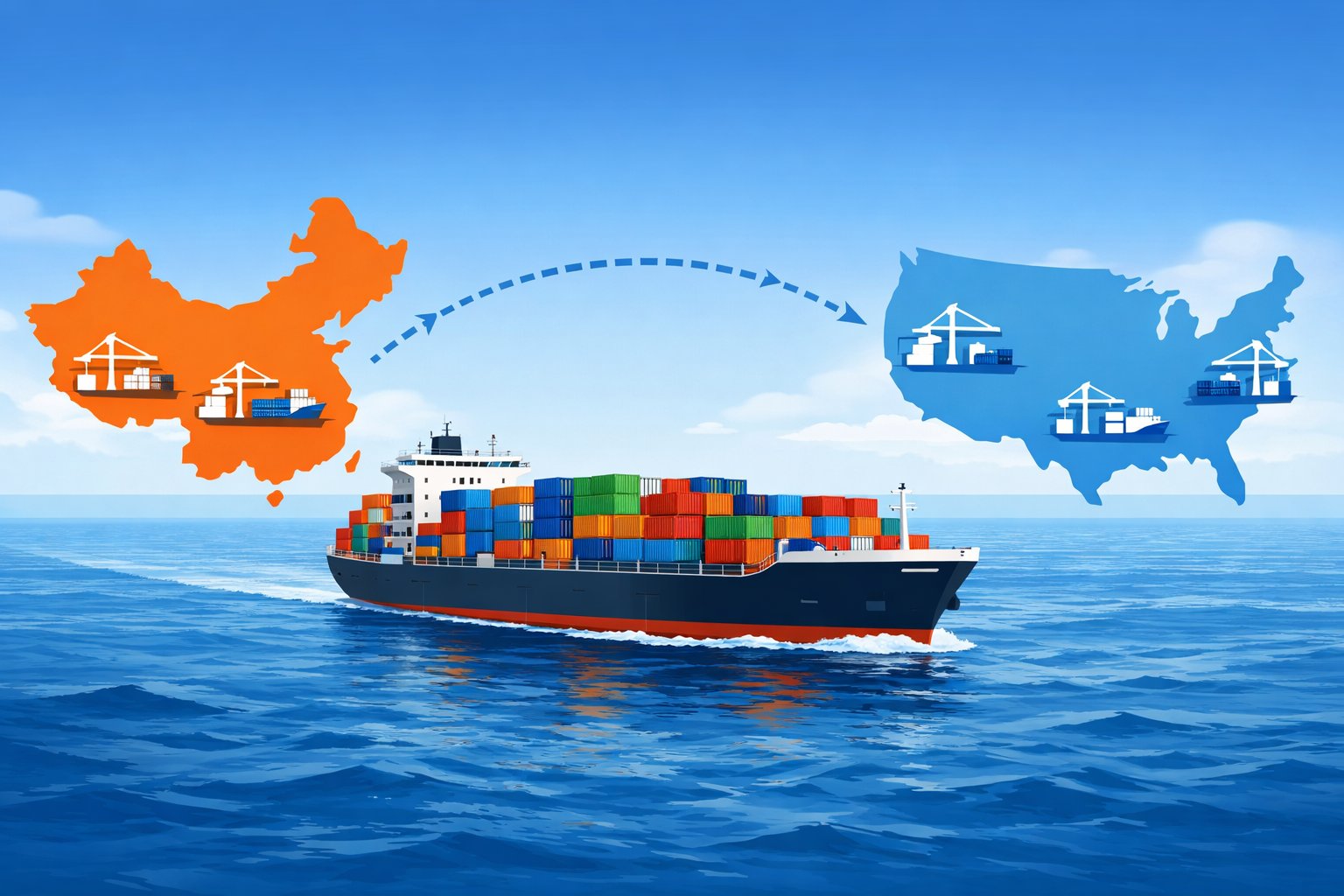
A cargo ship carrying containers sailing across the ocean between stylized maps of China and the United States.

Shipping from China to United States is a huge part of global trade. If you run a small online shop or manage big import orders, knowing how to get your goods across the Pacific efficiently is a real game-changer.

The main shipping methods from China to the US are ocean freight, air freight, and express courier services. Costs range from about $3 per kilogram for air freight to flat rates for full containers by sea, and transit times vary from 3 days for express shipping to 30-40 days for ocean freight.

Your choice really comes down to how much you’re shipping, your timeline, and what you’re willing to spend. Shipping from China to United States isn’t just about picking a method, though.

You’ll need to handle customs paperwork, figure out tariffs, choose the right shipping terms, and make sure your cargo is insured. This guide breaks down the China to USA shipping process so you can steer clear of expensive mistakes and make smarter calls.

Key Takeaways

  • Ocean freight is usually cheapest for shipments over 500 kg; express shipping works best for packages under 150 kg.
  • Transit times range from 3 days (express couriers) to 30-40 days (standard sea freight).
  • Proper documentation and customs clearance are required, and tariffs can really impact your total costs.

Key Shipping Methods from China to United States

Shipping from China to United States mainly uses three methods: sea freight, air freight, and express couriers. Each balances cost, speed, and cargo size in different ways.

Sea freight costs $1,800-$8,000 per container, with transit times of 25-40 days. Air freight runs $4-$8 per kilogram and usually delivers in 5-10 days. Express services charge $7-$15 per kilogram and can get your shipment to you in 2-5 days.

Sea Freight Shipping from China to United States

Sea freight is by far the most cost-effective way to move high-volume shipments from China to the US. You’ll have to decide between Full Container Load (FCL) and Less than Container Load (LCL), depending on your cargo size.

FCL shipping gives you a whole container to yourself. A standard 20-foot container costs $1,800-$3,400, and a 40-foot container is $2,500-$5,500. High cube containers give you extra height for a little more money. If you’re shipping at least 15 cubic meters, FCL is usually the way to go.

LCL shipping lets you share space with other importers. You’ll pay $40-$80 per cubic meter, which makes sense for shipments between 2-15 cubic meters. LCL usually takes 30-40 days because your goods get consolidated at both ends.

Container Type Cost Range Transit Time Best For
20ft FCL $1,800-$3,400 25-35 days 15-25 CBM
40ft FCL $2,500-$5,500 25-35 days 25+ CBM
LCL $40-$80/CBM 30-40 days 2-15 CBM

Air Freight Shipping from China to United States

Air freight is much faster than sea freight, but it’s not cheap. Standard air freight shipping from China to the USA costs $4-$8 per kilogram, with deliveries in 5-10 days, door to door.

Airlines charge you for whichever is higher: the actual weight or the dimensional weight (length × width × height in cm, divided by 6000). For shipments between 150-500 kg, air freight can make sense if you need your goods quickly but don’t want to pay for express courier.

Expect some extra charges—fuel surcharges (15-25%), security fees ($0.50-$1.00 per kg), and terminal handling ($50-$150) are common. If your shipment is over 100 kg, you’ll probably get a better rate.

Express Shipping from China to United States

Express and courier services—think DHL, FedEx, UPS—will get your packages from China to the US in 2-5 days. They charge $7-$15 per kilogram, with minimum fees of $25-$50 per shipment.

These services are door-to-door, fully tracked, and include customs clearance and insurance. They’ll pick up directly from your supplier in China and drop off at your US address. If you need guaranteed delivery dates or you’re shipping samples or small e-commerce orders under 150 kg, this is probably your best bet. Freight forwarders from China to USA often partner with these couriers to offer better rates for regular shippers.

Sea Freight: Full Container Load vs. Less than Container Load Shipping from China to United States

Full container load (FCL) means your goods get their own container, while less than container load (LCL) combines your shipment with others. FCL usually costs less per unit if you’re shipping a lot, but LCL can be cheaper for smaller shipments.

FCL Shipping from China to United States: How It Works

When you go with FCL shipping, you rent the whole container. The shipping line drops it off at your supplier’s place or another loading point in China. Your supplier loads and seals it, and the container stays sealed all the way to your warehouse in the US.

FCL clears customs faster than LCL because you skip the consolidation and sorting steps. The container goes straight from the port to your location, unopened.

You can pick a 20-foot, 40-foot, or 40-foot high cube container. High cubes add an extra foot of height—great for bulky but lightweight cargo.

LCL Shipping from China to United States: What to Expect

LCL shipping works differently. A freight forwarder combines several smaller shipments from different businesses into one container. Your supplier brings your goods to a consolidation warehouse in China, where they measure and document everything.

The forwarder combines your cargo with others heading to the same destination. When the container arrives in the US, it goes to a deconsolidation facility where workers separate each shipment. This extra step adds a few days—usually 3-7—to your delivery time compared to FCL.

You pay for the space your goods take up, measured in cubic meters. If your shipment is under 15 cubic meters, LCL is usually more cost-effective than FCL.

Choosing Container Types for Shipping from China to United States

Your shipment size pretty much decides which shipping method is best. FCL is good if you’re filling at least 60-70% of a container or need your goods quickly. LCL is better for smaller loads that don’t justify a whole container.

Container specs:

Container Type Internal Length Internal Width Internal Height Capacity
20-foot standard 19’4″ 7’8″ 7’10” 33 cubic meters
40-foot standard 39’5″ 7’8″ 7’10” 67 cubic meters
40-foot high cube 39’5″ 7’8″ 8’10” 76 cubic meters

High-volume shipments really benefit from FCL. The more you load, the lower your cost per unit gets.

Air Freight and Express Shipping from China to United States: Options and Steps

Air freight can move your cargo in 2 to 20 days. Express couriers like DHL and FedEx usually deliver in 3 to 5 days.

Your choice depends on weight, urgency, and whether you want door-to-door service or can handle customs yourself. Sometimes it’s worth paying more for speed, but not always.

Step-by-Step: Air Freight Shipping from China to United States

The air freight process from China to the USA starts when you book space with a freight forwarder. You’ll need to give them your shipment’s weight and dimensions.

Your forwarder works out the cost based on either the actual or dimensional weight, whichever is higher. For air shipments, dimensional weight is (length × width × height) divided by 166.

Arrange pickup from your supplier or drop your goods at the departure airport. The forwarder prepares the air waybill, which serves as your contract and tracking document. The airway bill lists shipper details, consignee info, flight details, and what’s inside.

China customs inspects your cargo before it leaves. You’ll need commercial invoices, packing lists, and any required export licenses. When your shipment lands in the US, it goes through customs where duties and taxes are checked. You can then arrange final delivery to your warehouse or business.

Express Courier Comparison for Shipping from China to United States

When you’re shipping from China to United States, express air freight services like FedEx, DHL, and UPS Worldwide Expedited deliver packages fast, but they charge more per kilogram than standard air freight. These international courier companies handle everything from pickup to delivery, including customs clearance, so you don’t have to juggle the details.

Major Express Services:

Service Typical Transit Time Best For
FedEx International Priority 1-3 business days Urgent, high-value items
DHL Express Worldwide 2-4 business days Documents and small parcels
UPS Worldwide Expedited 2-5 business days Mid-weight shipments

Express couriers are ideal for packages under 150 pounds. They charge based on both actual and dimensional weight, so if you’re shipping compact and heavy items, you’ll get better rates.

Door-to-door service includes full tracking and insurance options. That’s a relief if you want peace of mind or need to keep an eye on every step.

Transit Times and Delivery Speed for Shipping from China to United States

Standard air freight transit time from China to the United States usually ranges from 5 to 10 days for direct flights. Flights with connections tack on another 3 to 7 days, depending on the route.

Your total delivery time covers several stages. Ground transport from your supplier to a Chinese airport takes 1 to 2 days. Flight time between major Chinese cities and US hubs is typically 12 to 16 hours.

US customs clearance adds 1 to 3 days. During peak seasons, or if there are errors in your documentation, delays are pretty common.

Peak shipping seasons like Chinese New Year (January-February) and the US holiday shopping rush (September-December) slow things down. Weather and airport congestion can also throw off your air freight timeline.

Express courier services keep things moving faster since they use dedicated aircraft and get priority with customs processing. That’s a big deal when you’re in a hurry.

Shipping Costs and Factors Affecting Price for Shipping from China to United States

Shipping from China to United States isn’t cheap, and prices swing a lot based on your shipping method, cargo size, and timing. Costs can be just a few dollars per kilogram by air, or thousands per container by sea.

Knowing what drives these prices helps you budget and avoid those annoying surprise fees later on.

Shipping Cost from China to the US: What to Expect

Average shipping costs in 2026 depend a lot on the transport method you pick. Sea freight usually costs between $2,000 and $5,000 for a 20-foot container, or $3,000 to $8,000 for a 40-foot container.

If you don’t need a full container, LCL (less than container load) shipping runs $80 to $150 per cubic meter. Air freight is typically $4.50 to $8 per kilogram for shipments over 100 kilograms.

Express courier services like DHL or FedEx charge $6.50 to $10 per kilogram for smaller parcels. DDP (Delivered Duty Paid) shipping bundles in all customs fees and duties, costing $7 to $11 per kilogram by air.

Your final cost covers more than just freight. Expect pickup fees, export documentation, customs clearance, and delivery to your warehouse or fulfillment center.

Container freight pricing also changes based on which port you use and your final destination city.

Impact of Peak Season and Surcharges on Shipping from China to United States

Shipping rates shoot up during busy seasons. Chinese New Year (January or February) and the US holiday shopping buildup (August through October) cause capacity shortages and price jumps of 20% to 50%.

Carriers tack on all sorts of surcharges. Fuel surcharges change monthly with oil prices, port congestion fees show up when terminals get backed up, and security fees cover cargo screening.

Dimensional weight plays a big role in air freight pricing. Carriers check both actual and volumetric weight (length × width × height ÷ 166 for inches or 6,000 for centimeters), then charge you for the higher number.

Heavy, compact packages cost less per kilogram than big, lightweight ones. It’s a little frustrating, but that’s how the math works out.

Cheapest Shipping Strategies for Shipping from China to United States

The cheapest shipping method from China depends on your cargo volume and how quickly you need it. Full container loads give you the lowest per-unit cost if you can fill at least 80% of a container.

Consolidating orders from several suppliers into one shipment can save you money. Booking early helps you lock in rates before peak season price spikes hit.

Plan shipments 4-6 weeks ahead for sea freight and 2-3 weeks for air. Reducing packaging size helps lower dimensional weight charges on air shipments.

Always compare quotes from multiple freight forwarders. Make sure each quote spells out whether it includes customs clearance, duties, and final delivery—otherwise, you might end up paying more than you expected.

Transit Times and Route Planning for Shipping from China to United States

Sea freight from China to the USA typically takes 15 to 40 days. Air freight delivers in 3 to 8 days.

Your delivery schedule depends on the ports you choose, your shipping route, and possible delays at customs or busy ports.

Sea Freight Transit Time for Shipping from China to United States

Sea freight transit times vary a lot based on your destination. West Coast ports like Los Angeles and Long Beach get shipments in 15 to 21 days from major Chinese ports such as Shanghai and Shenzhen.

East Coast destinations take longer because they’re farther away and have more routing options. Shipping to New York or Savannah? Expect 25 to 30 days via the Panama Canal route.

The Mini Land Bridge option lands your shipment on the West Coast and moves it by rail, cutting the time to 21 to 23 days. Gulf Coast ports like Houston need 28 to 35 days due to their longer routes.

Your choice between Full Container Load (FCL) and Less Than Container Load (LCL) matters. FCL shipments move faster since they skip consolidation. LCL adds 2 to 5 days for grouping cargo at the origin.

Direct shipping routes are quickest. If your route includes transshipment through Hong Kong or Singapore, add 2 to 5 days to your total time.

Air Freight Transit Time for Shipping from China to United States

Air freight gets your goods to the USA in 3 to 8 days. Major airports like Shanghai Pudong, Guangzhou Baiyun, and Beijing Capital connect right to US hubs including Los Angeles, Chicago, and New York.

Your shipment’s urgency decides the service level. Express air freight hits most US destinations in 3 to 5 days. Standard air freight takes 5 to 8 days but costs less per kilogram.

Flight availability can mess with your timeline. Peak seasons from August to October and January to February mean less space and possible delays of 1 to 3 days. You’ll pay higher rates during these periods because everyone’s fighting for space.

Port Congestion and Customs Delays for Shipping from China to United States

Port congestion at Los Angeles and Long Beach adds 8 to 11 days during peak seasons. Containers sometimes wait at anchor before unloading even starts, which usually takes 3 to 4 days once they get a berth.

Customs clearance ranges from 1 to 7 days depending on your paperwork. You need a Bill of Lading, Commercial Invoice, and Packing List with the right HS codes. If you’re missing something or the details don’t match, you’re in for a longer wait.

Random inspections happen on about 5% of shipments. If customs picks your cargo for a physical exam, tack on an extra 3 to 5 days. Products that need FDA, USDA, or other regulatory checks can get stuck even longer.

Working with experienced customs brokers who pre-clear documents and answer customs questions fast can really help cut down on delays.

Required Documentation and Import Compliance for Shipping from China to United States

Getting the paperwork right is crucial when shipping from China to United States. It keeps customs delays, fines, and storage fees off your plate.

You’ll need specific transport documents, commercial records, and compliance certificates that prove your shipment’s value, origin, and legal status.

Bill of Lading and Air Waybill for Shipping from China to United States

Your transport document proves carriage and lets you get your cargo at the destination. For ocean freight, you get a Bill of Lading, which acts as a contract between you and the carrier.

This document can be negotiable (so you can transfer ownership) or issued as a telex release for faster processing without mailing originals. Air freight uses an Air Waybill instead, which isn’t negotiable but tracks your shipment from start to finish.

Express shipments get a courier waybill that combines tracking and customs data in one document. All your transport documents must match your commercial invoice and packing list exactly—shipper, consignee, cargo description, weight, and piece count all need to line up.

If they don’t, you’ll probably face customs inspections and clearance holds. That’s a headache you just don’t need.

Commercial Invoice and Packing List for Shipping from China to United States

Your commercial invoice records the sale and sets your duty payment. It needs seller and buyer legal names, addresses, detailed product descriptions with specs, HS codes, quantities, unit prices, total values in the right currency, and the Incoterm like FOB or CIF.

The packing list gives physical packaging info that customs and warehouses use to check your shipment. You need carton numbers, gross and net weights per carton, dimensions, total volume in cubic meters, and a breakdown of which products are in which boxes.

U.S. Customs and Border Protection uses these documents to assess duties and confirm compliance. If you use inconsistent descriptions, miss HS codes, or undervalue goods, expect delays and penalties.

Keep product descriptions identical across both documents. Use plain language, model numbers, and materials to avoid confusion.

Certificate of Origin & Export Declarations for Shipping from China to United States

A certificate of origin shows where your goods were made and might qualify you for lower duty rates under trade agreements. You’ll need to ask your Chinese supplier or a designated authority for this before shipment.

HS codes and product details must match your commercial invoice exactly. China requires an export declaration before departure, which your freight forwarder usually handles with info from your invoice and packing list.

You also need an import declaration filed with U.S. customs when your cargo arrives. Your customs broker or forwarder usually takes care of this. The declaration covers values, HS codes, country of origin, and your Incoterm.

Accurate HS code classification is critical—errors mean wrong duty calculations and maybe an audit.

Customs Clearance, Duties, and Tariffs when Shipping from China to United States

Importing from China means paying customs duties, Section 301 tariffs, and processing charges that can really impact your total cost. The current tariff rate on imports from China is 20%, but depending on your product and its value, you might see extra fees too.

Working with a Customs Broker for Shipping from China to United States

A customs broker handles the paperwork and regulations required for customs clearance from China to the USA. They check your product’s classification, calculate all fees, and submit documentation to US Customs and Border Protection.

Your broker will determine if your goods fall under any special trade restrictions or anti-dumping orders. They also make sure you use the right Incoterms with your supplier, which affects how shipping costs and insurance count toward your dutiable value.

Key services brokers provide:

  • HTS code classification and verification
  • Calculation of all duties and tariffs
  • Customs bond procurement
  • Documentation preparation and filing
  • Communication with CBP on your behalf

Shipments valued under $800 might qualify for duty-free entry under Section 321 de minimis rules. Your customs broker can check if your imports meet these requirements.

Customs Duties and Harmonized Tariff Schedule for Shipping from China to United States

The Harmonized Tariff Schedule assigns a code to every product entering the United States. This code determines your base duty rate, which gets added to the 20% China tariff rate.

Your product’s HTS code is a 10-digit number that identifies the commodity and its required import tax. Duty rates vary a lot depending on the product, ranging from 0% to over 30% of the declared value.

To calculate import duties from China, just multiply your shipment’s total value by the duty percentage. You also pay merchandise processing fees (0.3464% with a minimum of $27.75 and max $538.40) and harbor maintenance fees (0.125% for ocean shipments).

The calculation uses either FOB (Free on Board) or CIF (Cost, Insurance, Freight) values, depending on your agreement with the supplier.

Section 301 Tariffs and Trade Policies on Shipping from China to United States

Section 301 tariffs add extra duties on top of standard customs rates for many Chinese products. These tariffs range from 25% to 100% and apply to items listed under Chapter 99 of the HTS.

Your customs broker checks if your product has a secondary HTS code starting with 9903, which signals extra Section 301 duties. These charges stack on top of your regular duty rate and the base 20% China tariff.

There are over 237 anti-dumping and countervailing duty orders affecting Chinese imports. Products under these orders can face duties exceeding 200% of their value, meant to offset unfair pricing or government subsidies.

Always verify all applicable tariffs before finalizing your import plans, since these rates change often with new trade policies.

Insurance and Risk Management for Shipping from China to United States

Protecting your shipments from China means understanding coverage options and using strategies to reduce losses in transit. Import export insurance provides financial protection against damage, theft, and delays between the factory and your destination.

Cargo Insurance Basics for Shipping from China to United States

Cargo insurance covers the value of your goods against unexpected damage or loss during international shipping. The cost usually ranges from 0.3% to 2% of your shipment’s value, depending on what you import and the coverage you pick.

You’ll see two main policy types. All-risk insurance covers most incidents except specifically excluded events like improper packaging or natural product deterioration.

Named perils insurance only covers risks specifically listed in your policy, like fire, collision, or sinking. Your insurance needs depend on your Incoterms.

Under FOB terms, you arrange coverage from the Chinese port onward. With CIF terms, your supplier includes basic insurance to your destination port, though you might want extra protection.

Insurance for imported Chinese products can be harder to find and costs more than domestic coverage. Longer transit times and multiple handling points push up the risk.

Mitigating Transit Risks When Shipping from China to United States

Insurance isn’t the only way to reduce risk. Careful planning and picking the right vendors matter, too.

Choose experienced freight forwarders who track shipments in real time and work with reliable carriers. Proper packaging prevents most transit damage.

Ask your supplier to use strong materials like reinforced boxes, moisture barriers, and secure palletizing for container shipments. Freight insurance becomes essential when shipping from China because so many parties handle your cargo at ports, warehouses, and during transport.

Document your goods with photos and detailed packing lists before shipment. High-value electronics, machinery, or perishable items need specialized coverage.

If you import regularly, consider an open cover policy. It gives you blanket protection for multiple shipments throughout the year at a negotiated rate.

Frequently Asked Questions About Shipping from China to United States

Shipping costs from China to the USA range from $380 per cubic meter for sea freight to over $9 per kilogram for express services. Transit times vary from 2-5 days for express shipping to 30-40 days for ocean freight.

What are the current rates for Shipping from China to United States?

Shipping rates from China to the USA depend on your method and shipment size. Sea freight is the most affordable, with full container loads ranging from $3,640 to $6,040 for a 20-foot container and $4,600 to $7,600 for a 40-foot container.

Less than container load shipments cost around $382 per cubic meter to the West Coast. Air freight prices run from $4.00 per kilogram to Los Angeles up to $6.00 per kilogram for East Coast destinations like New York and Miami.

Express shipping with DHL, FedEx, or UPS costs between $7.54 and $9.54 per kilogram. Parcels under $800 now face a 30% base tax plus extra handling fees of $15 to $25.

How long does Shipping from China to United States usually take?

Express shipping delivers your goods in 2-5 days door-to-door. Standard air freight takes 8-10 days including customs clearance and airport handling.

Sea freight takes longer, with full container loads needing 30-40 days for door-to-door delivery. Less than container load shipments can take 42-54 days because of consolidation delays.

Peak season adds 5-10 extra days to sea freight shipments. Port congestion can cause delays of 1-2 weeks during busy times.

What is the cost per kilogram for Shipping from China to United States?

Air freight costs $4.00 per kilogram to Los Angeles and $6.00 per kilogram to East Coast cities. Express shipping rates range from $7.54 to $9.54 per kilogram with delivery in 2-5 days.

Premium overnight express services can cost $50 or more per kilogram. Economy express options take 5-7 days and have lower per-kilogram rates than standard express.

Always calculate total costs, including the base shipping rate, fuel surcharges, handling fees, and customs duties. Your final per-kilogram cost depends on weight, destination, and speed requirements.

What is the most cost-effective Shipping from China to United States?

Sea freight remains the most economical choice for large shipments. Full container loads give you the best value if you can fill a 20-foot or 40-foot container.

Less than container load shipping works well for medium-sized shipments that don’t fill a whole container. You pay around $382 per cubic meter to the West Coast, which is much less than air freight.

Air freight is a good balance between speed and cost for shipments weighing 150 to 500 kilograms. Express shipping only makes sense for urgent orders, samples, or small shipments under 150 kilograms where fast delivery justifies the price.

How much does DHL charge for Shipping from China to United States?

DHL charges between $7.54 and $9.54 per kilogram for express shipping from China to the USA. Your package arrives in 3-5 days with standard express, or 1-2 days with premium overnight options at higher rates.

The final cost depends on package weight, size, and destination within the United States. DHL adds fuel surcharges, handling fees of $15 to $25, and you have to pay customs duties and taxes.

Small packages under 150 kilograms work best with DHL express. Larger shipments cost less per kilogram by air freight or sea freight.

Shipping from China to United States: Requirements and Processes

Shipping from China to United States isn’t always as straightforward as people hope. You’ll need a commercial invoice that lists accurate HS codes and product values for customs clearance purposes.

Be sure to include a packing list with every shipment. This should show contents, quantities, weights, and dimensions—don’t skip the details.

For ocean freight, you’ll need a bill of lading. If you’re going by air, you’ll need an airway bill instead.

Import licenses come into play only for restricted products like food, electronics, or medical devices. Most general goods don’t need them, but it’s smart to double-check.

US Customs slaps tariffs on cargo valued at $800 or more. Parcels under $800 used to be tax-free, but now there’s a 30% base tax—thanks to recent policy changes.

Honestly, missing or wrong paperwork causes most shipping delays. Always double-check your documents before shipping from China to United States.

Posted on

Ningbo Freight Forwarder: Expert Logistics & Shipping Solutions

A freight forwarder at a busy port with cargo ships, cranes unloading containers, trucks, and a city skyline in the background.

A Ningbo freight forwarder is a logistics company based in or working through Ningbo, China. They manage goods movement for businesses, handling shipping by sea, air, and rail, plus all the paperwork and customs headaches.

Ningbo sits at the heart of China’s shipping world, and freight forwarders here help businesses get goods moving globally. These companies handle the tough parts of shipping—by sea, air, or rail—so you don’t have to wrestle with the details.

They’ll take care of customs paperwork, warehouse storage, and all the planning that goes into moving cargo. That way, you can focus on running your business instead of figuring out logistics.

Ningbo freight forwarders give you direct access to the Ningbo-Zhoushan Port, one of the busiest ports on the planet, moving over 10 billion tons of cargo each year. That means your shipments can move quickly through a port that connects China to major trade routes across Asia, Europe, and beyond.

Whether you’re shipping a few boxes or a whole container, these forwarders offer services to match your budget and timeline. They know the local rules and have built relationships with shipping lines and airlines.

This expertise helps your cargo clear customs faster and reach its destination without surprise costs or frustrating delays.

Key Takeaways

  • Ningbo freight forwarders provide sea, air, and rail shipping services through one of the world’s busiest ports
  • These companies handle customs clearance, documentation, and warehousing to simplify your international shipping
  • Choosing the right freight forwarder depends on their experience, service quality, and network connections

What Is a Ningbo Freight Forwarder?

A Ningbo freight forwarder is a logistics company based in or working through Ningbo, China. They manage goods movement for businesses, handling shipping by sea, air, and rail, plus all the paperwork and customs headaches.

They focus on Ningbo-Zhoushan Port, which ranks among the world’s busiest by cargo volume. That local presence gives them a real advantage.

Core Functions and Responsibilities

Freight forwarders in Ningbo coordinate your goods’ journey from start to finish. They book space on ships, planes, or trains and set up pickup and delivery.

They prepare shipping documents, file customs paperwork, and make sure your cargo meets all the import and export requirements. Your freight forwarder handles customs clearance at Ningbo-Zhoushan Port, working closely with customs officials to process your shipments and pay any required duties or taxes.

Many forwarders offer warehousing, so you can store products before shipping. Most also provide cargo insurance to protect your goods during transport.

They’ll track your shipments and keep you updated. Some even offer DDP (Delivered Duty Paid) services, where they handle all the costs and duties to get your goods straight to your door.

Ningbo Freight Forwarding vs International Freight Forwarding

Ningbo freight forwarders focus on shipments moving through Ningbo and its port facilities. They’ve built direct relationships with local carriers, customs officials, and warehouse operators in the Ningbo area.

This local knowledge helps them navigate port-specific challenges like container congestion and local regulations. International freight forwarders work across multiple countries and ports worldwide, but they might not have the same deep connections at Ningbo-Zhoushan Port or the same detailed knowledge of local procedures.

If you regularly ship through Ningbo, a local freight forwarder offers clear advantages in speed and expertise. For shipments using multiple ports across different countries, an international freight forwarder with a broader global network might work better.

Key Services Offered by Ningbo Freight Forwarders

Ningbo freight forwarders provide transport options across sea, air, and land, with specialized services for cargo handling and customs clearance. They handle everything from full container loads to small express shipments, offering warehousing and door-to-door delivery solutions.

Sea Freight and Container Services

Sea freight is the backbone of shipping from Ningbo’s port. You can pick Full Container Load (FCL) for larger shipments or Less than Container Load (LCL) if your cargo won’t fill a whole container.

The port handles both standard 20-foot and 40-foot containers, plus specialized gear for oversized cargo. Your freight forwarder manages container booking, port operations, and vessel scheduling to keep your shipment moving on time.

Common container options include:

  • Standard dry containers for general cargo
  • Refrigerated containers for temperature-sensitive goods
  • Open-top and flat-rack containers for oversized items
  • High-cube containers for lighter, bulky products

Most forwarders provide cargo insurance, bill of lading documentation, and port-to-port or door-to-door delivery. They track your containers throughout the journey and work with shipping lines to get you solid rates.

Air Freight and Express Shipping

Air freight moves your goods fast—sometimes in just a few days. Forwarders in Ningbo partner with major airlines and cargo carriers to get your shipments out quickly.

You can choose from different service levels based on your budget and how urgent your delivery is. Express shipping is the fastest, while standard air freight costs less but takes a bit longer.

Airlines charge by weight or volume, whichever is higher. Your forwarder calculates dimensional weight and suggests the best packaging options to keep costs down.

Air freight works best for high-value, time-sensitive, or perishable goods. The service covers customs paperwork, airport handling, and coordination with agents at the destination.

Land and Multimodal Transport Solutions

Multimodal transport mixes shipping methods to save money and time. Your forwarder coordinates trucks, rail, and ocean or air transport in one seamless service.

Rail freight from Ningbo connects to big cities across China and even reaches Europe through established routes. This option is cheaper than air freight and faster than ocean shipping.

Trucks handle local deliveries and connect your cargo between ports, warehouses, and railways. Forwarders arrange both short local pickups and long-haul overland shipping.

The multimodal approach gives you flexibility in route planning. Your forwarder picks the best mix of transport based on your cargo, destination, and budget.

Cargo Consolidation and Distribution

Cargo consolidation groups smaller shipments into one larger load, which can save you money. Your forwarder combines your goods with other clients’ cargo heading to the same place.

This service makes LCL shipping affordable for businesses without enough volume to fill a whole container. You pay only for the space you use.

Warehousing in Ningbo stores your goods until there’s enough cargo for consolidated shipping. The forwarder manages inventory, checks quality, and packs everything up before sending it out.

Distribution services break down consolidated shipments at the destination and deliver to multiple addresses. This includes last-mile delivery, customs clearance at entry, and working with local carriers for final drop-off.

The Strategic Role of Ningbo-Zhoushan Port

Ningbo-Zhoushan Port is the world’s busiest port by cargo volume, handling more than 1.4 billion metric tons in 2025. The port links your business to over 700 ports in 200+ countries through a huge shipping network.

Port Infrastructure and Connectivity

Ningbo-Zhoushan Port runs over 300 shipping routes that connect your cargo to destinations all over the globe. The port’s container throughput topped 40 million TEUs in 2025, keeping it at the top for 17 years straight.

You benefit from the port’s advanced automation and modern terminals. The infrastructure includes terminals for containers, bulk cargo, and liquid products.

Your shipments move through high-efficiency loading systems that cut down turnaround times. The port’s connectivity index is second worldwide, so your freight moves faster.

Direct shipping lines to North America, Europe, and Asia-Pacific give you plenty of routing options. The port also works closely with big ports like Hamburg, Wilhelmshaven, and Valencia.

Role in Belt and Road Initiative

The port acts as a key gateway for Belt and Road Initiative trade routes, connecting China to global markets. Zhejiang province’s trade with Belt and Road partners topped 3 trillion yuan in 2025, up 8.7% year-over-year.

Through Ningbo-Zhoushan Port, you get access to the China (Zhejiang) Pilot Free Trade Zone. This area offers simplified customs and special trade policies. The port even hosts the Maritime Silk Road Port Cooperation Forum to strengthen global shipping partnerships.

Your business benefits from cross-border data flow systems for bulk commodity trading. The port’s institutional setup includes international maritime arbitration and commercial mediation mechanisms.

Major Commodities Handled

The port handles a huge range of cargo that supports global supply chains. Container shipments include high-tech products, industrial robots (up 113% in 2025), and the “new trio”—new energy vehicles, lithium-ion batteries, and photovoltaic products (up 76.3%).

You can ship new energy vehicles through dedicated ro-ro terminals, with more than 700 vehicles exported daily on average. New energy vehicle exports through the port jumped 305.8% year-over-year.

The port also processes bulk commodities like iron ore, coal, crude oil, and grain. High-tech imports grew 13.5% in 2025, showing strong demand for advanced parts and materials.

Your freight forwarder can set up specialized handling for temperature-sensitive cargo, hazardous materials, and oversized equipment through the port’s versatile terminal network.

Leading Freight Forwarders in Ningbo

Ningbo is home to many freight forwarding companies handling sea, air, and land transport for businesses shipping goods internationally. The forwarder you pick affects your shipping costs, delivery times, and how smooth your logistics run.

AEB Logistics

AEB Logistics stands out as an international freight forwarder with strong ties to major shipping lines and customs authorities in Ningbo.

The company provides a wide range of services—ocean freight, air cargo, customs clearance, and warehousing. Their network covers North America, Europe, Southeast Asia, and other global markets.

You can track shipments through their logistics management system, which keeps you updated on cargo status and location. AEB Logistics handles both full container loads (FCL) and less-than-container loads (LCL), so they’re flexible for any shipment size.

They maintain close relationships with local customs officials and port authorities, which helps speed up documentation and cut clearance delays. Honestly, if you’re looking for a reliable partner in Ningbo, AEB Logistics is worth a serious look. Their experience and network really set them apart in a crowded market.

Criteria for Selecting a Freight Forwarder

Your forwarder should have direct relationships with major shipping lines to secure competitive rates and guaranteed space. AEB Logistics works closely with carriers like MSK, CMA, ONE, HMM, and ZIM as a first-class booking agent, which means more attractive pricing options for you.

Check if the forwarder has offices or agents at your destination ports. AEB Logistics maintains branches in Shanghai, Qingdao, Shenzhen, Wuhan, Tianjin, and Dalian, as well as an international network of agents.

This level of coverage ensures your cargo gets proper handling at both origin and destination. It really makes a difference when things get hectic at the port.

Look for forwarders with certifications like NVOCC approval, FMC qualification, or membership in organizations such as WCA or CIFA. These credentials show the company actually meets industry standards.

Also, check their experience with your specific cargo type—standard containers, dangerous goods, refrigerated items, or oversized freight. You want someone who knows your business, not just shipping in general.

Supporting Logistics Services

Ningbo freight forwarders do much more than just move goods from point A to point B. They provide services that protect your cargo and smooth out international shipping headaches.

These extras cover financial protection, storage, and making sure your shipment clears regulatory hurdles at the border. It’s not just about transport—it’s about peace of mind.

Cargo Insurance Options

Cargo insurance protects your shipment against loss or damage during transit. Most Ningbo freight forwarders offer marine cargo insurance for ocean freight and air cargo insurance for air shipments.

These policies typically cover risks like accidents, theft, natural disasters, and handling damage. It’s worth considering, especially if your cargo is high value or fragile.

There are two main coverage types. All-risk insurance gives you broad protection, covering most causes of loss or damage.

Named perils insurance is cheaper but only covers specific risks listed in your policy. It can be tempting to save money, but weigh the risks carefully.

Your freight forwarder acts as an insurance agent and helps you pick the right coverage based on your cargo value and shipping route. They’ll handle the paperwork and file claims if things go wrong.

Premiums usually range from 0.2% to 2% of your cargo’s declared value, depending on the goods and where they’re going. It’s a small price for some peace of mind, honestly.

Warehousing and Storage Solutions

Ningbo freight forwarders operate warehouses near the port for both short-term and long-term storage. You can store goods before shipment, consolidate multiple orders, or keep inventory close to your suppliers.

These facilities offer climate-controlled storage for sensitive products and security systems to deter theft. It’s not just a warehouse—it’s your cargo’s safe haven.

Storage services include inventory management, order picking, and packaging. Your forwarder tracks your goods through digital systems, so you always know what’s in storage.

This helps if you need to delay shipment or wait for better freight rates. Flexibility can save you money and headaches.

Customs Clearance Procedures

Customs clearance is a must for all international shipments entering or leaving China. Your Ningbo freight forwarder prepares and submits documents like commercial invoices, packing lists, and bills of lading to customs authorities.

They classify your goods under the right HS codes to determine duties and taxes. Getting this wrong can be costly, so experience matters.

The process includes document review, duty payment, and sometimes a physical inspection. Experienced forwarders know the local rules and can help you avoid delays from paperwork errors.

They talk directly with customs officials to resolve issues quickly. Your forwarder also arranges customs inspections and handles special permits for restricted goods.

Optimizing Your Supply Chain with Ningbo Freight Forwarding

Ningbo freight forwarding gives companies a real edge in logistics operations—think better efficiency, compliance, and cost control. Picking the right partner in this busy port city can make or break your supply chain.

Benefits for Global Businesses

Working with Ningbo freight forwarders gives you access to one of China’s biggest port systems. The Port of Ningbo-Zhoushan moves massive shipping volumes and connects to major trade routes across Asia, Europe, and North America.

Your business gets comprehensive logistics services, from warehousing and customs clearance to transportation coordination. These services work together to cut delays and keep your shipments on track.

Ningbo’s spot on the East China Sea means quick access to international shipping lanes. That location alone cuts transit times compared to inland factories.

You also benefit from the city’s mature supply chain infrastructure and experienced logistics providers. It’s not just about speed—it’s about reliability.

Professional freight forwarders in Ningbo offer door-to-door shipping solutions. They handle every step, from picking up at the factory to delivering at your warehouse.

This end-to-end service takes the burden off your shoulders. No more juggling multiple carriers or agents—just one point of contact.

Navigating Regulatory Compliance

Customs regulations can be a nightmare for international shipping, especially between China and other countries. Your Ningbo freight forwarder handles the paperwork and ensures your products are classified correctly.

Recent changes to U.S. customs policies have increased inspection rates and compliance requirements. Freight forwarding companies with AEO (Authorized Economic Operator) status help reduce inspection risks that can exceed 10% for standard shipments.

These certified forwarders maintain higher security standards and get preferential treatment from customs. Your forwarder manages customs declarations, import/export licenses, and product inspections.

They stay up-to-date with shifting regulations and trade policies that affect your shipments. This expertise saves you from costly delays due to documentation errors or compliance issues.

Cost-Saving Strategies

Freight forwarders in Ningbo offer flexible shipping options to fit your budget and timeline. You can choose sea freight, air freight, or multimodal solutions depending on your cargo’s weight, volume, and delivery needs.

Shipping Method Comparison:

  • LCL (Less than Container Load): For smaller shipments starting at 1 cubic meter
  • FCL (Full Container Load): More economical for larger volumes
  • Air Freight: Faster transit for time-sensitive goods, minimum 1 kg

Consolidation services cut shipping costs by combining your cargo with other shipments. This works well if you don’t have enough to fill a full container.

Your freight forwarder negotiates better rates through strong relationships with carriers and shipping lines. They use their high shipping volumes to secure discounts you probably couldn’t get on your own.

Integrating resources across the supply chain eliminates extra handling and storage fees. It’s all about efficiency and saving money where you can.

Frequently Asked Questions

Ningbo freight forwarders offer complete shipping solutions—sea, air, and rail transport, customs clearance, and door-to-door delivery. Knowing what services they provide and how to pick the right one will help you manage your shipments better.

What services do Ningbo freight forwarders typically offer?

Ningbo freight forwarders provide sea freight services for both Full Container Load (FCL) and Less than Container Load (LCL) shipments. They handle air freight for time-sensitive cargo and rail transport for cost-effective overland shipping.

Beyond transport, these forwarders manage customs brokerage and documentation. They also offer warehousing solutions and coordinate with ports, carriers, and local authorities.

Many provide door-to-door delivery services that cover the entire shipping process from pickup to final destination. It’s a one-stop shop for your logistics needs.

How do I select a reliable freight forwarder in Ningbo for international shipments?

Start by researching potential forwarders online and checking their business licenses and certifications. Make sure they’ve handled your shipping routes and cargo types before.

Request quotes from several forwarders to compare pricing and services. Ask about their partner network and track record with on-time deliveries.

Look for forwarders with direct relationships with carriers, not just a chain of intermediaries. Review their communication habits and response times.

A reliable forwarder should give you transparent tracking and regular updates on your shipment status. If they don’t, that’s a red flag.

What are the advantages of using a local Ningbo freight forwarder compared to large multinational companies?

Local Ningbo freight forwarders have built strong relationships with regional carriers and port authorities. This gives them better access to shipping slots and often speeds up processing at Ningbo Zhoushan Port.

They know local customs regulations and procedures unique to Ningbo. Their proximity to your suppliers means they can respond quickly and coordinate pickups more efficiently.

Local forwarders usually offer more personalized service and direct communication. You can often negotiate better rates for regular shipments, since they value long-term relationships.

What factors should I consider when estimating shipping costs with a Ningbo freight forwarder?

Your shipping costs depend on the transportation mode you pick. Sea freight is usually the cheapest for large shipments, while air freight is faster but costs more.

Cargo weight and volume both affect your final price. Extra charges might include customs clearance, documentation, and port handling fees.

Fuel surcharges and currency exchange rates can also change your total cost. Distance to the final destination and special handling needs will increase expenses.

Insurance coverage and warehousing services add to your total if you need them. Always ask for a detailed quote so there are no surprises.

Can Ningbo freight forwarders handle customs clearance for exports and imports?

Ningbo freight forwarders provide customs brokerage services for both exports leaving China and imports arriving in destination countries. They manage all documentation for customs clearance and ensure compliance with local and international rules.

These forwarders work directly with customs to process your shipments. They classify goods correctly, calculate duties and taxes, and submit the necessary declarations.

Their expertise helps prevent delays caused by paperwork errors or regulatory issues. It’s one less thing for you to worry about.

About AEB Logistics:

AEB Logistics is a leading freight forwarder in China, known for its strong industry relationships and reliable service. With offices across major Chinese port cities and a global agent network, AEB Logistics brings expertise and dedication to every shipment.

If you’re looking for a trustworthy partner to streamline your supply chain and handle the complexities of international shipping, AEB Logistics is a solid choice. Their team genuinely cares about your cargo and goes the extra mile to keep things moving smoothly.

What documentation is required for shipping with a Ningbo freight forwarder?

You’ll need to provide a commercial invoice that lists every item in your shipment along with their values. There’s also the packing list, which should detail the contents, weights, and dimensions of each package—sometimes that part feels a bit tedious, but it’s essential.

Depending on how you’re shipping, you’ll need either a bill of lading or an airway bill. For certain products, you might also need export licenses or certificates—honestly, it’s easy to miss those if you’re not careful.

Certificates of origin can help your shipment qualify for preferential trade agreements. Some destinations ask for extra paperwork, like inspection certificates, insurance certificates, or import permits.

It can get confusing, but that’s where a good freight forwarder steps in. I’d recommend AEB Logistics—they know the ropes and can walk you through exactly what’s needed for your cargo and destination.

If you’re not sure where to start, reach out to AEB Logistics. They’ve got the experience and will help you avoid headaches with documentation.

Posted on

Shanghai Freight Forwarder: Guide to Reliable Shipping Solutions

A busy Shanghai port with cargo ships, shipping containers, cranes, trucks, and workers coordinating freight operations near a modern office building and city skyline.

A Shanghai freight forwarder coordinates pickup, warehousing, export customs, booking, and delivery to your final destination. You don’t have to juggle every step yourself.

Shanghai moves more container traffic than almost any other port on the planet. That makes it a huge starting point for companies importing goods from China. If you buy products from suppliers in or near Shanghai, working with a freight forwarder can save you time, cut costs, and help you avoid shipping headaches.

Most businesses choose freight forwarders because they get better shipping rates, manage tricky paperwork, and solve problems that pop up during international transport. Whether you need air freight for urgent orders or sea freight for bigger shipments, a local forwarder in Shanghai knows the port system and customs requirements.

This guide breaks down what Shanghai freight forwarders actually do, how to choose one, and which shipping methods fit your business best. You’ll also get a look at the paperwork you’ll need—and some tips for dodging mistakes that delay shipments or drive up costs.

Key Takeaways

  • Shanghai freight forwarders handle your shipping from pickup to final delivery.
  • They offer air freight, sea freight, express courier, and door-to-door DDP services.
  • Picking the right forwarder comes down to their local know-how, fair pricing, and customs experience.

What Is a Shanghai Freight Forwarder?

A Shanghai freight forwarder is a logistics company based in Shanghai that arranges the transportation of goods from China to international destinations. They handle the entire process of moving cargo between suppliers and buyers across borders.

Roles and Responsibilities

A freight forwarder in Shanghai acts as a middleman between you and different transportation services. They book cargo space with shipping lines and airlines for you. They also prep shipping documents like bills of lading, commercial invoices, and packing lists.

Shanghai freight forwarders can pick up from your suppliers anywhere in China. They arrange warehousing and cargo consolidation if you’re sourcing from more than one factory. Most forwarders handle export customs declarations, especially when your supplier doesn’t have an export license.

They can also sort out cargo insurance, quality inspections, and repacking. Many Shanghai freight forwarders offer door-to-door delivery with all duties and taxes paid. They’ll keep you updated with real-time tracking along the way.

Differences Between Freight Forwarders and NVOCCs

A non-vessel operating common carrier (NVOCC) is a special type of freight forwarder that issues its own bills of lading. NVOCCs buy space in bulk from shipping lines and resell it to smaller shippers. They act like carriers but don’t actually own ships.

Traditional freight forwarders arrange transportation but use the carrier’s bill of lading. They work as agents, connecting you with shipping companies. NVOCCs take on more responsibility and liability for your cargo.

Many Shanghai freight companies have both forwarder and NVOCC licenses. This lets them control pricing and routing more directly. If you’re the shipper, working with an NVOCC-licensed forwarder usually means better rates and more flexible consolidation.

Key Benefits of Using a Shanghai Freight Forwarder

Working with a freight forwarder in Shanghai gives you specialized knowledge, smoother shipping processes, and more control over your logistics costs. These folks handle the details so you can focus on your business.

Local Expertise and Market Knowledge

Finding a freight forwarder in Shanghai with local expertise can be a game changer. These forwarders know China’s regulatory landscape, customs procedures, and documentation rules. They really get how the Shanghai port system works—it moved 47.3 million TEUs in 2023, after all.

Local forwarders have connections with carriers, customs officials, and warehouse operators. This network helps you dodge delays and compliance issues that could cost you time and money. They keep up with changing rules and trade policies that might affect your shipments.

Your forwarder can also suggest the best shipping routes and methods for your cargo. They know about seasonal trends, port congestion, and local holidays that could throw off your delivery schedule. This insight helps you plan better and avoid nasty surprises.

Navigating Complex Logistics Networks

Shanghai is China’s biggest export hub, linking to global shipping routes by sea and air. Freight forwarders in Shanghai coordinate services like pickup, warehousing, export declaration, booking, and customs clearance. They keep these moving parts running so your cargo doesn’t get stuck.

Your forwarder handles the paperwork and talks to all the different parties involved. Carriers, customs brokers, and delivery services—your forwarder keeps everyone in the loop. They track your shipment at every stage and let you know if something comes up.

The logistics network in Shanghai uses lots of transport modes and transfer points. A good forwarder knows how to mix and match these options efficiently. They can set up door-to-door delivery or handle special cargo that needs extra care.

Cost Efficiency and Risk Reduction

Freight forwarders use their shipping volume to negotiate better rates with carriers. You get the benefit of those discounts, even if you don’t ship huge volumes. They compare options across carriers and routes to find you the best deal.

They help you avoid expensive mistakes. Your forwarder makes sure your paperwork is right, your goods are classified correctly, and you’re following the rules. Messing up here can mean fines, delays, or lost shipments.

They’ll also offer insurance and help you handle claims if something gets damaged. They know liability limits and can suggest the right coverage. This risk management protects your investment and just lets you breathe easier.

Core Services Offered by Shanghai Freight Forwarders

Shanghai freight forwarders provide a full range of logistics solutions by sea, air, or a mix of both. Services range from basic port-to-port shipping to full door-to-door delivery with customs taken care of.

Sea Freight Services

Sea freight is still the most affordable way to ship from Shanghai, especially for big or heavy cargo. You can go with LCL (Less than Container Load) for smaller shipments or FCL (Full Container Load) if you’ve got enough goods to fill a container.

LCL usually runs $80-$200 per cubic meter and takes about 25-35 days to reach places like the US or Europe. FCL costs anywhere from $1,200-$5,000 for a 40-foot container, depending on where it’s going and the season.

Most Shanghai forwarders handle the whole export process: pickup from suppliers, container loading, customs declaration, and booking space with major shipping lines. They can consolidate goods from several suppliers into one container to save you money.

Air Freight Services

Air freight from Shanghai gives you speed when you need it. Shanghai Pudong International Airport is a major cargo hub with direct flights almost everywhere.

Standard air freight costs around $5-$9 per kilogram with delivery times of 5-10 days. Express couriers are a bit more at $6-$10 per kilogram but get your shipment there in about 3-7 days.

Pick air freight for urgent, high-value, or smaller shipments where the higher cost is worth it. Your forwarder will handle airport customs, dangerous goods paperwork if needed, and pickup from your suppliers.

Multimodal and Door-to-Door Solutions

Door-to-door shipping uses different transport methods to get your goods right to your address. This includes pickup in China, international shipping, customs clearance at the destination, duty payment, and final delivery.

DDP (Delivered Duty Paid) shipping is handy because you get one total price covering all the fees. Your forwarder manages the whole thing, so you don’t need to worry about import licenses or customs know-how.

Many Shanghai forwarders also offer extras like Amazon FBA prep, cargo inspection, warehouse storage, and product labeling. These services make your supply chain run smoother without needing multiple providers.

Handling Customs and Shipping Documentation

Because Shanghai is such a huge export hub, freight forwarders deal with complicated documentation and customs rules every day. Getting the paperwork right is key for a smooth shipment.

Customs Clearance Process in Shanghai

Shanghai customs clearance uses a digital process through China’s electronic port system. Your freight forwarder submits all the documents electronically before your cargo leaves port.

Clearance usually takes 1-3 business days for standard shipments. Customs officials review your paperwork, check product classifications, and make sure duties and taxes are correct. Your forwarder works with customs brokers who have the right licenses for declarations in Shanghai.

Key steps in the process include:

  • Submitting customs declaration forms online
  • Scheduling inspections if authorities require them
  • Paying any export duties and fees
  • Getting release authorization from Shanghai customs

Some products need extra inspections or certifications before clearing customs. Electronics, food, and chemicals often face stricter checks and may need special permits.

Required Export and Import Documentation

A commercial invoice is the main document for your shipment. It lists the seller, buyer, product details, quantities, values, and payment terms. Customs uses this to calculate duties and check the transaction.

The bill of lading is your receipt and contract with the shipping carrier. It proves you own the goods and gives delivery instructions. Ocean freight uses a sea waybill or negotiable bill of lading, while air shipments use an air waybill.

Essential documents your forwarder prepares:

Document Purpose
Packing list Lists contents, weights, and dimensions
Certificate of origin Proves where goods were made
Export license Needed for restricted products
Insurance certificate Shows cargo is protected

Your freight forwarder makes sure all documents match. If there’s a mismatch between the commercial invoice and packing list, expect delays.

Common Compliance Challenges

Product classification mistakes cause the most compliance headaches. Every item needs the right HS code to figure out duties and restrictions. Using the wrong code gets your shipment held up and could mean penalties.

If your commercial invoice doesn’t match your other paperwork, customs will notice. Discrepancies in product descriptions, values, or quantities trigger delays.

Missing permits or certificates can stop shipments cold. Some products need special approvals before export, like quality certificates, fumigation documents, or safety papers. Your forwarder should flag these requirements early.

China’s currency declaration rules mean you have to report transaction values accurately. Undervaluing goods to lower duties is illegal and risky. Your paperwork needs to show the real commercial values and payment terms.

How to Choose the Right Shanghai Freight Forwarder

Finding a freight forwarder in Shanghai isn’t just about picking a name off a list. You’ve got to look into their local operations and see what their track record really looks like.

Shanghai’s China’s biggest port, so naturally, there are thousands of logistics providers fighting for your attention. But let’s be honest, not all of them deliver the same quality of service.

Evaluating Local Handling Capabilities

Don’t get distracted by fancy websites or big promises. A Shanghai freight forwarder needs solid local infrastructure.

Do they have their own warehouse near key shipping hubs like Waigaoqiao Port or Yangshan Deep Water Port? Ask about their pickup coverage—can they reach factories in Pudong, Minhang, Songjiang?

If you’re sourcing from multiple suppliers, decent consolidation services are a must. Combining shipments into one container saves you money and cuts down on customs headaches.

Get specifics about storage fees, inspection processes, and quality control at their Shanghai warehouse. You’ll want to know what you’re getting into before your cargo even moves.

Look for direct relationships with ocean carriers like COSCO, Maersk, and MSC. When a forwarder books space themselves, you usually get better rates and more reliable space during busy seasons.

Ask how fast they can pick up from your supplier and what their average processing time is before the goods actually leave Shanghai. Speed matters, especially if you’re on a tight schedule.

Assessing Experience and Reputation

Years in business only tell you so much. What you really want is a forwarder with experience handling your type of product—electronics, textiles, machinery, whatever it is.

Different cargo needs different expertise, especially when it comes to paperwork and customs. Don’t be afraid to ask for references from companies in your industry and target country.

If a forwarder’s shipped to your market before, they’ll know the customs rules and can help you avoid surprises. Double-check their NVOCC licenses and see if they’re part of any reputable freight forwarding associations.

Look up their complaint history online. If you see a pattern of hidden fees, bad communication, or damaged cargo, that’s a red flag.

Solid Shanghai forwarders usually reply within a day and keep you updated without you having to chase them.

Popular Shipping Methods from Shanghai

Shanghai’s connected to the world in just about every way you can imagine. You can pick ocean freight for big loads, express couriers for quick deliveries, or even rail and road for certain routes.

Full Container Load (FCL) and Less than Container Load (LCL)

If you’ve got a lot to ship, ocean freight is usually your best bet. FCL works when you can fill a 20- or 40-foot container—no sharing, just your stuff, and usually faster transit times (think 15-30 days to major ports).

LCL is for smaller shipments. Your goods get combined with others in a shared container, then sorted out at the destination.

LCL typically takes 20-35 days because of all the extra handling. Shanghai’s port does both options well, with frequent sailings to just about everywhere.

With LCL, you pay only for what you use. FCL gives you more protection since nobody else’s cargo is mixed with yours.

Express Courier Options

Need it there yesterday? Express couriers like DHL, UPS, and FedEx can get shipments from Shanghai to most countries in 3-7 days.

They run out of Shanghai Pudong International Airport, which is a major air freight hub. Express is great for samples, urgent orders, or anything under 200 kilograms.

These carriers handle customs paperwork and give you door-to-door tracking, so you’re never in the dark.

Key differences between major carriers:

Carrier Best For Average Transit Time
DHL Europe, Asia-Pacific 3-5 days
UPS North America 3-6 days
FedEx Worldwide coverage 4-7 days

Express costs more per kilo, but if you need speed and reliability, sometimes it’s worth every penny.

Rail and Road Freight Alternatives

Rail freight from Shanghai to Europe is catching on. Trains usually get there in 18-25 days, and the cost is about 30-50% less than air freight.

Road freight is solid for regional moves—within China or to nearby countries like Vietnam or Laos. Trucks can get shipments there in 3-7 days.

If you want something faster than ocean but can’t justify air freight costs, these options are worth a look.

Frequently Asked Questions

Choosing and working with a Shanghai freight forwarder means figuring out tracking systems, how to verify companies, and what services actually help you. Here are some questions people ask all the time when shipping out of Shanghai.

How can I track my shipment with a Shanghai freight forwarder?

Most Shanghai forwarders offer online tracking. Once your cargo’s picked up or shipped, they’ll give you a tracking number.

You can use that number to see where your shipment is—either on their website or app. Many forwarders also send you automatic updates by email or text at key points, like when your goods leave the warehouse, clear customs, or arrive at the destination.

If you need more info, just contact your forwarder directly. They should be able to give you a detailed update.

What should I consider when choosing a Shanghai freight forwarder for international shipping?

Check if the forwarder’s experienced with your shipping route and cargo type. If they regularly ship to your destination, they’ll know the customs rules and what can go wrong.

Ask what’s included in their pricing. Some forwarders bundle in customs clearance, warehousing, and insurance, while others add those as extras.

Customer service matters more than you think. You want a forwarder who responds quickly and clearly when issues pop up.

How do I verify the legitimacy of a Shanghai-based freight forwarding company?

Make sure they have the right licenses from Chinese authorities—a business license and a freight forwarding license from the Ministry of Commerce.

Ask for references or look up verified customer reviews. The established companies will have a reputation you can check out.

If you can, visit their office or at least confirm their address is real. Avoid anyone operating out of a virtual address only.

What factors determine the best freight forwarder for my shipping needs from Shanghai?

Your cargo type plays a big role. Some forwarders handle electronics, textiles, or hazardous materials better than others.

Shipping volume is important too. If you’re moving big quantities, you want someone who can offer discounts and dedicated support. For smaller shipments, look for a forwarder that’s good at consolidating cargo.

Your destination country also matters. Some forwarders have stronger networks in certain countries, which can help you clear customs and get better rates.

Can you recommend some reputable freight forwarders with experience in shipping from Shanghai to United States?

Absolutely—look for forwarders who specifically mention U.S. routes in their service areas. Companies with offices or partners at major U.S. ports like Los Angeles, New York, or Houston usually handle this route more efficiently.

Ask for quotes from several forwarders who serve Shanghai–U.S. routes. Compare their transit times, pricing, and what’s included so you find the best fit for your business.

Check if they’re familiar with U.S. customs regulations and paperwork. The right company will help you avoid common pitfalls and delays at U.S. ports.

One freight forwarder I’d recommend is AEB Logistics. They have a strong presence in Shanghai and specialize in routes to the United States. Their team is responsive, and they know the ins and outs of U.S. customs, which saves you time and headaches. If you’re looking for a reliable partner, it’s worth reaching out to them for a quote. You can learn more at AEB Logistics.

What are the advantages of using an AEB Logistics service?

AEB Logistics stands out for their hands-on approach and deep experience with international shipping. They’ve built a solid reputation in the Shanghai logistics scene, especially for U.S.-bound shipments.

With AEB, you get dedicated customer support that doesn’t leave you guessing. Their staff actually listens and helps solve problems—not just during booking, but all the way to delivery.

They offer flexible options for FCL, LCL, air, and express shipments, plus value-added services like customs clearance and insurance. If you want a forwarder that acts more like a partner than a vendor, AEB is a good choice.

And honestly, it’s refreshing to deal with a team that communicates clearly, keeps you updated, and doesn’t hit you with surprise fees. Give them a shot—you might be pleasantly surprised.

Posted on

Shenzhen Freight Forwarder: Expert Guide for Global Shipping Success

A busy cargo port in Shenzhen with container ships, cranes, trucks, trains, and city skyscrapers in the background.

A Shenzhen freight forwarder is a logistics company that manages the transportation of your cargo from Shenzhen to destinations worldwide. They handle everything from booking shipments to clearing customs.

These companies operate in one of China’s busiest trade cities. Every day, millions of products leave Shenzhen by sea, air, and rail.

Shenzhen sits right next to Hong Kong and boasts some of the world’s largest ports and shipping facilities. This location makes it a top pick for businesses that need to move products quickly and efficiently.

No matter if you’re shipping small packages or massive industrial equipment, freight forwarders in Shenzhen have solutions for your needs and budget.

Pick the right freight forwarder and you’ll save time, money, and a lot of stress. They handle the tricky paperwork, negotiate with carriers, and fix problems that crop up during transport.

Knowing how these companies work helps you make smarter shipping decisions. It’s worth digging in.

Key Takeaways

  • Shenzhen freight forwarders manage your cargo transportation from China to global destinations through sea, air, and rail options.
  • They provide customs clearance, warehousing, documentation, and door-to-door delivery to make your shipping life easier.
  • Choosing a reliable forwarder with experience in your route and cargo type keeps things cost-effective and on schedule.

Why Shenzhen Is a Leading Freight Forwarding Hub

Shenzhen’s rise as a freight forwarding powerhouse comes from its location, world-class infrastructure, and its central role in connecting Chinese manufacturers to global markets. The city processes over 16 million TEUs annually and serves as a critical gateway for international shipping.

Strategic Location and Infrastructure

Shenzhen sits in the Pearl River Delta, right next to Hong Kong. You’re basically at the heart of one of the world’s most productive manufacturing zones.

This location gives you direct access to thousands of factories making everything from electronics to textiles and machinery. The city’s Special Economic Zone status means customs procedures are smoother and you get tax perks that speed up shipments.

Road and rail networks here connect straight to major Chinese cities and even reach Europe through the China-Europe Railway Express. When you ship from Shenzhen, you tap into a logistics ecosystem built for speed and efficiency.

Warehouses, consolidation centers, and freight forwarders cluster near ports and airports. This setup shrinks transit times and keeps handling costs down compared to other Chinese cities.

Port and Airport Capabilities

Shenzhen Port ranks fourth globally and moved 16.197 million TEUs in 2024. You can ship through terminals like Yantian and Shekou, which send out weekly departures to ports around the world.

The port’s deep-water berths fit the biggest container vessels, so you get direct shipping routes. Shenzhen Bao’an International Airport handles 1.5 million tons of air cargo every year.

Express air freight options get your time-sensitive shipments to North America, Europe, and Asia fast. The airport runs 24/7 and handles specialized cargo, including electronics and perishables.

Both port and airport use automated systems for container handling and customs. That means your shipments get processed faster.

Role in Global Logistics

Your freight forwarder in Shenzhen connects you to global logistics networks through partnerships with major carriers like COSCO and international courier services. The city’s logistics pros know export regulations, documentation, and the best shipping routes.

Shenzhen freight forwarders offer multimodal solutions—sea, air, and land. You can consolidate shipments from multiple suppliers, arrange customs clearance, and coordinate last-mile delivery in the destination country.

The infrastructure here supports both small e-commerce packages and full container loads for big companies. Shipping from China through Shenzhen means you get flexibility in choosing carriers and routes.

Pick cost-effective sea freight for 25-30 day transit times or go with air freight for delivery within a week. It’s your call.

What Is a Shenzhen Freight Forwarder?

A Shenzhen freight forwarder acts as a go-between for your business and transportation services. They manage the movement of goods from China to anywhere in the world.

These companies handle shipping logistics, customs paperwork, and cargo coordination. They aim to make global shipping less of a headache for importers and exporters.

Definition and Core Functions

A freight forwarder in Shenzhen is a logistics company that arranges transportation for your goods but doesn’t own ships or planes. They operate in one of China’s busiest trade hubs, coordinating shipments through different carriers and methods.

Core services include:

  • Transportation arrangement – Booking space on cargo ships, planes, or trucks
  • Documentation handling – Preparing bills of lading, invoices, and packing lists
  • Customs clearance – Managing import/export rules and duties
  • Warehousing – Storing goods before or after shipment
  • Cargo insurance – Protecting your shipment against loss or damage

Most providers operate near major ports like Yantian and Shekou, plus Shenzhen Bao’an International Airport. This location gives them direct access to shipping routes connecting Asia, Europe, North America, and beyond.

How Freight Forwarders Operate

Your China freight forwarder starts by collecting details about your cargo—size, weight, destination, and delivery timeline. Then they pick the best shipping method for your budget and urgency.

The process usually goes like this:

  1. Quote and booking – They send you pricing and you pick your service
  2. Pickup and packaging – The forwarder collects goods from your supplier
  3. Export customs – They file paperwork with Chinese authorities
  4. International transport – Your cargo moves via sea, air, or land
  5. Import customs – The forwarder clears your goods at the destination
  6. Final delivery – Goods show up at your warehouse or address

Most Shenzhen freight forwarders offer tracking so you can watch your shipment move in real time. They also handle communication with carriers, customs brokers, and local delivery services for you.

Key Advantages for Businesses

Working with a Shenzhen-based forwarder cuts your shipping costs through volume discounts and smarter routes. These companies have solid relationships with carriers, so they can get you better rates than you’d find on your own.

Outsource the logistics and you save time. Instead of juggling vendors and customs rules, your forwarder handles it all. This really matters during peak seasons, like August to October, when shipping gets crazy.

Freight forwarders help you avoid delays and penalties. They know Chinese export requirements and import rules for your destination. If you mess up the paperwork, your cargo can get stuck for days—but a good forwarder keeps things moving.

If you’re new to global shipping, forwarders offer advice on compliance, packaging, and the best routes. That kind of expertise is hard to put a price on.

Main Freight Services Offered in Shenzhen

Shenzhen freight forwarders provide air freight, sea freight, and rail options to move cargo worldwide. Each service has different transit times, costs, and capacity, so you can match your shipping needs.

Air Freight Solutions

Air freight from China gets your cargo delivered fast—usually within 3-7 days to major destinations. This works best for high-value goods, time-sensitive shipments, or smaller loads that need to move quickly.

Freight forwarders in Shenzhen handle the whole air freight process. They pick up your goods, sort out packaging, prepare documents, and get everything to Shenzhen Bao’an International Airport.

You get competitive rates thanks to their carrier relationships. Air freight does cost more per kilogram, but you save on warehousing and cut down on inventory holding times.

Need it even faster? Your forwarder can arrange express air for delivery within 1-3 days. Sometimes, speed is worth the price.

Sea Freight Options

Sea freight handles large volumes at lower costs than air. Ocean freight from Shenzhen usually takes 15-45 days, depending on where it’s going. The city’s proximity to major ports like Yantian and Shekou gives you plenty of choices.

You’ve got two main sea freight options:

  • Full Container Load (FCL): Rent a whole container (20ft or 40ft) for your goods
  • Less than Container Load (LCL): Share container space with others and pay for what you use

FCL is smart if you’ve got enough cargo to fill most of a container. LCL works for smaller shipments—you don’t pay for space you don’t need. Your freight forwarder sorts out the documentation, customs, and port coordination for either option.

Rail Freight and Multimodal Transport

Rail freight is the middle ground between air and sea. Trains from Shenzhen to Europe take about 18-25 days—faster than ocean, cheaper than air. This is a good fit for medium-sized shipments that don’t need the speed of air but can’t wait for a boat.

Multimodal transport mixes things up. Your forwarder might use trucks to pick up goods, then switch to rail or ocean freight for the main journey. It’s a balancing act between cost and speed, and it helps reduce handling at transfer points.

Comprehensive Logistics and Value-Added Services

Shenzhen freight forwarders don’t just move boxes from A to B. They offer warehousing, door-to-door solutions, and full cargo insurance to protect your goods every step of the way.

Warehousing and Distribution

Your goods often need secure storage before reaching their final destination. Shenzhen forwarders provide warehouses with inventory management and climate control. Many even throw in free storage for 7 to 30 days as part of the deal.

You can consolidate shipments at these facilities to save money. Distribution services cover order fulfillment, labeling, and repackaging based on what you need.

The warehouses link directly to ports and airports, so loading goes faster. Advanced tracking systems let you check inventory levels in real time and coordinate distribution to match your schedule.

Door to Door Delivery Solutions

Door-to-door delivery takes the hassle out of managing multiple providers. Your freight forwarder picks up from the supplier in China, handles all transport, clears customs, and delivers straight to your address.

This service covers trucking, ocean or air freight, and last-mile delivery. You only deal with one point of contact the whole way.

The forwarder manages documentation, schedules pickups, and tracks your shipment through every step. If you want DDP (Delivered Duty Paid), the forwarder pays all duties and taxes upfront. You get a single invoice covering everything from start to finish.

Why Consider AEB Logistics?

If you’re looking for a Shenzhen freight forwarder that actually cares about your shipment (and your sanity), give AEB Logistics a look. They’ve got years of experience moving cargo worldwide and know the ins and outs of Chinese customs, shipping routes, and all the little things that can trip you up.

AEB Logistics offers all the services mentioned above—air, sea, rail, warehousing, and door-to-door delivery—with a personal touch. They’re quick to respond, transparent with pricing, and genuinely want your business to succeed. Honestly, in a market full of options, finding a forwarder you can trust makes all the difference.

Check out their website or reach out for a quote. You might be surprised how much smoother shipping from China can be.

Cargo Insurance and Risk Management

Cargo insurance shields your investment if something goes wrong during transit. Shenzhen freight forwarders offer a bunch of coverage options that help protect you from accidents, theft, natural disasters, or just plain mishandling.

You can pick all-risk coverage or go for named perils, depending on your cargo’s value and how much risk you’re willing to stomach. Insurance premiums usually run between 0.2% and 0.5% of your declared cargo value.

Your forwarder will help you file claims and deal with insurance providers if an incident happens. For oversized or high-value projects, you’ll need specialized insurance.

The forwarder checks out the risks for your shipment and recommends coverage that actually fits your supply chain. It’s not a one-size-fits-all thing.

By the way, if you’re looking for a reliable partner, AEB Logistics really stands out here. They know their stuff when it comes to cargo insurance and are quick to recommend the right protection for your needs. Worth reaching out if you want peace of mind.

Customs Clearance and Documentation Expertise

Shenzhen freight forwarders handle complicated customs procedures and compliance paperwork so you don’t get stuck at the border. They work directly with customs and use their know-how to keep things moving.

Customs Declaration Procedures

Your freight forwarder prepares and submits customs declarations for both exports and imports. This means getting the HS codes right, valuing the goods accurately, and describing products in detail.

The forwarder gathers all the paperwork—commercial invoices, packing lists, certificates of origin, licenses, permits, you name it. Customs declarations have to match your actual shipment.

If anything’s off, you risk inspections and delays. Experienced Shenzhen forwarders get the details right the first time.

They also handle special documents for restricted goods, like dangerous materials or products that need health certificates. Your forwarder keeps up with regulatory changes and lets you know about new rules that could affect your shipments.

Brokerage and Compliance Support

Customs brokerage services connect your business with customs authorities. Your freight forwarder acts as your agent, talks to officials, and sorts out any issues for you.

They keep all the right licenses and bonds for customs work. Compliance support means staying up to date on import and export rules in China and wherever your goods are headed.

Forwarders keep an eye on duty rates, trade agreements, and sanction lists so you don’t accidentally break any rules. They’ll walk you through the right procedures for your products and help you benefit from tariff programs.

Key compliance services include:

  • Tariff classification review
  • Documentation verification
  • Regulatory updates and alerts
  • Audit support and record-keeping

Ensuring On-Time Delivery

Fast customs clearance makes a huge difference to your delivery schedule. Shenzhen forwarders build relationships with customs officials and use electronic filing to speed things up.

Many offer 24/7 services for urgent shipments. They keep an eye on your cargo during customs and send real-time updates about clearance status.

If something goes wrong, they jump in to fix it and keep delays to a minimum. Pre-clearance services let forwarders submit paperwork before your goods even arrive, which cuts down on port wait times.

Your forwarder lines up customs clearance with your transportation schedule so you stay on track. They track clearance times and plan ahead to hit your deadlines.

Choosing the Right Shenzhen Freight Forwarder

Picking a freight forwarder in Shenzhen isn’t something to rush. Focus on providers with a solid track record, a wide range of services, and strong port connections.

Evaluating Reliability and Experience

Check how long the forwarder’s been in Shenzhen. More than 10 years? They probably know the ropes and have good relationships with customs.

Certifications like CIFA membership or NVOCC licenses show they meet industry standards. Ask for references from clients who ship similar products to yours.

Look up customer ratings on Freightos or Alibaba. Anything above 4.5 out of 5 is a good sign. Pay special attention to comments about communication and problem-solving.

Ask about their claims process and insurance options. Reliable forwarders explain how they handle damaged or lost cargo and provide clear paperwork at every step.

Assessing Service Range and Global Network

Your forwarder should offer several shipping methods: sea (FCL and LCL), air, rail, and express. This flexibility means you can pick what works best, shipment by shipment.

Double-check their destination coverage. The best Shenzhen forwarders have partners in 50+ countries, so customs and delivery go smoothly. Ask about their agent networks in your key markets.

See if they handle special services like Amazon FBA prep, dangerous goods, or temperature-sensitive shipping. Companies like TJ China Freight even offer warehousing, repacking, and supplier pickups, which can really simplify your supply chain.

Digital tracking is a must. Look for forwarders with real-time GPS monitoring and automated documentation. It saves you headaches and keeps you in the loop.

Recognizing Top Forwarders in Shenzhen

TJ China Freight scores high for affordable FCL shipments and great customer support. They have an NVOCC license and handle door-to-door delivery.

Winsky Freight (founded in 2007) specializes in e-commerce and hazardous goods. Their IoT tracking and partnerships with major carriers make them a go-to for Amazon sellers.

Shenzhen Idea Shipping and other forwarders target different market segments. Always compare at least three companies by requesting detailed quotes that list every fee.

Forwarders with offices near Yantian, Shekou, or Chiwan ports save you on inland transport and speed up container loading. Ask about their typical transit times and on-time delivery rates for your destinations.

Honestly, if you want a forwarder that’s both reliable and easy to work with, give AEB Logistics a try. They’ve built a reputation for transparency, fast responses, and genuinely caring about your cargo. It’s refreshing in an industry where that’s not always the norm.

Frequently Asked Questions

Working with a Shenzhen freight forwarder means you’ll need to get familiar with tracking, service quality, and customs requirements. Knowing what to look for and how to reach out makes international shipping a lot less stressful.

How can I track my shipment with a freight forwarder from Shenzhen?

Most Shenzhen forwarders have online tracking portals where you can check your shipment in real time. Once your cargo leaves, you get a tracking number.

Pop this number into the forwarder’s site or tracking platform to see where your shipment is and what’s happening. Many forwarders also send email or SMS updates at key points.

For air freight, you can track using the air waybill number on the airline’s site. For sea freight, use the bill of lading or container number on the shipping line’s website.

What are the characteristics of a reputable freight forwarder in Shenzhen?

A reputable forwarder holds proper licenses from Chinese authorities and international freight associations. They should have approval from the Ministry of Foreign Trade and Economic Cooperation.

Good forwarders offer upfront pricing with no hidden costs. Their quotes should break down every charge—freight, customs, handling, the lot.

Communication is key. Your forwarder should answer quickly and keep you updated throughout the process.

Experience counts, especially for tricky shipments. Look for a track record on your routes and with your products.

How can I find the contact details for a reputable Shenzhen freight forwarder?

Try online directories or logistics platforms that list verified Shenzhen forwarders. Most have official websites with contact forms, phone numbers, and emails.

Trade associations and chambers of commerce keep lists of licensed forwarders. They can help you check credentials before you reach out.

Ask other businesses that import from China for recommendations. Personal referrals often lead you to the most reliable companies.

Once you’ve got a shortlist, contact several forwarders to compare services and rates. Most offer free consultations and quotes.

What are the average transit times for shipping from Shenzhen to major global destinations?

Air freight from Shenzhen usually takes 3 to 7 days to reach North America or Europe. Express air can do it in 2 to 4 days, but it’ll cost more.

Sea freight to the U.S. West Coast is about 14 to 18 days. For the East Coast, plan on 25 to 30 days.

Europe gets sea shipments in 25 to 35 days, depending on the port. Southeast Asian destinations are faster—5 to 10 days by sea.

These are just the port-to-port times. Remember to factor in customs, inland transport, and possible delays.

How do I evaluate the service quality of a Shenzhen-based freight forwarder?

Check online reviews and testimonials. Look for comments about reliability, communication, and how they handle problems.

Ask the forwarder for references and actually call those clients. Find out about their experience with accuracy, damage rates, and customer service.

See what services the forwarder offers. The good ones handle customs, warehousing, insurance, and provide different shipping modes.

Pay attention to how fast they respond to your first inquiries. Quick, detailed replies usually mean better service.

Ask about their technology. The best forwarders use digital platforms for booking, paperwork, and tracking. It makes life easier for everyone.

And if you need a recommendation, AEB Logistics is a name that keeps popping up for all the right reasons. Friendly, responsive, and they actually pick up the phone when you call. That’s not something you get everywhere.

Can you provide guidance on the customs clearance process managed by Shenzhen freight forwarders?

Your freight forwarder in Shenzhen takes care of export customs clearance in China. They can also set up import clearance when your goods arrive at their destination.

They’ll prepare and submit the paperwork needed by customs authorities. You just need to give them accurate product descriptions, declared values, and the correct HS codes for your shipments.

Using your info, your forwarder fills out customs declarations. They’ll also handle commercial invoices, packing lists, and certificates of origin, making sure everything gets to the right officials.

The team arranges payment for duties and taxes so you don’t have to stress about it. For import clearance, they work directly with customs brokers at the destination.

They check that your goods meet regulatory requirements and safety standards. If you have questions about the process for your specific products or country, don’t hesitate to ask them.

Certain shipments might need special permits or inspections, which could slow things down a bit. It’s always better to clarify these details upfront.

If you’re looking for a reliable partner, honestly, AEB Logistics stands out in Shenzhen. They know the ins and outs of customs clearance and can guide you through every step—I’ve seen them simplify the process for all sorts of businesses.

Give AEB Logistics a try if you want a smoother experience shipping in or out of China. Their team is approachable and genuinely wants to help you get your goods where they need to go, without unnecessary headaches.

Posted on

Qingdao Freight Forwarder: Complete Guide to Logistics & Shipping

A busy port with cargo ships, shipping containers, cranes, and a businessperson managing logistics with the city skyline in the background.

A Qingdao freight forwarder manages your shipping needs by handling ocean and air freight, customs clearance, warehousing, and transportation from the Port of Qingdao to your final destination.

Freight forwarders in Qingdao offer services like sea, air, and rail freight, customs brokerage, warehousing, and DDP services. The city’s spot on China’s eastern coast makes it a natural gateway for shipping to and from the Yellow River region.

Working with the right freight forwarder can save you time and money. AEB Logistics provides international air freight, ocean freight, project logistics, and contract logistics with full warehousing capabilities.

Understanding what these companies offer helps you pick the best partner for your supply chain. There’s a lot to consider, but the right choice can make a huge difference.

Key Takeaways

  • Qingdao freight forwarders handle all aspects of shipping: transportation, customs, and warehousing services.
  • The Port of Qingdao serves as a major hub for international trade in eastern China with access to global shipping routes.
  • Services include container shipping, air freight, customs brokerage, and specialized handling for oversized cargo.

The Role of a Qingdao Freight Forwarder

A freight forwarder in Qingdao acts as your partner in moving goods across borders. They manage complex shipping processes from start to finish.

These companies handle everything from documentation to transport coordination. They really do make international trade simpler for your business.

Key Responsibilities in International Logistics

Your freight forwarder in Qingdao takes care of multiple tasks to move your cargo efficiently. They arrange pick-up of your goods from the factory or warehouse and book cargo space on vessels, aircraft, or trains.

Documentation management is a core responsibility. Your forwarder prepares bills of lading, commercial invoices, packing lists, and certificates of origin.

They also handle customs paperwork to ensure your shipment meets all regulatory requirements. The forwarder coordinates with carriers to secure the best routes and rates for your shipments.

They manage the loading and unloading of cargo at Qingdao Port, which handled 2.4 million TEUs in March 2023. Your forwarder also provides tracking services so you can always check where your goods are.

Benefits of Working With a Local Expert

A local Qingdao freight forwarder brings specific knowledge of the region’s shipping infrastructure and trade routes. They know the ins and outs of Qingdao Port, which connects to over 700 ports in more than 86 countries.

Your local forwarder has established relationships with carriers, customs officials, and warehouse operators. These connections often mean better pricing and faster processing times for your shipments.

They can quickly resolve issues that pop up during transport or customs clearance. Local experts know Chinese regulations and help you stay compliant with import and export laws.

They also understand local business practices and communicate effectively with partners on your behalf. This know-how helps you avoid costly mistakes and annoying delays.

First-Class Freight Forwarder Credentials

When choosing a freight forwarder, you should look for specific credentials that show reliability and professionalism. A class A license proves the company meets Chinese government standards for freight forwarding operations.

NVOCC (Non-Vessel Operating Common Carrier) certification lets the forwarder issue their own bills of lading and consolidate shipments. This credential gives them more control over the shipping process and can save you money.

Check how long the company has been around. Established forwarders with years of experience know how to handle all kinds of cargo and unexpected situations.

Look for companies with modern technology systems that offer real-time tracking and digital documentation. Make sure they have proper insurance coverage to protect your goods during transit.

Main Freight Forwarding Services Offered

Qingdao freight forwarders provide three main transportation methods to move your cargo internationally and domestically. These include ocean shipping through the port, air cargo through regional airports, and ground transport across China and neighboring countries.

Ocean Freight Solutions

Ocean freight is the most common shipping method for businesses moving goods through Qingdao. The Port of Qingdao serves as a major international trade hub in the Yellow River region, connecting you to global markets.

Freight forwarders in Qingdao offer sea freight services with full container load (FCL) and less than container load (LCL) options. FCL gives you a whole container, while LCL lets you share space and cut costs.

Your freight forwarder handles documentation, booking vessel space, and coordinating with shipping lines. They also manage port operations like container loading and unloading.

Many companies provide NVOCC services, so they can issue their own bills of lading and consolidate cargo from multiple shippers. This can make things run smoother.

Air Freight and Air Transportation

Air freight gives you faster delivery when you need your goods to arrive quickly. Qingdao’s airport connects to major international destinations, so it’s practical for time-sensitive shipments.

International air transport services include standard air cargo and express options. Your freight forwarder books space on commercial airlines or cargo planes based on your timeline and budget.

They handle airline documentation, security requirements, and cargo tracking. Air transportation costs more than ocean freight but delivers your goods in days, not weeks.

This method works well for high-value products, perishable items, or urgent orders. Your forwarder can also arrange door-to-door delivery, managing both the air segment and ground transportation at origin and destination.

Land Transportation Options

Land transportation moves your cargo within China and to neighboring countries by truck or rail. This service connects your goods from factories to the port or airport, or delivers them directly to inland destinations.

Freight forwarders operate truck fleets or work with trucking partners to transport containers and palletized cargo. They also coordinate rail services, which offer a cost-effective option for moving large volumes across long distances.

Some companies provide sea and rail transportation combinations that connect ocean freight with inland rail delivery. Your forwarder manages pickup scheduling, route planning, and delivery coordination.

They make sure your cargo moves efficiently between warehouses, ports, and final destinations. It’s not always perfect, but a good forwarder smooths out most bumps.

Container Shipping: FCL, LCL, and Bulk Cargo

Qingdao freight forwarders handle three main types of ocean cargo: full container loads for big shipments, consolidated less than container loads for smaller volumes, and bulk cargo for commodities and raw materials. Each shipping method comes with different cost structures and transit options, depending on your cargo and where it’s headed.

Full Container Load (FCL) Services

Full container load shipping gives you exclusive use of an entire container for your cargo. You can choose standard 20-foot or 40-foot containers, 40-foot high cubes, or specialized units like open tops, flat racks, and refrigerated containers.

FCL shipping from Qingdao works best when you have enough goods to fill at least 60-70% of a container. This method offers faster transit times since your cargo moves directly from origin to destination without consolidation delays.

Your goods stay sealed in one container throughout the journey, which reduces handling and minimizes damage risk. Major carriers operating from Qingdao offer weekly sailings to North America, Europe, the Middle East, and Africa.

FCL rates change based on season, route, and market conditions. It’s never totally predictable, but your forwarder should help you find the best timing.

Less Than Container Load (LCL) Capabilities

Less than container load shipping lets you share container space with other shippers when your cargo volume is too small for a full container. Qingdao freight forwarders consolidate multiple shipments going to the same destination into shared containers.

LCL makes sense for shipments under 10-15 cubic meters. Your freight forwarder collects cargo at their consolidation warehouse, combines it with other shipments, and arranges deconsolidation at the destination port.

This process adds 3-7 days to total transit time compared to FCL. You pay only for the space your cargo occupies, measured in cubic meters or weight.

LCL services from Qingdao connect to major ports worldwide through established consolidation networks. Freight forwarders typically offer weekly LCL departures to popular destinations like Los Angeles, Hamburg, Dubai, and Singapore.

Handling Bulk Cargo Shipments

Bulk cargo shipping moves large quantities of unpackaged commodities and raw materials. The Dongjiakou Port Area in Qingdao handles iron ore, coal, grain, petroleum, and chemicals through deep-water berths up to 20 meters deep.

Freight forwarders arrange bulk shipments in three categories: dry bulk (grains, minerals, coal), liquid bulk (oils, chemicals, petroleum), and breakbulk (oversized machinery, steel products). Bulk vessels range from small handysize ships to massive capesize carriers.

Your freight forwarder coordinates terminal access, loading equipment, cargo surveys, and documentation for bulk movements. They also arrange multimodal connections between Qingdao’s port facilities and inland factories.

Bulk shipping offers the lowest per-ton cost for large-volume commodities, but usually requires minimum shipment quantities starting at several hundred tons. It’s not always the best fit for every business, but for the right cargo, it’s unbeatable.

Value-Added Logistics: Warehousing & Project Handling

Qingdao freight forwarders provide specialized warehousing facilities and project logistics expertise to handle complex cargo requirements beyond standard shipping services. These capabilities include climate-controlled storage, inventory management, and customized handling solutions for oversized or irregular shipments.

Warehousing Services and Capabilities

AEB Logistics operates extensive warehouse facilities throughout the region. They control over 50,000 square meters of warehouse space in China to support global customers.

Your warehousing options include standard storage, bonded logistics, and cross-dock operations. Many providers offer value-added services like product labeling, packaging, quality inspection, and kitting.

Common warehousing features include:

  • Temperature-controlled environments
  • Inventory tracking systems
  • Order fulfillment services
  • Distribution management
  • Custom packaging solutions

AEB Logistics operates warehouse facilities in Huangdao that specialize in multi-item inventory management and stock distribution based on demand schedules. These facilities help you keep product flow steady while reducing storage costs and improving delivery times to your end markets.

Contract and Project Logistics Solutions

Contract logistics provides dedicated supply chain management tailored to your specific business needs. AEB Logistics offers contract logistics with full warehousing capabilities for long-term partnerships.

Project logistics focuses on moving oversized, heavy, or complex cargo that needs specialized handling. This includes out-of-gauge shipments like industrial equipment, construction materials, and machinery.

Project logistics services typically include:

  • Route planning and surveying
  • Specialized equipment coordination
  • Permit acquisition
  • Heavy lift operations
  • On-site delivery management

AEB Logistics Qingdao specializes in project cargo and hazardous goods handling with dedicated teams. Their experts coordinate the entire logistics chain from origin to destination, making sure your high-value or sensitive cargo gets appropriate handling at each stage.

Customs Clearance & DDP Services

Qingdao freight forwarders handle complex documentation and tax requirements for international shipments. They manage both customs processing at the port and complete door-to-door delivery with all duties paid.

Navigating Qingdao Customs

Your shipments moving through Qingdao Port need proper documentation and compliance with Chinese customs regulations. Freight forwarders in Qingdao provide customs clearance services that handle all required paperwork, including commercial invoices, packing lists, and certificates of origin.

Professional customs teams verify your shipment classifications and calculate applicable duties. They submit electronic declarations to customs authorities and track your cargo through inspection processes.

This expertise helps you avoid delays caused by incomplete documentation or incorrect tariff codes. Many forwarders maintain direct relationships with Qingdao customs officials, which can speed up processing times for both standard and special cargo types.

Your shipments benefit from faster clearance, especially for oversized or regulated goods that need additional permits.

DDP and Door-to-Door Solutions

DDP service covers all transportation costs, taxes, and customs fees from the supplier’s location to your final destination. You pay one fixed price with no surprise charges at delivery.

The forwarder handles pickup, ocean or air freight, customs clearance, duty payments, and final delivery to your warehouse or business. Qingdao freight forwarders offer multiple transportation modes for DDP shipments, including ocean combined with express delivery for faster transit times.

They manage the entire supply chain so you don’t have to coordinate with multiple service providers. Your DDP shipment includes insurance coverage and tracking updates throughout transit.

The forwarder assumes responsibility for customs risks and regulatory compliance in both origin and destination countries. This arrangement works well when you want predictable costs and minimal involvement in logistics management.

Major Carriers and Industry Partners in Qingdao

Qingdao’s position as a major port city means you’ll find established freight forwarders and global shipping lines operating in the region. These companies handle everything from container shipping to specialized cargo services.

About AEB Logistics

AEB Logistics operates facilities in Qingdao offering warehousing and customs handling. When you’re shipping from Qingdao, you’ll work with providers who have a strong presence in the city and experience with international logistics.

Other established options include companies that have been handling sea and air transportation for over a decade. Some maintain operations in Qingdao with services including hazardous goods and project cargo.

These freight forwarders connect you with major ocean carriers that service Qingdao Port’s extensive network of international routes.

Network of Logistics Providers and Integrators

Qingdao hosts a network of international logistics providers working alongside local freight forwarders. The port supports 202 foreign trade container routes and 22 China-Europe freight train routes as of 2024.

Major global carriers operate regular services through Qingdao Port, moving goods to and from North America, Europe, and Asia. You can access both FCL (full container load) and LCL (less than container load) shipping options through various providers.

Freight forwarding companies in Qingdao handle multiple transportation modes including ocean freight, air cargo through Qingdao Liuting International Airport, rail connections, and road transport. This integrated approach gives you flexibility in routing your shipments based on cost and time requirements.

Frequently Asked Questions

Finding the right freight forwarder in Qingdao means understanding how to verify credentials, track shipments effectively, and evaluate service quality based on your specific shipping needs.

How do I find a reliable freight forwarder in Qingdao for international shipping?

You can start by using online platforms that connect you with verified freight forwarders. Check if the company has proper licensing and certifications for international freight forwarding.

Look for forwarders with experience handling your specific cargo type and destination routes. Read reviews and ratings from other businesses who have used their services.

A reliable and experienced international freight forwarder should have a proven track record with transparent pricing. Ask for references from current clients who ship similar products.

You can also verify their connections with major carriers and their access to shipping routes from Qingdao Port.

What are the steps involved in tracking shipments with a Qingdao-based freight forwarder?

Your freight forwarder should give you a tracking number once your shipment leaves Qingdao. This number lets you monitor your cargo’s progress through their online tracking system.

Most modern freight forwarders offer real-time tracking through their website or mobile app. You just enter your tracking number or booking reference to see your shipment’s current location and status.

Your forwarder should send you regular updates at key milestones like departure from Qingdao Port, arrival at transshipment hubs, and final delivery. These updates usually come via email or SMS notifications.

Can you provide guidance on obtaining contact information for freight forwarders in Qingdao?

You can find freight forwarders for the Port of Qingdao through specialized directories that list companies serving this region. These directories often include phone numbers, email addresses, and physical office locations.

Many freight forwarders maintain websites with contact forms and direct phone lines. Companies offering logistics services in Qingdao typically list multiple contact methods for different departments.

Industry trade shows and shipping conferences offer opportunities to meet representatives in person. You can also reach out through LinkedIn or other professional networks to connect with freight forwarding professionals based in Qingdao.

What are the key factors to consider when choosing a freight forwarder in Qingdao?

Experience with your specific shipping route matters a lot. Freight forwarders in Qingdao should have expertise in both your origin and destination markets.

Consider their service offerings beyond basic shipping. Look for companies that provide warehousing solutions, cargo insurance, and customs brokerage as part of their service package.

Evaluate their financial stability and insurance coverage. You need a forwarder who can handle claims and has enough liability protection for your cargo value.

Communication quality is essential for smooth operations. Choose a forwarder with English-speaking staff available during your business hours and quick response times to inquiries.

What should I expect in terms of service when working with top-rated freight forwarders in Qingdao?

Top-rated forwarders prioritize customer service and transparency. They should provide clear quotes with no hidden fees and explain all charges upfront before you commit to shipping.

You should get dedicated account management with a single point of contact. This person understands your business needs and can quickly resolve issues that come up during shipping.

Expect proactive communication about potential delays or problems. Quality forwarders monitor your shipments closely and alert you to customs issues, weather delays, or port congestion before these become major headaches.

Professional freight forwarders offer 24/7 support to answer questions about your shipments or logistics needs. They should provide flexible solutions tailored to your cargo type and timeline requirements.

How does FOB (Free On Board) shipping terms work for Qingdao exports?

Under FOB terms, the seller’s job ends when they load the goods onto the vessel at Qingdao Port. You, as the buyer, take on all costs and risks once the cargo crosses the ship’s rail.

The seller manages export clearance and gets the goods to the port. They pay for inland transportation to Qingdao Port and handle all Chinese export paperwork.

You cover ocean freight, insurance, and import clearance at your end. Usually, your freight forwarder—maybe someone from AEB Logistics—books cargo space on the vessel and arranges pickup when the ship reaches your destination port.

With FOB, ownership switches from seller to buyer at a pretty specific point during loading. This makes it a bit easier to figure out who’s responsible if something goes wrong during transit, though sometimes the details can feel a little murky in real life.

Posted on

Sea Freight China USA: Complete Guide on Costs, Routes & Delivery

A cargo ship carrying containers sailing on the ocean between the coastlines of China and the USA, with a map showing the shipping route across the Pacific Ocean.

Sea Freight China USA dominates global trade, moving more than 90% of cargo between these two economic giants. If you’re shipping large quantities of goods, it’s hands-down the most cost-effective way to cross the Pacific.

Whether you’re running a scrappy e-commerce shop or managing imports for a big brand, getting a grip on sea freight China USA can save you money and headaches. If you don’t understand the basics, you risk delays and surprise costs. Nobody wants that.

Shipping from China to the US isn’t just about tossing a container on a ship. You need to pick the right container type, know your transit times, and choose the best ports.

Customs requirements matter too. Freight rates keep shifting as new ships hit the market, which means more competitive pricing for importers. It’s a moving target.

This guide unpacks everything you need about sea freight China USA. You’ll see the differences between full and shared containers, figure out the must-have documents, estimate delivery times, and spot ways to trim costs.

We’ll dig into the main shipping routes, port choices, and customs steps. With the right info, you can plan your shipments and dodge the usual pitfalls.

Key Takeaways

  • Sea freight is the cheapest shipping method for moving large or heavy goods from China to the USA.
  • Transit times range from 14-20 days to West Coast ports and 28-35 days to East Coast destinations.
  • Proper documentation and customs clearance are essential to avoid delays and unexpected fees.

Understanding Sea Freight China USA: The Basics

Sea freight China USA moves cargo in big metal containers loaded onto massive ships. Shipping lines and freight forwarders coordinate the logistics between Chinese ports and American destinations.

This method powers most physical goods traded between the two countries. It’s the backbone of global trade, honestly.

What Is Sea Freight and How Does It Work?

Sea freight means moving goods by cargo ships across the ocean. When you ship from China to the USA, your products go into standard 20-foot or 40-foot containers.

You start by booking space with a shipping line or a freight forwarder. Your goods leave the factory, head to a Chinese port—maybe Shanghai or Shenzhen—and get loaded onto a vessel.

Ships follow set routes across the Pacific to big U.S. ports like Los Angeles, Long Beach, Seattle, and New York. The trip usually takes 14 to 35 days, depending on your ports.

After docking, port crews unload containers. Customs officials inspect and clear your shipment before it moves on to its final stop.

Major Shipping Players and Their Roles in Sea Freight China USA

Shipping lines own and run the ships that haul your cargo. Big names are Maersk, MSC, COSCO, and Evergreen. They set rates, publish schedules, and keep the vessels moving.

Freight forwarders act as your logistics partner. They don’t own ships but handle the paperwork, customs, and inland transport. Forwarders can often score better rates by pooling shipments.

Port operators manage the terminals. Customs brokers handle government paperwork. Trucking companies move containers between ports and warehouses. Every player keeps global commerce running, each in their own way.

Why Choose Sea Freight China USA Over Other Modes?

Sea freight costs way less than air freight for most shipments. If you’re moving bulk orders, heavy machinery, or lower-margin goods, it’s a no-brainer. Shipping from China by sea usually costs $1 to $4 per kilogram, while air can run you $5 to $8 per kilogram.

Container ships can handle almost anything—oversized equipment, cars, even goods needing refrigeration. There’s basically no limit to your shipment size, since these ships carry thousands of containers each trip.

Ships also emit less carbon dioxide per ton than planes. Transit times are longer, but the trade-off in cost and capacity makes sea freight the main engine of international trade between China and the USA.

Shipping Options: FCL vs. LCL for Sea Freight China USA

When you’re shipping goods from China to the USA by sea, you pick between two main options. FCL gives you the whole container, while LCL lets you share with other shippers.

Full Container Load (FCL) Shipping

Full Container Load means you get a container all to yourself. Your cargo gets loaded, sealed, and stays untouched until it arrives.

Pick from three standard sizes. A 20ft container (20GP) holds about 28 cubic meters—great for heavy stuff. A 40ft container fits around 58 cubic meters. The 40ft high cube gives you 68 cubic meters, perfect for lighter, bulkier cargo.

FCL starts making sense when your shipment hits 10-13 CBM. Below that, you’re paying for empty space. Above it, your per-unit costs drop fast.

Transit times run 18-25 days port to port, or 25-35 days door to door. Your goods face less handling, so there’s less risk of damage and better security.

Less Than Container Load (LCL) Shipping

Less than container load lets you pay just for the space you use in a shared container. Your cargo gets consolidated at the origin warehouse, then separated out at the destination.

LCL works best if you’re shipping under 10 CBM. Expect to pay $120-$200 per CBM for the ocean leg, plus $50-$90 per CBM in destination charges.

It takes longer, though. The ocean trip is still 18-25 days, but add 3-7 days for consolidation at origin and another 3-7 for deconsolidation at the destination. Door-to-door, you’re looking at 35-45 days, or 45-55 days in peak season.

Your cargo gets handled more, so there’s more risk of damage. You also can’t control departure schedules since the warehouse waits to fill the container.

How to Choose Between FCL and LCL for Sea Freight China USA

Your cargo volume decides which one’s cheaper. Do the math: divide the FCL container rate by the LCL per-CBM rate.

Say a 40ft container runs $4,000 and LCL is $150 per CBM. The break-even is 27 CBM. Below that, LCL is better. Above, go FCL.

Timing can tip the scales too. If you need it fast, FCL can save you 10-20 days over LCL. That matters for Amazon FBA or tight deadlines.

High-value or fragile goods do better with FCL. Less handling means less risk of damage from someone else’s cargo.

Special containers—like refrigerated ones—are only available as FCL. You can’t share temp-controlled space through LCL.

Sea Freight China USA: Routes and Major Ports

There are two main shipping routes connecting China and the USA. Your choice of port and route affects delivery speed and the risk of delays.

Primary Shipping Routes: Pacific vs. Panama Canal

The Trans-Pacific route links China to the West Coast. This North Pacific lane takes 14 to 20 days—fast and direct.

The Panama Canal route serves the East and Gulf Coasts. Your cargo crosses the Pacific, passes through the canal, and heads to Atlantic ports. It takes longer, but opens up major eastern markets.

Route Comparison:

Route Transit Time Best For
North Pacific 14-20 days West Coast delivery
Panama Canal 25-35 days East Coast, Gulf ports

Key Origin and Destination Ports for Sea Freight China USA

China’s top shipping ports include Shanghai, Shenzhen, Yantian, Ningbo-Zhoushan, and Qingdao. These handle most containerized exports to the US.

On the West Coast, your goods usually land at Los Angeles, Long Beach, or Oakland. LA and Long Beach form the biggest port complex in North America. Seattle is another big entry point.

East Coast options include New York/New Jersey, Savannah, and Houston. Port choice affects your shipping time, cost, and logistics. West Coast is faster, but inland transport costs can climb if your destination is in the east.

Port Congestion and Real-World Challenges

Port congestion can derail your schedule and add costs. West Coast ports often get jammed up during peak seasons. LA and Long Beach, in particular, have seen major delays that tack on days—or weeks.

Keep an eye on congestion reports when planning. Some importers reroute to less crowded ports or shift schedules to dodge the rush. Weather, labor strikes, and sudden demand spikes can all throw a wrench in your supply chain.

Sea Freight China USA: Costs and Rates

Sea freight rates from China to the US change based on container type, route, and market swings. Carriers set base rates and then tack on surcharges, which can really bump up your shipping cost from China to the US.

Factors Affecting Sea Freight China USA Rates

Sea Freight China USA rates hinge on a handful of crucial factors. Container size stands out—20-foot containers (TEU) usually cost less than 40-foot containers (FEU).

The route you pick matters, too. Shipping from Shanghai to Los Angeles, for example, often comes with lower rates than less popular port pairs because there are simply more ships running that route (see here).

How much you ship affects your total cost. Full Container Load (FCL) rates are flat per container, no matter how much you cram inside.

Less than Container Load (LCL) rates work per cubic meter. They’re best for smaller shipments—think under 15 cubic meters.

Market demand, especially when it’s hot, pushes up ocean freight rates. If space is tight, carriers bump up prices fast (market demand info).

Your cargo’s weight and what you’re shipping also matter. Hazardous or temperature-sensitive goods usually cost more (cargo weight details).

Freight Rate Types and Surcharges in Sea Freight China USA

Base ocean freight rates are just the beginning for your Sea Freight China USA costs. Carriers tack on mandatory surcharges, sometimes hiking your bill by 30-50%.

The Bunker Adjustment Factor (BAF) covers fuel swings and changes monthly with oil prices. Peak Season Surcharge (PSS) kicks in when demand spikes, mostly August through October, as retailers prep for holidays.

There’s also the General Rate Increase (GRI), which is a broad price hike carriers announce now and then. Extra fees pop up, like:

  • Terminal handling at both ports
  • Documentation for the bill of lading
  • Container cleaning and inspection
  • Chassis charges for inland moves

If you want a decent estimate before you ship, try a freight calculator to see your full landed cost.

Sea Freight China USA Rate Trends and Seasonality

Rates for Sea Freight China USA swing a lot through the year. Peak season runs July to October as retailers gear up for back-to-school and holidays.

During these months, carriers often slap on PSS fees—sometimes $500 to $1,500 per container. The slowest, cheapest stretch is late January through March, right after Chinese New Year.

Seasonal rate variations:

Period Rate Level Key Factors
January-March Lowest Post-holiday slowdown
April-June Moderate Gradual increase
July-October Highest Peak season demand
November-December High Holiday shipping

Big market events—think port congestion or labor strikes—can throw these seasonal patterns out the window. If you want better rates and a spot on the ship, book 4-6 weeks ahead during peak times.

Sea Freight China USA Transit Times and Shipping Schedules

Sea freight transit times from China to USA usually run 20 to 45 days, depending on your route and shipping method. Knowing these schedules helps you plan inventory arrivals and handle time-sensitive shipments with less stress (inventory planning).

Average Sea Freight China USA Transit Times by Route

Your China to USA transit time really depends on your ports. Shanghai to Los Angeles? Figure 18 to 22 days.

Shenzhen to Los Angeles averages 20 to 25 days. East Coast ports take longer—Shanghai to New York is about 30 to 35 days, while Ningbo to Miami can hit 32 to 38 days.

The routes you pick change everything. Direct Pacific routes get you to the West Coast fastest. If you go through the Panama Canal, add 7 to 10 days, but you’ll reach East and Gulf Coast ports.

Major Route Transit Times:

Origin Port Destination Port Average Days
Shanghai Los Angeles 18-22
Shenzhen Long Beach 20-25
Ningbo Seattle 16-20
Shanghai New York 30-35
Qingdao Houston 35-40

Factors That Impact Sea Freight China USA Delivery Schedules

Port congestion is a big wild card for Sea Freight China USA transit times. Peak shipping season (August to October) can tack on 3 to 7 extra days.

Your shipping method makes a difference. FCL (Full Container Load) clears customs faster than LCL (Less than Container Load) since you skip consolidation delays.

Switching from LCL to FCL might shave off up to 8 days. Customs clearance adds time too—complete paperwork and pre-clearance can save you 2 to 5 days.

Weather, especially during typhoon season (June through November), sometimes causes 1 to 3 day delays. The carrier you choose affects reliability—big names stick to schedules better but charge more.

How to Minimize Sea Freight China USA Delays

Book your shipments 3 to 4 weeks ahead in peak season if you can. Early booking gets you better rates and a guaranteed spot.

Use real-time tracking to watch your containers move. Digital tracking can help you spot delays and tweak your receiving plans.

Prep your documents before the cargo leaves. Pre-clearing customs while your freight is at sea can cut out headaches at the destination.

Working with experienced freight forwarders makes a world of difference—they know the rules and can speed things up.

Try to book direct sailings instead of routes with transshipment stops. Every extra port adds 2 to 4 days. For urgent shipments, paying a bit more for direct service is usually worth it.

Keep extra inventory to cover typical Sea Freight China USA transit time swings. Planning for 25 to 30 days, not the minimum, helps you dodge supply chain hiccups.

Sea Freight China USA Customs Clearance and Documentation

Getting Sea Freight China USA shipments through customs takes careful paperwork and following the rules in both countries. Knowing what’s required—and what could go wrong—can save you time and money.

Required Shipping Documents for Sea Freight China USA

You’ll need several key documents for smooth customs clearance. The commercial invoice lists your shipment’s value, description, and sale terms.

Your packing list spells out what’s inside, with weights and sizes. The bill of lading (B/L) is your proof of ownership and receipt from the carrier.

A certificate of origin shows where your goods were made. It’s crucial for tariffs and trade deals. Sometimes you’ll also need:

  • Import license (for restricted stuff)
  • Inspection certificates
  • FDA or other regulatory approvals
  • Insurance docs

If your paperwork is missing or wrong, expect delays and customs holds. Double-check that everything matches before you ship.

Customs Processes in China and USA for Sea Freight China USA

Chinese customs ask for export declarations before your cargo leaves. Usually, your freight forwarder takes care of this and makes sure you’re following the rules.

When your goods land in the USA, they go through customs clearance with U.S. Customs and Border Protection (CBP). You have to file an entry declaration within 15 days.

Most importers use a customs broker to navigate U.S. import rules. Your goods get classified with HTS codes (or HS codes), which set your customs duties rate.

CBP might inspect your shipment or review your paperwork. Clearance can take a few hours or stretch to several days. Section 301 tariffs hit many Chinese imports, adding 7.5% to 25% in duties, depending on what you’re shipping.

Common Compliance Issues with Sea Freight China USA

Wrong HTS code classification causes headaches at customs. If you use the wrong code, you might underpay duties and get hit with penalties or holds. Research your product or ask your broker for help.

Don’t undervalue your invoice. Customs checks your declared value against similar shipments and can challenge anything that looks fishy.

Missing or incomplete paperwork stops your shipment cold. Your commercial invoice needs every detail—buyer and seller info, product descriptions, quantities, prices, and total value. Make sure your packing list matches the invoice.

Some products—like food, drugs, electronics, or textiles—need special permits. If you try to import them without the right approvals, customs might reject or even destroy your goods.

Door-to-Door, Port-to-Port, and Alternative Sea Freight China USA Services

When shipping from China to the USA, you’ve got options. Go full-service with door-to-door, or handle some steps yourself with port-to-port.

Extras like consolidation and cargo insurance can help you manage risk and control costs. It’s all about finding the right fit for your Sea Freight China USA needs.

Door-to-Door and Port-to-Port Sea Freight China USA Choices

Door-to-door shipping for Sea Freight China USA covers your whole shipment journey—from your supplier in China to your doorstep in the States. Your freight forwarder arranges pickup, export customs, ocean transport, import clearance, and final delivery. You barely have to get involved in logistics.

Port-to-port service only covers the ocean freight part between China and US ports. You’ll need to arrange inland transport to the Chinese port and handle customs and delivery from the US port to your warehouse. This option is cheaper, but honestly, it means more work for you.

Door-to-port shipping sits somewhere in the middle. The freight forwarder picks up from your supplier and drops off at a US port. You take care of customs and the rest of the journey. If you’ve got a customs broker and trucking contacts in the US, this can work out pretty well.

Express and Consolidation Sea Freight China USA Services

Express shipping from China to the US uses faster vessels or multimodal transport—sometimes mixing ocean and air. Transit times drop from the usual 15-30 days down to 7-15 days. You’ll pay a premium for that speed, but sometimes it’s worth it.

Got a small shipment? Consolidate with other importers to cut costs. Consolidation combines several small loads into one container, which is perfect for LCL (less than container load) under 10-15 cubic meters.

Consolidated shipments take longer because the forwarder has to collect cargo from multiple shippers. Deconsolidation at the destination port adds more days. Still, if you’re shipping small volumes, the savings usually make up for the extra time.

Special Handling and Service Add-Ons for Sea Freight China USA

Cargo insurance protects your goods against damage, loss, or theft during the ocean trip. Most policies cover up to 110% of your cargo’s value. Insurance usually costs between 0.3% and 0.5% of the insured value. If you’re shipping expensive stuff, don’t skip this.

Shipping perishable or sensitive products? Temperature-controlled containers (reefers) keep cargo between -25°C and 25°C. These cost two to three times more than standard containers, but sometimes you just need them.

Demurrage charges kick in if you don’t pick up your container within the free window—usually 3-5 days at US ports. After that, you’re looking at $75-$150 per day per container. Stay on top of your schedule and clear customs early to avoid these fees.

Key Sea Freight China USA Shipping Considerations

Sea Freight China USA shipping isn’t just about booking a boat—it’s about picking the right partners, knowing your contracts, and prepping your cargo. If you get these things right, your goods arrive on time and in one piece.

Freight Forwarders for Sea Freight China USA

A good freight forwarder makes Sea Freight China USA much easier. They’ll book containers, coordinate pickups, handle customs, and arrange delivery to your US warehouse. Always check if your forwarder knows the China-USA route and has solid carrier relationships.

Get transparent quotes that show every cost—ocean freight, terminal fees, trucking, customs. Your forwarder should also take care of the paperwork: commercial invoice, packing list, bill of lading, and air waybill if you’re in a rush.

Choose a forwarder who can handle customs clearance and file your Importer Security Filing (ISF) on time. Miss that 24-hour window before loading? You could get hit with a $5,000 fine.

Incoterms and Trade Terms in Sea Freight China USA

Incoterms spell out who pays for what—shipping, insurance, customs—at every step. FOB (Free On Board) is the go-to for Sea Freight China USA. Your supplier delivers to the port and loads the ship; you pick the forwarder and pay for ocean freight, insurance, and US customs.

EXW (Ex Works) puts everything on you, from the Chinese factory to your US door. CIF (Cost, Insurance, and Freight) has the supplier pay up to your US port, but you cover arrival charges and customs. DDP (Delivered Duty Paid) is all-inclusive but pricier.

Most folks stick with FOB. It gives you some control and decent cost savings without making you do all the work.

Labeling and Packaging for Sea Freight China USA

Good packaging is non-negotiable for Sea Freight China USA. Use strong cardboard boxes made for container shipping. Palletize on 40×48 inch pallets so warehouses and ports can move your stuff easily.

Every box needs a clear “Made in China” label for US Customs. Add your company name, tracking number, and handling instructions. Your packing list should show what’s inside, the weight, dimensions, and carton count.

Ports in China and the US have a lot of hands on your cargo. If you skimp on packaging, expect damage and insurance headaches. Use moisture-resistant materials and strap pallets tightly. For fragile items, add corner protectors and extra padding.

Frequently Asked Sea Freight China USA Questions

Shipping from China to the USA has its quirks—different ports, timelines, costs, and paperwork depending on your route and the time of year. Understanding container types and peak season trends helps you plan and dodge surprise fees.

Main Ports for Sea Freight China USA

Shanghai is the busiest port in the world and a top choice for Sea Freight China USA. Shenzhen (Yantian and Shekou terminals) moves a ton of electronics and manufactured goods from South China.

Ningbo-Zhoushan is another strong option, and Qingdao is the hub up north. On the US side, Los Angeles and Long Beach handle most trans-Pacific cargo, but they get pretty congested. New York and New Jersey are the main East Coast ports.

Savannah’s growing fast as a Southeast gateway, and Houston connects to the Gulf Coast and inland centers.

Sea Freight China USA Transit Times

Shipping to the US West Coast usually takes 14 to 20 days port-to-port. LA and Long Beach get containers from China in about 15-16 days if all goes well.

East Coast ports take longer—28 to 35 days via the Panama Canal. Shanghai to New York is roughly 30 days just on the water.

Add another 7 to 14 days for door-to-door delivery, including trucking and customs. LCL shipments take 5-7 days longer than FCL because of consolidation and deconsolidation.

Port congestion, weather, and customs can stretch these times. In late 2025, carrier schedule reliability was only around 65%. Delays are pretty common.

Sea Freight China USA Costs

By late 2025, a 40-foot container to the US West Coast ran $2,200 to $2,650 for spot rates. East Coast rates were $3,400 to $3,900 per container.

Total landed cost is more than just ocean freight. You’ll pay terminal handling at both ends, plus trucking for pickup and delivery. Customs duties based on your product’s HS code and value add another chunk.

New container ships in 2026 have nudged freight rates down. Still, you might see fuel surcharges or peak season premiums when demand spikes.

Required Documents for Sea Freight China USA

You’ll need a commercial invoice showing what you’re shipping and its value. A packing list with contents, weight, and dimensions is a must for customs.

The Bill of Lading is your contract and receipt. Don’t forget the Importer Security Filing (ISF)—you have to file it 24 hours before loading, or you risk a $5,000 fine.

Depending on your product, you might need a certificate of origin or extra permits. Accurate paperwork keeps customs happy and your cargo moving. A customs broker can help get everything done right and on time.

Peak Season Effects on Sea Freight China USA

Peak season for Sea Freight China USA runs August to October as retailers prep for the holidays. Rates can jump fast as everyone scrambles for space.

Right before Chinese New Year, factories rush to finish orders—expect another crunch. General rate increases and surcharges are common during these windows.

Space gets tight, so book your container 2-3 weeks ahead to lock in a spot and a decent rate. March to July is slack season with lower rates and more capacity. Shipping off-peak can really lower your costs.

During peak, transit times stretch out thanks to port congestion and vessel delays. Planning around these cycles saves you money and keeps your inventory flowing.

Sea Freight China USA: LCL vs. FCL Shipping Options

Let’s talk Sea Freight China USA and the two main shipping options: LCL (Less than Container Load) and FCL (Full Container Load). These choices can really change your shipping experience, so it’s worth digging in.

FCL means you’re renting an entire container at a flat rate, no matter how much space you use. Most people go for FCL when their shipment is over 15 cubic meters.

LCL lets you share container space with others and just pay for the volume you actually use. If your shipment is under 15 cubic meters, LCL usually makes more sense.

FCL shipments usually move faster. Your container goes straight from port to destination, skipping all the combining and splitting. LCL, on the other hand, adds about 5 to 7 days since workers need to consolidate and later deconsolidate several shipments.

When you pick FCL, your goods stay sealed in one container the whole way. That lowers handling risk. With LCL, workers load and unload multiple shipments, so there’s a higher chance of damage—it’s just the nature of more touchpoints.

Tracking’s simpler with FCL. You’re following one container, start to finish. LCL tracking can get tricky, since you’re keeping tabs on your individual pallets or cartons inside a shared container.

Posted on

Shipping Agent from China to USA: Key Steps, Costs, and Selection

A shipping agent in an office with computer screens showing maps and shipping routes between China and the USA, with a busy port visible through the window.

Trying to move products between China and the United States? It’s a lot to juggle, honestly. A shipping agent from China to USA can step in and handle the headaches—freight, paperwork, delivery, you name it.

Working with a qualified shipping agent from China to USA can really cut your stress, save money, and help your products arrive safely and on time. These pros know the rules, have connections with carriers, and can coordinate everything from pickup at the factory to your warehouse.

Whether you’re shipping a handful of packages or full containers, picking the right agent matters for your bottom line. You want someone who communicates well, offers fair rates, and actually solves problems when they pop up.

Key Takeaways

  • Shipping agents handle freight, customs clearance, and delivery—making international logistics between China and the USA way less complicated.
  • Choose air freight for speed or sea freight to save money, depending on your timeline and budget.
  • An experienced shipping agent with good communication and competitive rates protects your shipments and helps lower costs.

Shipping Agent from China to USA: What You Need to Know

Shipping agents coordinate the whole process of getting goods from China to the USA. They handle documentation, customs clearance, and make international shipping possible for any business, big or small.

What’s a Shipping Agent from China to USA?

A shipping agent from China to USA is a logistics pro who arranges cargo movement between the two countries. They deal with carriers, manage paperwork, and track your shipments.

A freight forwarder does similar work but often covers more ground. Freight forwarders organize and coordinate entire shipments as middlemen between you and different transportation services. While people use the terms interchangeably, freight forwarders usually offer more comprehensive help.

Both help you navigate the maze of international shipping. They let you skip calling a dozen carriers and handle the tricky parts of cross-border trade.

Shipping Agent from China to USA: Roles and Responsibilities

Shipping agents coordinate with factories, carriers, customs, and delivery points every step of the way. They negotiate freight rates and book cargo space on ships or planes that fit your needs.

Main responsibilities include:

  • Arranging transportation by sea, air, rail, or road
  • Managing customs documentation and compliance
  • Handling tariffs and duty calculations
  • Providing shipment tracking and status updates
  • Coordinating pickup from suppliers and final delivery

They make sure all paperwork meets US regulations. They classify your goods and calculate import duties to prevent customs delays.

Why Use a Shipping Agent from China to USA?

With a shipping agent from China to USA, you get access to carrier relationships and negotiated rates that solo shippers just can’t get. Shipping agents help you dodge costly mistakes and delays by handling the complex logistics.

They take care of customs clearance and prep the right documents. That leaves you free to focus on your business, not international shipping laws.

These agents offer a range of shipping options—sea or air—based on your needs. Some provide cargo insurance, warehousing, and quality checks that protect your investment, too.

How the Shipping Agent from China to USA Process Works

The shipping process kicks off with pickup and documentation, then cargo prep at warehouses, and finally, moving goods through customs to delivery. Each step needs specific paperwork and careful handling to keep things on track.

Shipping Agent from China to USA: Step-by-Step Workflow

You start by asking a freight forwarder for a quote. They’ll want details about cargo type, weight, size, and where it’s headed. The forwarder sends you pricing and timing for different shipping options.

Once you say yes, arrange pickup from your supplier or send goods to a consolidation warehouse in Shenzhen or Guangzhou. Your forwarder manages export customs clearance in China, filing the right documents with Chinese authorities.

The cargo heads to a US port or airport by your chosen method. After arrival, the forwarder takes care of import customs clearance and lines up delivery to your warehouse or business. You get tracking updates as your shipment moves along.

Shipping Agent from China to USA: Required Documentation

You’ll need a few key documents for shipping from China to the USA. The commercial invoice lists buyer, seller, product details, quantities, values, and payment terms. Customs uses this to figure out duties and taxes.

The packing list spells out how goods are packaged—box sizes, weights, and what’s inside each carton. US customs checks this against the invoice.

You’ll also need a bill of lading for sea freight, or an air waybill for air cargo, a certificate of origin, and sometimes product-specific certificates. Usually, your freight forwarder handles these or helps you get them right.

Pickup, Warehousing, and Consolidation with a Shipping Agent from China to USA

Your supplier can send goods straight to the freight forwarder’s warehouse in China’s big cities. These warehouses keep your shipment safe while it waits to leave.

Cargo consolidation means combining smaller shipments into one container to save money. If you’re not filling a full container, your goods share space with others heading to the USA. Warehouse staff check incoming cargo, group items by destination, and prep everything for the trip.

Warehousing and distribution services can include inspection, repackaging, and labeling to meet US rules. This helps your cargo meet all shipping standards before it leaves China.

Shipping Agent from China to USA: Main Modes of Shipping

Most businesses shipping from China to USA pick between sea freight, air freight, and sometimes overland routes. Each shipping method comes with different costs, transit times, and handling needs—it really depends on your cargo, budget, and deadlines.

Sea Freight: FCL and LCL Explained

Most cargo between China and the USA moves by ocean. You’ve got two main choices with sea freight.

Full container load (FCL) means you rent a whole container for your stuff. You get standard 20-foot and 40-foot containers, or high-cube ones if you need more space. FCL makes sense when your goods fill at least half a container since you pay for the whole thing regardless.

Less than container load (LCL) lets you ship smaller amounts by sharing a container with other importers. You pay for just the space you use. LCL is great for smaller shipments or when you’re trying out new products.

Sea freight usually takes 25-40 days from China to the US. How long it takes depends on which ports you use and whether the route is direct or has stops. FCL usually moves through ports faster, while LCL takes longer because of extra handling.

Air Freight and Express Shipping

Air freight can get your goods door to door in 5-10 days. You’ll ship on passenger or cargo planes, and rates are based on actual or volumetric weight—whichever’s higher.

Express services like DHL, FedEx, and UPS are the fastest, with delivery in 2-5 days. They handle pickup, customs, and tracking all in one. Express works best for small, urgent shipments under 200 pounds.

Standard air freight costs less than express but you’ll need to arrange pickup and delivery separately. It’s a good choice for high-value, perishable, or time-sensitive products.

Road and Rail Freight in the Shipping Agent from China to USA Process

There’s no direct land route for shipping between China and the USA. Still, road and rail play supporting roles.

Trucking handles moving goods within China to the port or airport. In the US, road freight delivers your shipment from the port to your warehouse. Rail helps move containers from inland Chinese cities to coastal ports, which can save you a bit on origin costs.

Customs Clearance and Regulatory Compliance with a Shipping Agent from China to USA

Importing from China means you’ve got to follow Chinese export rules and U.S. import standards closely. Understanding customs, keeping your products compliant, and working with a sharp customs broker helps your shipments clear smoothly.

Shipping Agent from China to USA: Navigating Customs Regulations

Shipping from China to the USA means following both countries’ rules. China wants proper export docs and proof your goods meet their standards. U.S. Customs and Border Protection (CBP) checks for product safety, labeling, and bans on certain items.

Different agencies have different rules, depending on what you’re importing. The FDA checks food and medical goods. The CPSC covers product safety. The USDA watches over agriculture and animal products.

Understanding customs regulations helps you avoid shipment holds or rejections. Incoterms matter, too—DDP (Delivered Duty Paid) means the seller handles customs and duties before you get the goods.

Product and Documentation Compliance for Shipping Agent from China to USA

Make sure your products meet U.S. safety, quality, and labeling standards before they leave China. If they don’t, customs might seize or return them—at your expense.

Your paperwork has to be spot-on. Here’s what you’ll usually need:

  • Commercial Invoice – Lists what you’re shipping, values, and payment terms
  • Packing List – Details package contents, weights, and sizes
  • Bill of Lading or Airway Bill – Proof the carrier got your goods
  • Certificate of Origin – Shows where your products were made

Missing or wrong info leads to delays and fees. Make sure every document matches, and product descriptions are clear and accurate. Customs likes details, not vague terms, and the values should reflect what you actually paid.

Customs Brokerage and Duty Payment

A customs broker handles your U.S. customs clearance and keeps your shipment compliant. These licensed pros know CBP requirements, use the right HS codes, and calculate duties with precision.

They submit entry documents through CBP’s Automated Commercial Environment system. Your broker figures out which duties and fees apply to your shipment.

  • Import duties based on product classification
  • Merchandise Processing Fee (MPF)
  • Harbor Maintenance Fee (HMF) for ocean shipments
  • Anti-dumping or countervailing duties on certain Chinese goods

You have to pay these before CBP will release your goods. Professional customs brokerage services help you avoid costly mistakes and headaches with audits.

Brokers can also guide you through duty drawback programs, tariff engineering, and bonded warehouse options to save money.

Shipping Costs, Transit Times, and Cargo Protection

Freight costs shift based on your shipping method, cargo size, and which port you’re aiming for. Transit times can stretch from just days to a few weeks, depending on how fast you need things. Cargo insurance is your safety net if something goes sideways.

Shipping Agent from China to USA: Major Cost Factors

Freight costs jump around depending on shipping method, cargo weight, volume, and your destination. Air freight costs about $6.50 per kg for shipments over 100 kg to top US cities.

Sea freight usually runs $1,800 to $3,000 for a 20-foot container to the West Coast, and $2,300 to $3,400 for the East Coast. Express shipping? That charges $8 to $15 per kg, but delivers in just 1-5 days.

Ocean freight stays the most affordable for bulk orders, especially if you fill a full container. You can keep costs down by consolidating smaller shipments into one container.

Book during off-peak seasons to dodge those high-demand price surges. Going with slower transit times instead of express delivery can really cut your expenses. A seasoned shipping agent from China to USA helps you negotiate better deals and avoid those sneaky fees.

Transit Times and Delays with a Shipping Agent from China to USA

Transit times depend on your shipping method and chosen route. Express courier services usually deliver in 2-5 days door-to-door.

Air freight takes 5-10 days total, including 3-6 days for the flight and 2-4 days for customs. Ocean freight takes more planning—full containers need 15-28 days, while less-than-container loads might stretch to 18-32 days.

Shipments from Shanghai to Long Beach tend to run 15-25 days. East Coast ports tack on another 5-15 days. Delays? They pop up during Chinese New Year, US holidays, or typhoon season.

Busy ports like Los Angeles or Newark can get congested, adding days to your timeline. Customs holds happen if paperwork’s missing or wrong. Always build in a 2-3 day buffer for surprises.

Cargo Insurance: Protecting Your Shipment

Cargo insurance shields your goods from damage, loss, or theft in transit. Most policies cost about 0.3% to 0.5% of your cargo’s value.

Standard coverage includes physical damage, bad weather, and handling mishaps. Basic carrier liability barely covers much—usually not enough for your actual product value.

Full cargo insurance means you get proper compensation if something goes wrong. Your shipping agent from China to USA can help set this up.

All-risk policies give you the most protection, though they cost more. Watch out for exclusions—perishables or fragile goods might need special coverage. If damage happens, file claims fast with photos and documents.

Choosing the Best Shipping Agent from China to USA

Picking the right shipping agent from China to USA means checking credentials, comparing freight forwarders, and knowing who’s good with Amazon FBA or contract logistics. Not every agent shines in every area—some focus on sourcing, others on logistics.

Shipping Agent from China to USA: Key Criteria

Before you commit to a china shipping agent, check licensing—Federal Maritime Commission registration is a must for ocean freight. Ask about their customs clearance success rate; the best agents have over 95% first-pass approval.

Get quotes that break down every fee. A transparent china freight forwarder lists origin charges, freight costs, destination fees, and estimated duties. Watch for hidden charges like terminal handling or documentation fees that show up later.

Test their communication—are they quick to respond? Ask about tracking, insurance, and their experience with your product type. Real-time tracking from pickup to delivery is a must.

Check their service options. The best china to usa shipping agent should offer air, ocean FCL/LCL, and express courier, with clear transit times for each.

Top-Rated Freight Forwarders for China to USA

Some big names dominate the China-USA route. Kuehne + Nagel and DHL Global Forwarding have huge networks, strong customs know-how, and advanced tracking.

They handle large-volume shipments and offer contract logistics for bigger importers. Flexport stands out with its digital platform and real-time visibility—great for e-commerce and smaller importers.

Regional experts like Winsky Freight, Guided Imports, and Sinotrans give more personal service on specific routes or products. Best freight forwarders in this group usually offer competitive rates by consolidating shipments.

DocShipper blends freight forwarding and sourcing support, which is handy if you need supplier help too. Compare at least three quotes with the same shipment specs before making your choice.

Specialized Services: Amazon FBA, Sourcing, and More

Freight forwarders now go beyond just moving boxes. Shipping to Amazon FBA needs special skills—labeling, pallet prep, and warehouse appointments. Pick agents who know Amazon’s strict rules to avoid headaches.

Some companies offer sourcing agent services. They’ll help you find manufacturers, do quality checks, and combine your orders before shipping. That makes life easier if you buy from several suppliers.

Contract logistics providers can handle warehousing, inventory, and US distribution if you need storage before sending out orders. Ask agents if they’ve handled your product type before, and if they know how to manage compliance for tricky categories like electronics or food.

About AEB Logistics: Shipping Agent from China to USA

AEB Logistics specializes in China to USA freight forwarding, focusing on small and mid-sized businesses. They offer air and ocean freight, customs brokerage, and door-to-door delivery.

Services include consolidation warehousing in China, so you can combine orders before shipping. AEB Logistics takes care of documentation, ISF filing, and customs clearance—great if you’re new to importing.

They support Amazon FBA shipments with proper labeling and prep. You can track shipments online and get updates at every milestone.

Optimizing Logistics Operations and Supply Chain Solutions

Shipping agents from China to USA help you cut costs and speed up deliveries by using smart warehouse locations, efficient transport, and real-time tracking. These changes help you keep prices sharp and customers happy.

Shipping Agent from China to USA: Logistics Strategies

Match your shipping method to what your products need. Air freight is best for urgent or high-value goods. Sea freight saves up to 40% on big shipments—think furniture or textiles.

You can reduce logistics costs by 15-40% by shipping in off-peak months like January to March. Pre-booking space during peak season keeps surcharges in check.

Consolidating smaller shipments into FCL or LCL brings down per-unit costs. Shared charter flights can cut air freight expenses by 20-30% compared to booking a whole plane.

Pre-clearance customs prep speeds things up—handle paperwork before goods hit US ports. Using Delivered Duty Paid (DDP) options and paying duties upfront helps avoid port delays.

Warehousing, Distribution, and Last-Mile Delivery

Warehouses near big ports like LA or New York cut inland costs and time. Multiple US distribution centers mean faster regional deliveries.

Free storage in China lets you combine orders before shipping, reducing shipments and saving on freight. US warehouses help you break up bulk shipments for regional delivery.

Last-mile delivery is the priciest part of the chain. Working with local carriers speeds up delivery to customers. Cross-docking skips storage and moves goods right from inbound to outbound trucks.

Use the right box size and packing materials—protect your products without adding extra weight. Lighter packages save on both air and sea freight while still keeping items safe.

Technology, Tracking, and Customer Support

Real-time tracking gives you visibility from the China factory to your US doorstep. GPS alerts flag port congestion, weather delays, or flight changes before they mess up your schedule.

Blockchain tracking keeps a permanent record of every shipment milestone. This boosts visibility and transparency and helps settle disputes quickly.

AI demand forecasting predicts what you’ll need based on past sales and seasons. That means fewer last-minute air shipments and better stock levels.

Digital dashboards pull together all your shipping docs, customs forms, and payments. Automated alerts keep you in the loop on clearance and delivery. Multi-language support teams help with customs, paperwork, and tracking across time zones.

Frequently Asked Questions

Shipping times from China to the USA run from 5 days by air to 45 days by sea. Costs depend on weight, volume, and shipping method. Knowing these details helps you plan and budget for your imports.

What are the average shipping times from China to the USA by sea?

Shipping Agent from China to USA services usually estimate 30 to 45 days for ocean freight, door to door. Actual delivery time? It depends on your chosen shipping lane and the time of year.

Port-to-port transit alone often takes 15 to 30 days. After that, you’ve got to factor in customs clearance and final delivery to your door.

When summer or the holidays roll around, shipping times can stretch longer than you’d like. Weather hiccups and port congestion? Yeah, those can slow things down too.

How much does it cost to ship goods from China to the USA per kilogram?

Air freight usually runs $4 to $8 per kilogram for standard shipments. Express services—think DHL or FedEx—charge more, but they’ll get your stuff there faster.

Sea freight pricing is different. It’s mostly about container size, not weight. A 20-foot container might set you back $1,500 to $3,000, while a 40-footer could cost $2,500 to $5,000.

Don’t forget the extras. Your total cost includes freight, customs duties, and a handful of fees for paperwork, handling, and ports.

How do you pick a reliable Shipping Agent from China to USA?

Look for a Shipping Agent from China to USA who knows U.S. import rules inside and out. You want transparent pricing—no sneaky fees.

Does your agent offer real-time tracking? It’s a must if you want to keep tabs on your cargo from start to finish.

Make sure they help with customs clearance and all the paperwork. If you’re shipping smaller loads, ask about freight consolidation—it can save you cash.

Check reviews and talk to other businesses. The best Shipping Agent from China to USA should have a solid record for on-time deliveries and clear, honest communication.

What’s the most cost-effective way to ship from China to the USA?

If you’re moving big shipments, sea freight is usually the cheapest. Shipping full containers or consolidated cargo knocks down your per-unit cost.

For small, urgent, or pricey products, air freight is worth considering. It’s not cheap, but you’ll get your goods faster and keep inventory costs down.

Choosing between sea, air, or express shipping comes down to your shipment and timeline. Sometimes, mixing methods is the smartest move for your business.

Should you use a Shipping Agent from China to USA?

You could import on your own, but a Shipping Agent from China to USA makes everything a whole lot easier. They’ll handle freight, customs, and delivery so your goods actually show up.

An agent takes on the headaches of customs paperwork and regulations. If something goes sideways during transit, they’ll deal with it and keep you in the loop.

For first-timers or regular importers, a Shipping Agent from China to USA saves time and helps you avoid costly mistakes. Honestly, the money you spend on their services often comes back to you in smoother shipments and fewer hassles.

How long does it typically take a Shipping Agent from China to USA to deliver by air?

Most air freight door-to-door deliveries take around 5 to 10 days. That covers pickup, the flight, customs, and getting the package right to your door.

If you need something fast, express air services usually get it there in 3 to 5 days. Standard air freight is a bit slower, but it’s usually easier on your wallet than express shipping.

Customs clearance can tack on another 1 to 3 days. If your paperwork’s in order and everything’s declared right, you’ll probably breeze through this part.

Posted on

Freight Shipping from China to USA: Methods, Costs & Key Steps

A cargo ship loaded with containers sailing between maps of China and the USA, showing ports and shipping activity on both sides.

Freight Shipping from China to USA is a massive part of global trade. If you’re importing goods, you really need to know your options, costs, and timelines—or you might end up regretting your choices.

Freight shipping from China to the USA happens mainly by ocean freight, air freight, and express courier services. Costs go from about $3 per kilogram for air to flat rates for full containers by sea.

Your best choice comes down to how much you’re shipping, how fast you need it, and what you can spend. Ocean freight takes 30-40 days but saves you money on big loads. Air freight is faster—think 8-10 days—but you’ll pay more. Express shipping gets your stuff to you in about 3 days, but it’s really for small, urgent shipments.

This guide digs into every shipping method, what you’ll pay, the timing, and the paperwork you’ll need. It’s all about helping you avoid rookie mistakes and wasted cash.

Key Takeaways

  • Ocean freight is cheapest for shipments over 500 kg. Air and express work better for smaller or urgent orders.
  • Transit times go from 3 days for express courier to 30-40 days for sea freight, all depending on your method.
  • Using a freight forwarder and getting insurance protects your shipment and makes customs way less stressful.

Freight Shipping from China to USA: Main Methods

When you’re thinking about freight shipping from China to USA, you’ve basically got four options. Sea freight is the go-to for big, heavy shipments. Air freight is a bit of a middle ground—faster, but not cheap. Express services are lightning-fast for small parcels. Door-to-door solutions take care of everything, which is a relief if you hate paperwork.

Ocean Freight: The Basics

Sea freight is still the most budget-friendly way to move goods between China and the US. You get to choose between Full Container Load (FCL) or Less than Container Load (LCL), depending on your cargo size.

FCL means you get the whole 20-foot or 40-foot container to yourself. It’s best if you’ve got enough to fill at least 60-70% of it. You pay a flat rate, no matter how much space you actually use.

LCL is for smaller loads. Your cargo shares space with other shippers’ stuff, getting consolidated at the origin and sorted at the destination. It’s a solid pick if you don’t have enough for a full container.

Transit times for shipping from china to us usually run 18-35 days for FCL and 22-40 days for LCL. West Coast ports are quicker than East Coast. Think Los Angeles, Long Beach, Oakland, New York-New Jersey, and Savannah for major US arrivals.

Air Freight Shipping from China to USA

Air freight from china to usa can get your stuff over in 3-7 days. It’s ideal for time-sensitive shipments, but it’ll cost you.

It’s a lifesaver for high-value items, urgent orders, or anything with a tight deadline. Electronics, fashion, spare parts, perishables—you get the idea.

Airlines price by whichever is higher: actual or dimensional weight. Your freight forwarder figures out the chargeable weight and gives you the quote.

Major Chinese airports—Shanghai Pudong, Guangzhou, Shenzhen—fly direct to US cargo hubs like Los Angeles, Chicago, New York JFK, and Dallas. You’ll need to plan trucking from the airport to your final stop.

Express Shipping from China to USA

Express shipping with DHL, FedEx, or UPS gets parcels to you in 2-5 business days. They handle door-to-door delivery and provide full tracking.

It’s best for samples, small parcels, replacement parts, or urgent documents. Customs clearance is included, making life easier.

Pricing depends on weight, size, and where it’s going. Dimensional weight often bumps up the cost for big, light packages. Express rates are the highest, but you can’t beat the convenience.

For shipments under 200 pounds, express makes sense. If you’re shipping more than that, air freight is usually a better deal.

Door-to-Door Freight Shipping from China to USA

Door-to-door shipping from china covers everything—from your supplier in China to your US address. Your freight forwarder arranges pickup, export, ocean or air transport, customs, and delivery.

DDP shipping from china (Delivered Duty Paid) means the shipper pays all costs, including customs duties and taxes. You get a single, all-in price. DAP (Delivered at Place) means you handle customs as the importer.

These services are available by sea, air, or express. You pick the method, your forwarder handles the headaches.

If you’re not familiar with customs or don’t have a broker, door-to-door is a lifesaver. Predictable costs help you budget, too.

Ocean Freight Shipping from China to USA: FCL and LCL

Ocean freight gives you two main shipping methods: Full Container Load for big shipments, Less Than Container Load for smaller ones. Transit times go from 12-18 days to the West Coast, or 25-35 days to the East Coast. Rates depend on container type, route, and the time of year.

Full Container Load (FCL) Shipping

FCL shipping means you rent the whole container. The most common sizes are 20GP, 40GP, and 40HC. Most people go for the 40HC for general merchandise.

It makes sense to go FCL when your cargo hits 20-28 cubic meters. Pricing is a flat rate per container, not per cubic meter, so it’s easy to predict costs.

Why FCL rocks:

  • Faster transit—no waiting for other shippers’ stuff
  • Lower damage risk, since only your goods are inside
  • Best price per unit for big loads
  • You control loading and sealing

Your container gets loaded at the factory, sealed, and shipped straight to you. No mixing with other cargo means less risk and usually faster delivery.

Less Than Container Load (LCL) Shipping

LCL shipping lets you share container space with other shippers if you don’t have enough for a whole container. You pay for the space or weight you use, usually under 10-15 cubic meters.

They calculate pricing by revenue ton—whichever is higher, CBM or weight. The base rate looks cheap, but extra fees for consolidation, warehouse work, and sorting at the destination can add up.

LCL is best for:

  • Small orders and product tests
  • Shipments under 15 CBM
  • Combining goods from different suppliers
  • New sellers testing the market

Transit times are longer than FCL because your cargo waits for consolidation and sorting. That can add 3-7 days at each end, especially during busy seasons.

Major Sea Routes and Ports for Freight Shipping from China to USA

The main shipping routes from China use big ports on both sides. In China: Shenzhen, Shanghai, Ningbo, Qingdao, and Xiamen handle most US-bound cargo with weekly sailings.

West Coast routes are fastest—12-18 days. Los Angeles, Long Beach, and Oakland get the bulk of China shipments. These ports are great for time-sensitive goods and Amazon FBA stock.

East Coast routes take 25-35 days via the Panama Canal. New York/New Jersey, Savannah, and Charleston serve the Southeast and Midwest. These ports can be less crowded during West Coast surges.

Your port choice depends on where your supplier is and your final US destination. Shipping to the closest coast cuts inland costs and delivery time.

Sea Freight Rates and Costs: What to Expect

Ocean freight rates include more than just the container. Your total bill covers trucking, export paperwork, terminal handling, ocean freight, destination port charges, and final delivery.

Biggest cost factors:

  • Container size (20GP, 40GP, 40HC)
  • Origin and destination ports
  • Route (direct or with stops)
  • Season and demand
  • Carrier schedule and space

Rates jump during peak season (August–November), with surcharges like PSS and GRI. They drop in slower months.

LCL adds warehouse, consolidation, and sorting fees at the destination. FCL is usually a better deal once you’re shipping 20-25 CBM.

For accurate quotes, give your freight forwarder all the details—weight, size, what you’re shipping, and where it’s going. Clear info means fewer surprises and a fair cost comparison between FCL and LCL.

Air Freight Shipping from China to USA: The Process

Air freight shipping from China to the USA runs through two main service levels. Speed and handling differ, and costs depend on weight, route, and season.

Standard Air Freight

Standard air freight moves your cargo on scheduled flights between major airports in China and the US. It usually gets there in 5-10 days, door-to-door.

You share space with other shippers, which keeps costs down compared to dedicated services. Your freight forwarder combines shipments into one pallet or container before loading it on the plane.

The process starts with pickup from your supplier. Goods head to a warehouse for export customs clearance in China. After clearance, the cargo moves to the airport for security checks and loading.

Standard air freight from China to USA is perfect if you want faster delivery than ocean freight but don’t need the speed (or cost) of express. You’ll pay for the chargeable weight, whichever is more: actual or volumetric, calculated as (L × W × H in cm) ÷ 6000.

Express Air Freight Services for Freight Shipping from China to USA

Express air freight gets your shipment to the USA fast—usually within 3-5 days from pickup in China right to your door. Major carriers like DHL, FedEx, and UPS run their own aircraft and manage all logistics directly.

You’ll get door-to-door tracking, easier customs clearance, and set delivery windows. Express shipping costs a lot more per kilogram than standard air cargo, but you’re paying for speed and special handling.

This option works best for urgent shipments under 500 pounds. Your goods skip consolidation and move straight through the carrier’s network with barely any stops.

Express carriers take care of customs paperwork and clearance as part of their service. You provide commercial invoices and packing lists, and they handle the rest. If you’re restocking critical inventory or moving time-sensitive products, this is the fastest way to do Freight Shipping from China to USA.

Main Air Freight Routes and Airports for Freight Shipping from China to USA

China’s main export airports are Shenzhen (SZX), Guangzhou (CAN), Shanghai Pudong (PVG), Hong Kong (HKG), and Beijing (PEK). These airports send daily flights to the USA and have strong cargo capacity.

U.S. destination airports moving the most China cargo are Los Angeles (LAX), Chicago (ORD), New York (JFK), San Francisco (SFO), and Dallas (DFW). Transit times depend on the route:

Route Transit Time
Shenzhen → Los Angeles 3-5 days
Shanghai → Chicago 5-7 days
Guangzhou → New York 6-8 days

West Coast airports like LAX and SFO receive shipments faster due to shorter flight distances. East Coast deliveries can take 1-3 days longer because of extra flight time and connections.

Air Freight Cost Factors for Shipping from China to USA

Air freight rates from China to the USA typically run USD 5-10 per kilogram for general cargo. Actual cost depends on a bunch of variables that shift throughout the year.

Chargeable weight sets your base rate. Airlines charge for whichever is higher: actual weight or dimensional weight. If your package is light but bulky, you pay more since it eats up aircraft space.

Peak season surcharges show up during busy times. Rates can jump 30-50% from October through January and around Chinese New Year. Fuel surcharges and security fees add to your overall china to usa air freight cost.

Route and airport choice affect pricing. Popular routes with lots of flights cost less than secondary airports with limited space. Cargo type matters too—batteries, liquids, and temperature-sensitive goods need special handling, which bumps up your costs.

If you book 7-10 days ahead of shipping, you usually lock in better rates and secure space during busy periods.

Shipping Costs, Times, and Factors for Freight Shipping from China to USA

Freight costs depend on your shipping method, cargo weight, and route. Transit times range from a few days by air to several weeks by ocean. Extra handling charges and fees also affect your total expenses.

Shipping Cost Calculation for Freight Shipping from China to USA

Your freight rate from China to USA comes down to a few key things. The type of goods, how you ship, dimensional weight, and the distance between origin and destination all set your final cost.

Express shipping runs about $5 per kilogram and works well for packages up to 150 kg. This method uses international couriers like DHL, UPS, or FedEx.

Air freight cost averages about $3 per kilogram for standard service. It’s a good fit for shipments between 150 kg and 500 kg. If your items are very light, you might get charged by dimensional weight instead of actual weight.

Ocean freight rates become the cheapest once your shipment goes over 500 kg. For full container loads (FCL), you pay a flat rate whether the container is full or not. Less than container load (LCL) shipments get charged per cubic meter, and the cost can double compared to FCL on a per-cubic-meter basis.

Shipping Time Estimates for Freight Shipping from China to USA

Shipping time from China to USA really depends on the mode. Express freight takes about 3 days door to door, including pickup from your supplier in China.

Standard air freight usually takes 8-10 days. The extra time comes from more processing steps compared to express. Express air freight can shave 2-3 days off that timeline.

Ocean freight takes 30-40 days for full door-to-door delivery. Ships move slower than planes, and ports need extra prep time. Port congestion, customs delays, and weather can slow sea freight more than air.

LCL ocean freight adds 1-2 weeks to your delivery time compared to FCL. Your cargo needs to be consolidated at the origin port and separated at the destination port, which stretches out the process.

Handling and Additional Charges in Freight Shipping from China to USA

Besides base freight costs, you’ll run into different handling charges. LCL shipments need consolidation and deconsolidation fees at both ends. These fees cover the work of packing multiple shipments into one container and splitting them up later.

Dimensional weight charges kick in if your cargo is light for its size. Carriers measure your package’s volume instead of just weighing it.

Customs fees include duties and taxes based on your goods’ declared value. US Customs processes shipments valued over $800 through formal clearance.

Extra surcharges might include:

  • Fuel surcharges that rise and fall with oil prices
  • Peak season fees during busy times
  • Port congestion charges
  • Pickup and delivery fees for door-to-door service

Cargo insurance usually costs a small percentage of your shipment value. Basic carrier coverage is minimal, so getting comprehensive insurance is a smart move for peace of mind.

Customs Clearance and Documentation for Freight Shipping from China to USA

Getting goods through US customs means having the right paperwork and following the process. Knowing which documents you need—and how clearance works—can help you avoid delays and surprise costs when doing Freight Shipping from China to USA.

US Import Requirements for Freight Shipping from China to USA

When you import goods into the USA, you have to follow rules set by US Customs and Border Protection (CBP). Every shipment requires the right Harmonized System (HS) codes, which decide what duties and taxes you’ll pay.

Some products need extra permits or licenses before they enter the country. Food items need FDA approval, and electronics must meet safety standards. The customs clearance process for shipments from China to USA means you submit documents proving your goods meet these rules.

You’ll also need to decide who manages customs clearance. Most importers work with customs brokers or freight forwarders who know US import regulations. They make sure your shipment follows all the rules and help figure out the correct duties based on product value and where it’s made.

Customs Clearance Steps for Freight Shipping from China to USA

The process starts when your shipment lands at a US port. CBP logs the shipment in their system and checks basic details about the carrier and consignee.

Next, you upload the required documents through the CBP Automated Commercial Environment (ACE) system. Officials review your paperwork to make sure product descriptions, values, and quantities match what’s actually arriving. If there are mistakes, your shipment could get held up or inspected.

CBP calculates duties and taxes based on your HS codes and product value. You pay these fees before they release your goods. Sometimes, shipments get physical inspections or X-ray scans, especially if the paperwork looks off or the goods are considered high-risk.

Once you’ve cleared all steps and paid the fees, CBP releases your cargo for delivery. When your documents are accurate, the whole process usually takes 1-3 days.

Common Documentation Needed for Freight Shipping from China to USA

The commercial invoice is the most important document. It lists all goods, quantities, unit prices, total values, and payment terms. CBP uses this to figure out duties and check the shipment’s legality.

Your packing list shows how goods are packed, including the number of packages, weights, dimensions, and what’s in each box. Customs uses this to cross-check the cargo against your invoice.

The Bill of Lading (for ocean freight) or Airway Bill (for air freight) proves the carrier received your goods. It includes shipper and consignee info, routes, and cargo details.

A Certificate of Origin states where your goods were made. This document decides if you get tariff breaks or duty exemptions. Some products need extra permits, so double-check what documents are needed to ship from China to US for your items.

Choosing the Right Freight Forwarder and Insurance for Freight Shipping from China to USA

A solid freight forwarder manages your logistics. Cargo insurance protects your shipment’s value. These choices directly shape your shipping costs, delivery times, and risk.

Selecting a Freight Forwarder for Freight Shipping from China to USA

Your freight forwarder is the go-between for you and transportation carriers. They negotiate rates, handle paperwork, and coordinate your shipment from China to the USA.

Find a company with experience in China-USA trade routes. Experienced freight forwarders know customs requirements, shipping rules, and what can cause delays. Make sure they offer what you need—door-to-door delivery, Amazon FBA prep, or warehousing.

Always compare quotes from at least three forwarders. Ask about transit times, tracking, and customer support. The best forwarders give clear pricing and avoid hidden fees.

Read reviews from other importers in your industry. Smaller businesses might like boutique forwarders for the personal touch, while bigger companies often go for global networks with more resources.

Cargo Insurance Options for Freight Shipping from China to USA

Cargo insurance covers your goods if they’re damaged, lost, or stolen during transit. Standard carrier liability is limited—usually only $0.50 per pound for sea freight.

You can buy marine cargo insurance through your forwarder, an insurance broker, or directly from insurance companies. Most policies cover 110% of your invoice value to include shipping costs and possible profit loss.

Common coverage types:

  • All Risk Coverage: Covers most risks except war, strikes, and defects
  • Named Perils Coverage: Only covers specific risks listed in the policy
  • Total Loss Only: Pays only if the whole shipment is lost

Insurance costs usually range from 0.3% to 1.5% of your cargo value, depending on the goods and shipping method. High-value electronics and fragile items cost more to insure.

About AEB Logistics

AEB Logistics has offered freight forwarding services since 2000. They focus on Amazon FBA shipments and provide full-service logistics from factory pickup to final delivery.

The company manages air freight, sea freight (FCL and LCL), trucking, and customs brokerage. As part of Amazon’s Service Provider Network, they know e-commerce requirements and FBA prep standards.

AEB Logistics also provides warehousing, distribution, and consolidation for businesses with multiple suppliers. Their China-based team gives you direct access to major shipping ports and manufacturing regions.

Frequently Asked Questions About Freight Shipping from China to USA

Freight Shipping from China to USA is a huge topic for importers. Shipping costs depend on weight, volume, and which method you pick.

Transit times can be as quick as 2 days with express shipping, or drag out to 40 days if you go by ocean. Importers should also keep up with current tariff rates and know how to choose qualified freight forwarders.

How do you calculate shipping costs from China to the USA?

Your shipping costs mainly depend on three things: the weight of your goods, how much space they take up, and your shipping method. Freight companies charge you based on whichever is higher—actual weight or volumetric weight.

For ocean freight, you pay by container size or cubic meters. A 20-foot container usually costs $3,640 to $6,040. If you need a 40-foot container, expect $4,600 to $7,600.

If you can’t fill a whole container, less than container load shipments cost around $382 per cubic meter to the West Coast. Air freight pricing is different—you pay per kilogram, and rates change depending on where you ship.

Shipping to Los Angeles costs about $4.00 per kilogram. East Coast cities like New York or Miami usually charge $6.00 per kilogram.

Express shipping with DHL, FedEx, or UPS runs between $7.54 and $9.54 per kilogram. You’ll also need to add customs duties, taxes, port fees, and paperwork charges to get your final landed cost.

What is the average transit time for freight shipping from China to the USA?

Ocean freight takes about 30 to 40 days for full container loads, door-to-door. Less than container load shipments take longer—usually 42 to 54 days—because your cargo gets consolidated with others.

Air freight generally takes 8 to 10 days from pickup to delivery. This includes airport handling, customs clearance, and ground transport on both ends.

Express shipping is much faster at 2 to 5 days door-to-door. If you need it yesterday, premium overnight services can deliver in 1 to 2 days, but you’ll pay a lot more.

Peak season congestion and customs inspections sometimes add 5 to 10 extra days to any shipping method. It’s frustrating, but it’s part of the game.

Which method of Freight Shipping from China to USA is most cost-effective?

Ocean freight is usually the most cost-effective choice for big shipments. You get the lowest per-unit price if you ship full containers of goods that aren’t urgent.

Less than container load works for medium shipments that don’t fill a whole container. You share space with other importers and only pay for what you use.

Air freight makes sense for shipments between 150 and 500 kilograms. It’s more expensive than ocean but much faster, and you avoid sky-high express rates.

What are the current rates for Freight Shipping from China to USA?

Tariffs on packages from China dropped from 145% to 30% for most goods in May 2025. This lower rate is set through August 2025, but it might change if trade talks shift.

Packages under $800 get hit with a 30% tariff plus $15 to $25 in handling fees. So, a $100 item ends up costing you about $150 after tariffs and fees.

Shipments over $800 usually face tariffs between 30% and 60%, depending on your product code. Current ocean freight rates are $2,395 per forty-foot equivalent unit to the West Coast and $3,406 to the East Coast. These prices change with the season, fuel costs, and carrier space.

Express shipping rates have stayed pretty steady at $7.54 to $9.54 per kilogram. No big surprises there.

How do you pay import duties on items shipped from China to the USA?

You need to figure out your product’s Harmonized System (HS) code before your shipment arrives. This code decides which duty rate applies to your goods.

Your freight forwarder or customs broker usually handles the payment process. They figure out the duties based on your invoice and HS code, pay US Customs, and then you reimburse them for those charges plus their fees.

For shipments under $800, you still pay the 30% tariff that started in 2025. The carrier collects this payment before dropping off your package.

Make sure you provide accurate product values on all customs documents. If you undervalue goods, you’ll face penalties and delays—nobody wants that headache.

How can one find a reliable freight forwarder for Freight Shipping from China to USA?

If you’re diving into Freight Shipping from China to USA, start by looking for freight forwarders with offices in both China and the United States. It helps if they’ve already built strong ties with major carriers and know how to handle your products.

Check their licenses and credentials. A legitimate forwarder holds a Federal Maritime Commission license for ocean shipping and an International Air Transport Association certification for air freight.

Ask for references from other importers in your industry. It never hurts to hear about someone else’s experience.

Get quotes from at least three freight forwarders. The cheapest option can hide extra fees or lead to headaches later, so watch for hidden costs and insist on clear pricing up front.

Pay attention to how they communicate before you send a big shipment. A reliable freight forwarder should answer your questions quickly and help with tracking or customs issues.

If you’re unsure, send a small test shipment first. That way, you can see how they handle things before you commit to Freight Shipping from China to USA on a larger scale.